Skip to content




When it comes to AI meeting assistants, European business calls for European solutions. That might sound restrictive, until you look at how data is actually handled.
Specifically, you’re going to need a meeting intelligence tool that is compliant with GDPR and the new EU AI Act. Similarly, clients care about where their data is stored. Having data stored in the same region as your business is always a future-proof idea.
While many non-European meeting assistants, like Fireflies, Fathom, and Tactiq, for example, claim to be GDPR compliant, there’s a difference between compliance on paper and a business that is built within the EU and must comply with GDPR by law. Fireflies and Tactiq, for example, both have features like sentiment or emotion analysis, which in workplace meetings may fall into prohibited or high-risk categories under the EU AI Act.
Not only that, but EU businesses have been directly advised to minimize exposing user data to US jurisdiction. This is precisely because there are US data laws that conflict directly with GDPR and other EU data laws.
By picking an EU-based solution, you can keep your company out of hot water. And luckily for you, there are some great options for European meeting intelligence tools. Let’s dive in!
TL;DR: What are the Best European Meeting Assistants?
It’s one thing being GDPR compliant and EU-hosted, but what about quality? These tools are the best European meeting intelligence platforms:
- tl;dv: German-based, German efficiency, international team. All-round quality meeting assistant with CRM sync, multi-meeting intelligence, recurring reports, and a powerful “Ask tl;dv AI.”
- Leexi: A French platform that specializes in sales processes.
- MeetGeek: This underrated Romanian notetaker has a clear GDPR set-up and high-quality summaries.
- MeetJamie: A privacy-focused alternative that carries some shadow IT concerns.
There are some non-European alternatives that offer good frameworks for GDPR, too, like Sembly.
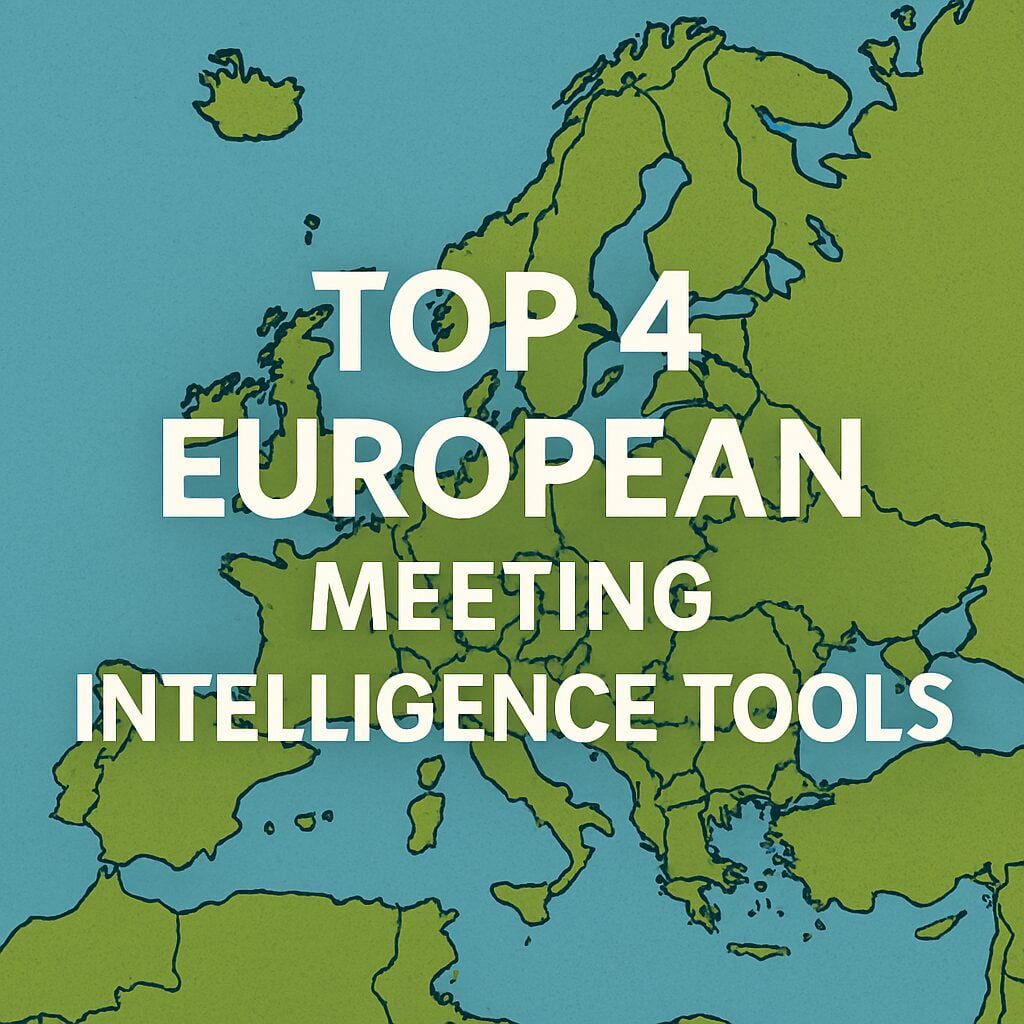
Top 4 European AI Meeting Assistants
In this list, we’ll be focusing only on tools that are founded in the EU. That means tools that are stringent with their data privacy rules and follow the EU’s evolving data protection laws closely.
1. tl;dv
- Founded in: 2020
- Headquarters: Aachen, Germany
- EU jurisdiction: Yes
- EU data hosting: Yes — EU‑based servers with explicit Europe‑only storage options
- GDPR by design: Yes — built around GDPR compliance with data minimisation and consent controls
- EU AI Act posture: Conservative / compliant (explicitly aligned with EU AI Act principles)
- AI risk posture: Conservative (privacy and opt‑in model training; human‑centred)
- Best suited for: Startups, product/ops teams, remote organizations
What Makes tl;dv Distinctly European?
tl;dv was built from the ground up in the EU (Germany), and that shapes every part of its design philosophy. Unlike many American tools that retrofit GDPR protections, tl;dv treats data protection as a core product premise.
Data hosting defaults to the EU, consent and opt‑in controls are first‑class, and legal signals like GDPR and EU AI Act alignment aren’t afterthoughts, they’ve been baked into the product from day one. It feels like a tool designed for EU risk teams, not a global tool that happens to comply.
What Are tl;dv’s Best Features?
In addition to this, tl;dv positions itself as the European leader with its unmatched feature set, including multi-meeting memory and intelligence. This empowers you to continuously mine past conversations for data by automatically cross-referencing them with other meetings to identify important trends, patterns, or broader insights.
tl;dv also offers recurring reports, allowing users to get updates delivered to their inbox that summarize specific meetings in search of specific things. Whether this is sales calls that contain price objections, or internal calls that feature your name, you decide.
tl;dv also features automatic language detection, empowering you to switch language mid-call and still receive a highly accurate transcript. It has over 6,000 integrations, including dozens of CRM systems which you can automatically fill out when synced up properly. You can create a custom note template that gets tl;dv’s AI to fill out the exact fields you need to maintain your CRM. For those looking to maximize their productivity, exploring the best free ai note taker tools can be an excellent choice. These tools often offer unique features that complement existing applications like tl;dv, making it easier than ever to organize your thoughts and tasks. By combining different platforms, you can create a streamlined workflow that suits your specific needs.
There’s also plenty of sales features to make use of, from playbooks to sales coaching dashboards.
tl;dv’s Strengths for European Teams
-
Low legal friction: Native EU jurisdiction and data residency mean procurement and legal review cycles are shorter, especially for public sector or regulated industries.
-
Strong privacy posture: EU hosting, explicit GDPR workflows, and transparent data use decisions reduce compliance headaches.
-
Async culture built for distributed teams: Especially useful for cross‑border teams across the EU. tl;dv encourages fewer meetings and more productive documentation.
-
Enterprise readiness: Roles, admin controls, and audit capabilities make it easier to onboard at scale.
Where tl;dv is Not the Best Fit
-
Not a revenue intelligence platform: It’s not built for deep deal analytics or revenue coaching.
-
Not ideal if you want aggressive data mining: Its conservative stance on AI and training data means less sentiment analysis. But this also keeps your company on a safe legal footing.
2. Leexi
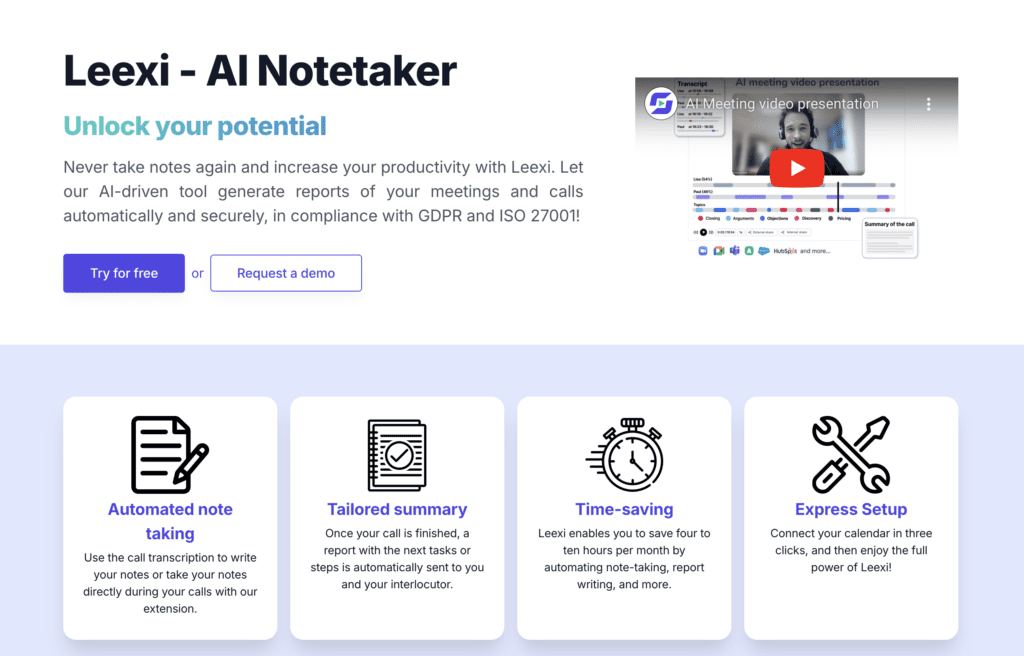
- Founded in: 2021 (self‑financed by founders)
- Headquarters: France
- EU jurisdiction: Yes
- EU data hosting: Yes (100% in France)
- GDPR by design: Yes (explicit GDPR + ISO 27001 compliance)
- EU AI Act posture / AI risk posture: Conservative / sales‑focused (compliance‑forward with EU sovereignty)
- Best suited for: Sales, customer success, and professional meeting note automation within EU companies
What Makes Leexi Distinctly European?
Leexi is born from an EU legal and cultural context (France), and markets itself squarely on European data sovereignty. Unlike US competitors that store or process data globally by default, Leexi keeps information in France/EU infrastructure and emphasises GDPR + ISO 27001 compliance. Its positioning is that compliance isn’t a checkbox, but a differentiator.
What Are Leexi’s Best Features?
Leexi stands out as a sales‑intelligence‑oriented meeting assistant that blends conversation tracking with actionable insights tailored to revenue teams. Rather than treating meetings as isolated events, Leexi views them as structured inputs into the sales process. It captures calls and demos, automatically identifying talk ratios, objection patterns, and recurring themes that can make or break deals. This level of insight is especially valuable for sales managers looking to coach reps, refine pitch techniques, or understand where prospects get stuck in the funnel.
By extracting key moments, such as commitments, next steps, and buyer hesitations, it creates a more complete picture of the sales cycle. The reporting dashboard visualizes these insights in ways that are easy to digest and share, helping teams align around what actually works in conversations with customers. Leexi also integrates with major CRM systems, meaning that insights from calls don’t live in isolation.
Leexi’s Strengths for European Teams
Sales‑focused intelligence with EU compliance: Talk ratios, objection tracking, and revenue insights within a framework that legal teams actually trust.
Data sovereignty built in: Hosting in France mitigates third‑country transfer concerns. This is a huge advantage for enterprises worried about Schrems‑type risks.
Enterprise posture: Admin controls and governance features make it easier to adopt in regulated sectors like finance, legal, public services.
Where Leexi Is Not the Best Fit
Not great for non‑sales use cases: It’s designed for revenue and customer‑facing workflows, not general meeting capture or cross‑team async work.
Narrower product focus: If you want a broad meeting memory or product/ops use case, Leexi’s sales lens can feel limiting.
Less community/third‑party integrations: Compared with larger ecosystems, it’s still building out its partner layer.
3. MeetGeek
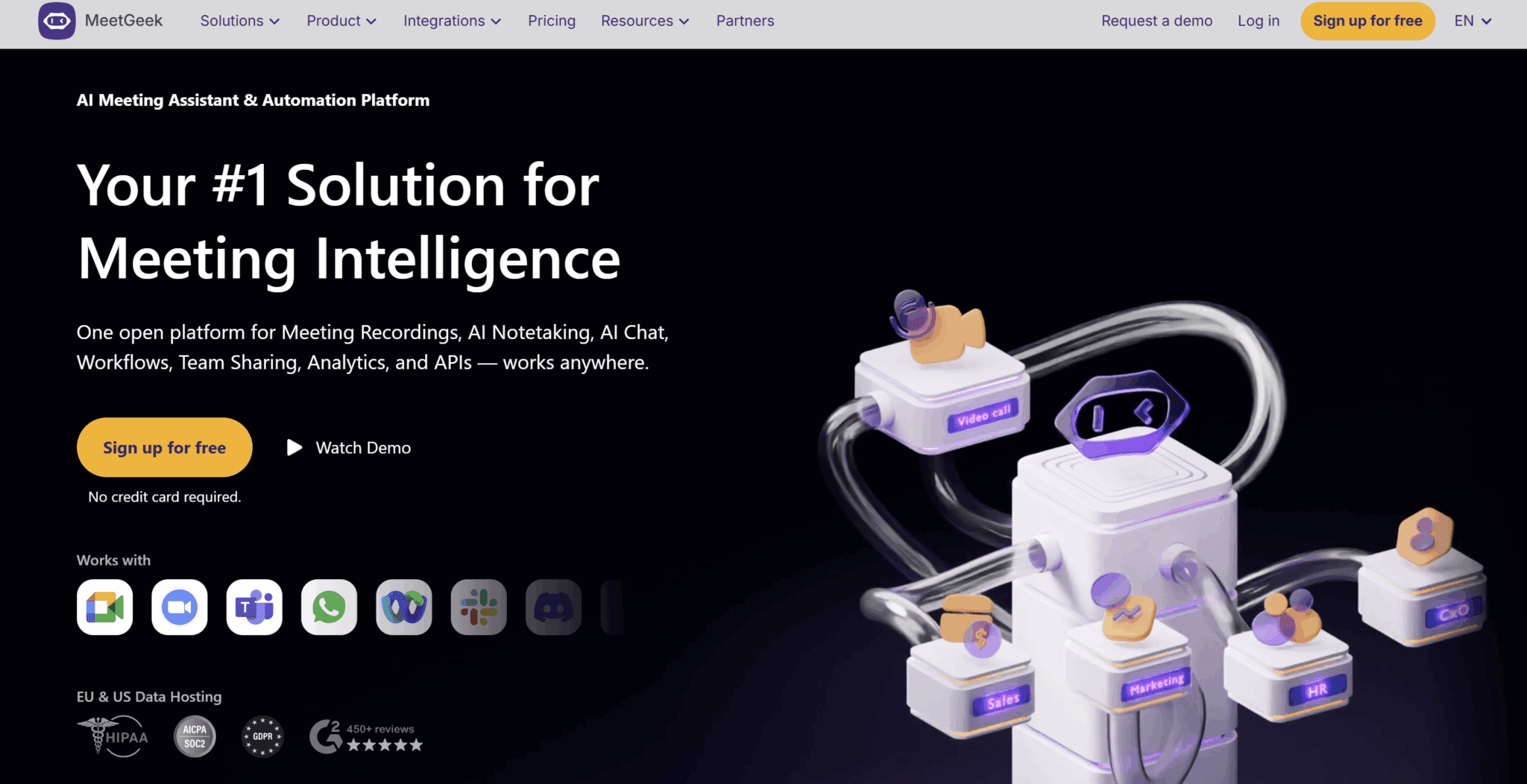
- Founded in: 2021
- Headquarters: Bucharest, Romania
- EU jurisdiction: Yes
- EU data hosting: Yes (EU/US options; you can choose storage region)
- GDPR by design: Yes (GDPR compliance with enterprise security standards)
- EU AI Act posture / AI risk posture: Balanced / modern features with security compliance (GDPR, SOC 2)
- Best suited for: SMBs and teams needing automated meeting summaries, insights, and CRM integration
What Makes MeetGeek Distinctly European?
MeetGeek is a bona fide EU company (Romania), and its compliance and data structures reflect that reality. It positions itself as a pragmatic, EU‑native alternative to bigger non‑EU tools by combining succinct meeting summarization with clear compliance documentation. It doesn’t overpromise on risky AI capabilities, choosing instead to deliver useful outputs that fit within EU legal frameworks.
What Are MeetGeek’s Best Features?
MeetGeek delivers a well‑rounded meeting intelligence experience that appeals to a broad range of teams, from small startups to mid‑sized enterprises. At its core, MeetGeek is designed to automate the mundane parts of meetings so people can focus on outcomes rather than note‑taking. Its transcription engine captures spoken words with impressive accuracy, turning live conversations from Zoom, Teams, and Google Meet into a searchable text record. That alone is a massive productivity booster for teams that spend a lot of time in calls.
For managers and team leads, MeetGeek can be invaluable in improving meeting quality and efficiency. But don’t expect anything mind-blowing. It takes care of basic transcription and meeting notes well, but it doesn’t push the boat out into other sectors.
MeetGeek’s Strengths for European Teams
Balanced capabilities: Good transcription, summaries, integrations (CRM, calendars) without risky behavioural analytics.
EU company + EU hosting options: Meeting data can reside in EU regions, which is instantly appealing to risk‑averse buyers.
Good for SMBs and mid‑size teams: It’s easier to onboard, and doesn’t require heavyweight governance structures.
Clear compliance messaging: Practical GDPR posture that’s easy to explain to procurement/legal.
Where MeetGeek Is Not the Best Fit
Less flashy than US competitors: It doesn’t have the same “AI wow” marketing or aggressive feature rollout.
Not sales‑centric: While it’s great for cross‑team usage, it won’t replace dedicated conversation intelligence tools for sales or revenue teams.
UX less refined: It’s functional and effective, but not as sleek as some larger players.
4. MeetJamie
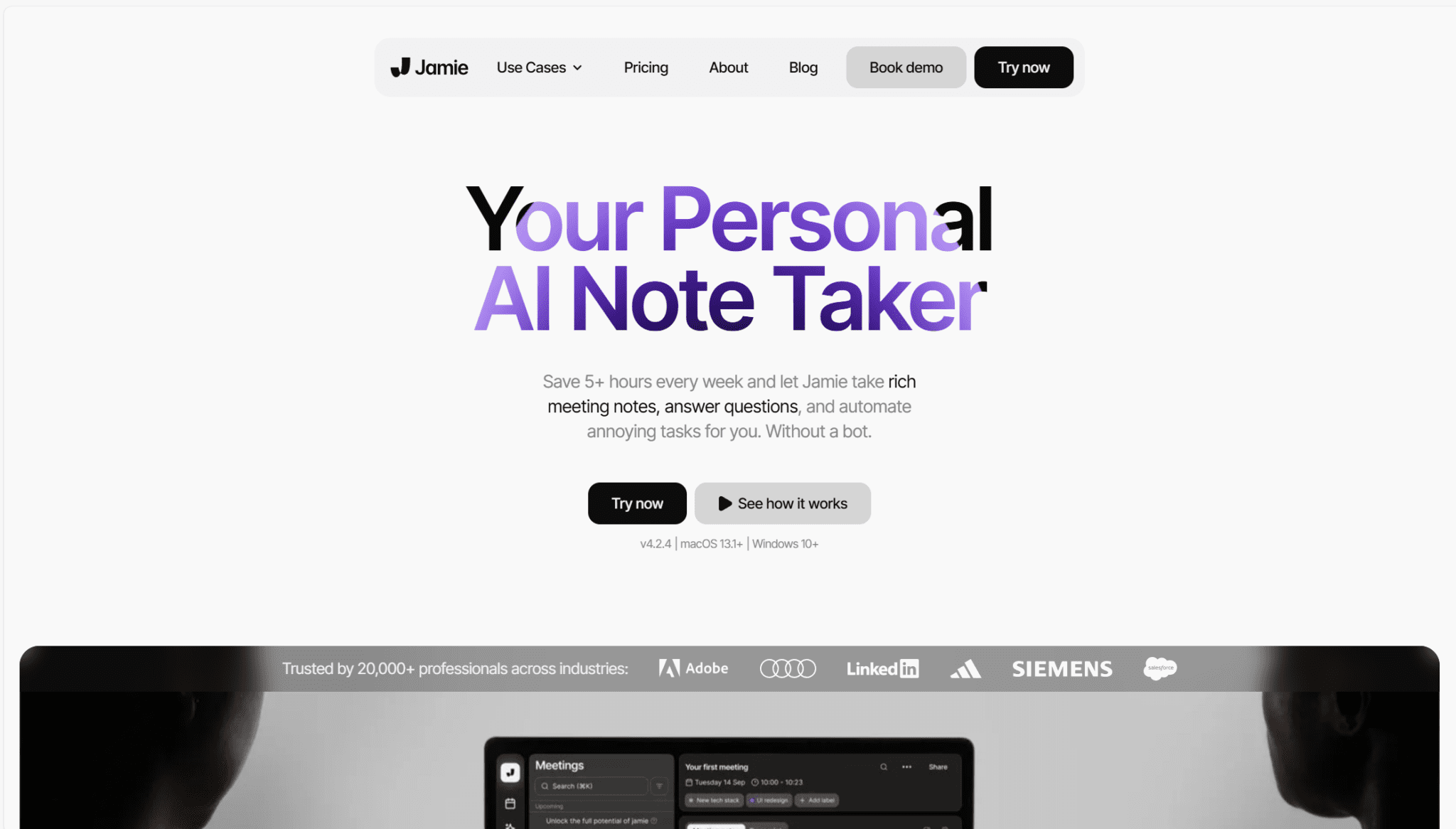
- Founded in: 2022
- Headquarters: Berlin, Germany 🇩🇪 (German company with official EU imprint)
- EU jurisdiction: Yes
- EU data hosting: Yes (data hosted in Frankfurt, Germany, with GDPR‑aligned storage and processing)
- GDPR by design: Yes (GDPR compliant; audio deleted after transcription; no model training on customer data)
- EU AI Act posture / AI risk posture: Balanced / privacy‑first (focus on secure, compliant summarization without unnecessary behavioural analytics)
- Best suited for: Teams and individuals seeking seamless meeting note capture and actionable summaries with bot-free notes
What Makes MeetJamie Distinctly European?
MeetJamie (branded simply as jamie) is built around a GDPR‑first, privacy‑sensitive approach consistent with EU expectations. Unlike meeting assistants that rely on bots joining calls or offloading data to non‑EU regions, Jamie captures meeting audio locally via a native app and then processes it in EU infrastructure with GDPR safeguards.
Its privacy design, including automatic audio deletion after transcription and a commitment not to use customer data for model training, reflects a distinctly European emphasis on data minimization and user control, rather than maximizing data capture or behavioural profiling.
What Are MeetJamie’s Best Features?
MeetJamie focuses on seamless and unobtrusive meeting note‑taking that works across platforms and contexts. Rather than requiring an additional participant bot to join calls, it uses a bot‑free, native app model that listens to audio directly from your device and produces high‑quality transcripts, executive summaries, and action items.
This makes it especially useful for teams that want reliable notes without complicating the meeting experience or getting stuck in configuration hurdles. One of the great things about Jamie is that, as it doesn’t join the call, it can record on any platform, even in offline or hybrid meetings.
MeetJamie’s Strengths for European Teams
Strong privacy and compliance posture: Built with EU data residency and GDPR at the core. Audio is stored only long enough to process, then deleted, and customers control their data.
Bot‑free design: Meets the security and IT policies of organizations that don’t allow bots in meetings, but this comes with HUGE shadow IT risks.
Enterprise‑ready controls: Admin features, SSO support, and encryption (AES‑256) all aid secure deployment.
Where MeetJamie Is Not the Best Fit
Not as feature‑rich as broader meeting platforms: While great at transcript and summary quality, it doesn’t offer the same analytics depth or project insights as some competitors.
Relies on local audio capture: The native‑app approach can be slightly more hands‑on compared with cloud‑only tools for some users.
Still maturing: Compared with older incumbents, some advanced integrations are still expanding.
Non-European Alternatives
Are there any non-European AI meeting assistants that could still be used by EU-based companies?
Short answer: yes, of course.
Long answer: it depends on your exact needs, particularly surrounding GDPR, data storage, and the increasingly important EU AI Act. Broadly speaking, you’re safer with an EU-based company as they must abide by EU law, whereas international tools don’t have that same pressure to comply.
The biggest names in the U.S.A for meeting notetakers are Fireflies, Otter, Fathom, Granola, and Gong. While all of these can work, they’re not guaranteed to protect your EU-specific interests, especially moving forward into 2026 and beyond.
Another interesting option is Sembly. As Dani covered in her article about GDPR compliant tools, Sembly is up there as one of the best, despite being US based. It’s built for enterprises and gives high-level control and visibility over your data.
The Verdict: Which European Notetaker is Right For You?
One thing is for certain: EU law isn’t a joke. In late 2025, Austria ruled that Meta’s ad model is illegal, ordering an overhaul of user data practices in the EU. Just because there hasn’t yet been a big legal scandal with an AI meeting assistant, don’t think that it won’t happen at all. It’s still early days, and it’s always better to be safe than sorry when your business and livelihood is at stake.
Overall, tl;dv is the standout European meeting assistant. It’s a direct competitor to Fireflies and Fathom, with additional features that help it stand out even without the German-based bonus. Where Leexi is too revenue-focused for most teams, MeetGeek is too simple, and Jamie is too likely to cause shadow IT concerns, tl;dv is the perfect blend of all three.
Try it out for free today and make up your own mind.
FAQs About European AI Meeting Assistants
What is a European AI meeting assistant?
A European AI meeting assistant is a call-recording and note-generation platform developed and operated under EU jurisdiction. That matters because data processing, storage, and model usage must follow regulations such as GDPR and the EU AI Act — not just claim compatibility, but legally adhere to it.
Why would a company choose an EU-based tool instead of a US one?
Two main reasons:
Data sovereignty — customer conversations stay inside EU infrastructure
Legal predictability — fewer conflicts between US surveillance laws and GDPR
In practice, procurement and legal approval are usually much faster with EU-hosted systems.
Are non-European tools still usable in Europe?
Yes, but risk tolerance matters.
Non-EU platforms like Fireflies, Fathom, and Tactiq can be configured for GDPR-friendly workflows. However, EU companies often still prefer EU vendors because compliance responsibility sits with the provider, not just the customer.
What does an AI notetaker actually do?
Typical features include:
Records calls automatically
Generates transcripts
Summarizes discussions
Extracts action items
Syncs notes into CRM or project tools
Lets you search past conversations
Some advanced tools also analyze trends across dozens of meetings to identify recurring themes.
Are these tools legal under GDPR?
Yes, provided they include:
Consent notification
Data minimization
Defined retention periods
Regional hosting options
EU-built tools are generally designed around these requirements from day one.
What about the EU AI Act: does it change anything?
It changes how AI can analyze people.
High-risk features (like behavioural profiling or emotional inference in workplace contexts) may become restricted. That’s why many European tools prioritize summaries and structured insights rather than psychological analytics.
Can European notetakers integrate with CRM systems?
Yes. Most connect to systems such as Salesforce or HubSpot to automatically log:
call summaries
deal notes
next steps
This removes a large chunk of manual admin from sales workflows.
Are my recordings used to train AI models?
It depends on the tool.
European vendors increasingly offer opt-in or no-training policies. Some explicitly state customer conversations never train global models, like tl;dv. This is a growing requirement for regulated industries.
Are there enterprise-grade alternatives outside the EU?
Yes . Tools like Sembly and Gong offer strong governance controls, but they require more configuration and legal assessment in EU contexts.