Zum Inhalt




tl;dr: How Does Gong Work?
- Gong records and transcribes your sales calls and emails, then uses AI to spot deal risks and coach reps.
- It suits revenue teams with RevOps support. For teams that mainly need notes and searchable recordings, it’s a lot of platform.
- Pricing isn’t published. You pay a per-user license plus a platform fee, and since June 2026 the heavier AI features also draw on Gong Credits (2,000 per paid core seat a year, pooled across the company).
- New since September 30, 2026: Enrich and Deep Mode are live. Agents that run automatically are announced for later this year.
Gong is a revenue intelligence platform. It records and transcribes your sales calls, then runs AI across those transcripts and your CRM data to show what’s happening in each deal. Users rate it highly for that: 4.7 out of 5 from 6,747 reviews on G2. It’s also expensive, and it takes real setup.
Gong isn’t plug-and-play. Expect a proper rollout, with admin configuration and rep training. And since June 2026, its heavier AI features run on a pooled credit allowance. When the allowance runs out, those features stop until you buy more.
A disclosure before going further: tl;dv competes with Gong, and I don’t have a Gong account, so nothing here comes from hands-on testing. Feature claims are checked against Gong’s own help docs. Gong doesn’t publish prices, so cost figures come from third-party reports and are labeled as estimates. Where Gong does something well, I’ve said so.
Das ist es, worauf es wirklich ankommt:
- What Gong does: recording, transcription and AI analysis
- What’s live and what’s only announced: Credits, Enrich, Deep Mode, AI Trackers and agents
- Where users report problems: missed recordings and limited data exports
- The real costs: seats, platform fees and Gong Credits
- Whether it’s right for you: team size, RevOps capacity and budget
Was ist Gong?
Gong is a revenue intelligence platform for B2B sales and RevOps teams. It records and transcribes calls and pulls in email and CRM activity from tools like Salesforce and HubSpot. AI then works across all of it to flag deal risks and forecast pipeline.
Gong now describes itself as a “Revenue AI” platform, and the product has grown well beyond call recording. You buy a core license, Gong Foundation, then add modules on top:
| Produkt | What it covers |
|---|---|
| Gong Foundation | The core license: call recording, transcription, conversation analysis, Gong Assistant and most AI agents |
| Enable Essentials | AI-based coaching for reps |
| Forecast Essentials / Gong Forecast | Pipeline visibility, deal intelligence and forecasting |
| Gong Engage | Outreach sequences and flows |
| Data Cloud | Exporting Gong data to your own systems |
Source: Gong’s plans and seats documentation, checked October 2026.
What Is Revenue Intelligence?
Revenue intelligence means using data from customer conversations and CRM records to understand what’s happening in your pipeline. The software analyzes what buyers say and how they say it, then uses those patterns to predict which deals will close.
The difference from a meeting recorder is scope. A recorder gives you the transcript and summary of one call. Revenue intelligence looks across hundreds of calls to find what separates won deals from lost ones, and shows managers where reps need coaching.
An AI assistant can now do part of that job. I run a setup where tl;dv’s MCP server connects their meeting library to Claude and ChatGPT, and it answers questions across calls on demand, like which objections keep coming up in deals they lost. Gong offers a similar route into its own data through its MCP server, which uses Gong Credits.
But an assistant only works when you ask it. It doesn’t watch every call automatically or score deals against past wins and losses. That always-on layer is what Gong charges for.
Wie funktioniert Gong ?
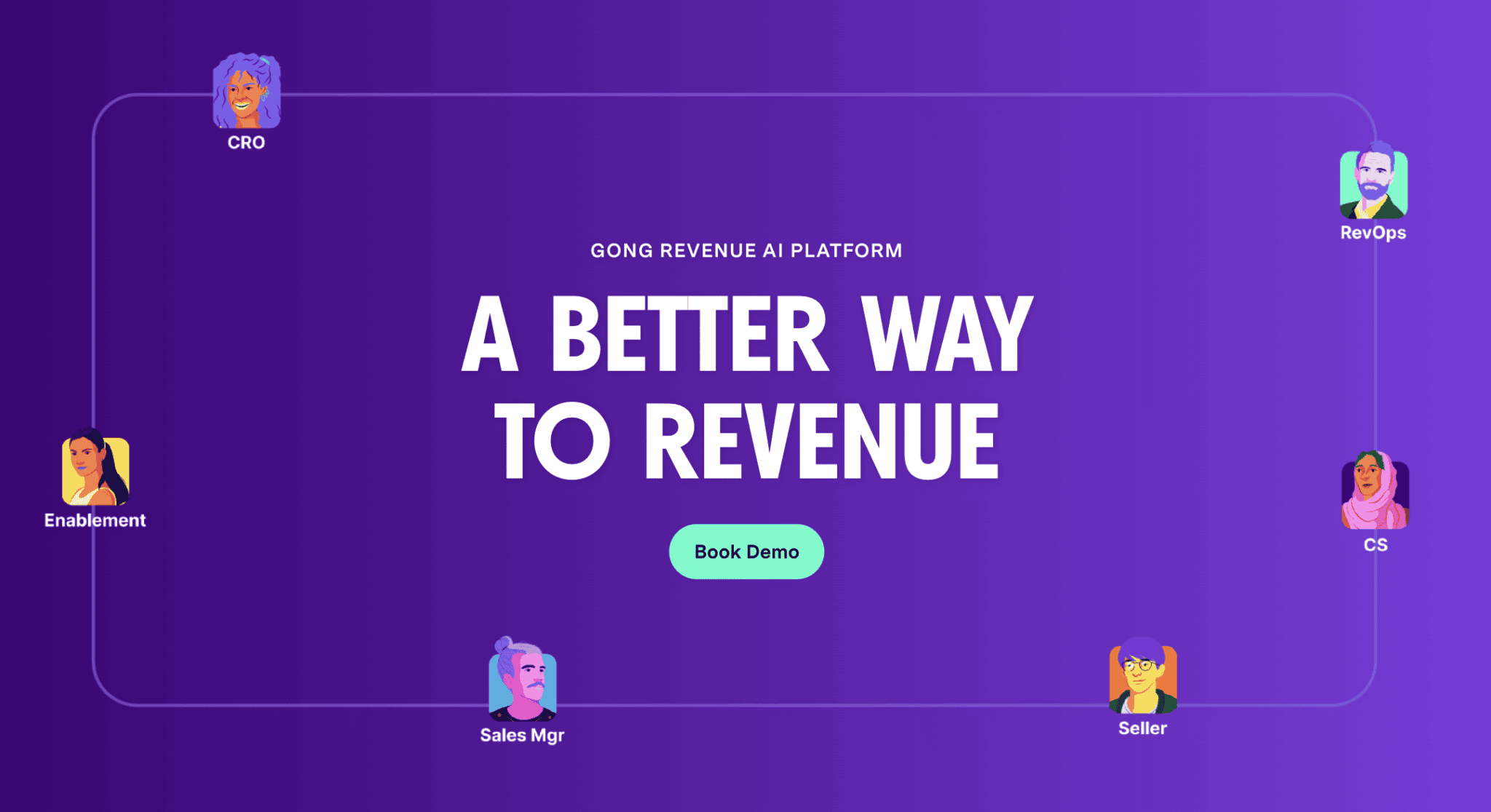
Gong joins your calls through a calendar connection and records them. After the call, it transcribes the recording and runs AI analysis across it. The results land in Gong’s dashboards and sync to your CRM.
The catch is access. Auto-recording only works once Gong is connected to your team’s calendars and your CRM, and someone has to set the rules for which calls get recorded and which don’t. That setup sits with an admin, not the reps.
Here’s each stage, and where it can go wrong.
Wie Gong Verkaufsgespräche erfasst und analysiert
Gong joins scheduled calls on Zoom, Google Meet and Microsoft Teams as a meeting participant. It finds those calls through a connection to Google Calendar or Outlook, then joins automatically based on rules your admin sets, or when a rep invites it. It records both audio and video.
When the call ends, the recording goes to Gong’s cloud for transcription. Speaker diarization splits the transcript by speaker, and every line is timestamped, so you can click a sentence and jump straight to that moment in the recording.
Gong’s AI then turns the transcript into structured data. AI Trackers flag moments where a topic comes up, like pricing pushback or a competitor mention, and those hits become searchable filters across every call your team has recorded.
Gong also scores how the conversation ran, not only what was said. These are the interaction stats it tracks, with the benchmarks Gong publishes for each:
| Stat | What it measures | Gong’s benchmark |
|---|---|---|
| Gesprächsquote | How much of the call the rep spends talking | Rep 43%, customer 57% |
| Longest monologue | The longest stretch the rep talks without a break | Under 2 minutes 30 seconds |
| Longest customer story | The longest stretch the customer talks | No number given |
| Interactivity | How often the conversation switches between your team and the customer, scored up to 10 | 5 or more |
| Geduld | The median pause before the rep replies after the customer stops | 0.6 to 1 second |
| Question rate | Questions the rep asks per hour of conversation | 18 or more |
There’s no sentiment score in that list. Gong measures the shape of a conversation, and the topic detection sits with AI Trackers.
Findings land in searchable dashboards and sync to CRMs like Salesforce and HubSpot. Gong’s AI Activity Mapper matches each call and email to the right CRM record, so deal history builds up without reps logging it by hand.
Wie Gong die Gespräche verarbeitet: Ein Zeitstrahl
- Pre-call: Gong scans connected calendars (Google Calendar or Outlook) for upcoming sales calls. If auto-recording is on, it joins automatically. If not, reps can invite it.
- During the call: Gong joins as a participant and records audio and video. Team members on the call can stop the recording, and so can admins. Whatever was captured before that point is kept.
- Post-call upload: The recording goes to Gong’s cloud, where speech recognition turns it into text and speaker diarization assigns each line to the right person.
- AI analysis: Gong calculates interaction stats and runs AI Trackers across the transcript to flag topics like objections and competitor mentions.
- Insight delivery: Results appear in Gong’s dashboards and sync to your CRM against the right deal.
Connecting Gong to Your Tech Stack
Gong’s pricing page says connecting your existing tools doesn’t cost extra. The main connections are:
- Calendar: Google Calendar and Outlook, so Gong can find scheduled sales calls. With auto-recording on, it joins them automatically. Otherwise, reps invite it.
- CRM: Salesforce, HubSpot and Microsoft Dynamics. Gong syncs calls and emails to deal records, and its AI Activity Mapper matches each one to the right record.
- Conferencing: Zoom, Google Meet and Microsoft Teams, where Gong joins as a meeting participant.
Gong also has an API and connectors for tools like Slack, for teams that want call data flowing into other systems.
Gong’s AI Features: What’s Live and What’s Announced
Gong’s AI now runs as a set of agents and trackers, and some of what Gong announced at its Celebrate ’26 event on September 30, 2026 isn’t available yet. This is the status as of October 7, 2026, based on Gong’s own documentation.
| Merkmal | Was es tut | Status | Uses Gong Credits? |
|---|---|---|---|
| Keyword trackers | Flag exact words or phrases in calls and emails | Live | Nein |
| AI Trackers (pre-built “By Gong”) | Flag common topics like pricing and objections by meaning, not exact words | Live | Nein |
| AI Trackers (custom, question-based) | Flag topics you define as a question | Live | Ja |
| Deep Mode | Research reports in Gong Assistant, with sources cited inline | Live | Yes, 1,000 to 3,000 per run (Gong’s estimate) |
| Gong Enrich | Fills in missing contact emails and phone numbers from partner data providers | Live since September 30, 2026 | Yes, varies by result |
| Pre-built AI agents | Around 17 agents for briefs, deal reviews, coaching and forecasting | Most live; Gong says some launch later this year | No, when used by individual users |
| Agent Builder (run manually) | Custom agents you describe in plain language | Live, included with Gong Foundation | Not stated |
| Agent Builder (automatic triggers) | Custom agents that run when set events happen | Announced for later this year | Not stated |
| Gong Assistant in deal and account boards | Assistant answers inside deal views | Announced for later this year | Not stated |
| Gong Dashboards | Custom revenue dashboards | Live for Gong Forecast users; wider access later this year | Not stated |
| Gong Activate | Always-on agents that work from a shared “revenue playbook” | Announced, no date given | Not stated |
| MCP-Server | Lets AI assistants like Claude query Gong data | Live | Ja |
AI Trackers
AI Trackers look for meaning rather than exact words, so “can you do anything on price?” and “that’s outside our budget” both count as pricing pushback. The pre-built “By Gong” trackers are free to run and can’t be edited. Custom trackers, where you define the topic as a question, use Gong Credits and pause automatically when the credit pool runs out. Keyword trackers still exist for exact terms like competitor or product names.
Deep Mode
Deep Mode is a research setting inside Gong Assistant for bigger questions, like why you keep losing enterprise deals to one competitor. You ask the question, answer a few clarifying questions, then approve a research plan before it runs. The report arrives by email with sources cited inline. Gong estimates each run at 1,000 to 3,000 credits, and users need a specific “Use deep mode” permission.
Gong Enrich
Enrich fills gaps in your contact data, finding missing or outdated emails and phone numbers through a waterfall of partner providers like ZoomInfo and Lusha. It can run on request or automatically when a contact enters a Gong Engage flow, and it can sync results back to your CRM. It’s Gong’s move into territory usually covered by standalone data enrichment tools.
AI Agents and Agent Builder
Gong lists around 17 pre-built agents, from AI Briefer for account summaries to AI Deal Predictor for deal health scores. Agent Builder lets you create your own by describing what you want in plain language. Right now you run custom agents yourself. Agents that trigger automatically on events, like a deal stage change, are announced for later in 2026.
Gong builds checks into the newer tools. Deep Mode makes you approve its plan before it runs and cites its sources in the report. I’d read that as Gong expecting a person to check the output, which is the right instinct for any AI working on deal data.
Gong für Ihr Verkaufsteam einrichten
Setting up Gong means connecting it to your calendars and conferencing tools, then deciding which calls it should record. Most of that sits with an admin. Reps mainly need to know how to bring Gong into calls it didn’t catch automatically.
How to Connect Gong to Your Calendar
Gong connects to Google Calendar and Outlook to find scheduled calls, then joins them based on recording rules your admin sets. Three settings are worth deciding before you switch auto-recording on:
- Which meetings to record: Set rules so Gong records external sales calls and skips internal or sensitive meetings.
- How much control reps get: Decide whether reps can choose which of their own calls Gong records.
- Privacy and consent: Check your recording rules against your privacy policy and local consent law before the first call goes out.
Aufzeichnen eines Gesprächs mit Gong
With your calendar connected and auto-recording on, Gong joins scheduled calls as a participant when they start and records audio and video. Reps don’t need to do anything.
For calls Gong didn’t pick up automatically, a rep with the right permission adds the company’s Gong Assistant email address as a meeting participant. It looks like [email protected]. If they can’t add participants, forwarding the invite to that address works too, but every updated invite has to be forwarded again.
Wie man einen Gong hochlädt
You can upload recordings you made elsewhere through the “Upload calls” option in Gong’s quick actions menu. Gong accepts WAV, MP3, MP4, MKV and FLAC files up to 2 GB, and processing takes up to an hour per call. Uploaded calls don’t know who the speakers are, so you’ll need to rename participants after processing.
For calls from a dialer Gong doesn’t connect to, Gong’s docs point to uploading the recordings instead. Our guide on how to upload a call to Gong walks through each step.
Wie man Gong zu einem Gespräch einlädt
Add your company’s Gong Assistant email address to the meeting invite in Zoom, Google Meet or Microsoft Teams, and Gong joins when the call starts. You need a Gong seat with the “Manually schedule & upload” permission, and your admin has to have that conferencing tool enabled in Gong. Our guide on how to add Gong to a call covers troubleshooting.
Does Gong Record Video as Well as Audio?
Yes, on video calls. On Zoom, Google Meet and Microsoft Teams, Gong records audio and video, including screen shares. Phone calls through dialers like Aircall or RingCentral are audio only, because there’s no video to record.
Can I Stop Gong Recording During a Call?
Yes. Team members invited to the call can stop a recording while it’s in progress, and so can the host and Gong admins. Whatever was recorded before that point is kept and processed. There’s no pause, so once you stop, Gong doesn’t pick up again. To keep a meeting out of Gong entirely, set recording rules that exclude it, or remove the Gong recorder from the call before it starts.
Does Gong Work with Phone Calls or Just Video Meetings?
Both. Gong connects to telephony systems like Aircall and RingCentral to record and transcribe phone calls, then links them to CRM records the same way as video calls. If your dialer isn’t one Gong connects to, you can upload the recordings instead.
Häufige Herausforderungen bei der Verwendung von Gong
Gong’s main drawbacks are cost and setup. It isn’t cheap and it isn’t quick to get running, and its AI works best with someone checking the output. None of that makes it a bad product, but it’s worth knowing before you sign.
Hohe Kosten und versteckte Preisgestaltung
Gong doesn’t publish prices. Its pricing page says licenses are priced per user, plus a platform fee based on how many users you have, and asks you to request a quote. Third-party reports put the license at roughly $1,200 to $1,600 per user per year, with platform fees reported between $5,000 and $50,000 a year. Those are estimates, not Gong’s figures. Our Gong pricing guide breaks down what’s been reported.
Contracts run annually. Gong’s own documentation talks about “contract years”, and credit allowances reset at the start of each one.
How Gong Credits Work
Since June 2026, Gong meters its heavier AI features through Gong Credits. Each paid core seat adds 2,000 credits a year to a pool shared across the company. Here’s what uses them, according to Gong’s documentation:
| Uses credits | Included without credits |
|---|---|
| Custom, question-based AI Trackers | Calls and call analysis |
| Deep Mode (an estimated 1,000 to 3,000 per run) | Training |
| Gong Enrich | Forecasting and deal predictions |
| Gong’s MCP server | Gong Agents used by individual users |
| AI APIs (Ask Anything and AI Briefer) | Pre-built “By Gong” trackers |
Processing costs 0.1 credits per email, 0.3 credits for a call up to 10 minutes and 1 credit for anything longer. When the pool runs out, credit-based features stop processing until you buy more, and existing data stays where it is. Admins can set monthly caps per user and per feature. Gong says there are no automatic charges, so the risk is features pausing mid-quarter, not a surprise invoice.
Komplexe Einrichtung und steile Lernkurve
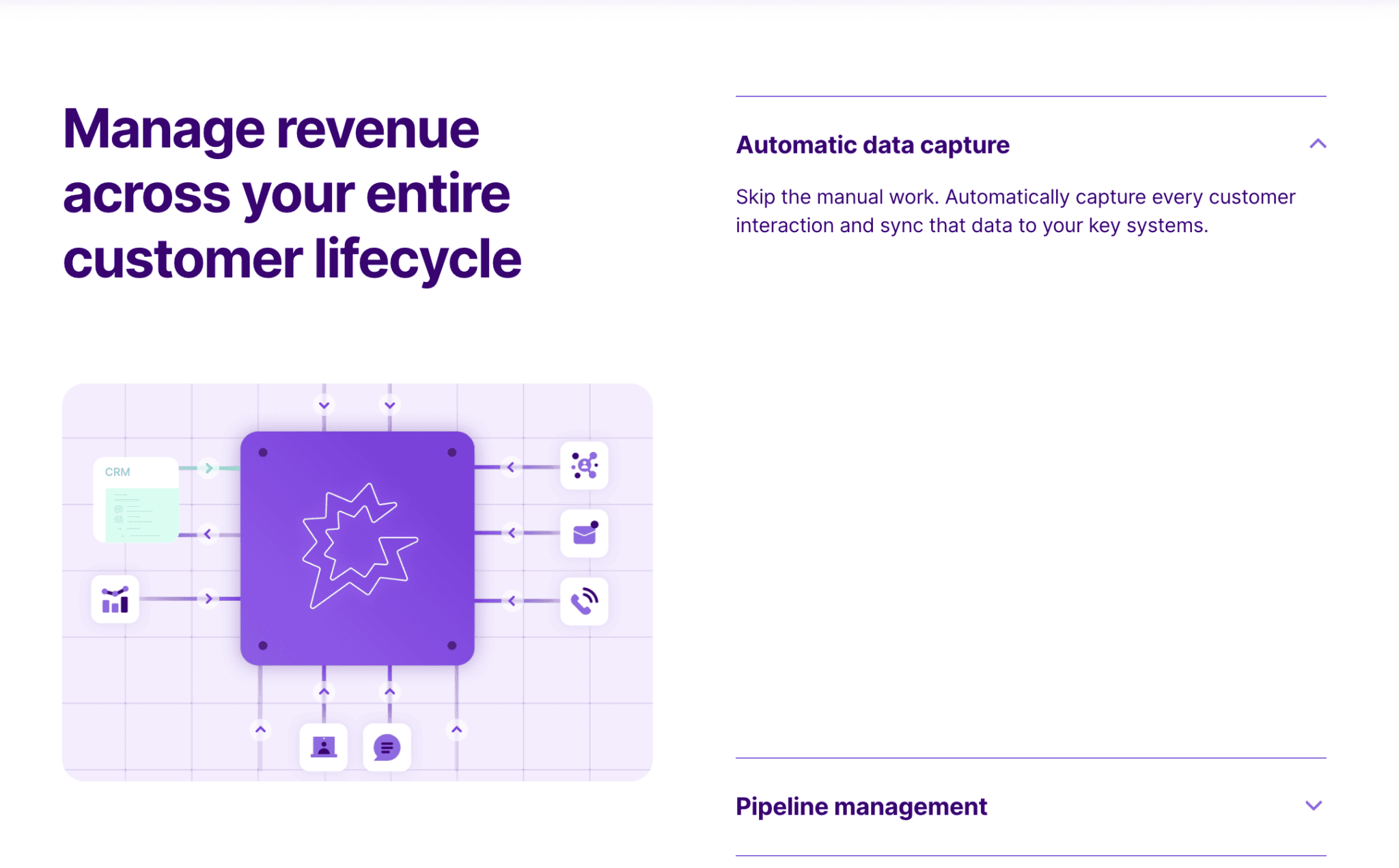
Gong isn’t plug-and-play. Before it’s useful, an admin has to connect calendars and your CRM, set recording rules, and decide who gets permissions for features like Deep Mode and Enrich. Once credits are involved, someone also has to manage the pool.
The reporting takes learning too. Dashboards and trackers only pay off if managers know which signals to act on, so budget time for training as well as setup.
Grenzen der KI von Gong
Gong’s AI is capable, but it works from what’s in your calls and your CRM, and it’s only as good as that data. Gong’s own design choices reflect this. Deep Mode makes you approve a research plan before it runs and cites its sources, and custom trackers pause when credits run out rather than carrying on silently.
Coaching is the clearest example. Gong’s interaction stats and AI Call Reviewer show where a rep talks too much or asks too few questions, but turning that into better selling is still a manager’s job. If coaching is the main reason you’re looking at Gong, our guide to sales coaching covers what the software can and can’t do on its own.
There’s a bigger debate underneath this. Gong’s CEO has argued that “have AI update my CRM” is a feature that won’t last, because AI will eventually read the transcripts directly and CRM fields won’t be needed. It’s a bold pitch, and it conveniently positions Gong as the system of record rather than a tool that feeds one.
The pushback is practical, and we’re inclined to agree with it. A CRM field forces a rep to stop and commit to a number. AI summaries of a long call can miss context. And a clean overview screen is still what most people use to make decisions. Querying transcripts is a great addition. It’s not yet a safe replacement for the structured record, which is why tools that work with your existing CRM, rather than trying to become it, are the safer bet for now.
Compliance- und Datenschutz-Risiken
Gong holds the certifications you’d expect from an enterprise vendor: SOC 2 Type II (including HIPAA), ISO 27001, 27017, 27018 and 27701, and certification under the EU-U.S. Data Privacy Framework. It offers a GDPR data processing agreement with standard contractual clauses.
Two details matter for European teams. Gong stores data in US data centers by default, with an EU option, and both run on AWS. It processes data in the United States, Israel and Ireland. If EU residency matters to you, ask for it during procurement rather than assuming it.
Gong’s certifications don’t make your recording compliant. You still need a lawful basis for recording, you have to tell participants, and you need to set retention rules that fit your policies. In healthcare or other regulated sales, check your industry rules before the first call is recorded.
It Can Be Overkill for Smaller Teams
Gong’s value comes from patterns across many calls: which talk tracks win, which deals stall, where forecasts drift. With a handful of reps, there aren’t enough calls for those patterns to mean much, and you’re paying a platform fee for analytics you won’t use.
If what you mainly need is recordings, searchable transcripts and solid notes, a lighter tool will cover it for far less. Gong earns its price when you have the call volume, and someone in RevOps to act on what it finds.
Verbessert die KI von Gongtatsächlich den Umsatz?
Gong’s customers report strong results, but the published numbers come from Gong. At its September 2026 Celebrate event, Gong said AT&T Business saw a 54% improvement in rep productivity, Cisco saw 32% larger deals and 26% higher win rates among early-adopting teams, and Experian saw a 25% lift in win rates. Treat those as vendor-reported figures from the companies most invested in making Gong work.
Independent reviewers are more mixed. G2 reviewers rate Gong highly overall, but some report recordings that fail to capture and data that’s hard to export. Gong improves sales when a team uses its insights consistently. It doesn’t improve them just by recording calls.
What Users Are Saying About Gong
Most users are happy with Gong. It holds 4.7 out of 5 from 6,747 reviews on G2. The complaints that do come up follow a pattern, and they’re worth knowing before you sign. These are the most common:
- Recording issues: Some reviewers report calls that Gong didn’t record, even with setup done correctly.
- Transcript display: Reviewers mention that it’s awkward to view the video and the transcript side by side.
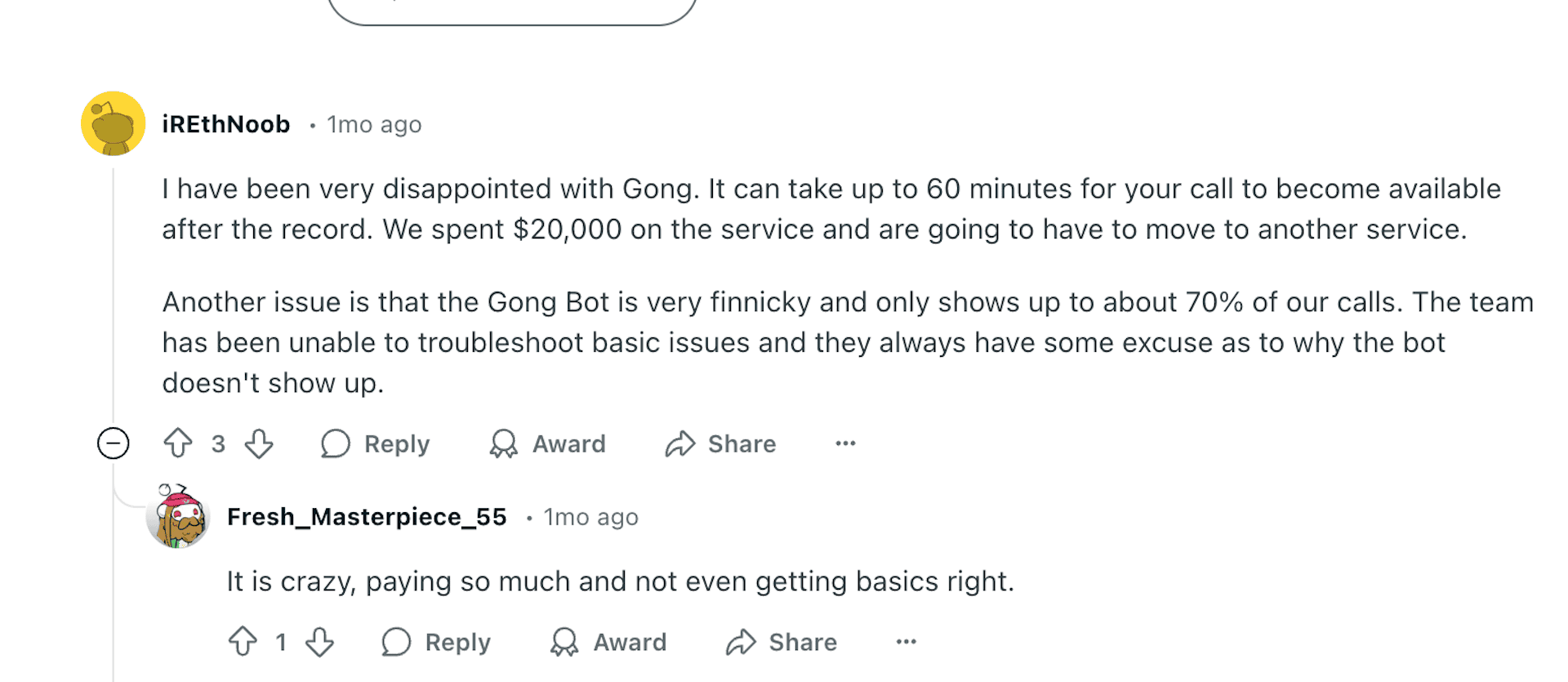
- Cost and contracts: Pricing comes up often in reviews, especially from smaller teams, along with annual contract terms.
- Getting data out: Some reviewers struggle to export their call data. Gong sells bulk export as a separate product, Data Cloud, which is a pointed irony given its CEO’s argument that the CRM shouldn’t be your system of record.
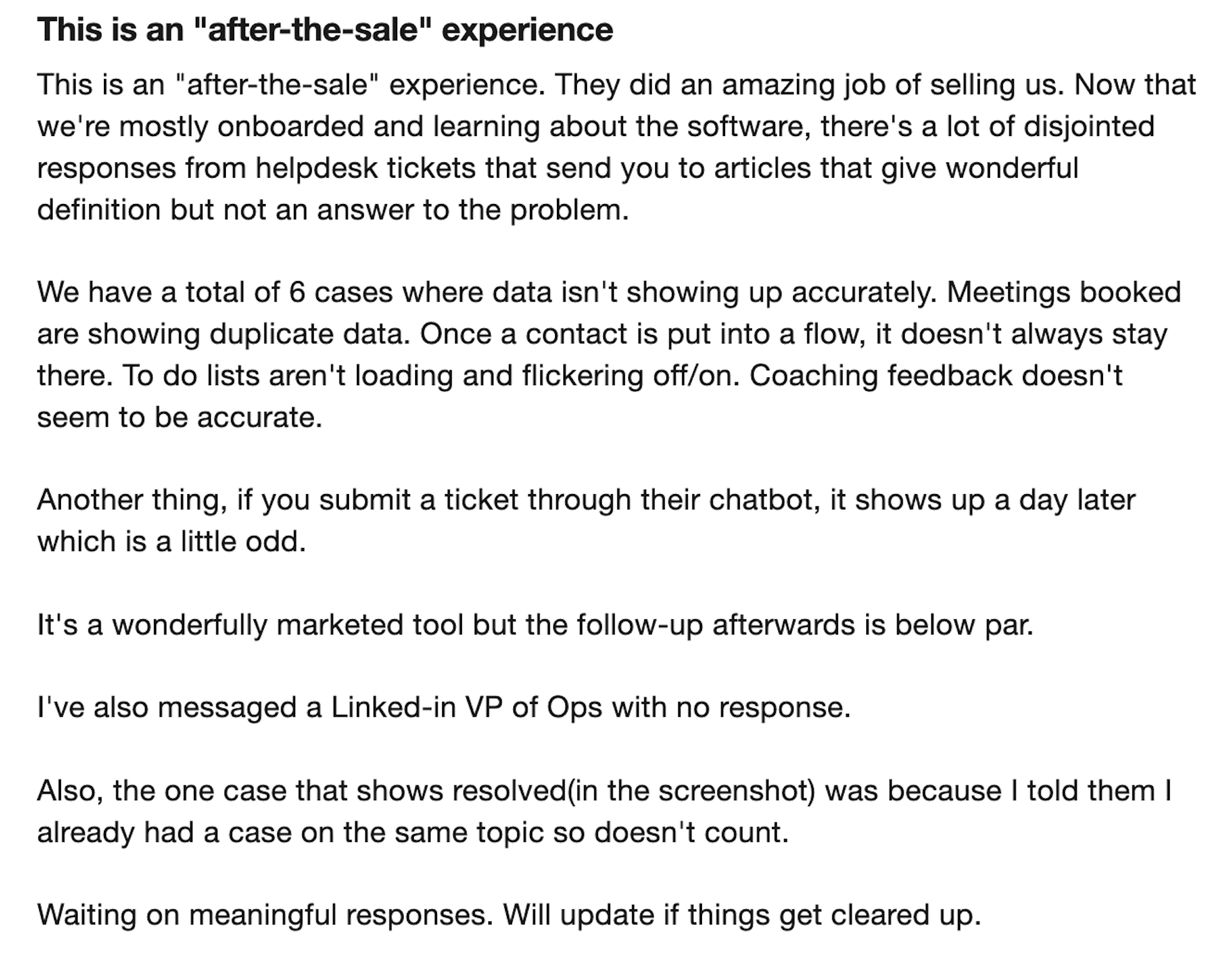
- Support: Some users describe slow responses from Gong’s support team after the sale.
Gong User Feedback at a Glance
Here’s a selection of user reviews from across the web, grouped by the issue they raise.
Fehler bei der Aufzeichnung von Besprechungen
Some reviewers report that Gong failed to record meetings, even after following the setup instructions.

Schwierige Schnittstellen- und Transkriptionsprobleme
Mehrere Nutzer erwähnen, dass die Anzeige der Mitschriften in Gongschlecht optimiert ist, was es schwierig macht, Anrufe zusammen mit Bildschirmfreigaben zu überprüfen.

Data Export Challenges
Some reviewers say getting historical call data out of Gong is harder than it should be. Gong’s answer is Data Cloud, a separate product for exporting Gong data to your own systems, so bulk export is something you pay for rather than a standard feature.

Customer Support & Onboarding
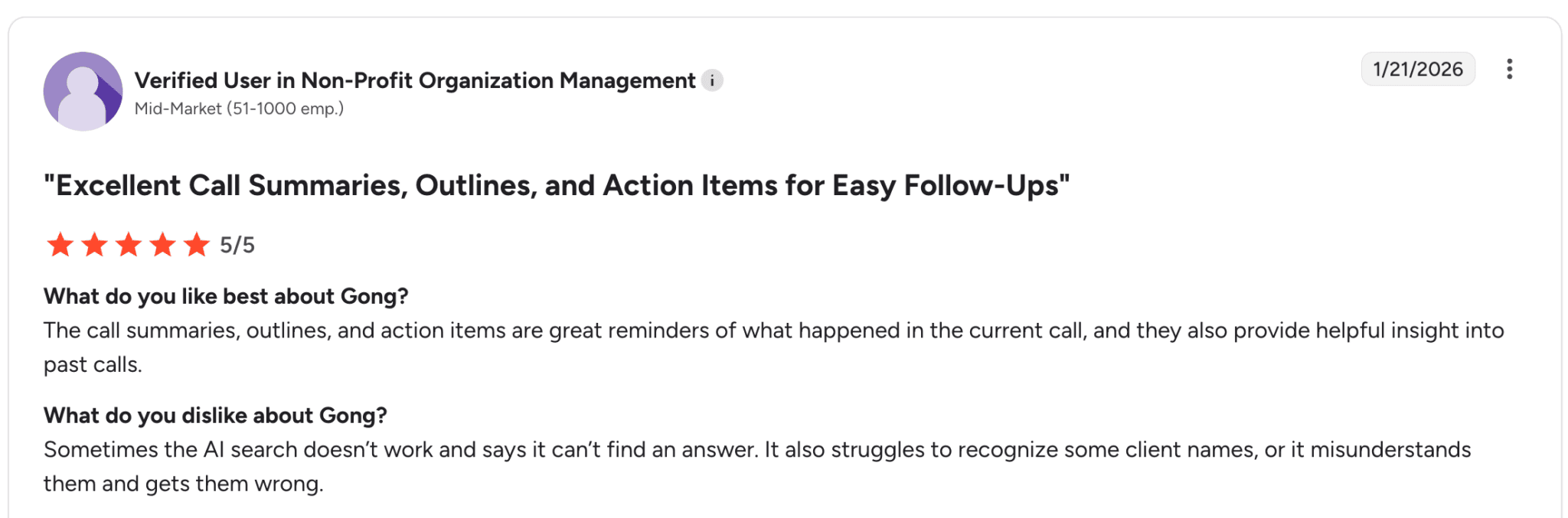
Some reviewers describe Gong as hard to set up and say support slows down after the sale. Recent feedback is more mixed. The January 2026 reviews below are mostly positive about the product, but several still flag setup or support as the weak point.


Pricing for Smaller Teams
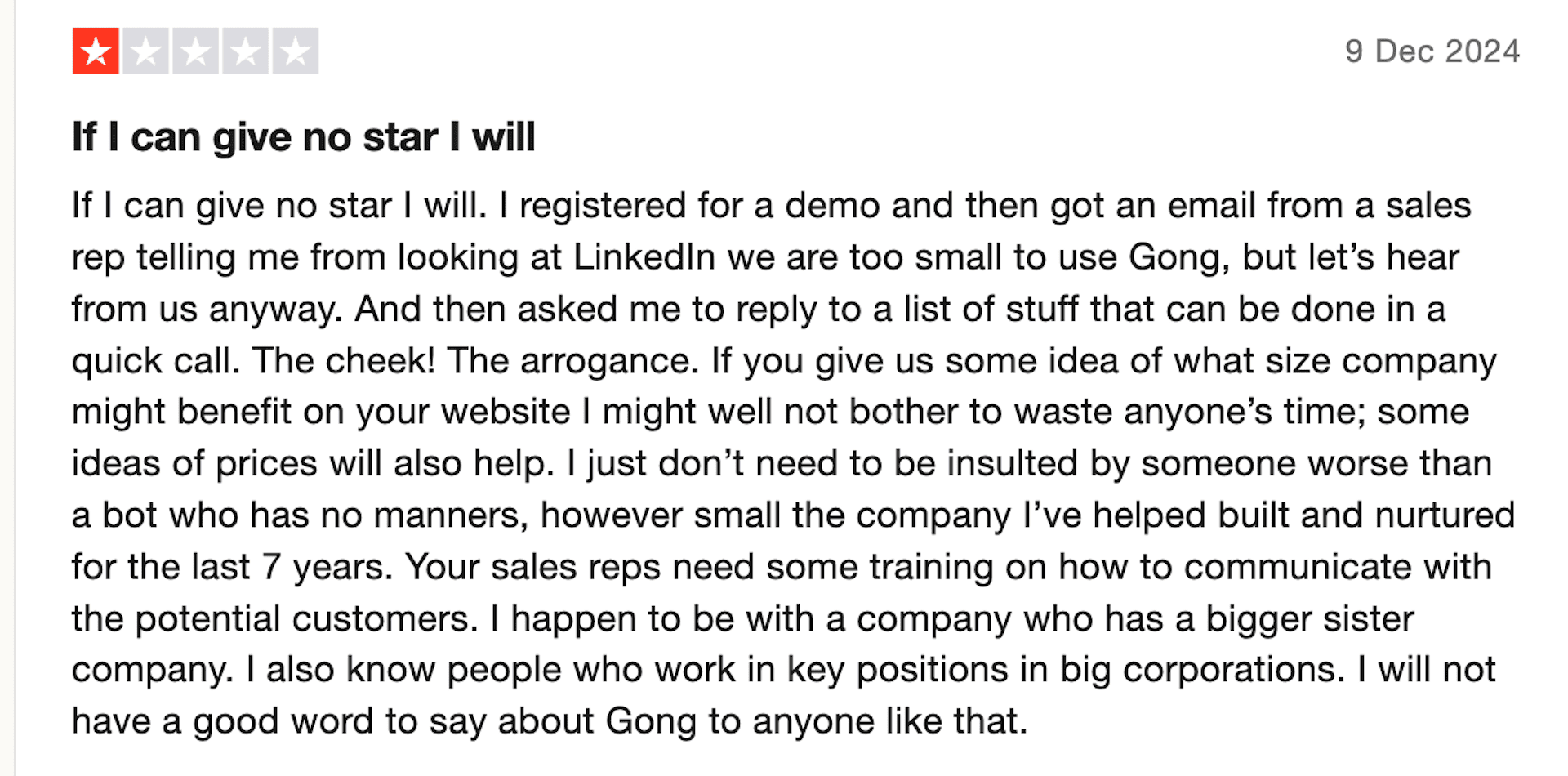
Cost is the most common complaint from smaller teams. The Reddit thread below is typical: the product gets credit, but the price is hard to justify without the call volume to match.
Gong bietet zwar leistungsstarke, KI-gesteuerte Einblicke in den Vertrieb, aber die Bewertungen deuten darauf hin, dass die Leistung des Programms nicht immer den Erwartungen entspricht. Fehler bei der Aufzeichnung von Meetings, Probleme mit der Datenzugänglichkeit und hohe Kosten geben vielen Nutzern Anlass zur Sorge. Unternehmen, die Gong in Betracht ziehen, sollten diese Faktoren sorgfältig abwägen, bevor sie sich festlegen.
AI Accuracy
Recent reviewers who like Gong overall still single out the AI as the weaker part. One account executive rating it 4 out of 5 on Capterra in January 2026 called it “hit or miss”, especially on follow-ups. Another, rating it 10 out of 10 on TrustRadius in August 2026, listed “the AI needs improving” as their main con.
These reviews follow the same pattern as Gong’s overall rating. Users like the product, and the complaints cluster around reliability and cost. If either is a deal-breaker for you, test it during a pilot before you sign.
Was sind die besten Alternativen zu Gong?
The best alternative depends on which part of Gong you actually need. Some tools compete on forecasting, some on sales engagement, and some cover recording and notes for a fraction of the cost. Few match Gong on everything, so start with the job you’re hiring the tool to do.
| If you mainly need… | Look at |
|---|---|
| Forecasting and pipeline inspection | Clari |
| Conversation intelligence inside the ZoomInfo ecosystem | Chorus von ZoomInfo |
| Sales engagement and call analysis in one platform | Salesloft |
| Conversation intelligence with published pricing | Avoma |
| A cheaper AI notetaker with CRM sync, hosted in the EU | tl;dv (see our tl;dv vs Gong comparison) |
For a wider comparison, our guide to the best conversation intelligence software covers how these tools differ on analytics, pricing and setup.
How Much Does Gong Cost in 2026?
Gong doesn’t publish prices, so the only way to get a number is a quote. Its pricing page asks for your team size and confirms how the bill is built: a license per user, plus a platform fee based on how many users you have. Third-party reports put the license at roughly $1,200 to $1,600 per user per year, but treat that as an estimate.
What you end up paying depends on which pieces you buy:
- Gong Foundation: the core per-user license every customer needs.
- Platform fee: an annual fee that scales with your user count.
- Add-on modules: Gong Forecast, Gong Engage, Enable Essentials and Data Cloud are sold separately on top of Foundation.
- Extra Gong Credits: only if your team uses up the pooled allowance that comes with your seats.
- Onboarding: third-party reports mention implementation fees, but Gong doesn’t list them.
Gong’s pricing page does say that connecting your existing tools doesn’t cost extra. For reported figures by team size, see our Gong pricing guide.
Gong Pros and Cons
Here’s how Gong’s strengths and weaknesses stack up, based on Gong’s documentation and recent user reviews.
| Vorteile | Nachteile |
|---|---|
| Highly rated by users: 4.7 out of 5 from 6,747 G2 reviews | No published pricing or self-serve trial |
| Call search and AI Trackers that find topics by meaning, not just keywords | Heavier AI features draw on a credit pool someone has to manage |
| Coaching stats with published benchmarks, like talk ratio and question rate | Needs admin setup and training before it pays off |
| Forecasting and deal prediction built on your own win and loss data | Some reviewers call the AI “hit or miss” |
| Enterprise certifications, including SOC 2 Type II and ISO 27001 | Data stored in the US by default; EU hosting is an option you request |
| New research and enrichment tools: Deep Mode and Gong Enrich | Bulk data export is a separate product (Data Cloud) |
Who Should Use Gong?
Gong suits revenue teams with enough call volume for patterns to matter, and someone in RevOps to act on them. If your managers run pipeline reviews from forecasts and will use the coaching stats and AI Trackers every week, the price buys something real.
It’s a harder sell if what you mainly need is a record of your calls. Gong’s value sits in the analysis layer, and you pay for that layer whether you use it or not. Since June 2026, its most advanced AI features also draw on a credit pool that someone has to manage.
Gong earns its price when forecasting and deal inspection drive how your team sells.
To see how it compares on recording, CRM sync and data hosting, read our tl;dv vs Gong comparison.
Häufig gestellte Fragen zu Gong im Jahr 2026
Ist Gong im Jahr 2026 sein Geld wert?
For most teams, probably not. In 2026, Gong’s pricing still favors large enterprise sales organizations, with a per-user license plus a platform fee on annual contracts. Smaller teams often struggle to justify the cost once reported onboarding fees are factored in. If you don’t actively use deep conversation analytics, or have time to interpret them, the return rarely matches the spend.
What are Gong credits?
Gong Credits are usage units for Gong’s heavier AI features, introduced in June 2026. Each paid core seat adds 2,000 credits a year to a company-wide pool. Custom AI Trackers, Deep Mode, Gong Enrich and the MCP server use them. Call analysis, coaching and forecasting don’t. When credits run out, those features pause.
Is Gong GDPR compliant in 2026?
Gong can be used in a GDPR-compliant way, but responsibility is shared. Gong offers a data processing agreement with standard contractual clauses and is certified under the EU-U.S. Data Privacy Framework. Data is stored in the US by default, with an EU option. You still need a lawful basis for recording and must tell participants.
Does Gong have a free trial?
No. Gong doesn’t offer a self-serve free trial or a free plan. Its pricing page asks for your team size and leads to a custom quote, so any trial or pilot has to be arranged through Gong’s sales team after a demo. Ask for one before you sign an annual contract.
What is Deep Mode in Gong?
Deep Mode is a research setting inside Gong Assistant, live since September 2026. It handles bigger questions, like why you keep losing deals to one competitor, by analyzing many calls and deals at once. You approve a research plan first, and the report arrives with sources cited. Each run uses an estimated 1,000 to 3,000 credits.