Przejdź do treści





TL;DR: Salesforce Integrations in 2026
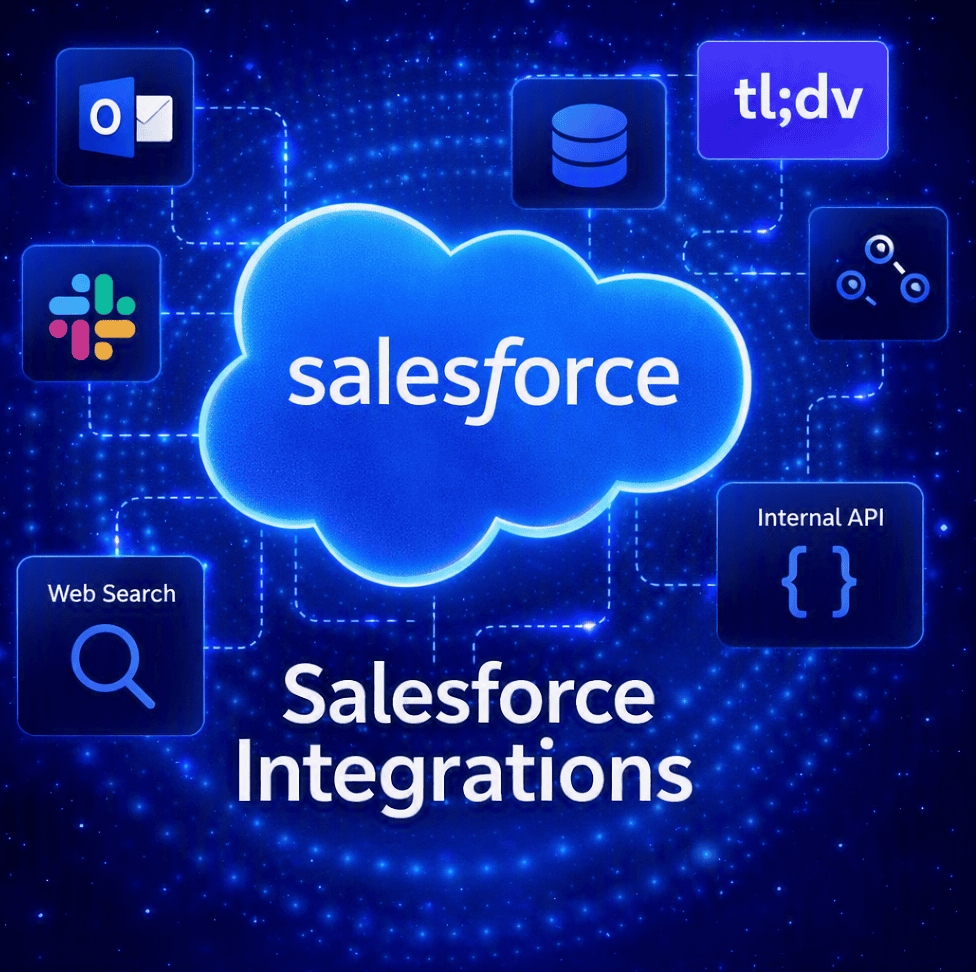
Salesforce integrations connect Salesforce to other apps so data moves between them without anyone copy-pasting it. There are four main routes:
- Native connectors
- AppExchange packages
- Direct API builds
- iPaaS middleware
The right one depends on how much engineering you want to manage. Below, you’ll find the types, the tool categories, setup, security, and cost.
Salesforce integrations connect your CRM to the other tools your business runs on. Think: email, calendars, marketing platforms, support desks, meeting recorders. It’s a way to make information flow automatically between them instead of doing everything by hand. Among other things, this means sales calls log themselves, so a human doesn’t have to try to remember after every single call.
For anyone running sales calls, you’ll know how valuable that is. Gartner puts the cost of poor data quality at $12.9 million a year for the average organization. Most of that figure comes from data that never even made it into the system in the first place, or got there but in the wrong place, making it as good as lost.
This guide covers what Salesforce integrations actually are, the main ways to build one, which tools connect, how to set one up, and how to keep the data clean once it’s flowing.
What Are Salesforce Integrations?
A Salesforce integration is a connection that lets Salesforce exchange data with another application. It can allow you to push records out, pull them in, or sync in both directions. The point is a single, current view of the customer instead of the same information scattered across a dozen tools that don’t talk to each other.
What data actually moves depends on your setup. A one-way integration sends data in a single direction; consider a support ticket flowing straight into the contact record. A two-way (bidirectional) integration keeps both systems matched, so a change in either place shows up in the other.
Timing varies too: some integrations fire in real time the moment something happens, while others run on a schedule or in scheduled batches when you’re moving large volumes. Underneath, most integrations talk to Salesforce through its APIs, though you rarely need to touch that layer yourself if you’re using a pre-built connector.
Salesforce Integration vs. App vs. Automation
These three get muddled constantly. An integration moves data between Salesforce and a separate system. An app (or package) adds features inside Salesforce itself. An automation triggers actions based on rules, like updating a stage when a field changes.
They overlap in practice: plenty of AppExchange listings bundle an integration, and Salesforce Flow can automate steps within an integrated workflow. But when you’re focusing on Salesforce integrations, the distinction is worth keeping in mind.
Why Businesses Integrate Salesforce
Why do you fly across an ocean rather than swim? Because it’s easier and saves a whole lot of manual effort. In all seriousness, businesses integrate Salesforce to kill manual data entry dead. It closes data silos and gives every team the same bird’s eye view of the customer.
The case is clear: reps who hand-log everything don’t sell all that much. Forbes, reporting on a study of sales reps, found they spend just 35.2% of their time selling and only 17.9% of it inside the CRM. The rest? It disappears into admin, research, and retyping notes into systems that were supposed to save time.
Integrations attack that directly. When a meeting recorder logs its own summary, a marketing form creates its own lead, and an accounting tool updates its own invoice, the data arrives without needing a rep to take care of anything. It makes a big difference. The McKinsey Global Institute estimates roughly a third of sales tasks can be automated with today’s technology.
There’s a data-quality angle too. Manually entered data is inconsistent, incomplete, and often late. Gartner notes 59% of organizations don’t even measure what that costs them. Integrated systems capture information at the source, which means fewer typos and fewer gaps. It’s just there, straight away.
Also keep in mind that reps learn to enter the bare minimum that keeps management off their backs, according to Forrester. This is precisely how a CRM ends up with thin, stale records.
But when it comes down to it, a unified customer view helps the business as a whole: support sees the sales history, sales sees the support tickets, and nobody walks into a call blind. That’s a customer success manager opening an account and finding the last three sales calls, the open support ticket, and the signed contract all in one place. Gone are the days of pinging four colleagues at the same time just to reconstruct the story.
Types of Salesforce Integrations (Native, AppExchange, API, iPaaS)
There are four main ways to integrate Salesforce: native connectors built into an app, AppExchange packages you install, direct API integrations you build, and iPaaS middleware that brokers the connection between systems. Which one fits comes down to how much engineering you want to own and how custom the workflow needs to be.
Native connectors are the simplest. The other tool already has a Salesforce integration baked in. Just authenticate and go. AppExchange packages are pre-built listings you install into your org, ranging from free to paid. Custom API builds are exactly what they sound like: your developers wire the two systems together directly, which gives total control at the cost of build and upkeep. iPaaS (integration platform as a service) tools sit in the middle as a broker, connecting Salesforce to dozens of apps through visual, low-code workflows.
Here’s how the four compare at a glance:
| Approach | Coding Needed | Najlepsze dla | Cost Model |
|---|---|---|---|
| Native connector | Brak | Popular, well-supported apps | Usually included |
| AppExchange app | Little to none | Pre-built connectors you install fast | Free to paid add-on |
| Custom API build | Required | Bespoke or unusual workflows | Developer time + upkeep |
| iPaaS / middleware | Low-code | Connecting many apps without heavy dev | Monthly subscription |
Can You Integrate Salesforce Without Coding?
Absolutely. Most Salesforce integrations no longer require a developer. Native connectors and AppExchange packages install in a few clicks, and iPaaS tools connect apps through point-and-click workflows rather than code.
You’ll still want someone who understands your data model to map fields sensibly, but the days of every integration meaning a custom build are long gone. Code becomes necessary only when your workflow is bespoke by necessity or you’re connecting a system nobody has built a connector for yet.
As a general rule of thumb: if a native or AppExchange option exists, start there and only expand to custom development when it can no longer do what you need.
Which Tools Integrate With Salesforce? (by Category)
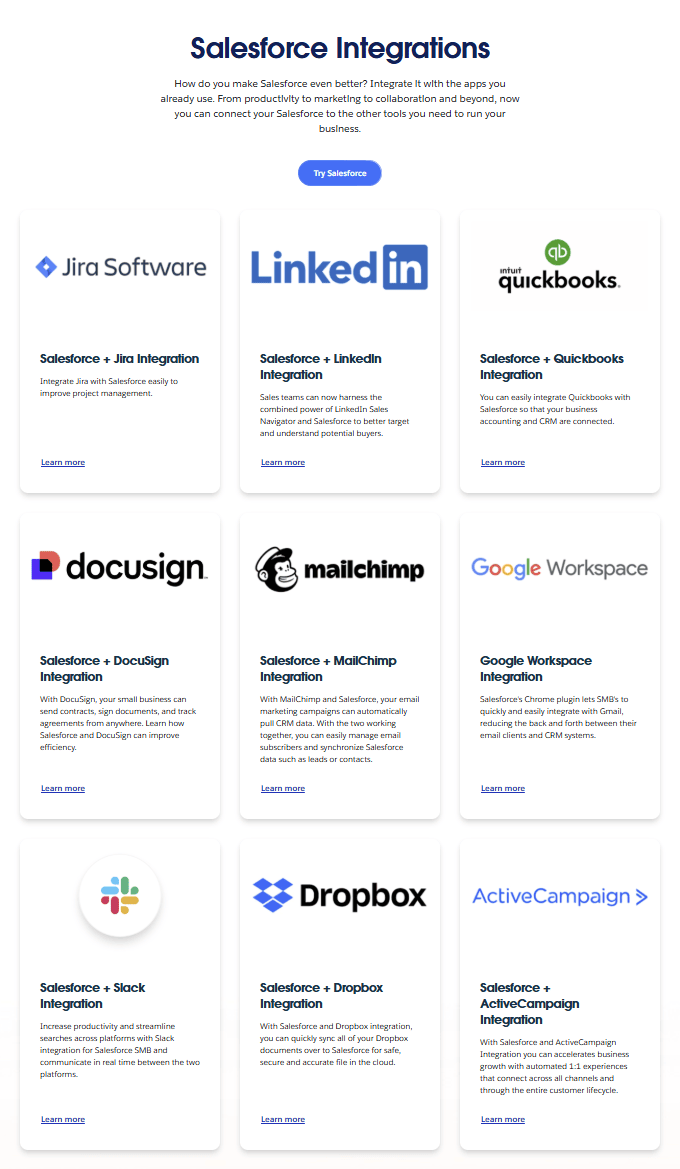
Salesforce connects with practically every category of business software: email and calendar, marketing automation, customer support, ERP and accounting, collaboration and comms, e-commerce, BI and analytics, and meeting intelligence.
AppExchange alone lists thousands of pre-built options, and third-party platforms that build connections push that number into the tens of thousands.
The usual suspects by category:
- Email and calendar: Outlook, Gmail, Google Workspace
- Marketing automation: Marketo, Mailchimp, Marketing Cloud Account Engagement
- Support: Zendesk, Intercom
- ERP and accounting: NetSuite, SAP, QuickBooks, Xero
- Collaboration: Slack, Teams
- E-commerce: Shopify
- BI: Tableau, Power BI
Most connect through a native listing or an AppExchange package. One category, though, is much more important. It has the potential to reshape how much your CRM data is worth. It also just so happens to be the one most teams under-use.
Meeting Intelligence and AI Notetakers for Salesforce
Meeting notes, transcripts, and action items can sync to Salesforce automatically, so the record updates itself the moment a call ends. This is the category that drains the most rep admin time. Without it, every sales and customer call becomes a manual logging chore that happens (badly) three days later or not at all.
Here’s how it works in practice. tl;dv’s Salesforce integration, for instance, allows recordings and AI summaries from your online calls (Google Meet, Zoom, Teams and more) to be logged automatically under the right Salesforce account.
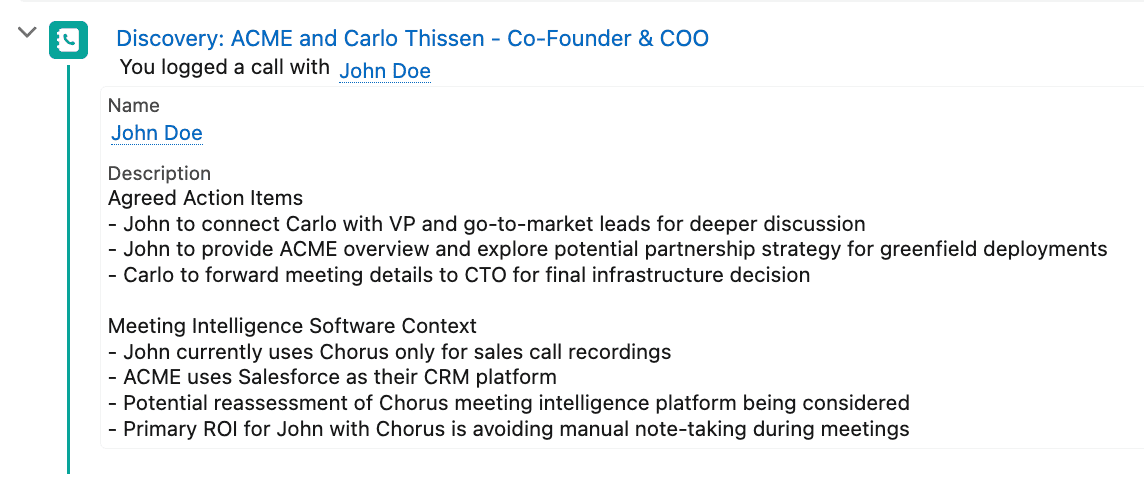
Its custom field mapping means the specific things you care about, like next steps, budget, and competitor mentions, all land in the specific Salesforce fields you’ve chosen.
Every logged moment is timestamped back to the recording, so anyone reviewing the account can jump to the exact bit of the call rather than trusting a one-line note. This also works with HubSpot, Pipedrive, and several other CRMs natively, as well as thousands of tools via Zapier too. If you want the step-by-step, we’ve covered how to sync Google Meet calls to Salesforce separately.

How to Set Up a Salesforce Integration
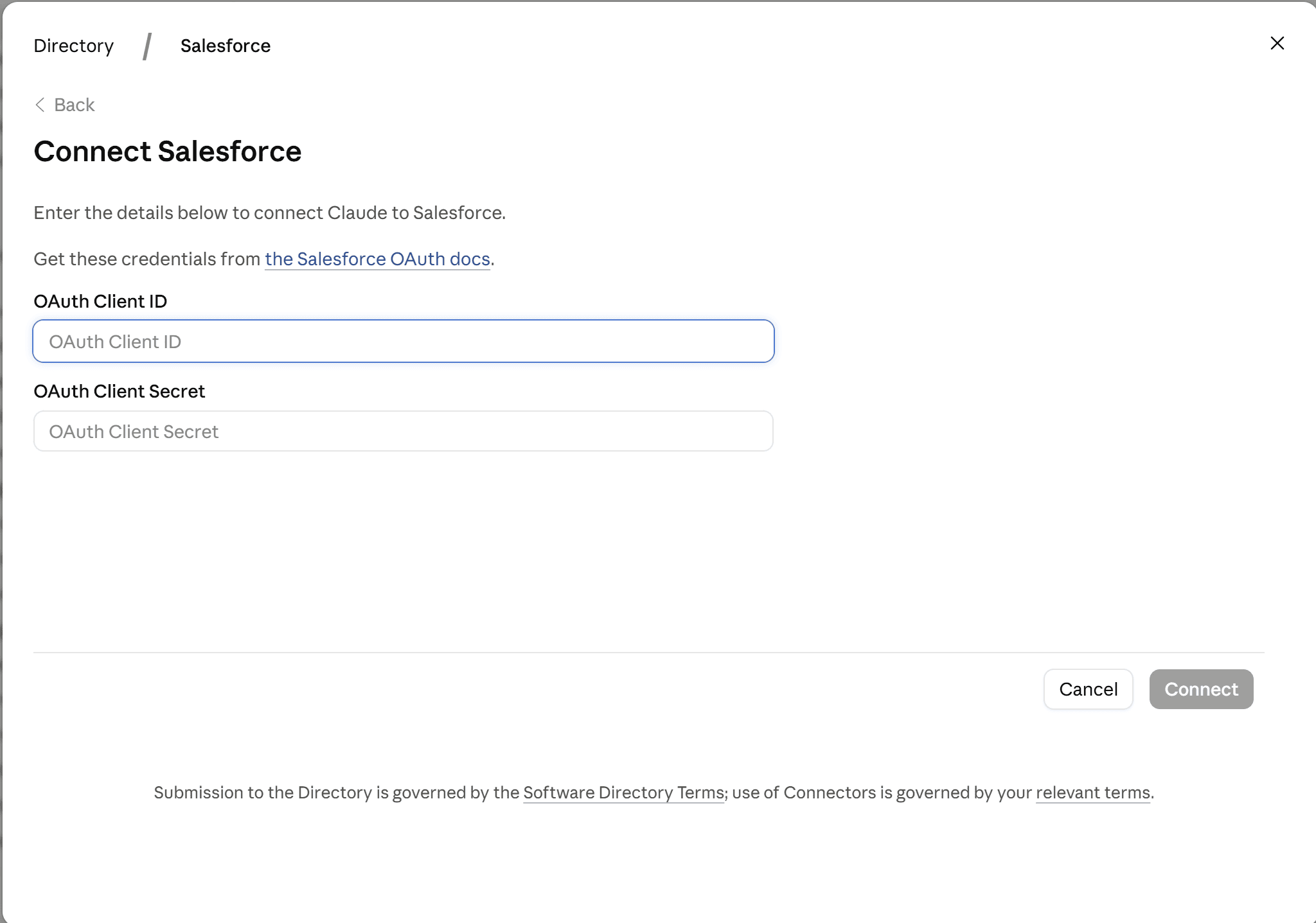
Setting up a Salesforce integration follows the same path whether you’re installing a connector or building custom: create a connected app, authenticate, assign a dedicated integration user, map your fields, and test in a sandbox before you go live. Pre-built connectors hide most of this behind a setup wizard; custom builds make you do it by hand.
The connected app is the entry point. It’s how Salesforce recognizes the external system and decides what it’s allowed to touch. Authentication almost always runs on OAuth, the open standard that lets one app access another without ever handing over a password.
Next, create a dedicated integration user rather than tying the connection to a real employee’s account; when that person leaves, you don’t want your sync to break.
Then you’ll want to map the fields. This is where you decide exactly which data in the external tool corresponds to which Salesforce field.
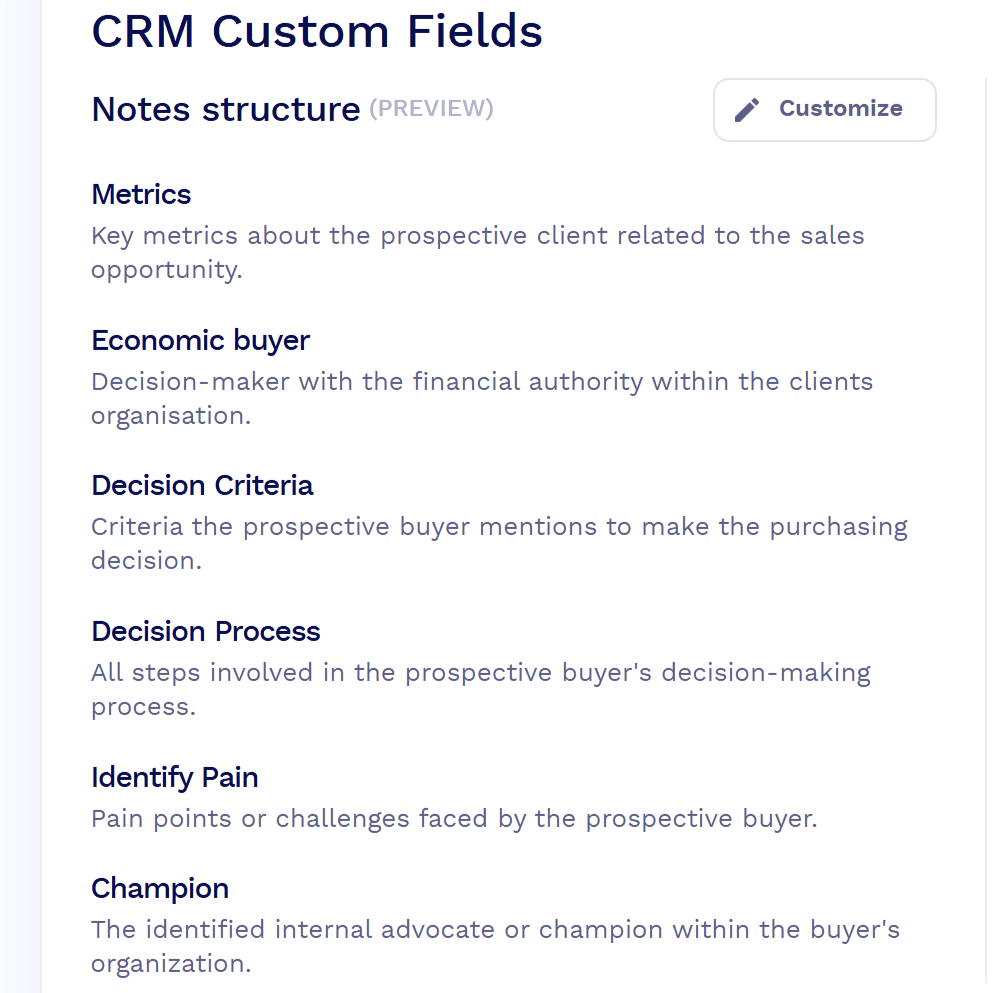
It’s kind of like the architecture step where most of the actual thinking happens. Get this wrong and you’ll sync the right data into the wrong place. Pay attention to data types, required fields, and picklist values. A mismatch there is the most common reason a sync fails.
Finally, test in a sandbox. Salesforce sandboxes are copies of your org where you can run the integration against real-shaped data without risking production, catching mapping mistakes before they pollute live records.
How Salesforce APIs Work (REST, SOAP, Bulk, Streaming)
Salesforce exposes several APIs, each suited to a different job.
- REST handles everyday app-to-app calls and is what most modern integrations use.
- SOAP is the older, more rigid option that legacy enterprise systems still rely on.
- Bulk is built for moving large volumes of records efficiently.
- Streaming pushes real-time event notifications so external systems react the moment data changes.
You won’t pick between these directly with a pre-built connector, but knowing they exist explains why some integrations feel instant and others run in batches. The same API layer is increasingly how AI tools act on your data, which is the whole idea behind the Model Context Protocol. Our guide to Salesforce MCP covers that.
Keeping Data Clean: Sync, Duplicates, and Source of Truth
Connecting the systems is the easy part. The hardest part of any Salesforce integration is keeping the data trustworthy once both sides can write to it. Two rules prevent most of the mess: decide which system is the source of truth for each field, and use external IDs so records match instead of multiply.
Source of truth means naming, up front, which system wins when two of them disagree about the same record. Without that call, a bidirectional sync will happily overwrite good data with stale data in an infinite loop of confusion.
External IDs are unique reference values shared between systems, letting an integration recognize “this is the same contact”. This is what lets you update the existing record correctly rather than creating a duplicate or an “upsert” (update or insert). Duplicates are the most common integration failure, and they compound: every downstream report, AI agent, and forecast built on doubled-up records inherits the error.
You’ll also want a plan for deleted records and for Salesforce validation rules, which can reject an incoming record that doesn’t meet your org’s requirements. Just another way to break a sync. The cleanest defense is capturing data automatically at the source, so there’s less manual entry to go wrong in the first place.
Are Salesforce Integrations Secure?
Salesforce integrations are secure when you follow the basics: authenticate with OAuth instead of storing passwords, grant least-privilege access, and review your connected apps regularly. The integration itself is rarely a red flag. Over-permissioned access on the other hand… That can end up biting you on the ass.
Least privilege is ideal. Give each integration only the permissions it can’t live without. Avoid giving full admin rights “to be safe.” OAuth keeps credentials out of the picture entirely, and Salesforce lets admins review, restrict, and revoke connected apps from a single settings panel.
That’s worth doing on a regular basis, as opposed to waiting for something to break.
If you’re handling EU personal data, the integration also has to respect GDPR: consent, access, and deletion rights have to survive the trip between systems, which is why data residency and retention settings matter when you’re vetting a tool. Reputable vendors build compliance into the core of the product rather than taping it on as an afterthought. For example, tl;dv is SOC 2 and GDPR compliant with EU-based data centers (as well as US, Japan, and others upon request). That’s exactly the kind of thing to confirm before you connect anything to your CRM.
How Much Do Salesforce Integrations Cost?
Salesforce integrations range from free to five figures a year. Native connectors and many AppExchange packages cost nothing beyond your existing licenses; premium AppExchange listings and iPaaS platforms charge monthly subscriptions; custom API builds cost developer time up front plus ongoing maintenance.
The “free” options are rarely the cheapest once you count the hours spent maintaining them. But if you’re considering building your own, you have to be prepared for full ownership. A custom integration you own outright can be cheaper at scale but ties up engineering time every time Salesforce or the other tool changes its API.
One cost that catches teams off guard is API limits. Salesforce caps how many API calls your org can make per day. That ceiling varies: a high-volume integration on a lower edition can hit the wall and start failing silently. Before committing to an integration-heavy stack, check your edition’s limits against the call volume you’re actually planning.
Tool-cost context is worth researching per category too; our roundups of cold calling tools and HubSpot integrations break down what similar sales tools charge.
Get Connected to Salesforce
Salesforce integrations have four routes to the same destination. The trick is picking the best route for your team. If a native connector or AppExchange package already exists for your tool, use it. If your workflow is genuinely custom, an API build or iPaaS platform is likely worth the money.
Whatever you pick, the goal is the same: data that captures itself at the source, so nobody’s retyping call notes at 6pm. If most of that admin is coming from meetings, an AI notetaker that logs straight to Salesforce is the fastest place to start.
FAQs About Salesforce Integrations
Can Salesforce integrate with any software?
Practically, yes. If a tool has a native Salesforce connector, an AppExchange listing, or an API, it can be integrated — and iPaaS platforms bridge most of the rest. Truly custom or legacy systems may need a bespoke build.
Are Salesforce integrations included with Salesforce?
Some are. Salesforce ships with native integration tools and API access (subject to your edition’s limits), and many AppExchange connectors are free. Premium packages, iPaaS platforms, and custom builds cost extra.
Do Salesforce integrations require coding?
Usually not. Native connectors and AppExchange packages install without code, and iPaaS tools use visual workflows. Coding is only required for bespoke integrations or unsupported systems.
Can meeting notes automatically sync to Salesforce?
Yes. AI notetakers like tl;dv record and summarize calls, then log the summary — with custom field mapping — straight to the matching Salesforce account, so reps don’t log calls by hand.
Native integration vs. Zapier vs. iPaaS — which is best?
Native connectors are simplest when one exists. Lightweight automation tools suit small, single-purpose connections. Full iPaaS platforms are best when you’re connecting many systems with complex, high-volume workflows.
Are Salesforce integrations GDPR-safe?
They can be, if the connected tool handles consent, data residency, retention, and deletion correctly. Vet the vendor’s compliance posture — SOC 2, GDPR, data-center location — before connecting anything holding personal data.
What are Salesforce API limits?
Salesforce caps daily API calls per org, and the limit scales with your edition and user count. High-volume integrations can exceed it, causing failed syncs, so match your integration plan to your edition.
Why isn't my Salesforce integration syncing?
Common causes: an expired OAuth token, a permissions gap on the integration user, a field-mapping mismatch, a validation rule blocking the record, or hitting API limits. Check the integration’s error logs first.
How long does a Salesforce integration take to set up?
A native or AppExchange connector can be live in under an hour. iPaaS workflows take a few hours to a few days depending on field mapping. Custom API builds run from a couple of weeks to months, depending on complexity and testing.
What's the difference between a Salesforce integration and a data migration?
An integration is an ongoing connection that keeps two systems in sync over time. A migration is a one-time move of data from one system into Salesforce. You often run a migration first to load existing records, then an integration to keep them current.