Skip to content





Your prospect screened your call, deleted your email, and scrolled past your LinkedIn DM — not because your product is bad, but because your pitch sounds like the last 14 AI-generated messages they ignored today.
These are B2B-ready sales pitch examples split by role (SDR vs AE), channel (phone, email, LinkedIn, deck), and buyer persona (CFO, CTO, end user). Each includes tonality cues, objection pivots, and the reasoning behind why it works when buyers assume everything was written by a bot.
Table of Contents
Quick-Start: 9 Best Sales Pitch Examples
| Example | Best For | Channel | Section |
|---|---|---|---|
|
Pattern Interrupt Opener |
SDR |
Cold call |
Openers |
|
Radical Transparency Opener |
SDR |
Cold call |
Openers |
|
Trigger-Based Opener |
SDR |
Openers |
Cold call |
|
Earned-Insight First Touch |
SDR |
Email |
Emails |
|
Post-Demo Re-Engage |
AE |
Email |
Emails |
|
Marketplace Growth Angle |
SDR/AE |
Email |
Emails |
|
“We help teams cut onboarding from 6 weeks to 6 days without adding headcount.” |
SDR |
Any |
One-liners |
|
“Your cloud bill has a 22% ghost-spend problem. Most teams don’t find it until renewal.” |
AE |
Any |
One-liners |
|
“Three of your competitors switched off legacy LMS this quarter. Their completion rates doubled.” |
SDR/AE |
Any |
One-liners |
What a Sales Pitch Actually Is (and the SDR vs AE Mistake)
A sales pitch is a short, buyer-focused message designed to earn a next step. It names a specific problem, gives one credible reason you can help, and asks for a single action. It is not a product walkthrough, origin story, or feature list.
The Mistake That Ruins Most Sales Pitch Scripts
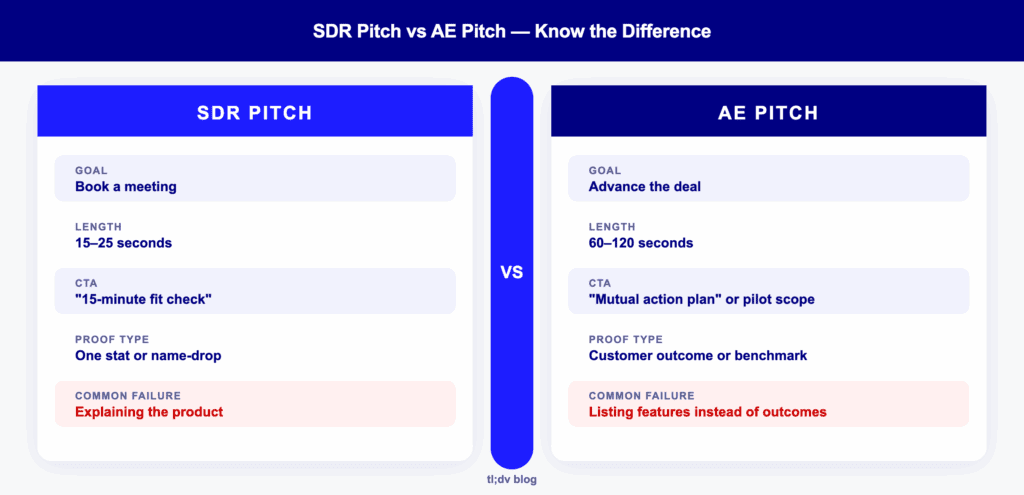
An SDR pitch and an AE pitch serve completely different purposes. Blurring them produces SDRs who sound like product manuals and AEs still trying to book meetings.
| SDR Pitch | AE Pitch | |
|---|---|---|
|
Goal |
Book a meeting |
Advance the deal |
|
Length |
15–25 seconds |
60–120 seconds |
|
CTA |
“15-minute fit check” |
“Mutual action plan” or “pilot scope” |
|
Proof type |
One stat or name-drop |
Customer outcome or benchmark |
|
Common failure |
Explaining the product |
Listing features instead of outcomes |
Every example in this guide is tagged SDR or AE so you never use the wrong pitch for the wrong job.
Why Most Sales Pitch Examples Fail in 2026
1. The Trust Recession: AI Makes Everything Feel Fake
Prospects receive dozens of AI-generated emails weekly. Research shows optimizing LLMs for competitive success can drive misalignment — a 6.3% sales increase accompanied by a 14.0% rise in deceptive marketing. Researchers call this “Moloch’s Bargain.” Human verification is now part of the sale. If you claim a number, be ready to show it.
2. The Elevator Pitch Is Dead — Use a 5-Second “Memory Dart”
The classic elevator pitch is speaker-centric: 30 seconds of compressed talking points that spike cognitive load and tank retention. A Memory Dart flips this — a 5-second hook designed to earn the next question.
Elevator Pitch (old): “We’re a cloud optimization platform that helps mid-market companies reduce infrastructure spend through automated resource allocation and real-time cost monitoring.” → 30 seconds. Forgotten instantly.
Memory Dart (new): “Your cloud bill probably has a 22% ghost-spend problem. Most teams don’t find it until renewal.” → 5 seconds. Prospect asks, “What do you mean by ghost spend?” Now you’re in dialogue, not monologue.
3. Data Beats Tradition on Openers and Sequences
Myth 1: “Did I catch you at a bad time?” — Gong’s analysis: this makes you 40% less likely to book a meeting (0.9% success rate vs 1.5% baseline). Stating your reason for calling increases success rate by 2.1x.
Myth 2: More outreach touches always win. Belkins analyzed 16.5 million cold emails: highest reply rate (8.4%) comes from one email. Performance declines with each follow-up; 4+ emails more than triple unsubscribe/spam rates.
Replacement strategy: High-impact first touch → one follow-up → switch channel or stop.
The Pitch OS: Build Once, Swap Channel, Persona, and Proof
Every example follows five blocks. Learn them once, build any pitch.
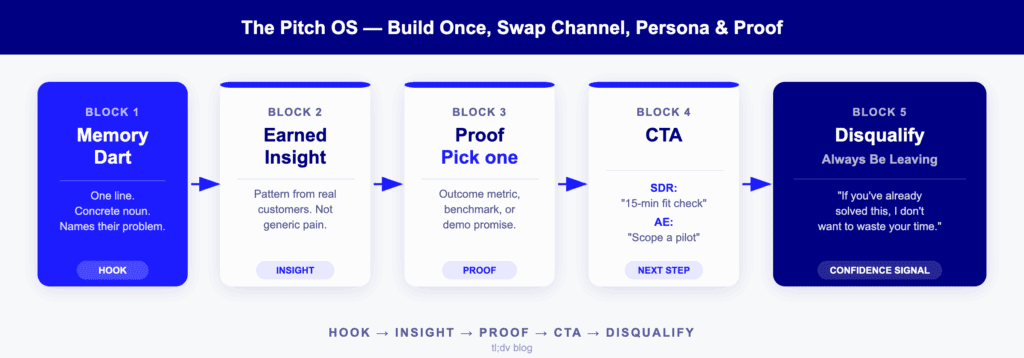
Block 1 — Memory Dart (Hook): One line. Concrete noun. Names a problem the prospect recognizes but hasn’t articulated.
Block 2 — Earned Insight: Show operational pattern recognition, not generic pain. “After onboarding 40 mid-market SaaS teams, we noticed reps aren’t slow because of training quality — they’re slow because the CRM setup creates 11 extra clicks per deal update.”
Block 3 — Proof (pick one): Customer outcome with a metric, credible benchmark, or demo promise. One proof point per pitch — stacking creates cognitive overload.
Block 4 — CTA: SDRs: “15-minute fit check this week?” AEs: “Want to scope a 2-week pilot?”
Block 5 — Disqualifier (Always Be Leaving): “If you’ve already solved this internally, I don’t want to waste your time.” The ABL approach signals confidence and respect — when you’re willing to walk away, the prospect leans in.
Flow: Hook → Insight → Proof → CTA → Disqualify
Opening Sales Pitch Examples (Cold Call Lines That Earn 30 Seconds)
1. Pattern Interrupt Opener (Gong-backed)
“Hey [Name], we’ve never spoken before. I’ll be upfront: I have a hunch about something your team is dealing with, and I want to check if I’m right. Got 20 seconds?”
Best for: SDR | Tonality: Conversational, slight pause after “I’ll be upfront.”
2. Radical Transparency Opener
“This is a cold call. I know. Two sentences, then you can tell me to get lost. Fair?”
Best for: SDR | Tonality: Calm. Almost amused. No apology in your voice.
3. Trigger-Based Opener
“[Name], I noticed you’re hiring three new [roles]. Usually when teams scale that fast, [specific problem] shows up around month two. Is that on your radar?”
Best for: SDR | Tonality: Curious, not declarative. Asking, not telling.
4. Earned-Insight Opener
“We’ve worked with about 20 [industry] companies this year. The pattern we keep seeing is [specific insight]. Is that showing up for you too?”
Best for: SDR or AE | Tonality: Steady, slightly detached. Consultant, not salesperson.
Gong data confirms permission-based openers that own the cold call and disarm with honesty show an 11.18% success rate. Stating your reason for calling shows 2.1x higher success.
Tonality: The “Doctor Tone”
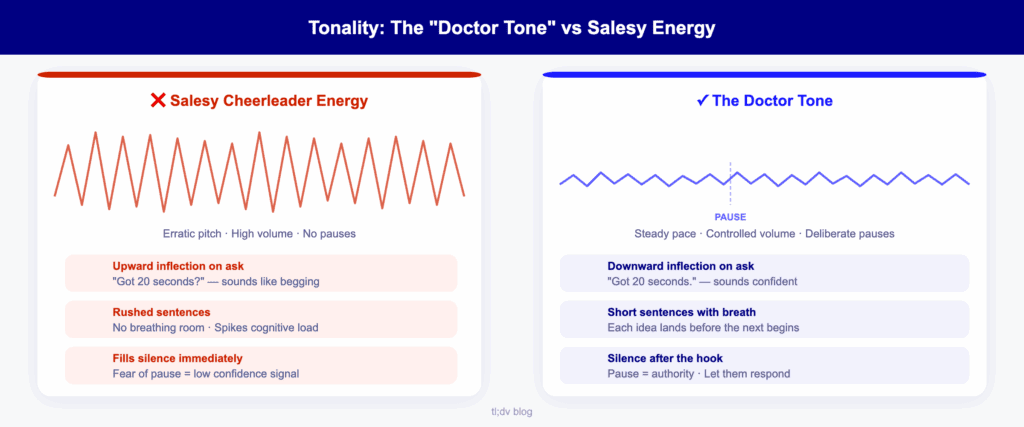
What you say matters less than how you say it. An overly excited voice reads as “salesperson.” The tone that performs best is calm, neutral competence — like a doctor delivering a diagnosis.
- Short sentences. Long sentences on cold calls are a death sentence.
- Downward inflection on the ask. “Got 20 seconds?” with downward tone = confident. Upward = begging.
- Pause after your hook. Silence is not your enemy.
Sales Pitch Examples Over the Phone (SDR + AE Scripts)
SDR Script: B2B SaaS Product Pitch
“Hey [Name], this is [Your Name] from [Company]. We’ve never spoken. Quick reason for the call: we work with [2–3 similar companies] and keep seeing the same thing — reps spend about 40% of their week on data entry instead of selling. We’ve helped cut that nearly in half. I’m not sure if that’s an issue for your team. Is it?”
Tonality: Moderate pace. Drop your voice on “Is it?” — genuinely asking. The “40% on data entry” figure is a common industry reference but specific sourcing varies. Swap in your own verified data point. Source: Salesforce State of Sales research.
Pivot — “Send me an email”: “Happy to. So I send something relevant — what’s the biggest headache on the admin side?”
Pivot — “We already have a solution”: “Good. Quick question — are you happy with adoption, or is that still a battle?”
SDR Script: Enterprise Software (Multi-Stakeholder)
“[Name], this is [Your Name] from [Company]. Quick — companies at your scale usually have 3–5 tools doing the same job across departments. That creates a data integrity problem nobody owns. Is that something you’ve run into, or am I off base?”
Tonality: Slow. Deliberate. Pause after “nobody owns.”
Pivot — “Not interested”: “Fair. Is it because you’ve solved the multi-tool problem, or it’s not a priority this quarter?”
AE Script: Post-Demo Follow-Up (Enterprise SaaS)
“[Name], I’ve been thinking about what you shared Tuesday about [pain point from discovery]. [Customer in similar industry] dealt with the same issue — went from [before metric] to [after metric] in [timeframe]. The part that mattered most was [specific capability], because their team didn’t have to change their workflow. Here’s what I’d suggest: a 2-week scoped pilot. We define success criteria upfront. If it doesn’t hit those marks, no hard feelings. Does that make sense to explore?”
Tonality: Measured. Pause before “I want to be honest.” Partner, not closer.
Pivot — “Need more people involved”: “Who else should be in the room? I can prep a version tailored to their priorities — financial case or technical integration.”
Voicemail Sales Pitch Examples (The “Double Tap” Rule)
Gong data: voicemails increase email reply rates from 2.73% to 5.87%. But after three or more voicemails, email reply rates drop to 2.2% — lower than leaving none. Two voicemails max per prospect.
Voicemail 1 (8–12 sec): “Hey [Name], [Your Name] from [Company]. Sent you a quick email about [topic]. Take a look when you get a chance.”
Voicemail 2 (20–25 sec): “[Name], [Your Name] again. We helped [similar company] [specific result], and I think there’s a similar opportunity. If I’m wrong, ignore me. If I’m right, the email has details.”
Short enough to be heard completely. Drive action to the email where you have space to pitch.
Sales Pitch Email Examples (First Touch + One Follow-Up Only)
Belkins’ analysis: highest reply rate (8.4%) from one email. After the second touch, unless you bring new value or switch channels, you’re shouting into the void.
Email 1: SDR Meeting Ask (SaaS)
Subject: [Company]’s [process] — quick question
Hi [Name], We work with [2–3 similar companies], and the pattern we keep seeing is [specific problem] costs teams about [X hours/dollars] per month — usually because [root cause]. [Customer] fixed this in [timeframe] and [specific result]. I’m not sure this applies to you. If it does, 15 minutes and I’ll walk through the how. Would [day] work?
Email 2: AE Re-Engage After Demo
Subject: Following up on [specific topic from demo]
Hi [Name], Been thinking about what you mentioned on [day] — specifically [their pain point]. [Customer in similar industry] was dealing with the same thing. After rolling out [solution], they went from [before state] to [after state] in [timeframe]. I also want to address the [implementation/security] concern you raised: [1–2 sentence explanation]. If this still makes sense, I’d suggest we [specific next step]. I can have a draft by [day]. Worth it?
Email 3: Marketplace / Ecommerce Growth Angle
Subject: How [competitor] grew [metric] in [timeframe]
Hi [Name], [Similar company] added [specific result] in [timeframe] by changing one thing: [insight]. Most marketplaces at your stage still do [common approach]. The shift to [your approach] is where the leverage is. If relevant, I can share the playbook in 15 minutes. If not, I’ll get out of your inbox.
Email 4: Sales Pitch Examples for Students
Subject: [Specific ask] — [Your Name], [University]
Hi [Name], I’m [Your Name], [year/major] at [University]. I’m reaching out because [specific reason tied to their work]. I recently [project/experience] where I [result]. That made me think I could contribute to [their initiative]. Open to a 15-minute call this week?
Tools like tl;dv can auto-generate follow-up drafts from meeting transcripts, keeping details accurate so you’re not rewriting from memory.
Online Sales Pitch Examples (LinkedIn DM)
Connection request (250 chars): “[Name] — saw your post about [topic]. Working in a similar space. No pitch, just relevance.”
Message 1 (after accepted): “Hey [Name], we keep seeing [industry pattern] hit teams at [their company type] around this stage. Is that something you’re dealing with, or am I off?”
Message 2 (if they engage): “What we found with [similar companies] is that the root cause is usually [insight], not [common assumption]. Happy to share a 2-minute breakdown — no call required.”
Voice notes rule: Never send without a 1–2 line text summary first. Most recipients view unsolicited voice notes as unscannable. Keep under 30 seconds, provide a text alternative, and ask permission before sending video.
One Line Sales Pitch Examples (Memory Darts)
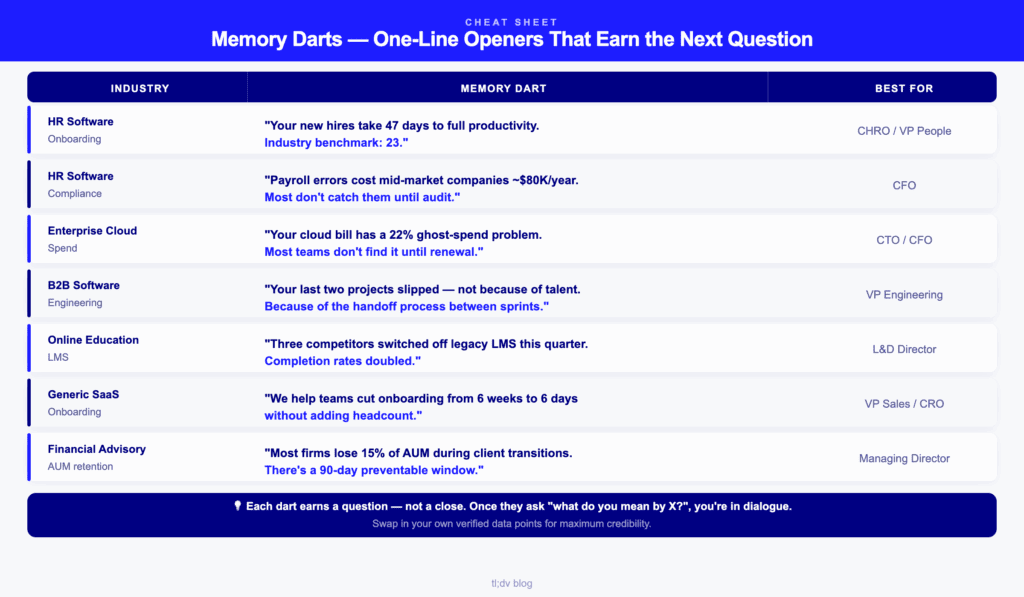
Single-line hooks for cold calls, emails, or events. Each earns the next question, not the close. Swap in your own verified data for maximum credibility.
| Industry | One-Line Memory Dart | Best Persona |
|---|---|---|
|
HR Software |
“Your new hires take 47 days to full productivity. Industry benchmark: 23.” |
CHRO / VP People |
|
HR Software |
“Payroll errors cost mid-market companies ~$80K/year in compliance penalties. Most don’t catch them until audit.” |
CFO |
|
Enterprise Cloud |
“Your cloud bill has a 22% ghost-spend problem. Most teams don’t find it until renewal.” |
CTO / CFO |
|
B2B Software Eng. |
“Your last two projects slipped not because of talent — because of the handoff process between sprints.” |
VP Engineering |
|
Online Education |
“Three competitors switched off legacy LMS this quarter. Completion rates doubled.” |
L&D Director |
|
Financial Advisory |
“Most firms lose 15% of AUM during client transitions. There’s a 90-day preventable window.” |
Managing Director |
|
HVAC |
“Systems installed before 2018 in this area fail at 3x the rate during July. Yours is from 2016.” |
Homeowner |
|
Roofing |
“Your neighbor had the same shingle type. We found $4,000 in preventable damage during a free inspection.” |
Homeowner |
|
Generic SaaS |
“We help teams cut onboarding from 6 weeks to 6 days without adding headcount.” |
VP Sales / CRO |
One Word Sales Pitch Examples (Memory Anchors)
A Memory Anchor is a word you plant early that becomes the prospect’s label for the problem. When they think about it later, they use your word.
- “Leak” — “You’ve got a revenue leak in your renewal process.”
- “Drift” — “Your messaging has drifted from what reps actually say on calls.”
- “Latency” — “There’s a 6-day latency between lead-in and first rep touch.”
- “Variance” — “The variance between top and middle reps is 4x. That’s process, not talent.”
- “Rework” — “Your team does 30% rework because specs change after kickoff.”
- “Blind spot” — “There’s a blind spot between your CRM data and what happens on calls.”
- “Drag” — “Admin drag is eating 40% of selling time.”
- “Decay” — “Deals over 60 days old close at 1/5th the rate. You have a pipeline decay problem.”
The anchor doesn’t sell. It reframes. Once the prospect uses your word, you own the conversation.
Persona Multi-Threading: CFO vs CTO vs End User
Generic pitches fail in enterprise deals because stakeholders care about different things.
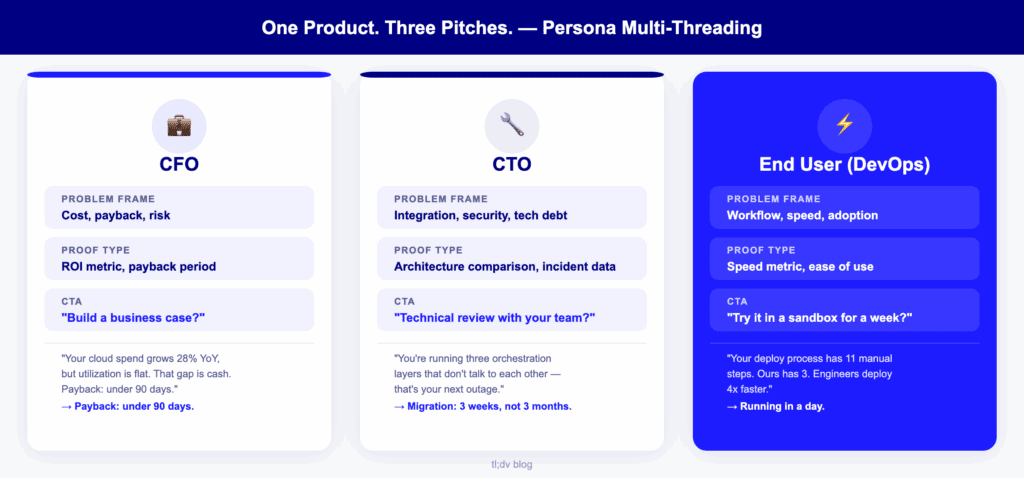
Enterprise Cloud Platform — One Product, Three Pitches
CFO: “Your cloud spend grows 28% YoY, but utilization is flat. That gap is cash. We help finance teams get resource-level visibility. [Customer] found $1.2M in recoverable spend within 60 days. Payback: under 90 days.”
CTO: “You’re running three orchestration layers that don’t talk to each other — that’s your next outage. [Customer] consolidated to our control plane, reduced incident response by 40%. Migration: 3 weeks, not 3 months.”
User (DevOps): “Your deploy process has 11 manual steps. Ours has 3. Engineers deploy 4x faster — no context switching, no ticketing detour. [Customer]’s team got it running in a day.”
| Persona | Problem Frame | Proof Type | CTA |
|---|---|---|---|
|
CFO |
Cost, payback, risk |
ROI metric, payback period |
“Build a business case for your budget review?” |
|
CTO |
Integration, security, debt |
Architecture comparison, incident data |
“Technical review with your team?” |
|
User |
Workflow, speed, adoption |
Speed metric, ease of use |
“Try it in a sandbox for a week?” |
Industry Sales Pitch Examples With Objection Pivots
HR Software Sales Pitch Examples
SDR: “How long does it take to onboard a new hire to full productivity? We keep seeing 40+ days at companies your size — usually disconnected systems between HR, IT, and hiring managers. [Customer] cut it to 18 days. Worth 15 minutes?”
AE (CFO): “Payroll errors at companies with [X employees] average ~$80K/year in penalties, mostly preventable with automated classification. [Customer] eliminated 94% in Q1. Platform cost was less than half what they’d paid in penalties.” EY payroll error cost analysis (HR Dive).
Pivot — “Locked into a contract”: “When does that renew? I’d rather have this conversation 60 days before so you have real options.”
Enterprise Cloud Platform Sales Pitch Examples
SDR: “We help cloud teams find and kill ghost spend — resources running but unused. Average: 22% of total cloud bill. Worth 15 minutes to see if that applies?” Flexera State of the Cloud waste estimate (CIO Dive).
AE (CTO): “The risk is orchestration fragmentation — [2–3 tools] managing infrastructure without sharing state. That’s how outages start. [Customer] consolidated to our control plane, cut incident response 40%. Migration: 3 weeks.”
Pivot — “Built internal tooling”: “How much engineering time goes into maintaining it each quarter? That’s usually the hidden cost lives.”
Online Education Sales Pitch Examples
SDR: “Three competitors shifted off legacy LMS this quarter — completion rates doubled. The lever wasn’t better content, it was delivery format. Is completion something you’re actively fixing?”
AE (L&D): “Learner drop-off happens at module 3, not module 1 — the content isn’t the problem, engagement design is. [Customer] went from 34% completion to 71% in one semester.”
HVAC and Roofing Sales Pitch Examples
HVAC: “HVAC systems installed before 2018 in [area] are hitting their failure window this summer. We do free diagnostics — 30 minutes. This week or next?”
Roofing: “We just finished a project on [nearby street]. Your roof has the same shingle profile flagged for wind damage. We found $4,000 in preventable damage at your neighbor’s place during a free inspection. Want us to take a look?”
Sales Pitch Deck Examples (Cognitive Load Score)
10-Slide B2B Deck Structure
- Title + one-line Memory Dart
- The problem (their world)
- Why now
- Your insight (root cause)
- Solution (plain language)
- How it works (3 steps max)
- Proof (one customer story + metric — most important slide)
- Pricing range (transparency builds trust)
- Implementation (timeline, risk controls)
- One clear CTA (not “Questions?”)
Cognitive Load Score
High cognitive load leads to poorer reasoning, risk-aversion, and hesitation — even when the product is good. Score each slide:
- Words per slide: target under 30
- Concepts per slide: target 1, max 2
- New terms introduced: 0–1 (define immediately)
- Total slide count: 10–12 for first meetings
A slide with 85 words, 3 concepts, and 2 acronyms = “high load.” Fix: split into 2 slides, cut acronyms, use a visual.
AI decks rule: AI drafts the skeleton. You add proof, customer stories, and “I’ve seen this before” credibility. AI-generated narrative is generic — prospects can tell.
Objection Handling Micro-Pivots
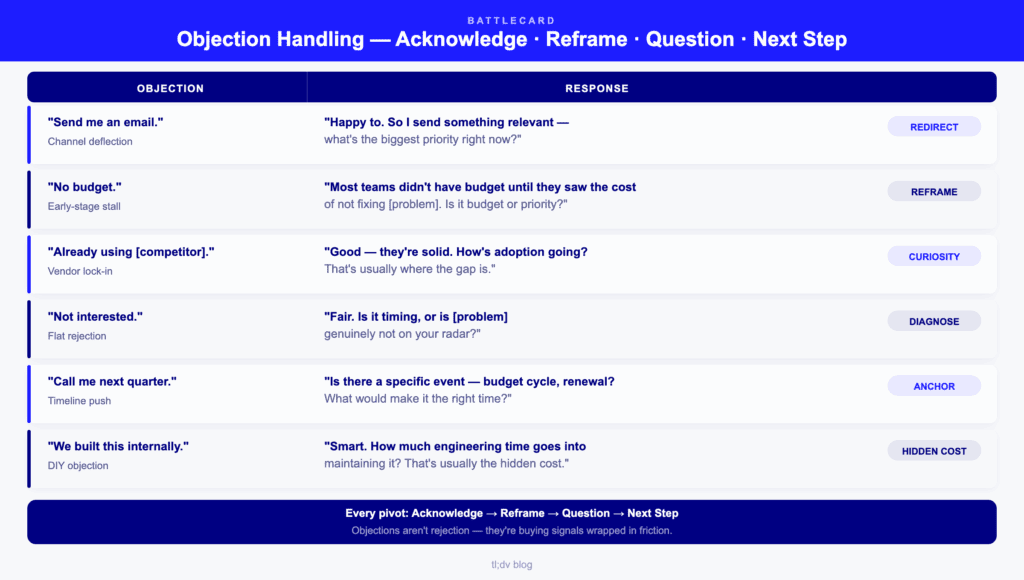
Every pivot: acknowledge → reframe → question → next step.
| Objection | Response |
|---|---|
|
“Send me an email.” |
“Happy to. So I send something relevant — what’s the biggest priority right now?” |
|
“No budget.” |
“Most teams we work with didn’t have budget until they saw the cost of not fixing [problem]. Is it budget or priority?” |
|
“Already using [competitor].” |
“Good — they’re solid. How’s adoption going? That’s usually where the gap is.” |
|
“Not interested.” |
“Fair. Is it timing, or is [problem] genuinely not on your radar?” |
|
“Call me next quarter.” |
“Is there a specific event — budget cycle, renewal? What would make it the right time?” |
|
“We built this internally.” |
“Smart. How much engineering time goes into maintaining it? That’s usually the hidden cost.” |
|
“Just email pricing.” |
“So I send the right tier — how many users, and is there a budget range?” |
|
“Who are you again?” |
“[Name, Company]. I know — cold call. Got 20 seconds for why I called? If not relevant, I’m gone.” |
Creative Sales Pitch Examples (Without Cringe)
Radical transparency: “This is a cold call. You didn’t ask for it. Two sentences, then you decide.” / “I’m going to tell you what we’re bad at before I tell you what we’re good at.”
Disqualifiers: “We’re not for everyone. Our sweet spot is [profile]. Does that sound like you?”
Stop using: Rhetorical stats (“Did you know 73%…”), fake personalization (“I saw you went to [University]!”), overly excited tone, “What keeps you up at night?”, and “Just circling back.” These trip the buyer’s “salesperson” filter instantly.
Practice Loop + Where tl;dv Fits
Weekly cycle: Record one call → review pacing, filler words, talk-to-listen ratio → rewrite one pitch block → retest. Track opener-to-meeting conversion, talk-to-listen ratio (aim 40/60), and time-to-first-question.
tl;dv can record and transcribe calls automatically, let you clip pitch moments into a team library, track which Memory Darts land via conversational intelligence, coach with playbook scoring, and push outcomes to your CRM through native integrations. Free to start.
5 Traits Every Good Sales Pitch Shares
- Buyer-first framing — names the prospect’s problem, not your features.
- One proof point — not three, not zero.
- Single clear next step — SDRs: meeting. AEs: pilot or action plan.
- A disqualifier — willingness to walk away signals confidence.
- Low cognitive load — short sentences, concrete nouns, zero jargon.