Перейти до змісту





- What it is: A 1 on 1 meeting is a recurring, private conversation between a manager and one direct report where the employee's agenda comes first.
- How often: Biweekly, 30-minute meetings are a sensible default, with weekly meetings for new hires, remote reports, and anyone struggling.
- What to cover: Use a shared agenda that runs from a check-in to their priorities and blockers, then feedback and growth, then action items.
- The main caveat: Take notes every time, but only record with explicit consent, because employees raise sensitive topics in 1:1s.
Most people have sat through a 1 on 1 that changed how they saw their job, and plenty more that could have been a Slack message sent to nobody.
The difference is rarely the manager’s charisma. It’s whether the meeting has a purpose, a structure, and someone who remembers what was said last time.
This guide covers all three, plus a free 1 on 1 meeting template you can steal today. Managers, this is mostly for you. Employees, there’s a section for you too. Jump to the template or build your agenda.

What Is a 1 on 1 Meeting?
A 1 on 1 meeting is a recurring, private conversation between a manager and one employee, where the employee’s priorities, problems, and growth come first. It isn’t a status update, and it isn’t a performance review.
The practice owes a lot to former Intel CEO Andy Grove, whose High Output Management made the case for regular one-on-ones as one of a manager’s highest-leverage habits. The evidence has since caught up.
A 2022 review by meeting researchers at UNC Charlotte notes that an estimated 47% of all meetings are 1:1s, citing internal studies at Microsoft and Cisco where employees with more frequent, well-run 1:1s were more engaged.
Gallup goes further: 80% of employees who received meaningful feedback in the past week are fully engaged. The catch? In a study of nearly 15,000 employees, only 16% said their last conversation with their manager was extremely meaningful.
1 on 1 vs. Performance Review vs. Status Update vs. Skip-Level
| Meeting | Purpose | Who drives it | Typical cadence |
|---|---|---|---|
| 1 on 1 | Support, feedback, growth, and unblocking | Mostly the employee | Weekly to monthly |
| Performance review | Formal evaluation against goals | Manager and HR | Quarterly or annually |
| Status update | Progress on projects and tasks | Whoever owns the work | Daily or weekly, often async |
| Skip-level | A big-picture pulse check across layers | The manager's manager | Quarterly or ad hoc |
How Often Should You Have 1 on 1 Meetings?
For most teams, a biweekly 30-minute 1 on 1 is the sensible default, with weekly meetings for new hires, remote reports, and anyone going through a rough patch. Gallup found that regular 15 to 30-minute conversations have a greater impact than 30 to 60-minute ones, as long as they actually happen regularly.
| Cadence | Найкраще підходить для | Suggested length |
|---|---|---|
| Щотижня | New hires, remote employees, anyone struggling or mid-change | 15–30 minutes |
| Biweekly | Most established team members | 30 minutes |
| Щомісяця | Senior, highly autonomous reports | 45–60 minutes |
Whatever the cadence, reschedule instead of canceling. A canceled 1 on 1 tells your employee exactly where they rank on your list.
Running remote 1:1s on a free Google account? Two-person calls dodge the Google Meet time limit that cuts group calls off at 60 minutes.
How to Run a 1 on 1 Meeting (Step by Step)
A good 1 on 1 has three phases: a shared agenda before, an employee-led conversation during, and written follow-up after.
Before the Meeting: Build a Shared Agenda
- Keep one running doc per report. Both of you add topics throughout the week, so nothing depends on memory.
- Let the employee go first. Their topics sit at the top, and yours go underneath.
- Review last time’s action items. If you promised something, check whether you did it before they have to ask.
These meeting agenda templates are a good starting point for the format.
During the Meeting: Let Them Talk First
- Open with a real check-in. “How are you doing, honestly?” works better than “Any updates?”
- Hand them the wheel. Work through their topics before yours, and spend most of your time listening.
- Give feedback on specific moments. “Your summary in Tuesday’s client call was sharp” beats “Great job lately.”
- Close the phones and the other tabs. People notice.
After the Meeting: Follow Up within 24 Hours
- Confirm action items out loud before you hang up: who does what, by when.
- Send a short written recap the same day. If you need a structure, here’s how to write a meeting summary that people actually read.
- Start the next meeting with those action items. Nothing builds trust faster than a manager who remembers.
1 on 1 Meeting Template (30-Minute Agenda)
Here’s a 1 on 1 meeting template that fits into 30 minutes and keeps the employee in the driver’s seat.
| Час | Розділ | What to cover |
|---|---|---|
| 0–5 min | Check-in | How they're doing, anything on their mind |
| 5–15 min | Their priorities and blockers | Wins, what's stuck, what they need from you |
| 15–25 min | Feedback and growth | Feedback both ways, skills, career goals |
| 25–30 min | Actions and next steps | Owners, deadlines, topics for next time |
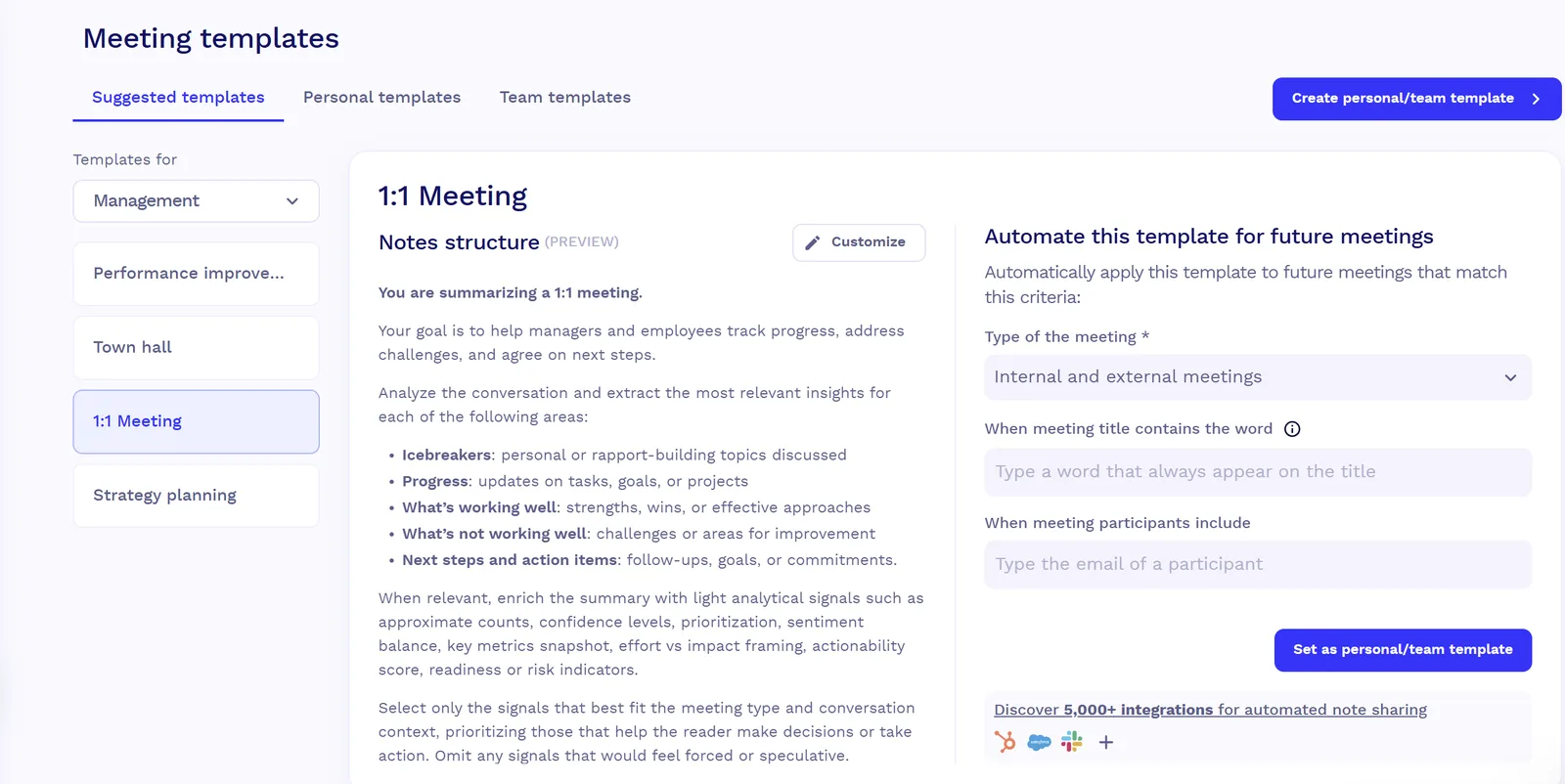
The agenda is the easy part. What’s difficult is taking notes while trying to actually listen. That’s where the tl;dv 1:1 Meeting Template comes in: it structures the AI notes from your 1:1s and tracks action items and follow-ups for you, so you can look at the person instead of your keyboard.
On Pro and above, you can also write your own: a custom template is a plain-language prompt telling the AI what to capture, and it can apply automatically to future meetings by meeting type, title keyword, or participant.
Adapting the Template for Different Reports
The same 30 minutes won’t suit everyone. Use the 1-to-1 agenda builder below and build your agenda to match who’s across the table and how much time you have. When you’re done, copy the agenda into your shared doc so you both have access beforehand. Bookmark this page to come back and use the agenda builder again in the future.
1-on-1 Meeting with Manager Template (for Employees)
If you’re the one being managed, don’t wait for your boss to bring the structure. Show up with this 1-on-1 meeting with manager template instead.
| Розділ | Prompt to prepare |
|---|---|
| Wins | What went well since our last 1:1? |
| Blockers | What's slowing me down, and what would unblock it? |
| One ask | One specific thing I need from you this week |
| Feedback for you | One thing you could do differently to help me |
| Growth | A skill, project, or career question on my mind |
Add your topics a day early, and if your manager keeps canceling, propose a shorter slot rather than none. And keep your own notes, because “you said I’d lead the Q3 project” lands better with a date attached. This ultimate guide to meeting notes covers the basics.
1 on 1 Meeting Questions to Ask
The best 1 on 1 questions are open-ended, specific, and about the employee rather than the project. Rotate through them, because nobody enjoys an interrogation.
Check-in
- How are you doing, honestly?
- What’s been the best part of your week?
- What’s taking up most of your headspace right now?
- Is there anything you want to make sure we cover today?
Priorities and blockers
- What’s the one thing slowing you down most?
- Is anything unclear about what “done” looks like?
- Where could I remove an obstacle for you?
- What are you working on that nobody sees?
Feedback (both ways)
- What’s one thing I could do differently to support you?
- Is there feedback you’ve been holding back?
- Which piece of your recent work are you proudest of?
- How do you prefer to receive feedback?
Growth
- What skill do you want to build this quarter?
- Where do you see yourself in two years?
- Which projects would stretch you?
- Who in the company would you like to learn from?
Workload and well-being
- How sustainable does your workload feel, on a scale of 1 to 10?
- What would you drop if you could?
- When did you last feel really energized at work?
- Is anything outside work affecting you that I should know about?
Getting upward feedback is only half the job. Acting on it, and telling people you did, is how you go about closing the feedback loop.
Taking Notes, Recording, and Using AI in 1 on 1s
Take notes in every 1 on 1 meeting, share them with your report, and only record with clear, explicit consent. The notes are what turn a nice chat into accountability.
Should You Record a 1 on 1 Meeting?
Only if both of you are genuinely comfortable. A 1 on 1 is where employees raise sensitive topics, and a recording can change what they’re willing to say. (Usual caveat: this isn’t legal advice, so check with your own HR or Legal team.)
Consent rules vary by country and state (here’s the rundown on whether it’s illegal to record someone without their permission). In the UK, the ICO’s guidance on monitoring workers says consent is not usually appropriate in an employment context because of the power imbalance, and that workers must be told about monitoring in a way they can understand.
A good rule of thumb: ask every time, offer an off-the-record option for anything personal, and remember that switching to bot-free recording changes how visible the recording is, not whether you need to disclose it. AI summaries are also interpretations, which matters more in a 1 on 1 than in a sales call. There’s more on that in this piece on AI and privacy.
How AI Helps You Track Themes across Your Whole Team
Running one great 1 on 1 is easy. Running twelve every two weeks, while remembering who said what, is where managers start to fall apart.
With consent in place, AI meeting minutes from tl;dv capture summaries, decisions, and action items automatically, each linked to the moment it was said.
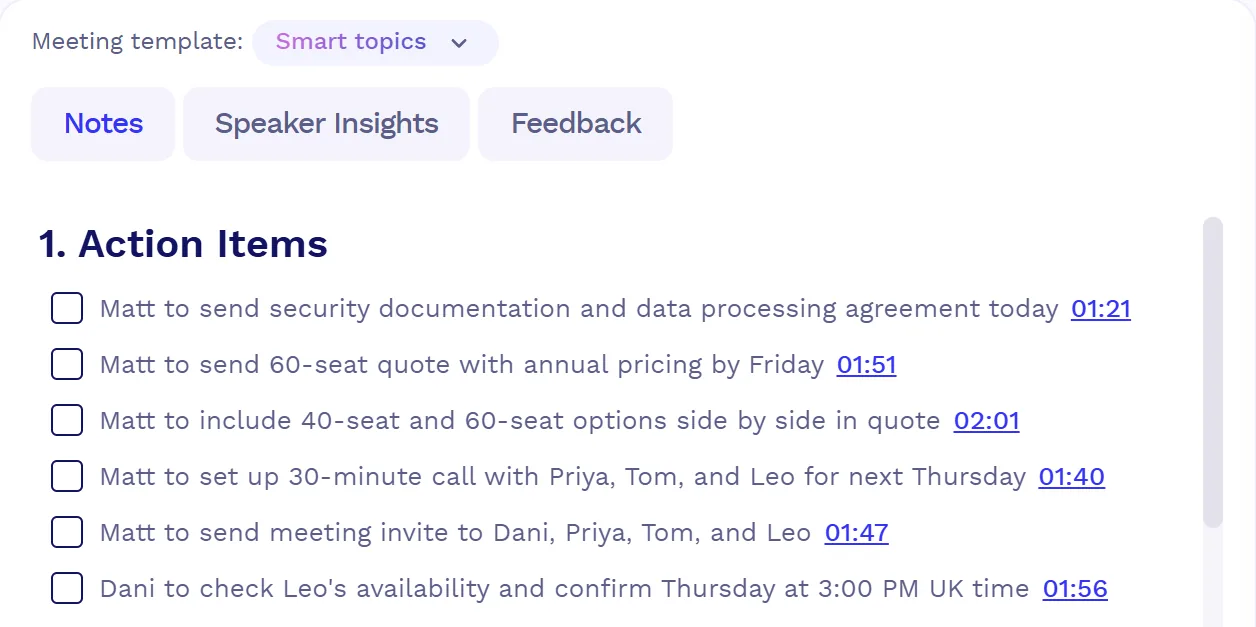
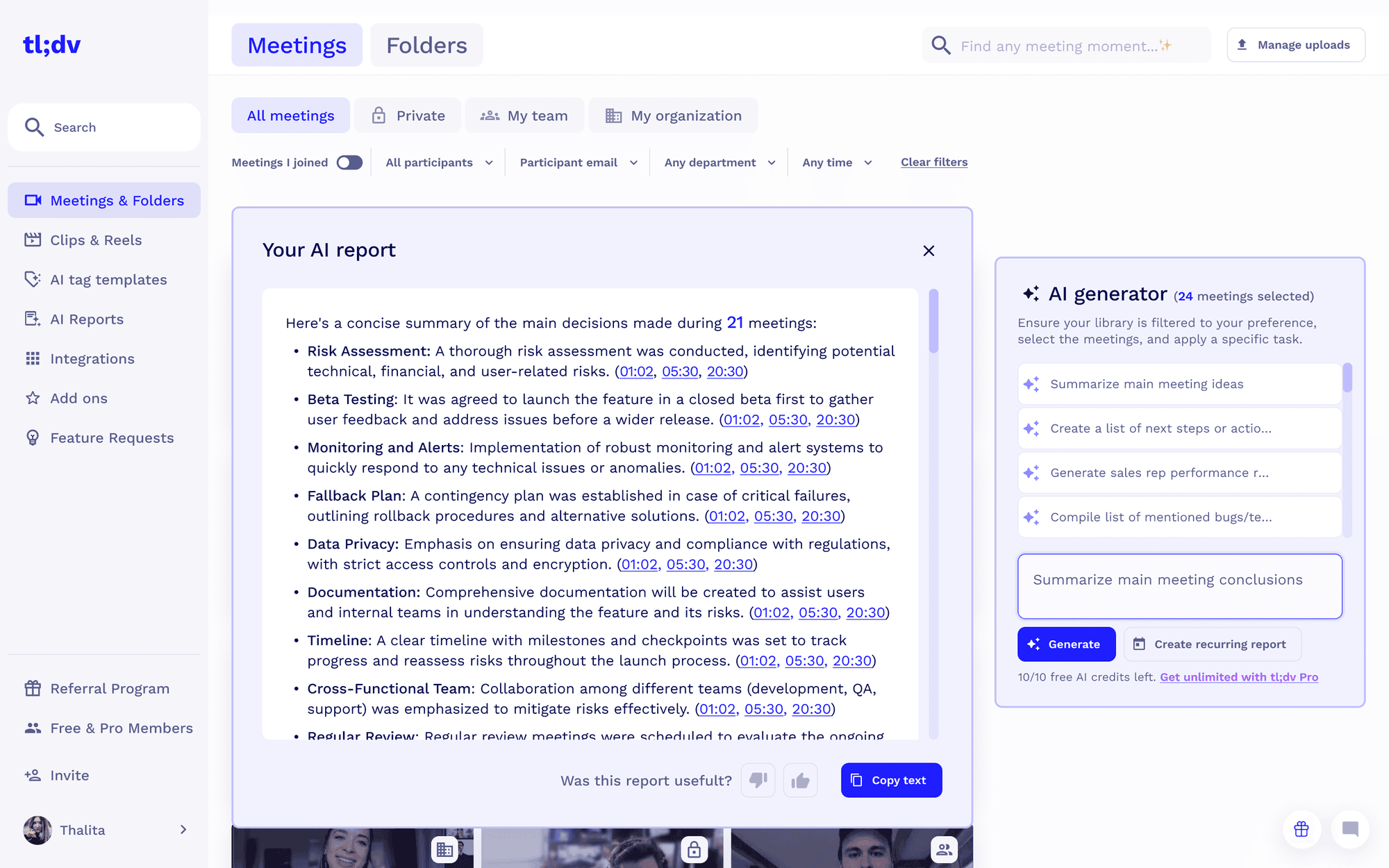
The bigger win is across meetings. tl;dv’s conversational intelligence pulls insights from multiple meetings at once, like which blockers keep coming up across your team this month. Unlimited multi-meeting insights come with tl;dv’s Business plan, while Pro covers unlimited questions about single meetings. It surfaces patterns across dozens of calls at once, but it never replacese your judgment.
Common 1 on 1 Meeting Mistakes (and How to Fix Them)
Most bad 1 on 1s fail in predictable, fixable ways.
- It’s become a status update. Move project updates to a board or async channel, and protect the 1 on 1 for people topics.
- You keep canceling. Reschedule within the same week, or shorten it. Never skip it.
- You do most of the talking. Aim for them talking most of the time. If you’re past halfway, stop and ask a question.
- Action items vanish. Write them down, assign owners, and open the next meeting with them.
- You only talk about weaknesses. Gallup found that discussing weaknesses is the topic employees find least meaningful. Recognition, goals, and strengths land far better.
- They say they have “nothing to discuss.” Pick a question from the growth or well-being list. Silence usually means they don’t feel safe yet, not that everything is fine.
For more on fixing meetings in general, see these effective meeting strategies.
Set Up Your 1-to-1 Meetings Today
A great 1 on 1 meeting isn’t complicated: a regular slot, a shared agenda, a manager who listens, and notes that survive until next time. Build your agenda, pick five questions, and put the first one on the calendar today.
Action items and follow-ups, captured while you listen.
FAQs About 1-on-1 Meetings
Who Should Lead a 1 on 1 Meeting?
The employee should own most of the agenda, while the manager keeps time and makes sure feedback and action items happen.
Should 1 on 1 Meetings Be in Person or on Video?
Either works. Video is fine for remote teams, and a walking 1 on 1 can help if a conversation needs less intensity.
How Do You Know Your 1 on 1s Are Working?
Your reports add their own topics, raise problems early, and action items actually get done. If you’re unsure, ask them directly.