Zum Inhalt






TL;DR
A MEDDPICC sales methodology is only useful when it helps you see what is missing from a deal before that gap becomes a problem.
This guide focuses on how to use MEDDPICC in real sales conversations, the questions worth asking at each stage, and 10 practical examples. I’ll also show where tl;dv can help reps check what buyers actually said, review missed questions, and keep useful qualification details from disappearing after the call.
Inhaltsübersicht
What Is the MEDDPICC Sales Methodology?
MEDDPICC is a sales qualification methodology for complex B2B and enterprise deals. It helps sales teams understand the people, business case, decision-making process, internal approvals, and competitive pressure around an opportunity.
The methodology grew from MEDDIC, which was developed at PTC in 1996. MEDDICC later added Competition, and MEDDPICC added Paper Process to account for the steps between a buying decision and a signed contract.
MEDDPICC works well when several people can influence the outcome. A RevOps lead might run the evaluation, a VP Sales may control the budget, Security could have technical requirements, and Procurement or Legal may determine when the contract can actually be signed.
That is why I would not treat MEDDPICC as an eight-step sales process. The information develops throughout the deal. Pain and Metrics might come up during discovery, while the Paper Process may only become clear once the buyer is serious enough to involve Procurement.
MEDDIC vs MEDDICC vs MEDDPICC
MEDDIC, MEDDICC, and MEDDPICC share the same qualification foundation. The later versions add more visibility into competition and what happens after the buyer decides to move forward.
| Framework | What It Includes | Where It Fits |
|---|---|---|
| MEDDIC | Metrics, Economic Buyer, Decision Criteria, Decision Process, Pain, Champion | Complex deals where qualification and stakeholder mapping matter |
| MEDDICC | MEDDIC + Competition | Deals where another vendor, the current setup, or another internal option could affect the outcome |
| MEDDPICC | MEDDICC + Paper Process | Enterprise deals where Procurement, Security, Legal, or contracting can delay the close |
For a short transactional sale, the full MEDDPICC framework may be unnecessary. It becomes more useful once a deal has several stakeholders, a longer buying cycle, or formal approval steps before signature.
How the 8 Parts of the MEDDPICC Framework Work in Practice
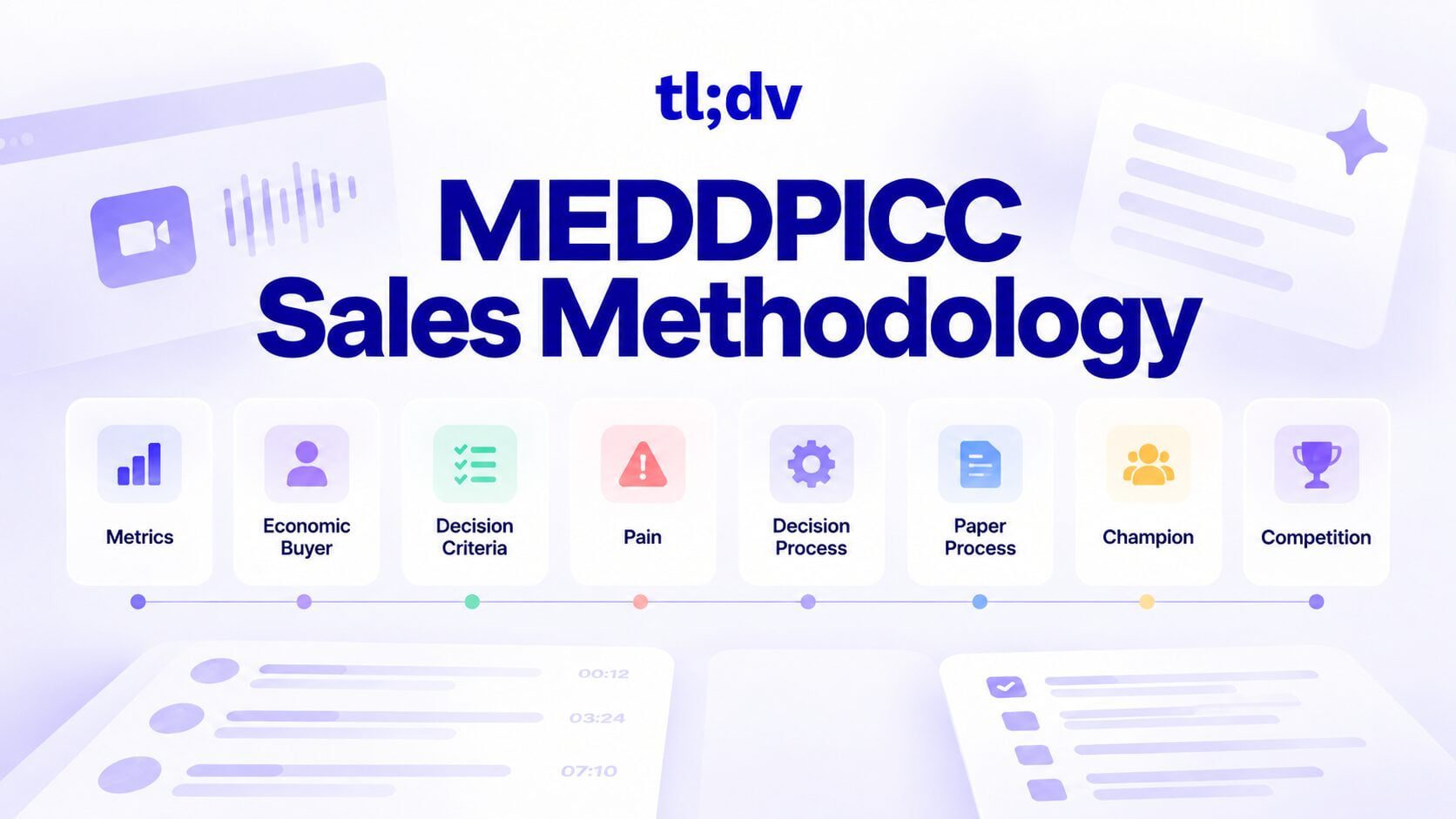
Each part of the MEDDPICC framework focuses on different questions. Together, they help the rep understand why the buyer may act, who needs to be involved, how the decision will be made, and what could still hold the deal up.
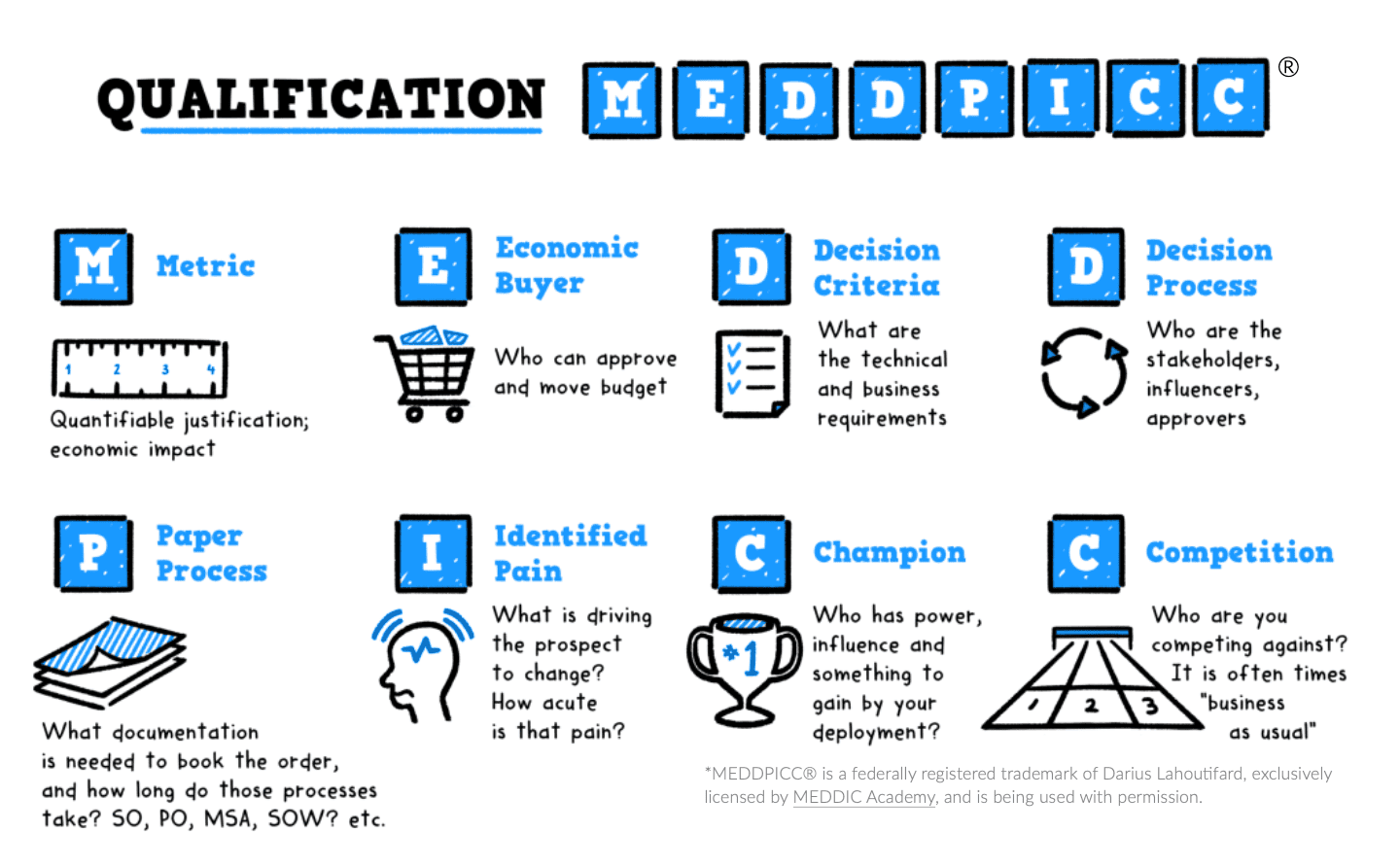
1. Metrics
Metrics are the measurable outcomes the buyer expects from solving the problem.
“Save time” is a starting point, but it does not tell you enough to build a business case.
Example 1: A sales manager says their reps spend too much time writing call notes. Later in the conversation, the rep learns that 40 people spend around two hours each week on meeting notes and CRM admin.
Now the problem has a scale: roughly 80 hours of rep time each week.
I’d ask:
- How are you measuring this today?
- How much time or money does the current process cost?
- What would a good result look like?
- Is there a target the team needs to reach?
The number may become more precise later. What matters at this point is having something the buyer recognizes as a meaningful outcome.
2. Economic Buyer
The Economic Buyer is the person with overall authority in the financial decision.
Example 2: A RevOps Director organizes the evaluation, attends the calls, and manages the pilot. Later, the rep learns that the VP Sales needs to approve the budget.
Adding “VP Sales” to the CRM is not enough. I’d still want to know:
- What does the VP care about?
- When do they normally get involved?
- What do they need before approving the spend?
- Can the current contact bring them into the conversation?
A title tells you who may approve the purchase. It does not tell you how that approval will happen.
3. Decision Criteria
Decision Criteria are the requirements the buyer will use to compare its options.
Example 3: A company is evaluating three meeting intelligence platforms. Sales leadership cares about coaching and adoption. RevOps wants CRM integration. Security is focused on data handling. Finance cares about cost.
The rep needs to understand the criteria across the buying group, especially anything that could block the purchase.
I’d ask:
- What will the team compare vendors on?
- Which requirements are non-negotiable?
- Who owns each part of the evaluation?
- Are some criteria weighted more heavily than others?
A strong discovery call should start uncovering more than the buyer’s immediate pain. It should also give the rep an early view of how the wider buying group will judge the solution.
4. Decision Process
Decision Process covers how the buyer will reach the final decision.
Example 4: The buyer says they want to choose a vendor by the end of October.
A few follow-up questions reveal that they first need to:
- run a two-week pilot
- collect feedback from five managers
- present the recommendation to the VP Sales
- get Finance approval
The date now has a process behind it.
I’d ask:
- Who else needs to be involved?
- What happens after this stage?
- Which approvals are still outstanding?
- Is anything likely to delay the decision?
This is useful when a deal slips. Instead of simply changing the close date, the rep can see which part of the process has moved.
5. Paper Process
Paper Process covers the steps between the buying decision and the final signature.
Example 5: The buyer confirms they want to move forward and the rep expects the deal to close that week.
Then Procurement gets involved.
Security still needs to complete a review. Legal usually takes ten business days. Finance cannot issue a purchase order until both are finished.
The buyer has selected a solution, but the deal is not ready to close.
I’d ask:
- What happens once a vendor is selected?
- Does Security need to approve anything?
- How long does Legal normally take?
- Who handles Procurement internally?
- Is a purchase order required before signature?
These questions do not need to take over the first call. I would bring them in early enough that the expected close date accounts for the work still left to do.
6. Identify the Pain
Identifying Pain tells you what is wrong. Implicating it means understanding the wider business effect and what happens if the problem continues.
Example 6: A sales manager says: “We don’t have enough visibility into our reps’ calls.”
Further discussion shows that managers can only review a small sample manually, discovery issues are often noticed after opportunities have already been lost, and the company is preparing to onboard 20 new reps.
The problem now has a business impact and a reason to matter now.
I’d ask:
- What is this affecting today?
- Who else is affected by it?
- What happens if nothing changes?
- Why has this become a priority now?
Good sales techniques help here because the aim is to keep digging without turning discovery into an interrogation.
7. Champion
A Champion is someone inside the customer organization with enough influence and credibility to help the opportunity move forward.
They do not have to be the end user. Enthusiasm on a demo is not enough either.
Example 7: A Sales Operations Manager attends every meeting and likes the product.
Over the next few weeks, they introduce the rep to the VP Sales, explain what Security is concerned about, share feedback from an internal discussion, and help prepare the business case.
Those actions tell you much more about their influence.
I’d look for signs such as:
- making introductions to the people you need to meet
- sharing useful internal context
- explaining how the opportunity is being discussed internally
- helping move the project when you are not in the room
A helpful contact can become a Champion, but I would judge that by what they do inside the deal.
8. Competition
Competition covers anything competing for the same budget, attention, or resources. That includes another vendor, the current setup, an internal build, another project, or simply doing nothing.
Example 8: A company is comparing two meeting intelligence platforms.
During discovery, the rep learns that basic recording is already bundled into another product the team uses.
The existing setup is limited, but it costs nothing extra.
The question is no longer only which vendor the buyer prefers. The rep also needs to understand whether the problem is important enough for the buyer to spend more money fixing it.
I’d ask:
- What other options are being considered?
- What does the buyer like about them?
- What are they using today?
- Could another project take the same budget?
- What happens if they keep the current setup?
How to Use MEDDPICC (Without Turning Discovery Into a Checklist)
| What You Know | What Needs to Happen Next |
|---|---|
| The buyer has described the problem, but there is no measurable impact | Quantify the cost, time, revenue, or business outcome behind it |
| A senior stakeholder has been named, but their budget authority is unclear | Establish who controls the spend and how they enter the decision |
| The buyer has given you a target close date, but no clear approval path | Map the decision steps, people involved, and dependencies behind that date |
| Your main contact is engaged, but has not influenced anything internally | Test their ability to make introductions, share internal context, and move the deal forward |
| No competitor has been mentioned | Check the current setup, internal alternatives, competing initiatives, and the option to do nothing |
| The buyer wants to proceed, but Procurement has not been discussed | Clarify Security, Legal, contracting, vendor onboarding, and purchasing timelines before relying on the close date |
Economic Buyer: VP Salesdoes not tell the rep much. This is more useful:
Economic Buyer: Not confirmed. VP Sales needs to approve, but budget ownership and involvement are still unclear. Confirm on next call.Whatever is still unclear should guide the next move in the deal.
How tl;dv Can Support MEDDPICC Sales Coaching
tl;dv can help reps and managers check MEDDPICC qualification against the conversation itself, especially when the notes in the CRM do not tell the whole story.
tl;dv records and transcribes sales calls, links insights back to timestamps, and includes Playbook Monitoring in its AI Coaching Hub. MEDDIC is available as a built-in sales playbook, while teams using MEDDPICC can extend the same approach to Competition and Paper Process through a custom playbook.
Example 9: Check what the buyer actually confirmed
Ask tl;dv can be useful when a MEDDPICC field is still unclear after a call.
For example, I tested the following question:

In this case, the buyer had discussed the budget, future budget conversations, and the expected decision timeline, but had not explicitly said who had approval authority. tl;dv kept that distinction clear and surfaced the related comments with timestamps rather than treating the Economic Buyer as confirmed.
The rep can then take that gap back into the next conversation and establish who owns the budget, when they become involved, and what they need before approving the purchase.
The same approach can be used to check other parts of MEDDPICC, such as:
- What measurable outcomes did the buyer mention?
- What requirements will they use to evaluate the options?
- Which decision steps and stakeholders were discussed?
- What did the buyer say about Procurement, Security, Legal, or contracting?
- Which competitors, current tools, or alternatives came up?
Example 10: Use MEDDIC for call coaching
The AI Coaching Hub also gives managers a way to review how qualification is being handled across selected calls.
MEDDIC appears as one of the built-in sales playbooks in tl;dv. Playbook Monitoring can then be used to see how consistently the relevant areas are being covered and to return to the call moments behind the result.

This is useful when the rep technically covered a MEDDIC area, but did not go far enough to qualify it properly.
For example, asking who approves the purchase is not enough if the rep never finds out when that person gets involved or what they need to see. The same applies to Pain: identifying the problem is useful, but the manager should also check whether the rep understood its business impact and urgency.
That gives the manager something specific to coach on the next call. For teams using MEDDPICC, the review should also cover Competition and Paper Process.
MEDDPICC Questions You Can Check With tl;dv
A few targeted questions can help reps check what was actually confirmed during the call, especially when the CRM notes are vague or incomplete.
Ask tl;dv can already surface things like customer pain points, competitors, action items, and meeting insights. For MEDDPICC, the questions can be more specific:
| MEDDPICC Area | What I’d Ask tl;dv |
|---|---|
| Metriken | What measurable goals or quantified impacts did the buyer explicitly mention? |
| Wirtschaftlicher Käufer | Who did the buyer explicitly say approves the budget? |
| Kriterien für die Entscheidung | What requirements did the buyer say they would use to evaluate the options? |
| Decision Process | What decision steps, stakeholders, and approvals were mentioned? |
| Paper Process | What did the buyer say about Procurement, Security, Legal, or contracting? |
| Pain | What problems and business consequences did the buyer describe? |
| Meister | What evidence in the call shows this contact is helping move the deal internally? |
| Wettbewerb | Which competitors, current tools, internal alternatives, or status quo options were mentioned? |
Not every answer should be taken at face value. Champion status, budget authority, and internal influence often need more context than a transcript alone can provide. If something was not clearly confirmed, leave it open and follow up on it in the next conversation.
Once the useful details have been checked against the call, they should also make it into the systems the sales team already works from rather than staying buried in the transcript.
tl;dv can structure meeting notes for CRM workflows in tools such as HubSpot, Salesforce, and Pipedrive, including details like competitors, decision-makers, approval steps, and next actions. Its workflow for automating CRM logging from sales calls shows how meeting insights can be mapped into CRM fields.
For MEDDPICC, the important part is keeping the CRM close to what the buyer actually confirmed. A named competitor is straightforward. A clearly stated procurement step is straightforward. Champion status or budget authority may need another call before they are treated as settled.
MEDDIC- und MEDDPICC-Schulungen und -Ressourcen
Informationen über MEDDPICC und MEDDIC-Schulungen finden Sie unter MEDDPICC.net und MEDDICC.com. Schauen Sie sich auch dieses Buch an, das ausführliche Erklärungen zu MEDDICC und MEDDPICC enthält. Es gibt mehrere Online-Schulungszentren und -praxen. Es gibt auch viele Videos im Internet, sogar von den Paten von MEDDICC selbst, wie z. B. dieses YouTube-Video von einem der Erfinder von MEDDIC, John McMahon.
Put MEDDPICC Sales Methodolgy to Work
The easiest way to start using MEDDPICC is to take one live opportunity and review what you already know against the eight areas. Go back to the latest sales call, separate what the buyer actually confirmed from what the rep has assumed, and note the parts that are still unclear. If you do not know who controls the budget, how the decision will be made, what Procurement needs, or what alternatives the buyer is considering, those become the questions for the next conversation.
With tl;dv, reps can use Ask tl;dv to pull those details directly from the call and jump back to the relevant timestamps instead of relying on memory. MEDDIC is already available as a built-in sales playbook, and teams using MEDDPICC can build on it by adding Competition and Paper Process to a custom playbook.
That way, MEDDPICC stays useful throughout the deal rather than becoming something the team completes once and forgets about.
FAQs About MEDDPICC Sales Methodolgy
What’s the Difference Between MEDDIC and MEDDPICC?
MEDDIC covers Metrics, Economic Buyer, Decision Criteria, Decision Process, Pain, and Champion.
MEDDPICC adds Competition and Paper Process. Those two additions matter most in larger deals, where another vendor, the status quo, Procurement, Legal, or Security can affect whether the deal closes.
Is MEDDIC Still Relevant Today?
Yes, especially in complex B2B and enterprise sales. MEDDIC and MEDDPICC are still useful because the underlying questions have not changed much: is there enough business value, who can approve the purchase, how will the decision be made, and what could stop it?
The framework has also evolved beyond a simple qualification checklist. MEDDICC itself describes it as a common language teams can use throughout the sales process.
What Are the Three Whys of MEDDPICC?
The three whys are:
- Why anything? Is the problem important enough for the buyer to make a change?
- Why you? Why should they choose your solution over the alternatives?
- Why now? What is creating enough urgency to act now rather than later?
MEDDICC uses the Three Whys to connect pain, value, differentiation, and urgency inside the deal.
Can tl;dv Be Used With MEDDIC or MEDDPICC?
Yes. tl;dv includes MEDDIC as a built-in sales playbook in its AI Coaching Hub. Teams using MEDDPICC can build on that by adding Competition and Paper Process to a custom playbook.
Reps can then review calls against the framework, go back to the relevant timestamps, and use Ask tl;dv to check what the buyer actually confirmed before updating the CRM or planning the next conversation.
Do You Need to Complete MEDDPICC in Order?
No. MEDDPICC is not an eight-step sequence.
Different parts of the framework become clearer at different points in the deal. Pain and Metrics may come up during discovery, while Paper Process might not be fully understood until Procurement or Legal joins the conversation.
What Is a MEDDPICC Scorecard?
A MEDDPICC scorecard gives reps and managers a consistent way to review how well each part of the opportunity has been qualified.
A good scorecard should reflect the strength of the evidence behind each field, not simply whether someone typed something into it. “VP Sales” is much weaker than knowing who owns the budget, when they get involved, and what they need before approving the purchase.
Can AI Help With MEDDPICC?
Yes, particularly for reviewing what was said during sales calls.
AI can help surface pain points, measurable outcomes, competitors, approval steps, and follow-up actions from a transcript. It is less reliable for things such as Champion strength or internal influence, where context and salesperson judgment still matter.