Vai al contenuto





TL;DR: What Are the Best User Research Methods?
User research methods are the techniques teams use to understand what users need, do, and struggle with. Popular UX research methods include: interviews, usability testing, surveys, card sorting, and more.
The right one depends on your question: use generative methods (interviews, field studies) to discover problems, and evaluative methods (usability testing, A/B tests) to check whether your solution works. Qualitative methods tell you why; quantitative methods tell you how many. Most teams need a mix of both.
User research methods are the structured techniques teams use to learn how real people think, behave, and struggle when they use a product. The most common ones (user interviews, usability testing, surveys, card sorting, diary studies, and A/B testing) each answer a different question about your users. This means picking the right one tends to matter more than knowing them all.
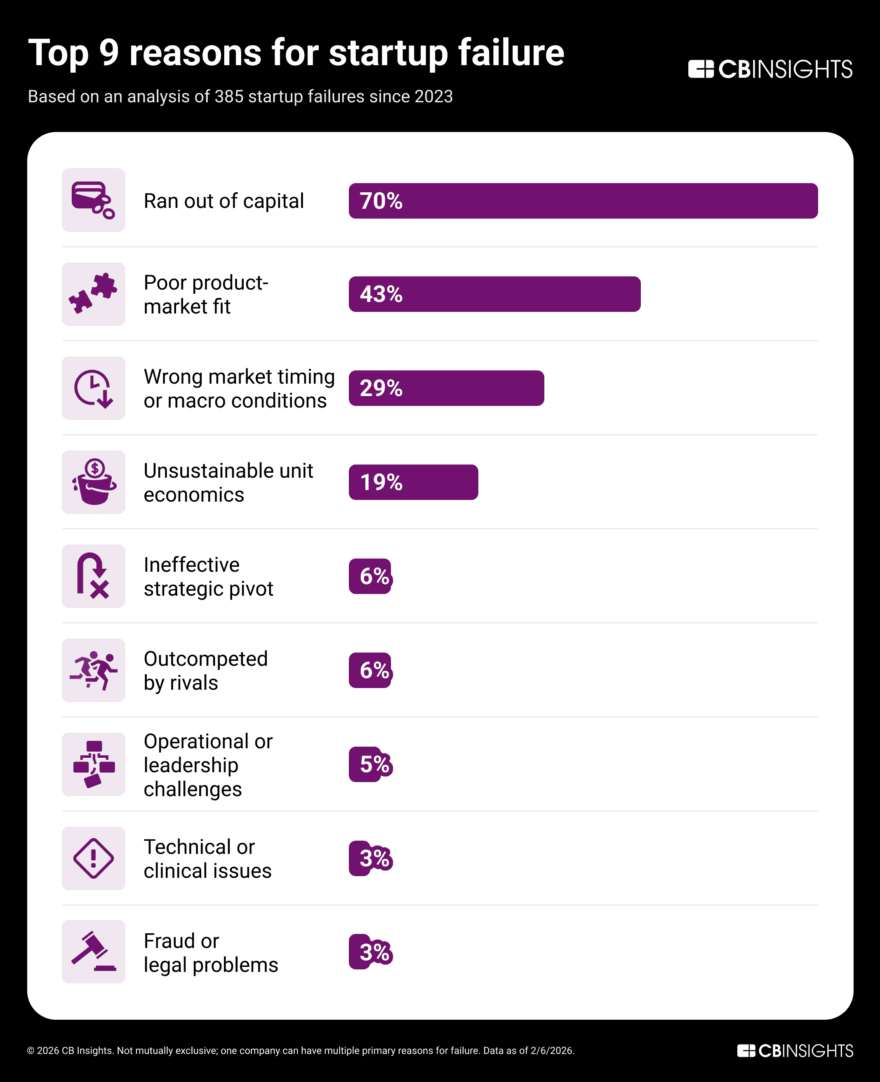
When CB Insights analyzed why startups die, poor product-market fit came out as the leading root cause, showing up in 43% of shutdowns. Translation: a lot of teams built something nobody wanted, and most of them could have found out sooner by talking to users first.
This guide covers the methods that matter and when to use each.
What Are User Research Methods?
User research methods are the specific approaches researchers use to gather evidence about user needs, behaviors, and attitudes. They consist of everything from a one-on-one user interview to a thousand-response survey. They exist so product decisions get made on evidence instead of whoever argued loudest during the meeting.
Every method sits on a few axes. Qualitative methods (interviews, field studies) tell you why; quantitative methods (surveys, analytics) tell you how many. Generative research helps you discover problems you didn’t know existed — the job users are really trying to get done, as Harvard Business Review frames it — while evaluative research checks whether your solution actually works. And attitudinal research captures what people say, while behavioral research captures what they do, which are frequently not the same thing.
One clarification, since the terms get muddled: user research and UX research are effectively the same discipline. Market research is the cousin who cares about market size and pricing rather than how someone fumbles through your onboarding. It’s related and occasionally overlaps, but they’re not interchangeable.
The Main User Research Methods (At a Glance)
The main UX research methods break down into a handful of workhorses you’ll reach for again and again. Here’s the shortlist, what each one answers, and when it earns its place:
| Metodo | Tipo | What It Answers | Best Stage to Use It |
|---|---|---|---|
| Interviste agli utenti | Qualitativo | Why users behave the way they do; needs, motivations, pain points | Discovery / generative |
| Test di usabilità | Qual + quant | Whether people can actually complete tasks in your product | Evaluative / pre- and post-launch |
| Sondaggi | Quantitativo | How many users think or do something, at scale | Any stage |
| Card sorting & tree testing | Qual + quant | How users expect information to be organized and labeled | Information architecture / design |
| Focus groups | Qualitativo | Group attitudes, reactions, and early concept feedback | Early exploration |
| Diary studies | Qualitativo | How behavior and needs change over days or weeks | Discovery / longitudinal |
| Contextual inquiry / field studies | Qualitativo | What users actually do in their real environment | Discovery / generative |
| A/B testing | Quantitativo | Which of two versions performs better on a metric | Post-launch optimization |
| First-click & five-second tests | Quantitativo | First impressions and whether users know where to click | Design / evaluative |
| Concept & prototype testing | Qualitativo | Whether an idea resonates before you build it | Validation / pre-build |
User Interviews and Focus Groups
User interviews are the backbone of qualitative research: one researcher, one participant, open-ended questions, and a lot of listening. They’re unbeatable for understanding motivation and context.
Focus groups run the same idea with a group. They’re useful for surfacing a range of reactions fast, though the loudest person in the room often hijacks the results. If you’re running either, recruiting the right participants matters more than how many you talk to.
Test di usabilità
Usability testing puts a real person in front of your product and asks them to complete tasks while you watch where they get stuck. It’s the fastest way to find out that the button you were sure was obvious is, in fact, invisible to actual humans.
It works moderated or unmoderated, and you need far fewer participants than people assume. Usually around five per round catches most of the serious issues. Moderated tests let you ask “why did you do that?” in the moment; unmoderated tests trade that depth for speed, letting dozens of users run through tasks on their own while you review the recordings.
Sondaggi
Surveys are your quantitative scale play: ask the same questions of a lot of people and count the answers. They’re great for measuring how widespread a behavior or opinion is, but terrible for understanding why. They pair best with interviews precisely because of that.
Write neutral questions otherwise your own self-bias will corrupt the survey. Mix closed questions (for clean numbers) with a couple of open text fields (for the surprises), and remember: a survey can tell you how many people are unhappy, but it very rarely tells you why.
Card Sorting and Tree Testing
Card sorting reveals how users expect your content to be grouped and labeled; tree testing checks whether they can actually find things in the structure you built.
Together they’re the antidote to navigation that made perfect sense to the team and nobody else. Open card sorts let users name their own groups; closed sorts test categories you’ve already defined.
Diary Studies and Contextual Inquiry
Diary studies track behavior over days or weeks, catching the patterns a single session misses. Contextual inquiry goes to the user’s real environment, like their desk, workflow, and very own chaos. This is because what people do at work rarely matches the tidy version they describe in a conference room.
Both are heavier lifts than a quick interview, but they catch the messy, real-world behavior that decides whether a product survives contact with actual life.
A/B, First-Click, and Five-Second Tests
These are the quick, quantitative gut-checks. A/B testing compares two live versions on a real metric; first-click tests reveal whether users know where to go; five-second tests measure the first impression before the rational brain kicks in. Small questions, fast answers.
Qualitative vs. Quantitative (and Generative vs. Evaluative)
Qualitative research tells you why; quantitative research tells you how many. Choosing between them starts with which of those questions you actually want answered. Qualitative methods (interviews, usability testing, field studies) give you depth, nuance, and the occasional quote that changes a roadmap. Quantitative methods (surveys, analytics, A/B tests) give you scale and statistical confidence, so you can say “40% of users” instead of “some users, I think.”
The second axis is timing. Generative (or discovery) research happens before you build. It’s how you find the right problem. Evaluative research happens after you have something to test. That’s how you check you solved it well. Get these backwards and you’ll run a beautiful usability test on a feature nobody needed.
The honest answer most of the time: use both. A survey tells you what’s happening across thousands of users, and a handful of interviews tells you why. One without the other is always going to be half a picture.
How to Choose the Right User Research Method
The fastest way to choose a user research method is to start with your question. Write down what you’re trying to learn, and the method usually picks itself:
- Discovering user needs or problems? Reach for interviews, field studies, or diary studies — generative methods that go wide and deep.
- Validating a design or prototype? Usability testing and concept testing tell you fast whether it works.
- Measuring how widespread something is? Surveys and analytics. Numbers need volume.
- Fixing information architecture? Card sorting and tree testing are the optimal methods.
- Optimizing a live product? A/B testing on the metric you care about.
Then reality intervenes: budget and time. The UK Government’s service manual, which runs research at scale, advises choosing methods that give strong evidence for the least time, effort, and cost, and starting with simple methods the whole team can join in on. That’s good advice whether you’re building a tax service or a to-do app. If you’re short on both time and money, guerrilla research (grabbing five people and a coffee) beats the rigorous study you never actually run.
Timing matters just as much as the method, so it’s worth knowing when to do user research in the first place.
Moderated vs. Unmoderated, Remote vs. In-Person
Two more choices that are important to make before every study. Moderated research (a researcher present) lets you follow up and dig; unmoderated research runs without you in the room, meaning you trade the ability to probe for scale but it’s a lower cost per participant.
Remote UX research reaches users wherever they are and has swiftly become the default; in-person research still wins when you need to read body language, physical context, or hardware. If in doubt, remote-and-unmoderated is the faster, more affordable option. Just expect shallower insight than sitting in the room.
Here’s how the four combinations stack up:
| Combination | Velocità | Costo | Depth | Scale | Ideale per |
|---|---|---|---|---|---|
| Moderated + In-Person | Slow | Alto | Alto | Basso | Contextual inquiry, hardware and physical products, high-stakes discovery |
| Moderated + Remote | Medio | Medio | Alto | Basso | In-depth interviews with distributed users — the everyday workhorse |
| Unmoderated + Remote | Fast | Basso | Basso | Alto | Quick usability checks, first-click and five-second tests, large samples |
| Unmoderated + In-Person | Medio | Medio | Medio | Medio | Niche lab or kiosk setups — rarely the best pick |
How AI Is Changing User Research
AI has changed the sloggy part of user research more than the thinking part. It now handles transcription, note-taking, and first-pass synthesis, which used to eat entire afternoons. You still get to judge and make the decisions. AI is just there to speed up your day.
The clearest win is in interviews. Instead of scribbling notes while half-listening (and missing the good stuff), you can record and transcribe the session automatically, then search the whole library later.
This is where tl;dv is worth considering for the interview-analysis layer: it records and transcribes user calls, generates AI summaries, and lets you clip and tag the exact moment a user said the thing that changes your roadmap. Everything lands in a searchable UX research repository, so insights don’t die in someone’s Notion board. As product research software, it’s built to turn raw calls into shareable evidence — and there’s a free AI note-taker tier if you just want to try it on your next session, no commitment required.
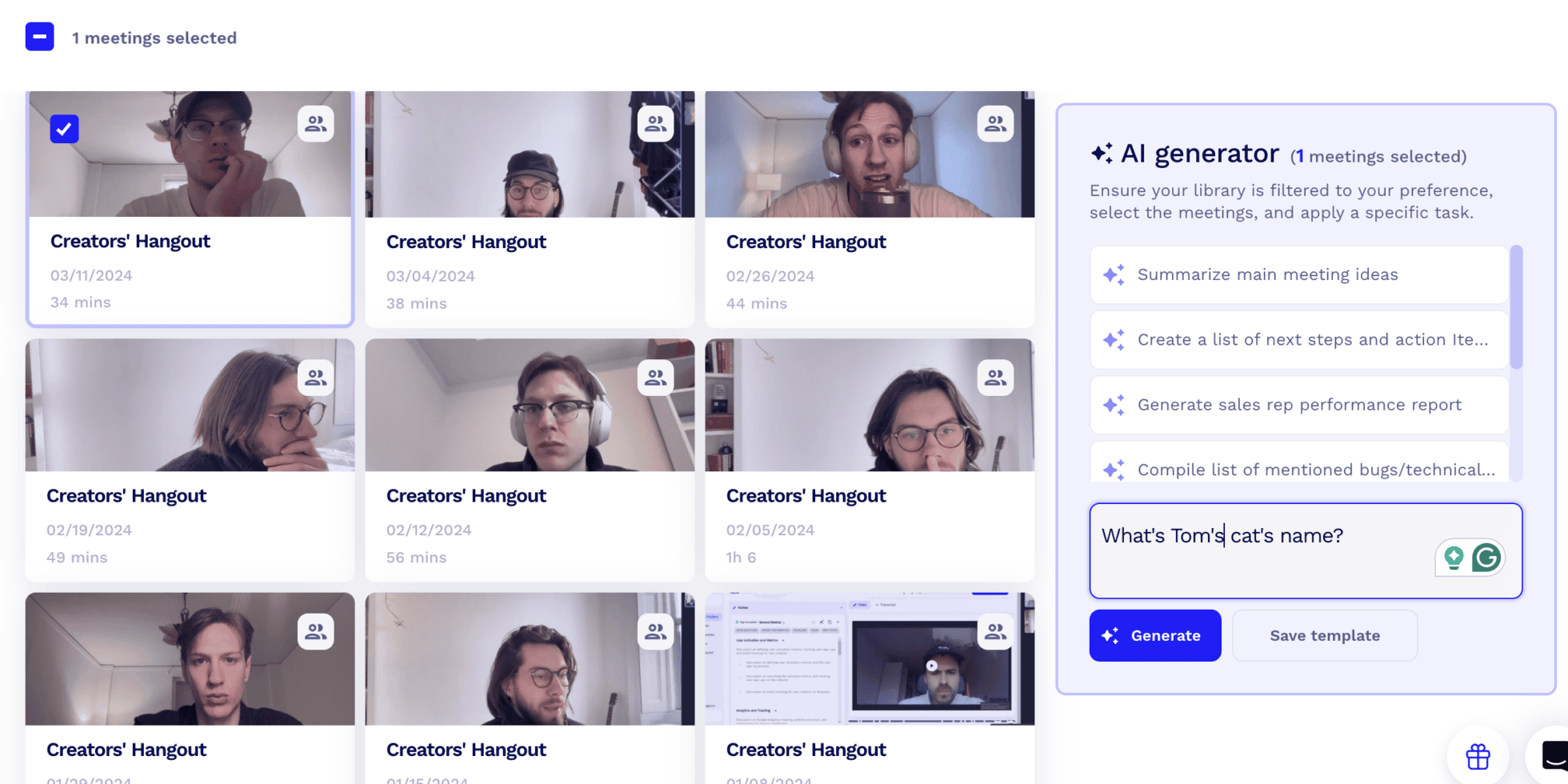
AI can also spot patterns across dozens of interviews faster than any human, surface recurring objections, and draft summaries you’d otherwise write by hand. Plenty of teams are already using ChatGPT to accelerate this. The rigor test is simple: never ship an AI-generated insight you can’t trace back to a specific timestamp in a real recording. If the quote isn’t real, the insight isn’t either.
Now the anti-hype part. Just because we’re an AI company, doesn’t mean we’re not sick of the slop. AI-assisted synthesis introduces its own bias, and a confident summary of a leading question is still garbage in, garbage out. Let AI do the transcription and the first pass. Keep a human on the part where you decide what it means.
Free User Research Templates
A user research template is a reusable starting point — a discussion guide, a research plan, a usability script — that saves you from rebuilding the same document every study. The point isn’t to be fixed and rigid; it’s not staring at a blank page at 9 a.m. before a session.
The templates worth having on hand map neatly to the methods above: a research plan to define goals and scope, an interview discussion guide with your open-ended questions, a usability test script with tasks and prompts, a screener to recruit the right participants, and a findings report to make the insights actually land with stakeholders. A user journey map is worth adding once you’re synthesizing across sessions.
Rather than send you off to build these from scratch, tl;dv has ready-made user interview templates and a set of UX research meeting templates for your research calls. Grab one, tweak it for your product, and get back to talking to your users.
Common User Research Mistakes
The most common user research mistake is asking leading questions. Any phrasing that subtly (or not) tells the participant what you want to hear, so they oblige, is a big mistake. “How much do you love this feature?” isn’t research; it’s fishing for a compliment. Ask neutral, open questions and let people surprise you.
The other repeat offenders:
- Confirmation bias in synthesis. You’ll unconsciously weight the quotes that agree with you. Get a second person to review the raw data, or you’ll just find what you went looking for.
- Treating tiny samples as gospel. Five users is plenty to catch usability problems; it is not enough to claim “80% of customers prefer X.” Match the sample to the claim.
- Only recruiting people who already love you. Interviewing loyal customers feels great and teaches you almost nothing about why others bounce.
- Mistaking what people say for what they’ll do. Attitudinal and behavioral data diverge constantly. When it matters, watch behavior.
The gov.uk service team frames the fix well: involving more people in research reduces the risk of bias and unchallenged assumptions. Research is only as good as your willingness to be wrong.
Get Running Those Tests!
There’s no single best user research method. There’s only ever the right method for the question you need answered. Use generative methods to find the right problem, evaluative methods to check your solution, qualitative work to understand why, and quantitative work to know how many. Then mix them, because the strongest insight almost always comes from triangulating more than one source.
Get the recording and synthesis handled automatically, keep a skeptical human on the interpretation, and you’ll spend less time arguing about what users want and more time actually knowing.
FAQs About UX Research Methods
What are the main user research methods?
The most common user research methods are user interviews, usability testing, surveys, card sorting and tree testing, focus groups, diary studies, contextual inquiry, and A/B testing.
Each answers a different question — interviews explain why users behave a certain way, while surveys and A/B tests measure how many do.
What is the difference between qualitative and quantitative user research?
Qualitative research (interviews, field studies) explores why users think and act as they do, favoring depth over numbers. Quantitative research (surveys, analytics, A/B testing) measures how many users do something, using scale and statistics.
Most strong research programs combine the two.
How many participants do you need for user research?
It depends on the method. For qualitative usability testing, around five participants per round typically uncovers most major issues. For quantitative methods like surveys or A/B tests, you need a much larger sample — often in the hundreds — to reach statistical confidence.
What is the best user research method for a new product?
For a brand-new product, generative methods win: user interviews, field studies, and diary studies help you discover real user needs before you build. Concept and prototype testing then validate the idea early, while it’s still cheap to change course.
What is the difference between generative and evaluative research?
Generative (or discovery) research happens before you build, to find the right problem. Think: user interviews and field studies.
Evaluative research happens after you have something to test, to check you solved it well. Think: usability testing and A/B testing.
Is user research the same as UX research?
Effectively, yes. The terms are used interchangeably for the discipline of understanding user needs, behaviors, and attitudes. Both differ from market research, which focuses on market size, segmentation, and pricing rather than product usability.