Passer au contenu




tl;dr: Is Wispr Flow Notetaker Worth It in 2026?
Wispr Flow Notetaker is worth trying if you already use Wispr Flow for dictation and have 16 GB of memory, but it isn’t ready to be a team’s meeting notetaker.
- Wispr Flow Notetaker is a bot-free meeting notetaker built into the Wispr Flow app, available on Mac since August 5, 2026 and Windows since September 15, 2026. There’s no mobile app for meetings yet.
- Wispr trains on your meeting data by default on the Free and Pro plans. You can switch it off in settings. Only Enterprise has it locked off.
- Wispr Flow Notetaker doesn’t keep meeting audio, so there’s no recording to check when the transcript is wrong.
- The free plan includes Notetaker with a weekly meeting limit that Wispr doesn’t publish. Pro costs $15 a month, or $12 billed annually.
- In my testing, transcription was strong on hard vocabulary but weak on speaker labels. Three people came back as three labels, just not the right three.
- Wispr’s MCP connector works with Claude, ChatGPT and Gemini, but it was read-only on free and Pro, and its search doesn’t cover transcripts.
- Wispr Flow used nearly 1 GB of memory while recording, about three and a half times tl;dv’s desktop app at rest, and calls lagged on an 8 GB Mac.
- Best for: Wispr Flow dictation users on 16 GB machines who want meeting notes in the same app
- Not great for: teams, EU-based users, 8 GB laptops, or anyone who needs the audio recording
Tested 22 to 25 September 2026 on Flow v1.6.937, 2023 iMac (M3, 8 GB), free and Pro accounts.
I’ve been testing the Wispr Flow Notetaker, and the first thing I want to point out is that Wispr Flow can now record meetings as well as do dictation. You do this in their desktop app, without a bot. It just listens from your computer and has a notepad box that pops up on your screen.
It wasn’t my first time dealing with Wispr Flow. I have a client who actually uses it day-to-day, mostly for dictation, writing emails, and tidying up documents. He’s one of the people it’s good for: people who have more words to get out than their fingers can type.
I had joined some calls with the Wispr Flow Notetaker before, and I ran into issues that made me wonder how effective it really was. So I downloaded it expecting to be unimpressed, but was actually quite impressed with the onboarding.
When the dashboard came up, I thought, “Oh, this looks like everything else.” If you’ve used anything like Granola or Jamie or any of those desktop apps, it looks very similar.
For context, Wispr has moved fast. They launched the Notetaker on Mac in August, and Windows followed in September. They claim to cover 21 languages, and they have an MCP that works with Claude, ChatGPT, and Gemini. They’ve shipped a lot in a seven-week period, and there’s a lot of marketing to go with it.
But a slick setup and a layout that seems quite useful don’t necessarily make it a good meeting notetaker. There are other things to take into consideration, like:
- Accuracy
- Étiquettes pour haut-parleurs
- How it deals with privacy
- What it does to your computer
That’s what I tested Wispr Flow Notetaker on.
Just for full disclosure, I write for tl;dv, which is now one of Wispr’s competitors since they launched the Notetaker. I used a free Mac account, and later upgraded to Pro to test the MCP. Where a claim comes from Wispr’s own documentation and not my testing, I highlight that.
How Did I Test Wispr Flow Notetaker?
To test Wispr Flow Notetaker, I used a free account on my Mac between 22 and 25 September 2026, and later upgraded to Pro to test the MCP.
The plan was originally to test it on real calls. As I mentioned in the intro, my client has used Notetaker on our calls in the past, and it didn’t go particularly well. His Google Meet screen share stopped working, and the call kept lagging. We tried to troubleshoot by closing windows, restarting our computers and rejoining the meeting. When he closed Wispr Flow on his side, everything went back to normal. So I was a little apprehensive, to say the least.
During testing, I tried Notetaker myself on an external call, and the same thing happened to me. The call lagged, everything went disjointed, and there were loads of issues. I spent a good amount of time testing my internet speed, which came back as very fast, and came to the conclusion that, for whatever reason, there wasn’t enough memory. For context, my computer is a 2023 iMac with 8 GB of memory.
Because I couldn’t rule out Notetaker as the cause, I didn’t use it on live calls for the rest of the review. Instead, I played recorded audio and talked over it, which a desktop app allows you to do. This included a three-person YouTube video I could check against YouTube’s own captions. I also connected Notetaker to Claude to see what its MCP could actually reach, and measured memory use in Activity Monitor.
I don’t have a Windows machine, so anything about Windows comes from Wispr’s documentation.
Wispr Notetaker vs tl;dv: How They Compare in 2026
| Fonctionnalité | tl;dv | Wispr Flow Notetaker |
|---|---|---|
| Capture | Bot or bot-free desktop app Winner | Bot-free desktop app only |
| Plateformes | Mac and Windows, plus iOS and Android Winner | Mac and Windows. No mobile app for meetings |
| Audio and video playback | Kept and searchable Winner | No audio kept |
| Langues | 30+ Winner | 21 |
| Dictation | Non | Included in the same app Winner |
| MCP | Pro and above | Free plan and up, read-only Winner |
| Plan gratuit | Enregistrements illimités | Weekly meeting cap, number not published |
| Collecte des consentements | Built-in Winner | On-screen reminder. Enterprise admins can require confirmation |
| Training on your data | Never Winner | On by default on Free and Pro |
| Data location | EU Winner | États-Unis |
| Memory at rest (8 GB Mac) | 211 MB Winner | 748 MB |
What Is Wispr Flow Notetaker?
Wispr Flow Notetaker is the bot-free meeting notetaker that’s been added to Wispr Flow’s app, which means the dictation tool can now record meetings without any bot joining your call. It works by capturing your microphone and your computer’s audio, transcribing the conversation live, and then giving you a cleaned-up transcript and a summary afterward, in its own notepad window or within the app itself.
It’s the same app and the same subscription as the original Wispr Flow dictation tool. If you already have Wispr Flow installed for writing emails or documents, Notetaker is just another tab in the sidebar.
A lot of what’s already out there is out of date. As of September 25, 2026, this is where it stands.
It’s not Mac-only anymore. It originally launched on Mac on August 5, and Windows was added on September 15. One caveat: Wispr asks Windows users to have at least 16 GB of RAM and 2 GB of free storage. I’ll get onto that a bit later.
It’s not English-only anymore either. Wispr says it can handle 21 different languages. More on that below.
It has its own MCP, so Claude, ChatGPT and Gemini can access your meeting information. And you can bring your old notes with you. If you use another tool, you can import everything from the likes of Granola and Otter.
There’s no mobile app for meetings yet. Wispr Flow’s dictation works on iPhone and Android, but Notetaker doesn’t. Wispr says it’s on the roadmap.
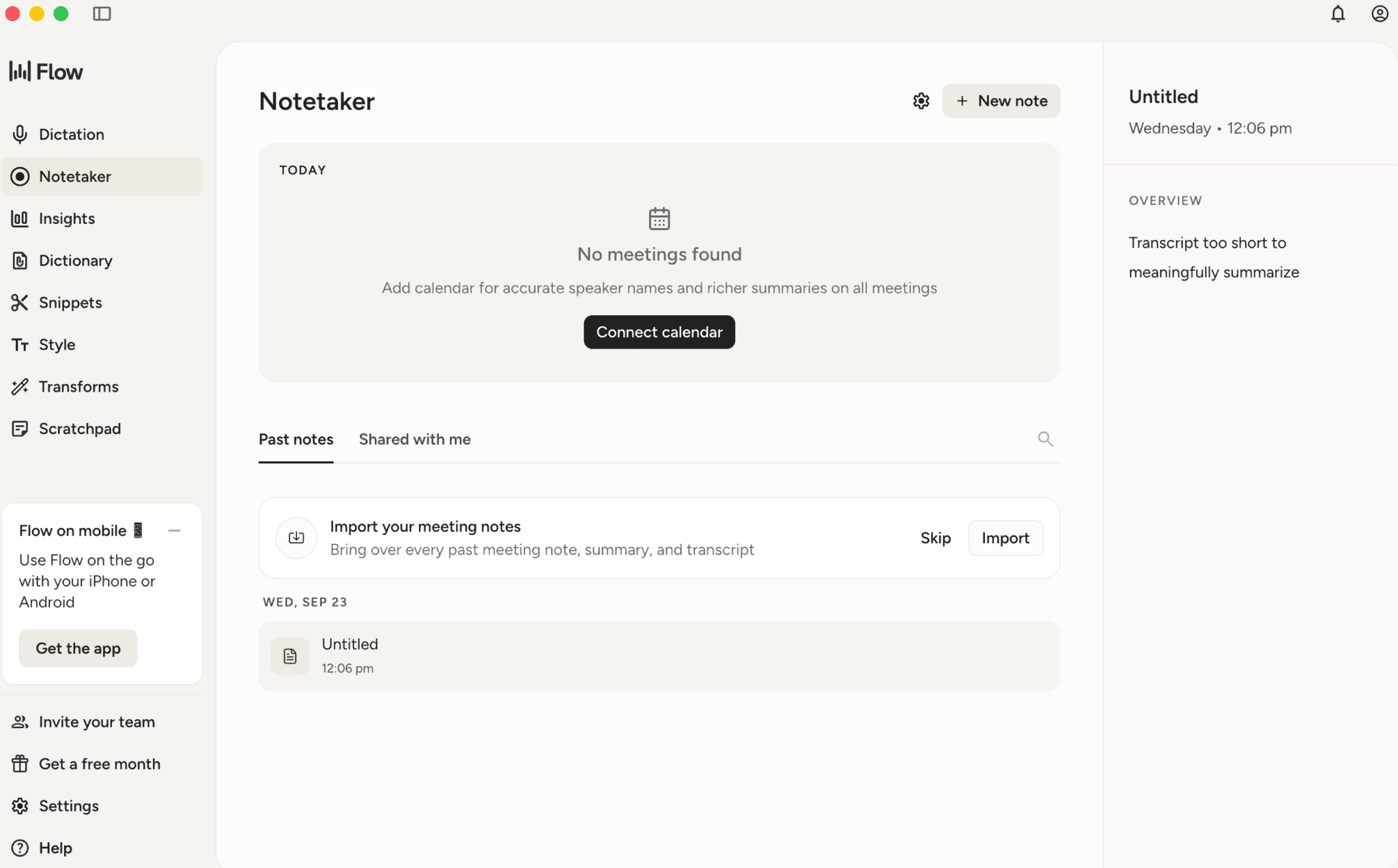
As for the look, if you’ve used Granola or any of the other desktop apps, it’s very similar. You have your left-hand sidebar with all the different tools, and the open meeting next to it, so you’ll recognize it straight away.
My Honest Wispr Flow Notetaker Review
I tested Wispr Flow Notetaker on setup, meeting notes, transcription, speaker labels, languages, memory use, the MCP and privacy. Here’s what I found.
How Easy Is Wispr Notetaker to Set Up?
As much as it pains me to say it, setting up Wispr Flow Notetaker was really easy. It took about 10 minutes, and it’s super interactive without dragging on for too long. You tell it which meeting tools you already use, choose your data settings, grant three permissions (spotting meetings, your microphone, and your meeting audio), and then do a quick dictation test.
There were also some videos from the founder, which, to be honest, were both personable and super polished. There’s a really fine line with these. It seemed really human, but at the same time it felt a little bit startupy. That’s just a personal take. You want that mix of human and corporate. Anyway, I liked it.
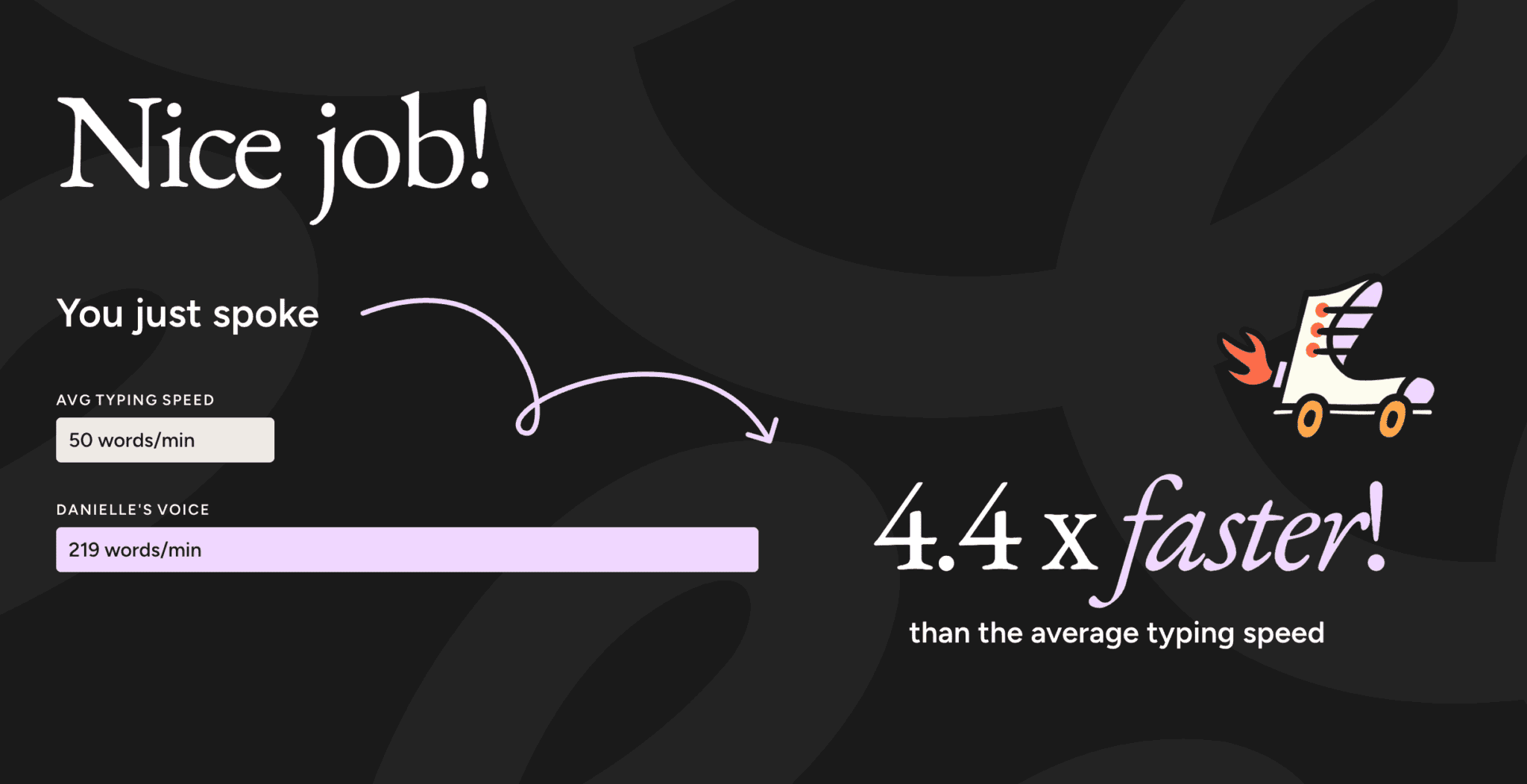
It also tested my voice and came back with some figures on how much time it would save me. Apparently, I speak at about 219 words a minute, which Wispr says is 4.4 times faster than typing. I type a lot faster than the average it’s comparing me to.
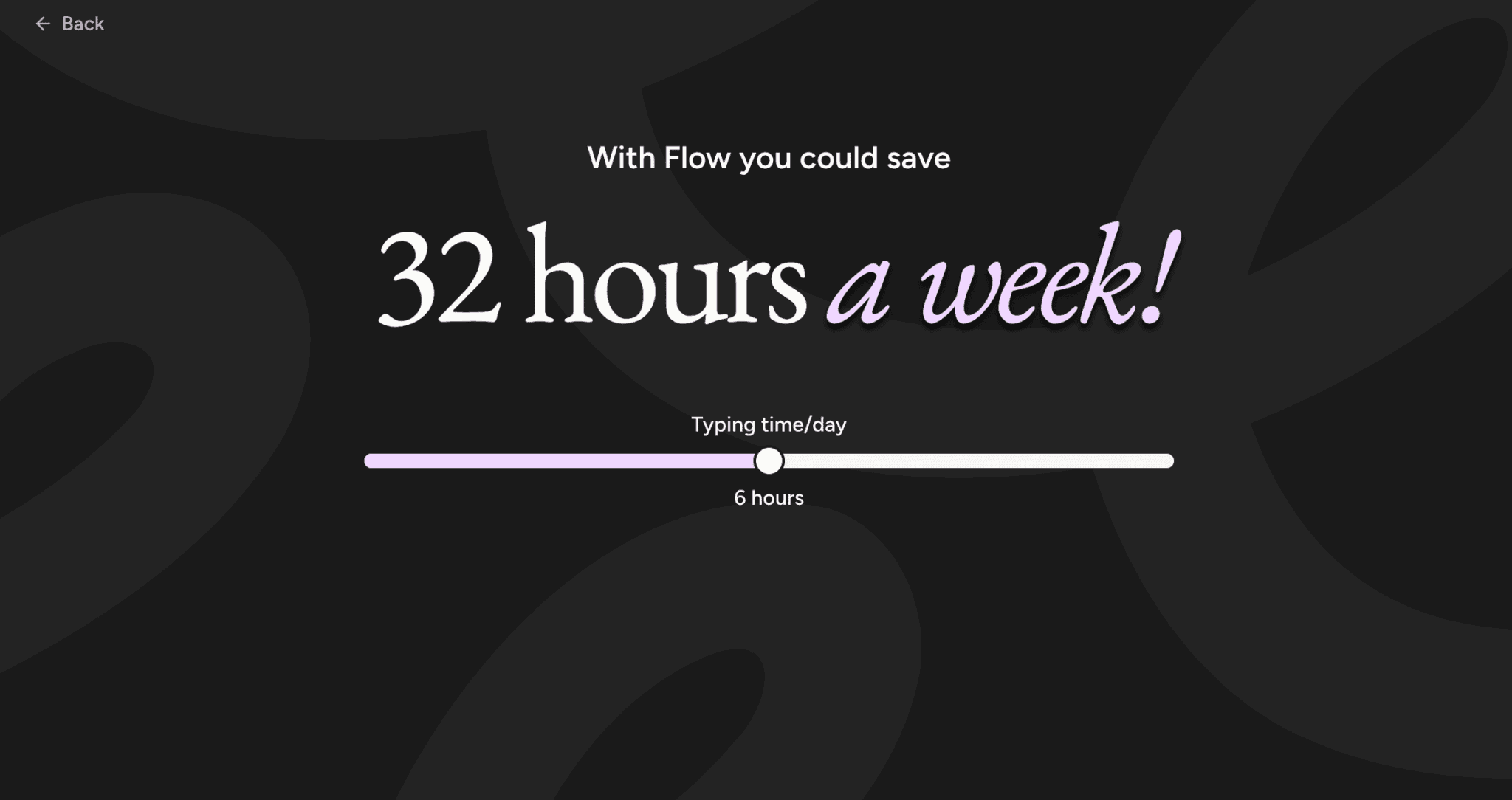
The next screen told me it could save me up to 32 hours a week, at six hours of typing a day. That only works if you’re typing seven days a week. After dictating 3,285 words of this review, my dashboard put me at 177 words a minute, so either way, take it with a pinch of salt. It felt a bit like a politician telling you how much money they’re going to save you, when it’s based on numbers plucked out of the ether.
Then there’s the data screen, and I did appreciate the transparency. “Improve the model for everyone” is highlighted by default, which lets Wispr train on your audio, transcripts and edits, but I was able to switch it off straight away, which is good.
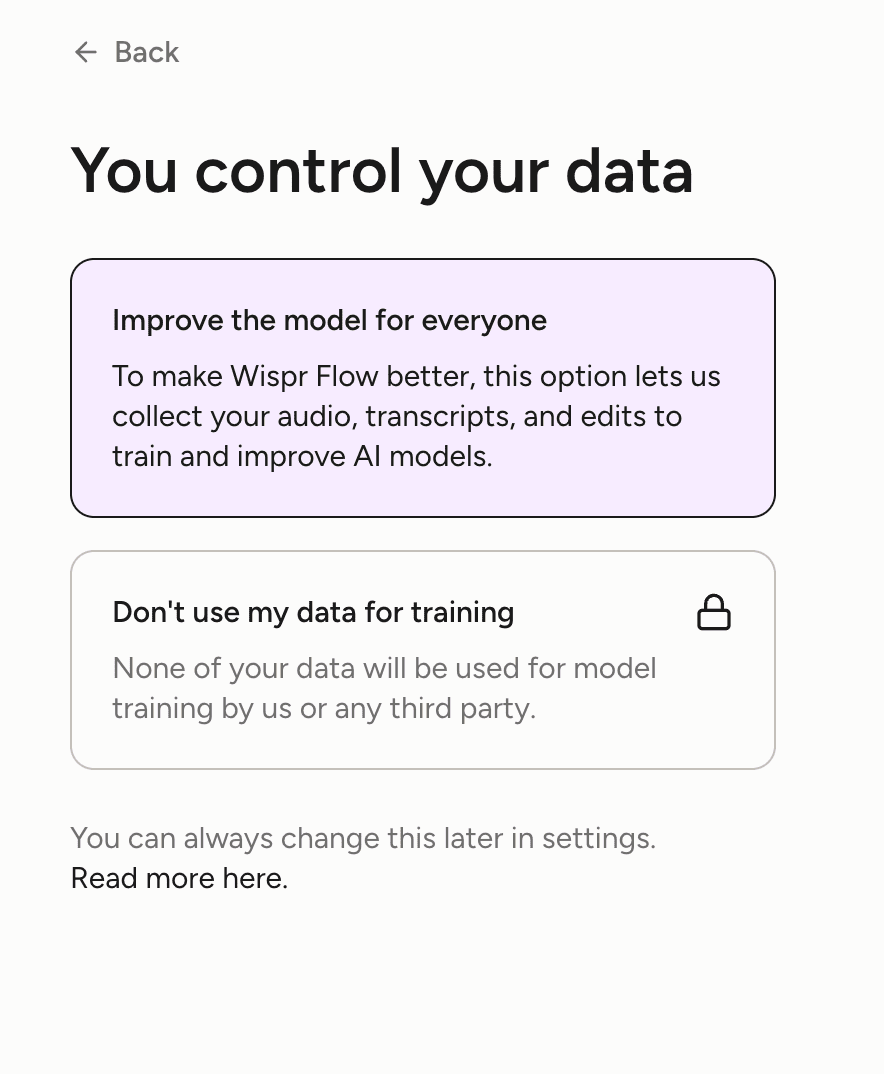
Before you’ve even recorded a single meeting, it asks you to refer a friend. I like making recommendations, but only ones I believe in. I get the funnel, but it felt a bit presumptuous.
What Are Wispr Flow’s Meeting Notes Like?
Wispr Flow’s meeting notes live in a Notepad window with three tabs:
- My thoughts, for your own notes
- Transcription
- Résumé
The interface is clean, it’s easy to follow, and it’s also quite big. Granted, you can adjust the size of it, but it initially took up quite a large part of my screen. The live transcript scrolls and the Flow Bar stays on screen at all times, and both are on by default. I found it a little bit more distracting than useful. You can switch the live transcript off in settings, which I’d recommend.
After the call, Wispr processes the meeting in three steps.

Then it pops up on your desktop to tell you your summary is ready, and it titles the meeting for you too. Mine was “Testing Award-Winning Beauty Products”, which was pretty much spot on.
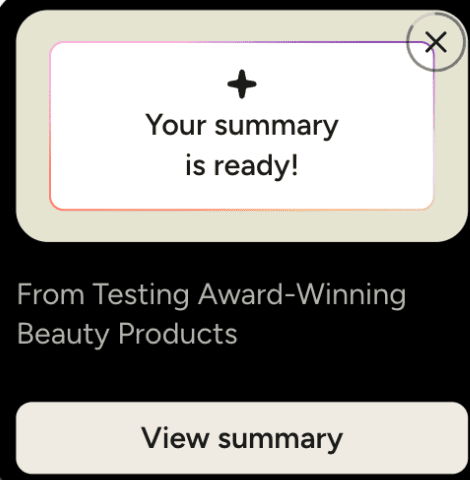
I ran a five-minute clip, and the summary was pretty solid. It was organized by topic, and the product names were right. It even pulled out next steps, which matched what the host on the video agreed to on camera. Early users online say it misses more on longer calls, which I’ll come back to.
I pressed “What did I miss?” mid-recording and got three accurate bullets on what had just been said.

Detection, I’d say, is probably its weak spot. On a live call I was on, the Notetaker prompt didn’t pop up until about 10 minutes in. You can pause and resume a recording, and it stops itself after two hours by default.
How Accurate Is Wispr Flow’s Meeting Transcription?
I would say Wispr Flow transcription is pretty strong on hard words but tends to fall apart on who said what. To test it, I compared Wispr’s transcript of a three-minute stretch of a YouTube video with YouTube’s own automatic captions, the same kind of baseline we used in our German transcription testing. When the two disagreed on something important, I personally listened back to check which one was right.
The disagreement was about 7% on words, so there were 49 differences across 672 that were logged. Both were automatic, so that’s a disagreement rate rather than a word error rate, just for clarity. Most of the differences were fairly trivial, like “Lite” versus “Light”. These are the ones that mattered.
| What was said | Wispr Flow Notetaker | Sous-titres YouTube | Got it right |
|---|---|---|---|
| Shiseido eyelash curler | Shiseido | Chaseedo | Wispr |
| Squalene, açaí extract | squalene, açaí | squaline, asai | Wispr |
| “Nothing not to like” | nothing not to like | nothing to like | Wispr |
| “According to Vogue” | according to both | according to Vogue | YouTube |
| “Matching sweatshirt with my daughter” | A second speaker replying “you’ve got daughters” | matching sweatshirt with my daughter | YouTube |
Of the two, Wispr was definitely better on the vocabulary that would normally trip up a tool like this. It also got right a line that YouTube’s captions got completely wrong. YouTube dropped a single word and turned a rave review into a negative one.
But Wispr Flow’s mistakes were mostly about people. It turned a quote from Vogue into a quote from “both”, so the quote lost its source. And it heard “I just got this matching sweatshirt with my daughter” as a second person replying “You’ve got daughters”, inventing a line for someone who never said it.
One more thing: I was particular and set my account to British English, but Notetaker still wrote everything in US spelling. Just something to be aware of if spelling matters to you.
How Good Is Wispr’s Speaker Identification?
Speaker identification was certainly the weakest part of Wispr Flow, I found. During the actual recording, the live transcript splits everything into “You” and “Them”, and it got that right. That’s the easy bit, though. Your microphone and your computer’s audio come in separately, so telling them apart doesn’t really take that much.
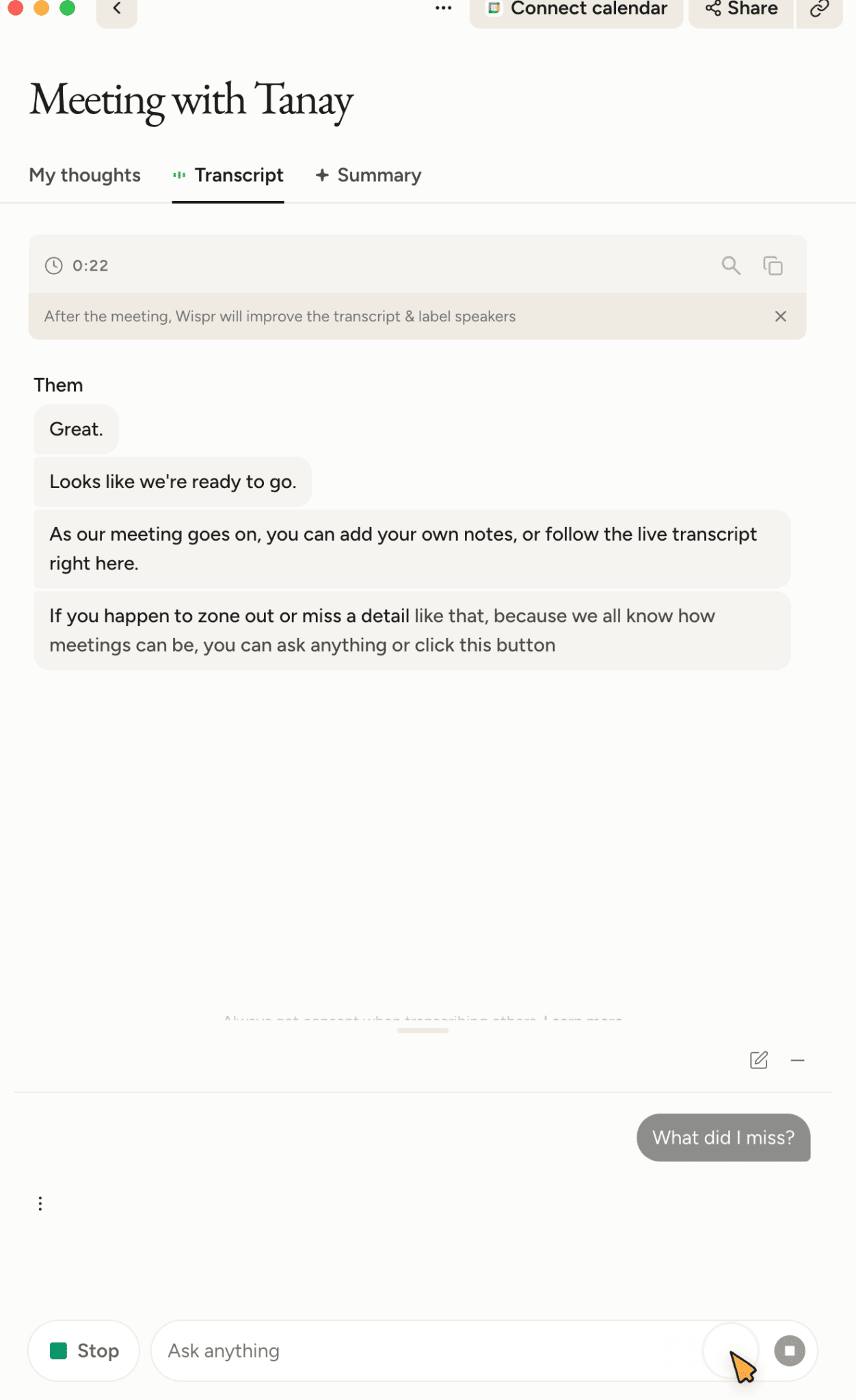
At the beginning of the recording, I tried talking over the video to create an almost argument-style setting, like one of those meetings where people talk over each other. (I’m really bad for talking over people. All my colleagues will admit that.) It did manage to tell me apart from the video, but when another person came into the fold, it got a bit confused.
The real test was what happened after the meeting finished, when Wispr improves the transcript and starts labeling speakers. My clip had three people plus a voiceover: me, the main YouTuber, her friend, and the voiceover. Wispr came back with three labels, but they weren’t the right three. It split the main YouTuber into two separate speakers when she switched over to a voiceover. Her friend never got her own label. It then filed the friend’s lines under my label, and basically none of it made any sense. By the end, I’d effectively vanished from my own meeting.
Names do typically come from a connected calendar, and I hadn’t connected one. It was done kind of impromptu, so “Speaker 1, 2 and 3” was always going to be the best case. But a calendar invite wouldn’t have stopped the voices from being merged and split.
This isn’t just my experience, though it’s not unanimous either. One Reddit user called the speaker tagging “really useful”. But Wispr says its final transcript labels speakers by name, and on my clip, it didn’t come close. Mixed-up speakers are a common problem in this space, but if Wispr Flow tells you it’s really good at speaker identification, I’d be wary of that.
What Languages Does Wispr Notetaker Support?
Wispr Notetaker transcribes 21 languages, according to Wispr’s own marketing material. These are:
- Anglais
- Espagnol
- Français
- Portugais
- Allemand
- Néerlandais
- Italien
- Polonais
- Russian
- Danish
- Swedish
- Czech
- Chinese (Wispr doesn’t say whether that means Mandarin, Cantonese or both)
- Japonais
- Coréen
- Hindi
- Bengali
- Marathi
- Urdu
- Arabic
- Turkish
That Chinese entry is worth a second look. Mandarin and Cantonese are spoken very differently, so if your meetings are in Cantonese, don’t assume “Chinese” covers you. Test it first.
You can attempt other languages, but Wispr says to expect mixed results, which I think is pretty fair. A lot of tools out there claim to support over 100 languages, and when we’ve run our transcription accuracy tests, plenty of them have come out pretty badly. Just because an underlying engine can do a language doesn’t necessarily mean it’s good at it.
If a meeting switches languages, Wispr Flow follows whichever one dominated. Summaries come back in the language that was spoken, but section headings and speaker labels stay in English.
Personally, I only tested English, and even there, there’s a catch. As I mentioned before, my account is set to British English. (I am British.) But that’s a dictation setting in Flow. Notetaker has no language setting of its own, so all my transcripts came out in US spelling.
Your personal dictionary carries over from Flow, and “auto-add to dictionary” is on by default. I didn’t test how much this helps, though.
Does Wispr Flow Notetaker Slow Down Your Computer?
On an 8 GB Mac, Wispr Flow Notetaker can slow your computer down, and it did mine.
First of all, this is a section I’ve never had to include in any review I’ve ever done. Coming into this review, it was the one thing that I was like, “I need to test this,” because my experience with Wispr Flow prior to doing this review was so negative. It really did break the meetings.
Everything aside, if a tool doesn’t work in your meetings, it’s simply not fit for purpose, and it wasn’t made super clear whether you need a certain amount of memory or free space. Now, granted, maybe I should have the fastest computer going, but I’m not made of money, so I can’t be going out and buying a brand-new computer every time a SaaS tool decides it needs 16 GB of memory.
| App | Processes | Memory at rest | Memory while recording |
|---|---|---|---|
| Wispr Flow (v1.6.937) | 11 | 748 MB | 989 MB |
| Granola | 10 | 490 MB | Not measured |
| tl;dv | 6 | 211 MB | Not measured |
| Fathom | 5 | 202 MB | Not measured |
| Wispr Flow and tl;dv measured two minutes after a fresh launch, not recording. Granola and Fathom measured while open and not recording. Wispr’s figure includes its dictation features. | |||
In the interest of “science”, I decided to do a little bit of testing of how much drag it takes on the computer, comparing it to tl;dv, Granola and Fathom as well. I ran it on an 8 GB Mac. Wispr Flow was by far the heaviest meeting tool I measured, and it’s actually why I stopped testing it on real-life calls.
To do this, I measured memory in Activity Monitor on my Mac, adding up every process each app runs. At rest, Wispr was using about three and a half times more memory than the tl;dv app, and when it was recording, it pushed up to nearly 1 GB. To be fair, that figure covers dictation as well as Notetaker, because it’s all in one app, but on an 8 GB machine, that’s an eighth of my memory gone before I’ve even opened Google Meet.

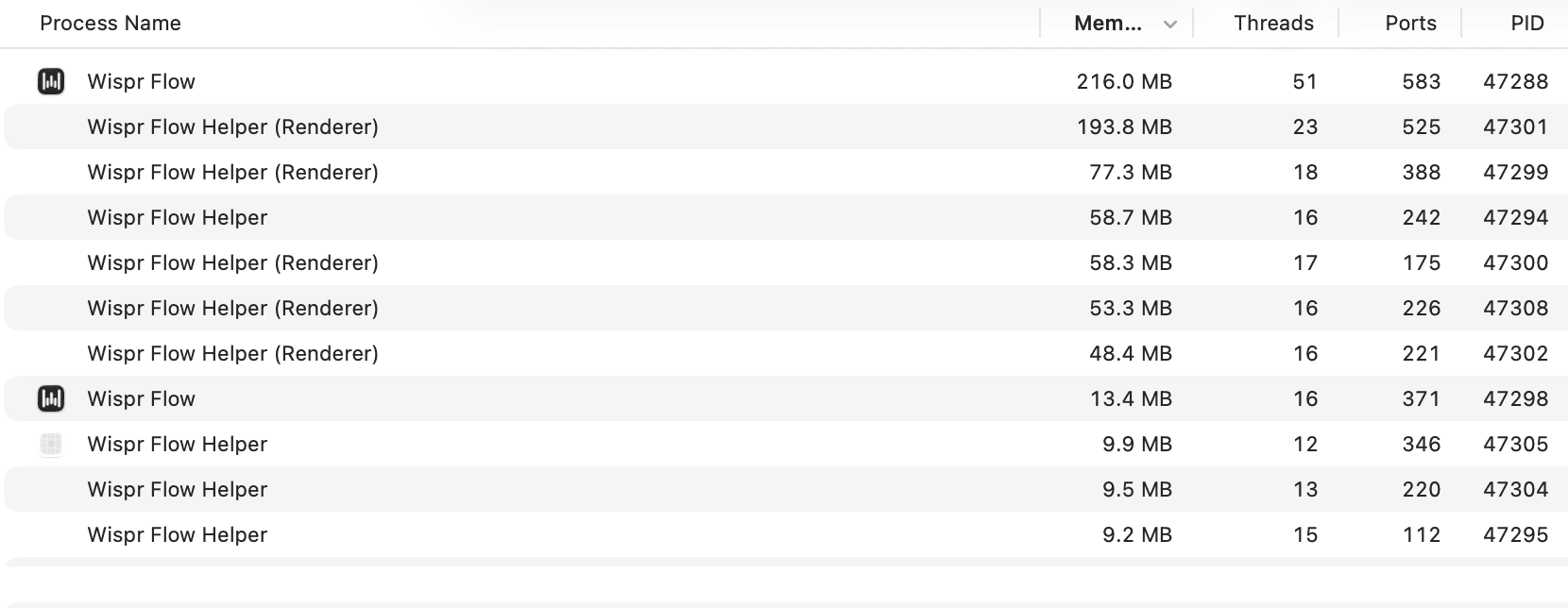
My Mac was already under memory pressure because I will always have too many tabs open, but adding a video call on top is what tipped my calls into lag. In Wispr’s defense, 8 GB was Apple’s base spec until it moved every Mac to 16 GB in late 2024, so plenty of work laptops will still have it. Wispr tells Windows users to budget 16 GB for Notetaker, but gives Mac users no figure at all.
If you’re on 16 GB or more, you probably won’t even notice this. But if you’re on a slightly older model, make sure to close everything first, and test it on a call that doesn’t actually matter.
Can You Connect Wispr Notetaker to Claude or ChatGPT Using the Wispr Flow MCP?
Yes. Wispr has its own MCP, which lets you connect Claude, ChatGPT and Gemini to your meetings. It’s also available on the free plan. I only tested it with Claude. Connecting it was literally one click, and all the basics worked pretty well.
I asked several questions about things that came up in my meeting, and Claude found the right answers, in the right meeting, at the right time. I asked it to quote what was said about a specific item, and the quote matched the transcript word for word. Happy days.
When I asked about one of the products in the meeting, Claude’s answer also included a link to my meeting notes. I hadn’t asked for one. Wispr’s links default to “anyone with the link”, so be careful where you paste those answers.
Then I tried to make it a bit harder. I asked about a name that was in the transcript but not the summary, and Claude found nothing. Wispr’s own tool description explains why: its search matches titles, summaries and notes, but not the transcript. Once I told Claude which meeting it was in, it found the name straight away. So anything that doesn’t make the summary is only findable if you already know which meeting it was in. This isn’t uncommon, but it’s something to be aware of.
I also asked Claude which speaker was me. Wispr’s participant data listed me as the only attendee and said I hadn’t spoken. I had.
It’s also read-only, and I found a bit of a disconnect there. The Claude directory says Wispr can create, update and search action items. On my free account, the connector only loaded 14 tools, none of them for tasks, so Claude couldn’t create anything. I upgraded my Wispr Flow account to see if that made any difference, and it didn’t. On Pro, it was the same 14 tools, all read-only.

| Group | Outils | In the directory listing | Loaded on free and Pro |
|---|---|---|---|
| Réunions | search_meetings, get_meeting, get_meeting_by_calendar_id, list_meeting_series | Oui | Oui |
| Calendrier | search_calendar_events, get_calendar_event, list_upcoming_meetings, get_upcoming_meeting, resolve_calendar_link | Oui | Oui |
| Notes and account | search_scratchpad_notes, get_scratchpad_note, get_account_info | Oui | Oui |
| Tasks | add_task, get_task, search_tasks, update_task | Oui | Non |
| Not in the listing | get_meeting_participants_enriched, resolve_share_link | Non | Oui |
| 16 tools in the Claude directory listing. 14 loaded, all read-only. Tested with Claude, Flow v1.6.937. | |||
The connector has been around longer than Notetaker, too. The Claude directory shows it was added in June 2026, two months before Notetaker launched publicly on August 5.
If you’re planning to build anything on top of it, long meetings come back in chunks. Wispr’s tool description says transcripts are returned in ranges of up to 12,000 characters by default, and 40,000 at most per request, so Claude has to go back several times for a long call.
Granola’s free plan cuts its MCP off at 30 days of history, which we found in our Granola review. My Wispr account was too new to test whether there’s a similar limit.
One practical tip: Claude also searched Fathom and Granola, because I had them connected too. If you use more than one meeting tool, tell Claude which one to look in.
Is Wispr Notetaker Private?
Wispr Notetaker is private from the other people in your meeting, but not when it comes to Wispr’s servers. Transcription happens in the cloud, and all Wispr Flow customer data is processed in the United States. There’s no local mode, as far as I can see. That’s something to bear in mind if you’re based in the EU, or places like Japan.
Wispr doesn’t keep any meeting audio that I can access. It appears to be held briefly for processing, then deleted, which I guess is better for privacy, but it does mean you can’t play anything back if the transcript’s wrong. There’s no way to double-check it.
Sharing is fairly straightforward out of the box. Nothing is shared automatically, and full transcripts only go to the people you invite by email. The one catch: if you copy a meeting link, anyone who has it can open the summary. This can be changed in the settings, though.
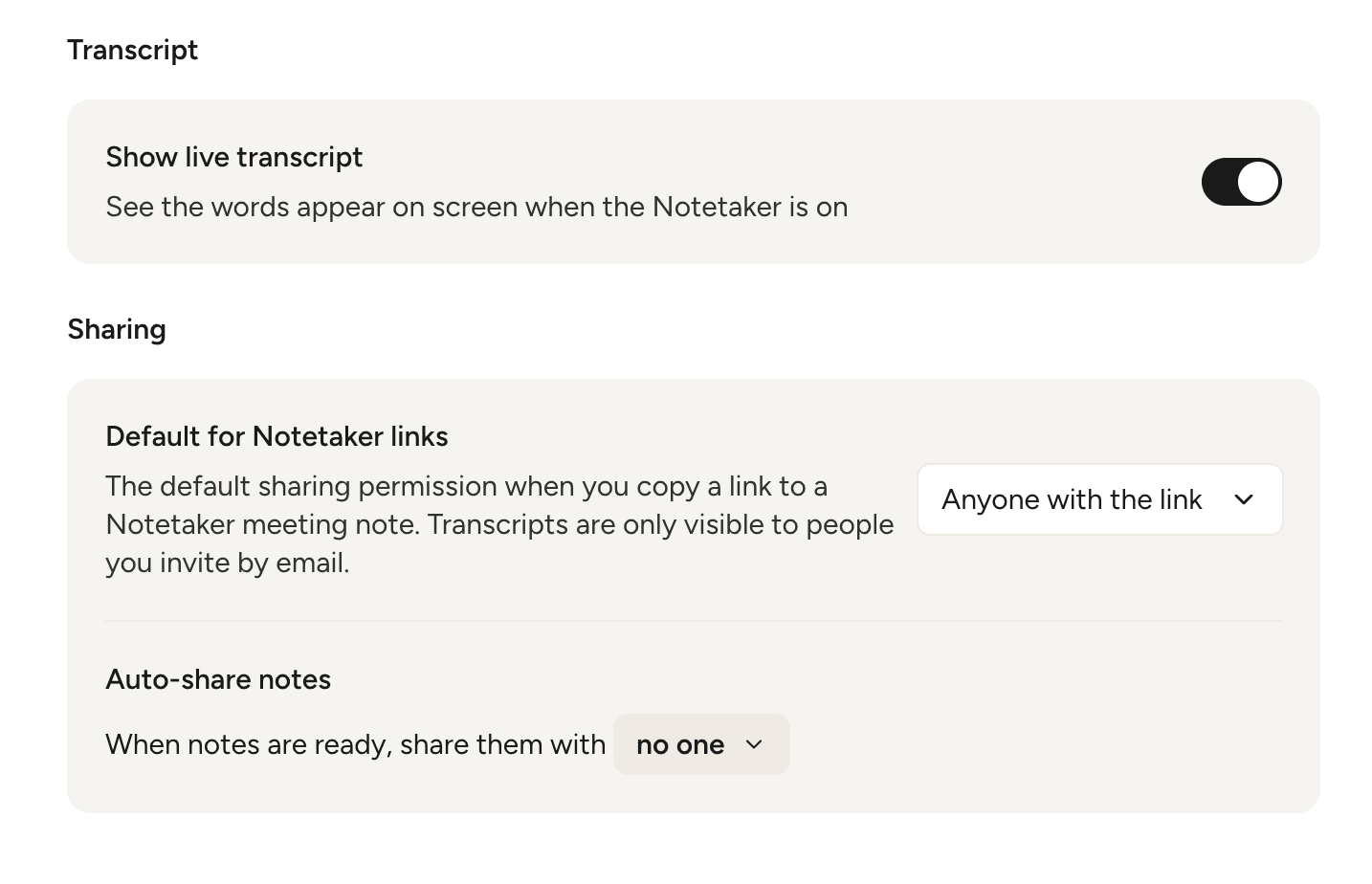
Also, there’s nothing that tells other people on the call they’re being recorded. Wispr shows you a consent reminder on screen, and there’s even an option to hide Notetaker from your own screen share. It’s off by default, but it is there.
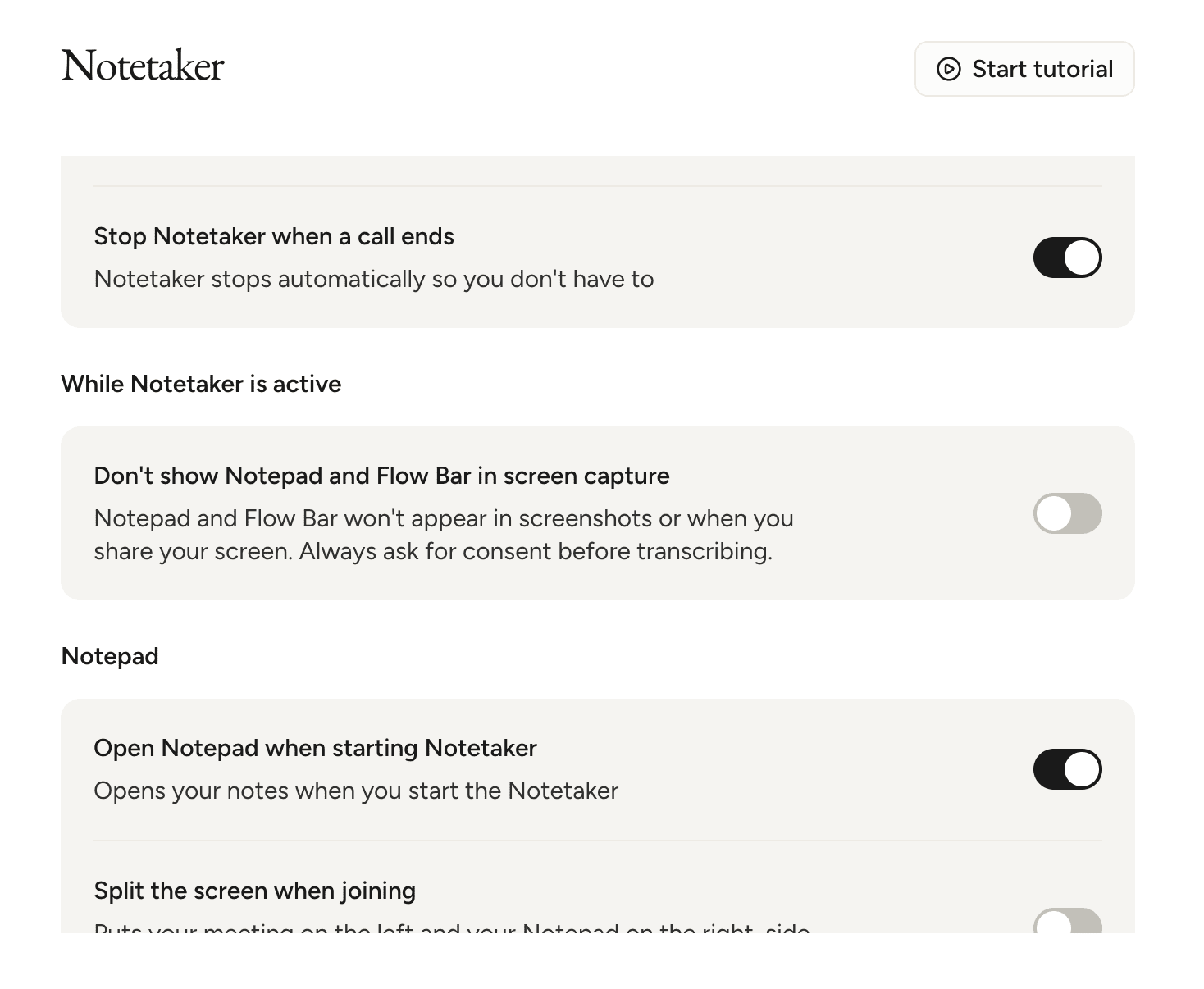
There are a few more things I found when looking around in the small print:
- There’s no transcript retention setting on my account, even though Wispr’s docs say you can set one.
- Some features, including meeting briefs, aren’t covered by Wispr’s zero-retention agreements with its AI providers, so that’s something to keep in mind.
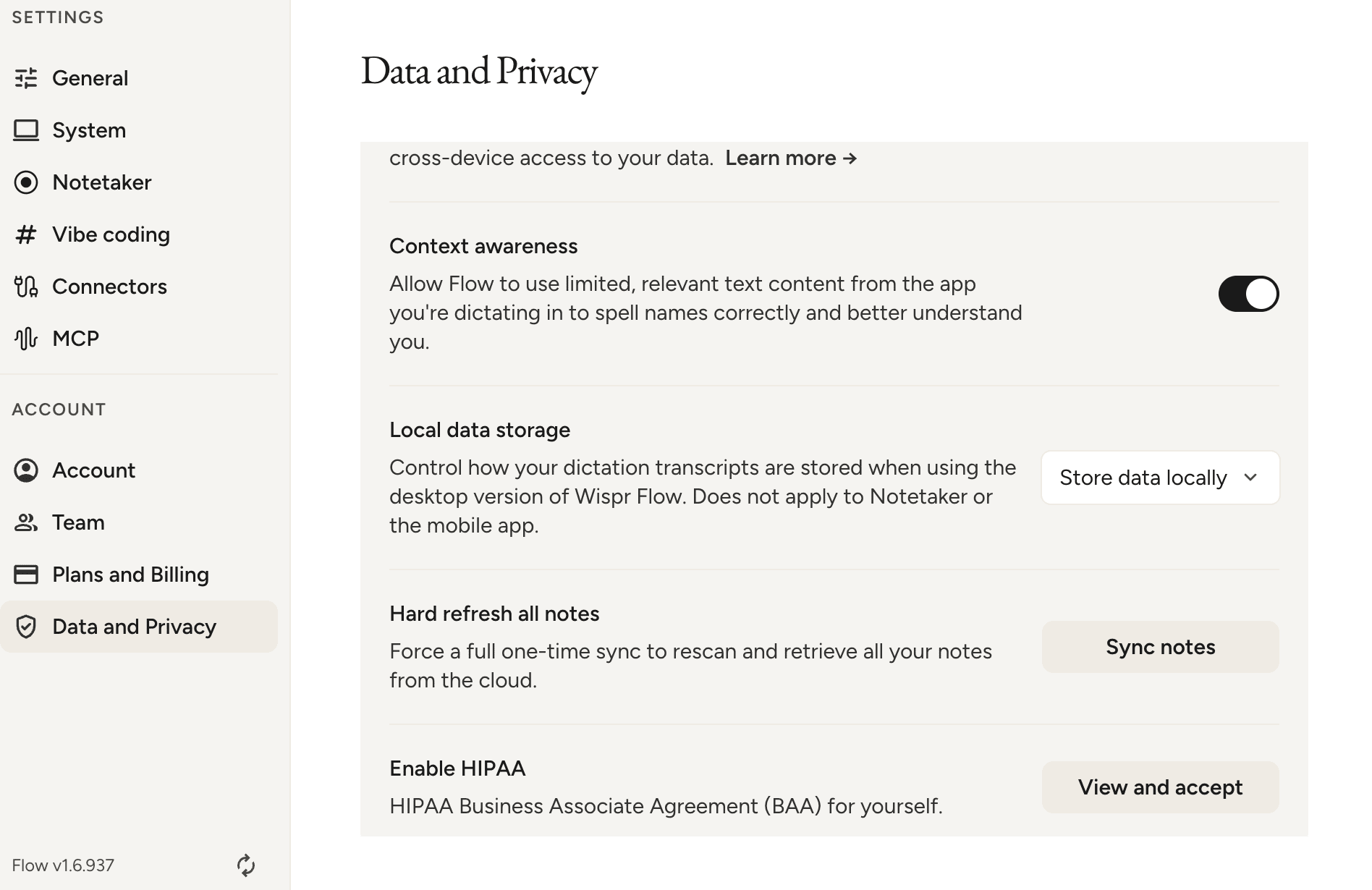
- Everything you dictate is stored too. Dictation cloud storage is on by default, and my drafts of this review are sitting in Flow’s history.
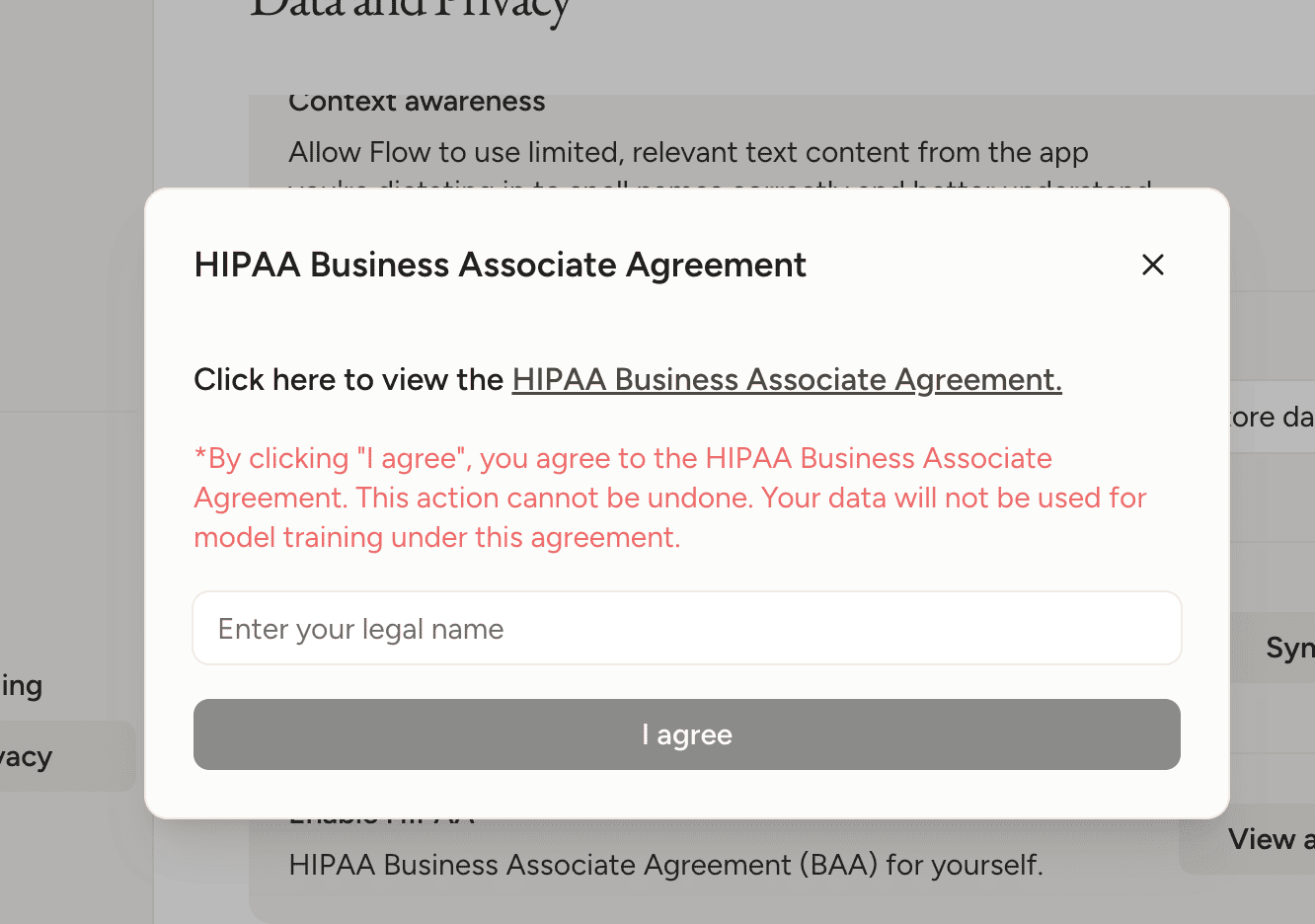
- The HIPAA agreement can’t be undone, and the sign-up screen doesn’t mention that, according to Wispr’s docs, signing it blocks Notetaker from recording.
Does Wispr Train Its AI on Your Meetings?
Yes, by default. If you’re on the Free or Pro plan, “Improve the model for everyone” is on automatically, which lets Wispr use your audio, transcripts and edits to improve its models. You can switch it off, though. I was able to switch it off during onboarding. On Enterprise, it’s off, and it’s locked.
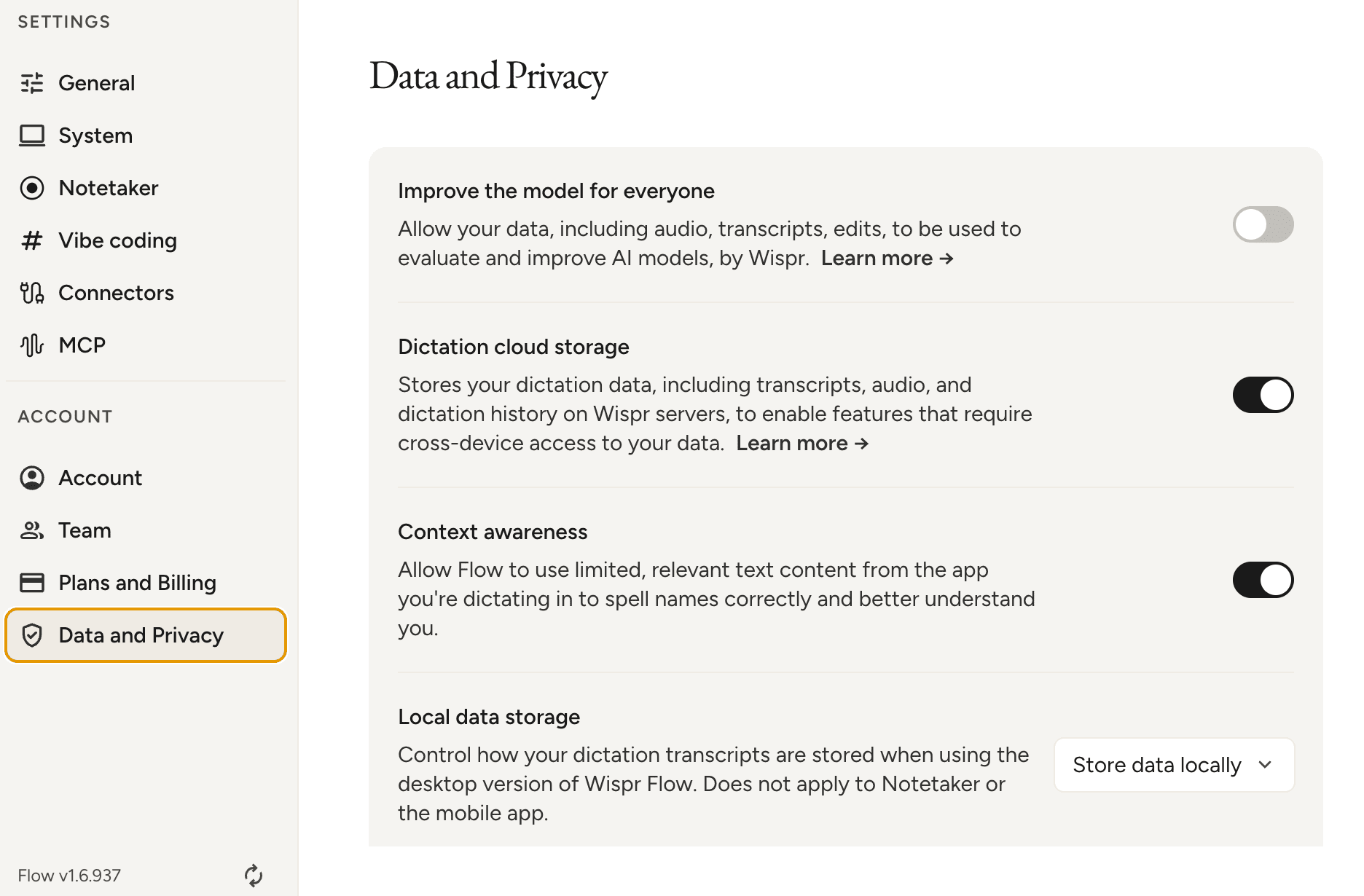
It used to be called Privacy Mode, which is why some of the older reviews I’ve seen say it’s opt-in. Same switch, different name, different framing.
Wispr also collects usage stats, like how many words you’ve dictated, whatever you choose. They sound fairly innocuous, but Wispr doesn’t say whether they’re linked to your account.
Wispr Flow Notetaker Pricing: Is It Free?
Yes, you can use Wispr Flow Notetaker for free. The free plan includes Notetaker, speaker identification, Ask and MCP access. There’s a weekly meeting limit that Wispr doesn’t seem to put a number on, and only recordings over five minutes seem to count.
Cost-wise, Pro is £15 a month in the UK ($15 in the US), or $12 a month billed annually. It gives you more meetings, unlimited dictation, and keeps your meetings for longer. I paid for it to test the MCP, and it made absolutely no difference to what Claude could do. Enterprise pricing isn’t on the page, so you’ll need to talk to Wispr’s sales team.
What Do Early Users on Reddit Think of Wispr Notetaker?
A lot of the early feedback suggests Wispr Notetaker is better at some parts of the meeting experience than others. Transcription and speaker identification have got praise, while AI-generated summaries are a bit weaker compared with other tools.
One user running both tools said they preferred Wispr for transcript generation, particularly because the speaker tagging was “really useful”, but were sticking with their current tool for notes because its summaries were better. Another user was more direct, saying the summaries “are not as good as granola”. A third called Wispr’s default summaries “pretty poor”, although they found asking the AI to add more detail improved them.
That criticism gets more specific in the same discussion. One user said Wispr can “miss a lot of major points” from classes and calls, and missed the ability to customize how detailed a summary should be. They also said the live transcription indicator was too large and hard to keep out of the way.
That pretty much lines up with my own experience of the Notepad window. The speaker tagging praise doesn’t, as you’ll have seen above.
Some users have switched anyway. One said they’d quit their current tool “with a very heavy heart” because of Notetaker, and the original poster in that thread praised being able to tell Claude to pull a meeting transcript through MCP for further analysis.
Others are less convinced. One person paying for Wispr personally, with their employer paying for another tool, said the transcripts seemed similar, but the company one did a better job of “staying out of the way” on their desktop.
So far, the fairest summary of the reaction is that Wispr’s transcripts look competitive, and what you can do with them afterward gets praise. The generated notes still look like the weaker offering.
There isn’t enough independent review volume yet to call any of this settled. G2 lists five Wispr Flow Notetaker reviews with a 4.9 average, but at least two of them are dated 29 and 31 July 2026, before Wispr’s August 5 launch. Capterra currently lists Wispr Flow with zero user reviews.
Wispr Flow vs Granola: Which Notetaker Should You Use?
If the transcript matters most, Wispr Flow has the edge. If the notes matter most, or you’re on an 8 GB machine, Granola does.
| Fonctionnalité | Wispr Flow Notetaker | Granola |
|---|---|---|
| Bot-free | Oui | Oui |
| Audio playback | Non | Non |
| Identification des orateurs | Labels after the meeting, mixed results in my test | Speaker tags, on by default |
| Résumés | Solid on short calls, early users rate them lower | Early users rate them higher |
| Langues | 21 | 10 on desktop |
| Memory at rest (8 GB Mac) | 748 MB | 490 MB |
| MCP on the free plan | Yes, read-only | Yes, 30 days of history |
| Plan gratuit | Weekly meeting cap, number not published | Unlimited meetings, 30 days of history |
| Formule payante | $15 a month, or $12 billed annually | $14 a month, no annual discount |
| Trains on your data | By default | By default |
| Data location | États-Unis | États-Unis |
| Mobile | No mobile app for meetings | iOS and Android |
| Dictation | Inclus | Non |
They look almost the same, so the decision comes down to what you need from a meeting. Wispr’s transcripts were strong on hard words in my test, but its speaker labels weren’t. Granola is lighter on memory, and early users prefer its summaries. Neither keeps your audio, both train on your data by default, and both process it in the US.
If you already use Wispr Flow for dictation, trying Notetaker costs you nothing. And Wispr can import your Granola history, so it’s easy to test both on the same meetings. If neither fits, we’ve rounded up the best Granola alternatives.
Wispr Notetaker vs tl;dv: Who Is Each One For?
Wispr Flow started as a dictation app and, like others, then decided to add meeting notes. tl;dv was built for meetings from the start, and through my testing, it really showed. Almost every problem I hit with Wispr is one tl;dv doesn’t have.
- Wispr slowed my calls to a crawl. On the same 8 GB Mac, tl;dv’s desktop app used less than a third of the memory.
- Wispr doesn’t keep your audio. When the transcript turned “Vogue” into “both”, there was nothing to check it against. tl;dv keeps the recording, so you can go back and listen.
- Wispr has to be on your computer, in the meeting. tl;dv can join as a bot, record bot-free from the desktop app, or go to the meeting you can’t make.
- Wispr trains on your data by default and processes it in the US. tl;dv never trains on your calls, and your data stays in the EU.
- Wispr has no mobile app for meetings. tl;dv records on iOS and Android.
- Wispr leaves consent to you. tl;dv has consent collection built in.
- Wispr’s notes stay in Wispr, apart from a read-only MCP. tl;dv connects to 5,000+ tools through Zapier, with native HubSpot and Salesforce integrations.
- Wispr transcribes 21 languages. tl;dv covers 30+.
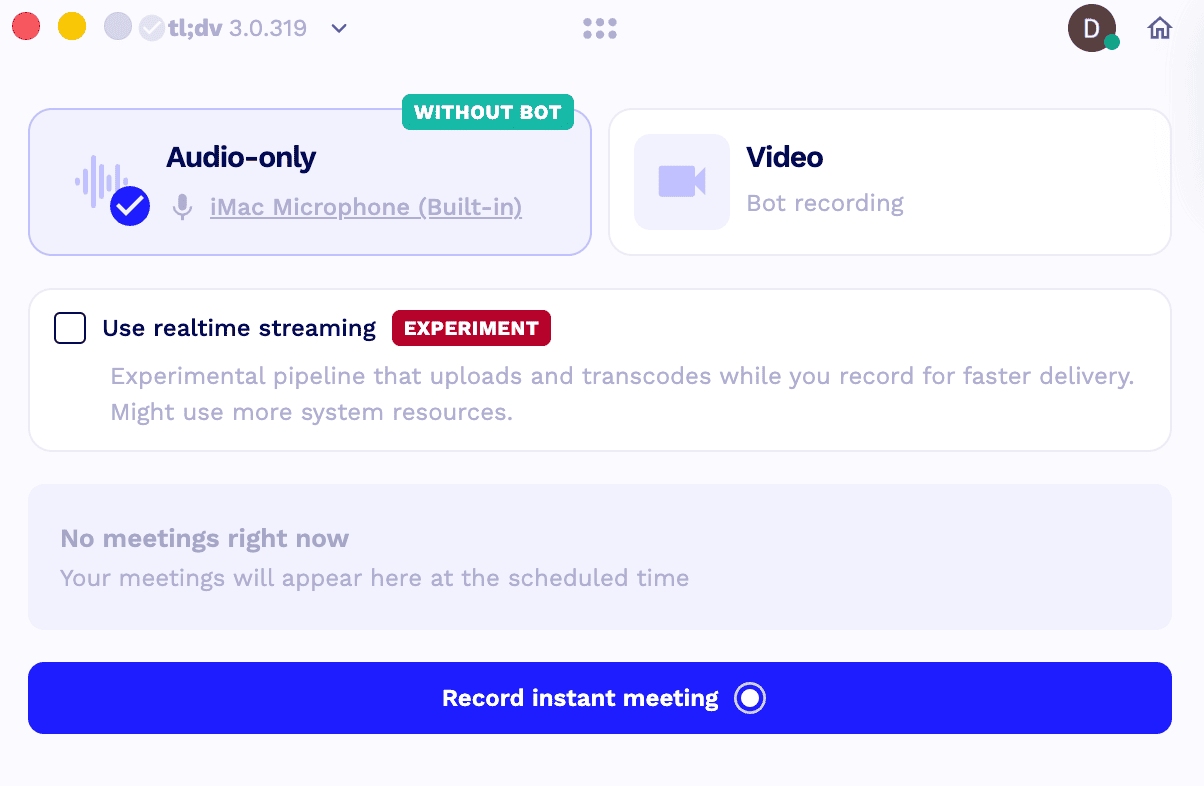
To be fair to Wispr, it wins in two places. It includes dictation in the same app, and its MCP works on the free plan, whereas tl;dv’s needs a paid plan.
Le Wispr Flow Notetaker est le modèle qui vous conviendra le mieux si :
- Already dictate with Flow all day and want meetings in the same app
- Want MCP access without paying
- Work alone, on a machine with 16 GB or more
tl;dv la solution la plus adaptée si :
- Need the recording, not just a transcript
- Want a notetaker that can go to meetings without you
- Work with EU clients or data, or need it kept out of AI training
- Use an older or 8 GB laptop
- Take calls on your phone
- Want your meeting notes pushed into your CRM and other tools
Is Wispr Flow Notetaker Worth It?
For dictation, Wispr Flow is great, but Notetaker is probably not the best meeting notetaker I’ve ever tested.
If you already use Wispr Flow for dictation and your computer has 16 GB of memory or more, go for it. It’s free, and setup takes 10 minutes at most. It got hard vocabulary right, but it isn’t ready to be your team’s meeting notetaker yet.
When I tested it, it gave three people three speaker labels, just not the right three. It kept no audio for me to check against. It used nearly 1 GB of memory whenever I ran it while recording. And it trains on your data by default and processes everything in the US.
For me, as someone based in Europe with a slower computer, Notetaker made my meetings unusable. I couldn’t do it. If you’re a solo user and you’re careful with your settings, it’s manageable. But if you’re working across an international team, it’s not going to be the best fit for you.
I’ll probably keep using Wispr Flow for dictation. I actually prefer it to Superwhisper. But I won’t be using it for meetings any time soon, even if I buy a newer computer with more memory.
tl;dv’s free plan keeps the recording, joins as a bot or records bot-free from the desktop app, never trains on your calls, keeps your data in the EU, and has consent collection built in. On my Mac, it used a fraction of the memory, and it’s free to try. Why not test tl;dv for free today and give it a whirl?
FAQs About Wispr Flow Notetaker
Can Wispr Flow record meetings?
Yes, since August 2026. Wispr Flow Notetaker transcribes meetings on Mac and Windows without a bot joining the call. It doesn’t keep the audio, though, so you can’t play anything back. You get a live transcript, a cleaned-up transcript after the meeting and an AI summary, but not a recording.
Is Wispr Flow Notetaker free, and how many meetings do you get?
Yes, with a weekly limit. The free plan includes Notetaker, speaker identification and MCP access, but Wispr doesn’t publish how many meetings you get each week. Only recordings over five minutes seem to count. Pro costs £15 a month in the UK ($15 in the US), or $12 a month billed annually.
Does Wispr Flow Notetaker work on Windows?
Yes, since September 15, 2026. It launched on Mac in August. Wispr asks Windows users for Windows 10 or 11, 16 GB of RAM and 2 GB of free storage. I tested it on Mac only. There’s no iPhone or Android app for meetings yet, though Wispr says both are on its roadmap.
Does Wispr Notetaker tell other people they're being recorded?
No. It records from your computer, so nothing joins the call and nobody else gets a notice. Wispr shows you a consent reminder on screen, and Enterprise admins can make users confirm they’ve got consent before recording. On every other plan, telling people is up to you.
Can I connect Wispr Notetaker to Claude or ChatGPT?
Yes. Wispr’s MCP connector works with Claude, ChatGPT and Gemini, including on the free plan. In my testing with Claude, it could read meetings, notes and calendar events but couldn’t create or change anything, on both free and Pro. Its search also skips transcripts, so details outside the summary are hard to find.