Passer au contenu





⚡Verdict rapide (en bref)
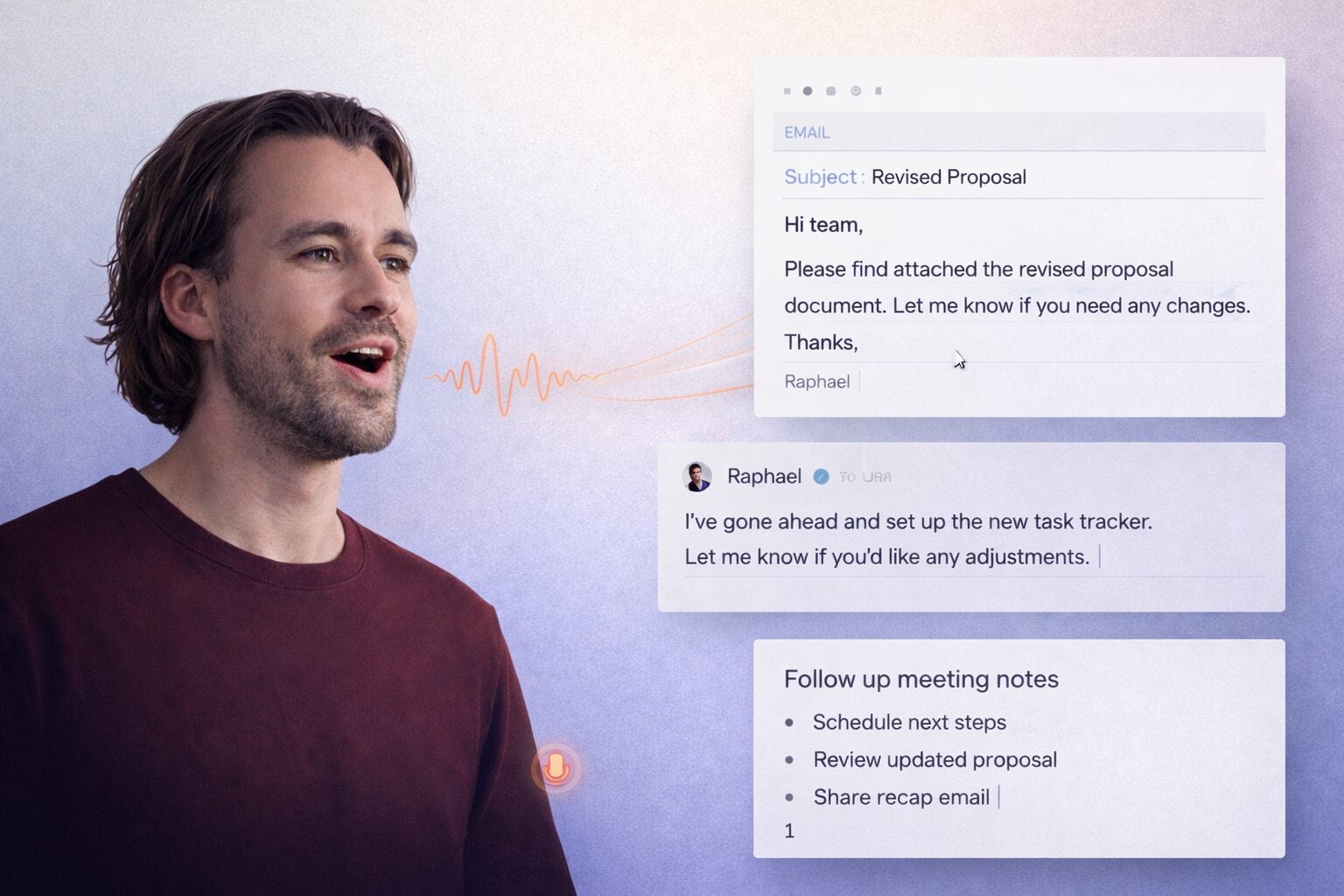
What Wispr Flow is: An AI voice keyboard that works inside every app on Mac, Windows, iOS, and Android. Press a hotkey, speak naturally, and get clean, context-aware, formatted text wherever your cursor is sitting. No separate editor, no switching windows. It now also ships Wispr Flow Notetaker, a bot-free meeting recorder on Mac and Windows, which we’ve reviewed separately in our Wispr Flow Notetaker review.
Who it’s good for: Knowledge workers who write heavily across email, Slack, docs, and notes. Professionals who move between multiple devices or operating systems. Healthcare and legal teams who need HIPAA-ready dictation without paying enterprise prices. Anyone who already lives in AI tools like ChatGPT or Perplexity and wants to drive them by voice.
Who should avoid it: Users who need fully offline, on-device processing with zero cloud involvement. Mac-only power users who want to configure their own AI models (SuperWhisper is the better fit there). Very light users who won’t come close to the 2,000-word weekly free limit. Teams hoping the bundled notetaker will cover their meetings. It has no mobile app, trains on your data by default, and in our hands-on test it made calls lag on an 8 GB Mac. Dictation itself is unaffected.
The one thing you must know before subscribing: All transcription happens in the cloud, and Wispr processes and stores data in the United States, with no EU region. There is no offline mode. If sending audio to external servers is a hard no for your workflow, Wispr Flow is not the right tool regardless of plan.
Overall rating: 4.3 / 5: One of the most polished AI dictation tools available right now. The cloud-only architecture is the one very real caveat, but the “Improve the model for everyone” setting (formerly Privacy Mode) handles it well for most professional use cases, once you switch it off.
For businesses prioritizing strict data privacy and compliance across their entire workflow, exploring other GDPR-compliant enterprise AI platforms like Langdock can provide additional solutions.
Pourquoi j'ai arrêté de taper : mon expérience de deux semaines avec le Wispr Flow Pro
Je tape vite. Ça a toujours été le cas. Alors quand un collègue m'a dit : « Essaie plutôt de parler à ton ordinateur », j'ai pris ça un peu à la légère.
J'ai ensuite testé Wispr Flow pendant deux semaines, sur un MacBook M3, un PC sous Windows 11 et un iPhone 16 Pro. Et pour être honnête, je ne reviens plus autant à la saisie classique.
Ce n'est pas une déclaration anodine. Diriger une entreprise comme tl;dv, où nous réfléchissons chaque jour à la voix et à l'IA, signifie que je suis assez difficile à impressionner par les promesses en matière de technologie vocale. Wispr Flow m'a pourtant impressionné.
J'ai utilisé la dictée vocale d'Apple, je me suis battu avec la saisie vocale de Google, et j'ai passé un après-midi avec SuperWhisper, convaincu que cela allait tout changer (ce ne fut pas le cas, pas pour moi). Ce qui distingue Wispr Flow est subtil mais bien réel : il ne se contente pas de transcrire ce que vous dites, il comprend ce que vous vouliez et le met en forme en conséquence.
Les messages sur Slack ont un ton décontracté. Les e-mails ont un ton professionnel. Les commentaires de code sont rédigés sans tous ces mots de remplissage que l'on utilise quand on réfléchit à voix haute. Sa capacité à s'adapter au contexte m'a vraiment surpris.
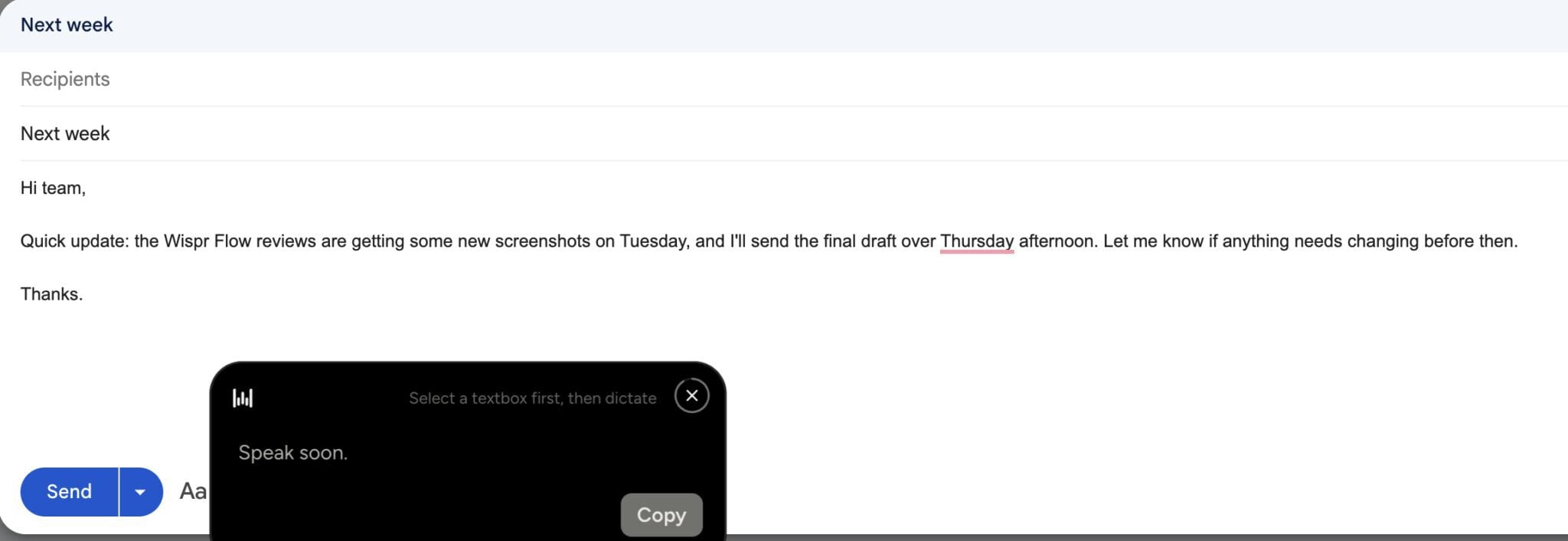
Bon. Est-ce vraiment le meilleur outil de dictée IA pour Mac, Windows et les appareils mobiles en 2026 ? Voyons cela de plus près.
Qu'est-ce que Wispr Flow ? (Et en quoi diffère-t-il de SuperWhisper ?)
Wispr Flow est un clavier vocal basé sur l'IA qui fonctionne dans toutes les applications de votre appareil. Il vous suffit d'appuyer sur une touche de raccourci, de parler naturellement, et il insère un texte clair et soigné directement à l'endroit où se trouve votre curseur, que ce soit dans Gmail, Notion, Slack, VS Code ou un formulaire quelconque sur un site web.
Le mot clé ici est « peaufiné ». Il ne s'agit pas d'une simple transcription brute. Wispr Flow traite votre discours à l'aide de modèles d'IA basés sur le cloud qui comprennent le contexte et suppriment automatiquement les mots de remplissage, corrigent la structure des phrases et adaptent le format du résultat à l'application que vous utilisez.
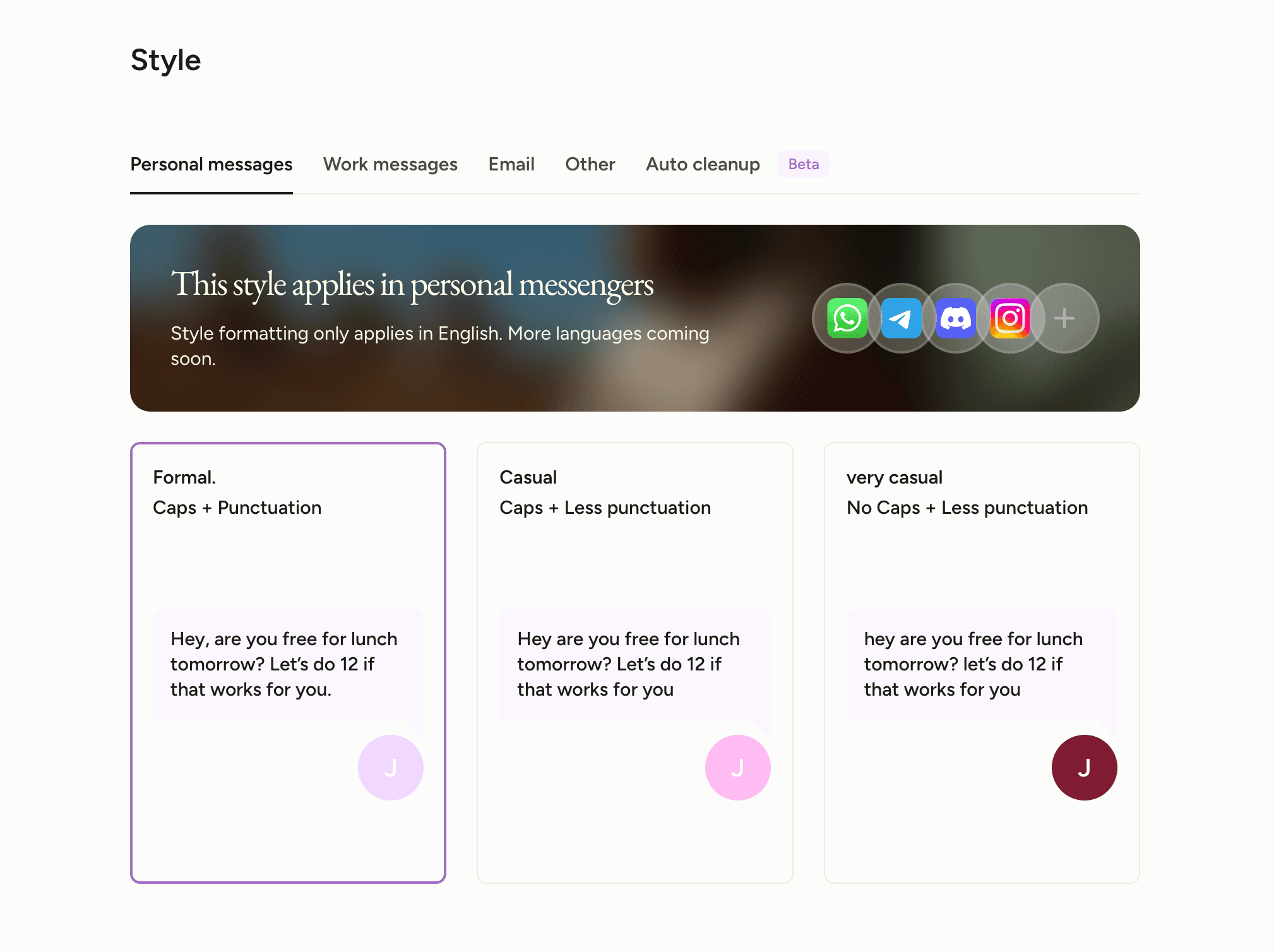
You control how that formatting behaves in Flow’s Style settings, with separate styles for personal messages, work messages, email and everything else, from formal to very casual.
L'entreprise affirme que ce système est quatre fois plus rapide que la saisie au clavier, ce qui correspond à environ 220 mots par minute contre une vitesse moyenne de saisie d'environ 45 mots par minute. Au cours de mes deux semaines de test, cette affirmation s'est vérifiée pour les contenus plus longs, comme les e-mails et les documents. Pour les réponses courtes et concises, l'écart est moindre, mais reste perceptible.
En quoi diffère-t-il donc de SuperWhisper ?
C'est un sujet qui revient sans cesse dans toutes les discussions sur la dictée par IA, alors abordons-le clairement.
SuperWhisper fonctionne entièrement hors ligne sur Apple Silicon. Vos données vocales ne quittent jamais votre appareil. C'est un outil véritablement puissant pour les utilisateurs expérimentés qui souhaitent configurer leurs propres modèles d'IA, choisir entre vitesse et précision, et tout conserver en local. Si vous êtes un utilisateur exclusivement Mac qui traite des données extrêmement sensibles et ne souhaite aucune implication du cloud, SuperWhisper mérite sérieusement d'être pris en considération.
Wispr Flow adopte une approche diamétralement opposée. Il s'agit d'une solution basée sur le cloud, ce qui se traduit par un traitement plus rapide et une reconnaissance contextuelle plus intelligente, mais cela implique également que vos enregistrements audio sont transférés vers des serveurs externes. Il fonctionne également sur Mac, Windows, iOS et Android, ce qui n'est pas le cas de SuperWhisper. Si vous passez d'un appareil ou d'une plateforme à l'autre, cette synchronisation multiplateforme change à elle seule complètement la donne.
The community consensus, backed up nicely by this head-to-head comparison from Willow Voice, is roughly this: Wispr Flow is the more polished, more accessible, better-designed product for most professionals. SuperWhisper is the privacy-first powerhouse for technical users who want control.
Un créateur YouTube comptant 18 000 abonnés, qui a comparé les trois principaux outils, l'a formulé simplement : Wispr Flow « dispose de loin de la meilleure interface utilisateur ». Cela correspond à mon expérience. Il fonctionne dès son installation. Aucune configuration n'est nécessaire.
Principales fonctionnalités : décryptage des fonctionnalités de Wispr Flow
Test de vitesse : peut-on vraiment écrire plus de 150 mots par minute ?
Le slogan annonce une vitesse quatre fois supérieure à celle de la saisie au clavier. D'après mes tests, cela s'avère particulièrement vrai lorsque l'on rédige des textes de plus de deux phrases.
For email drafts, meeting notes, long Slack threads, or any kind of document work, speaking is dramatically faster than typing. Wispr puts the top end at around 220 words per minute, and how close you get depends on how freely you talk once you stop second-guessing yourself. The AI handles cleanup, so you don’t need to speak like you’re dictating to a court stenographer.
Pour les réponses très courtes (une réponse en deux mots, une réaction rapide), le temps nécessaire pour activer le raccourci clavier et parler rend cette méthode à peu près équivalente à la saisie au clavier. Cela ne pose pas de problème. L'outil est conçu pour traiter un volume important de messages.
Mode Commande : la fonctionnalité qui change tout
C'est en mode Commande que Wispr Flow commence vraiment à se démarquer des outils de dictée classiques.
It’s switched off by default, so the first step is turning it on under Settings, then Experimental. It needs a paid plan or an active trial.
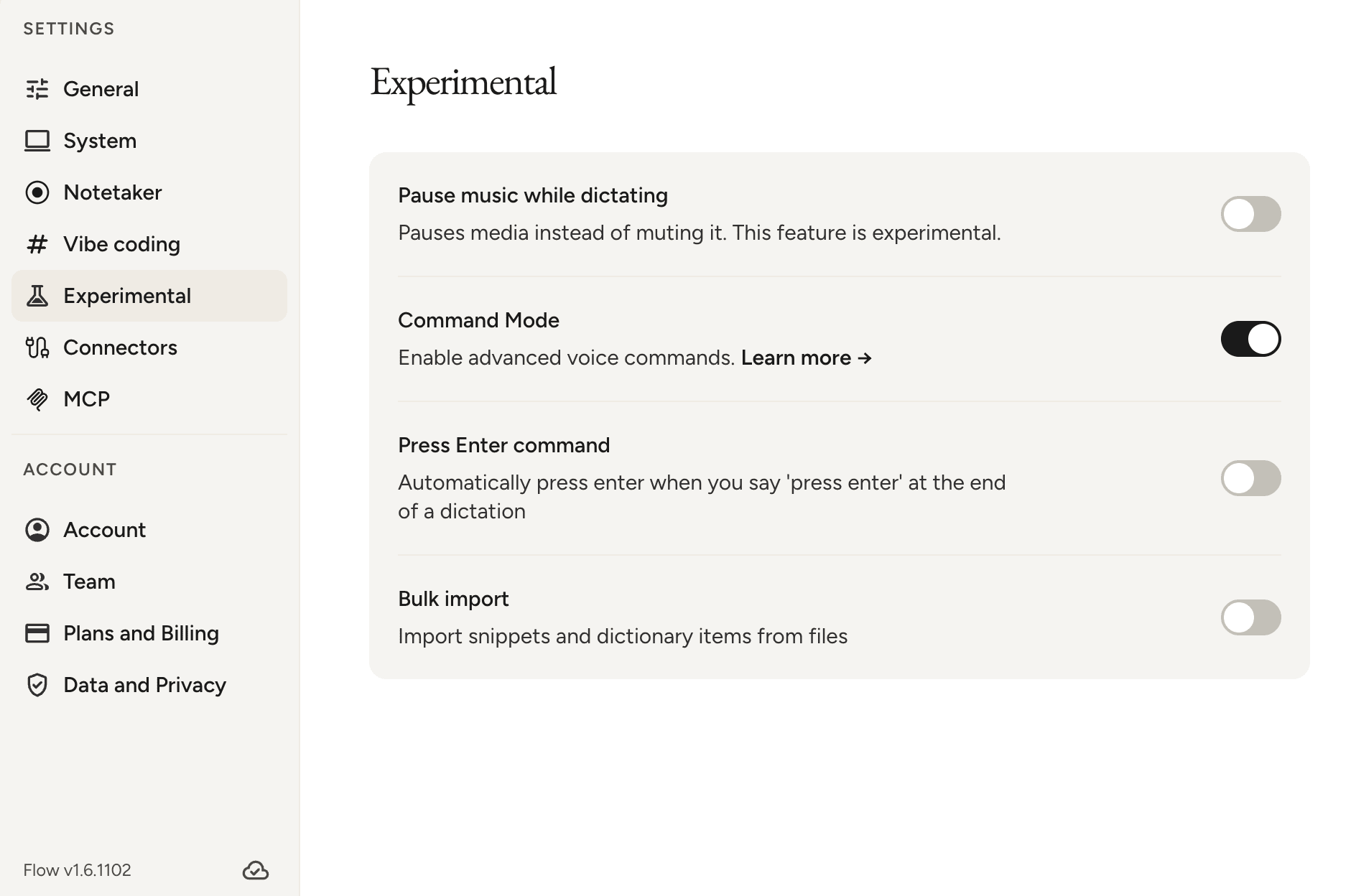
Here’s how it works: highlight some text, hold the Command Mode shortcut (Fn + Ctrl on a Mac), and say “make this more formal” or “translate this to Spanish” or “turn this into a bullet list.” Flow rewrites the selection. In apps where it can’t write back directly, such as Google Docs, it shows the new version in a popup for you to copy.
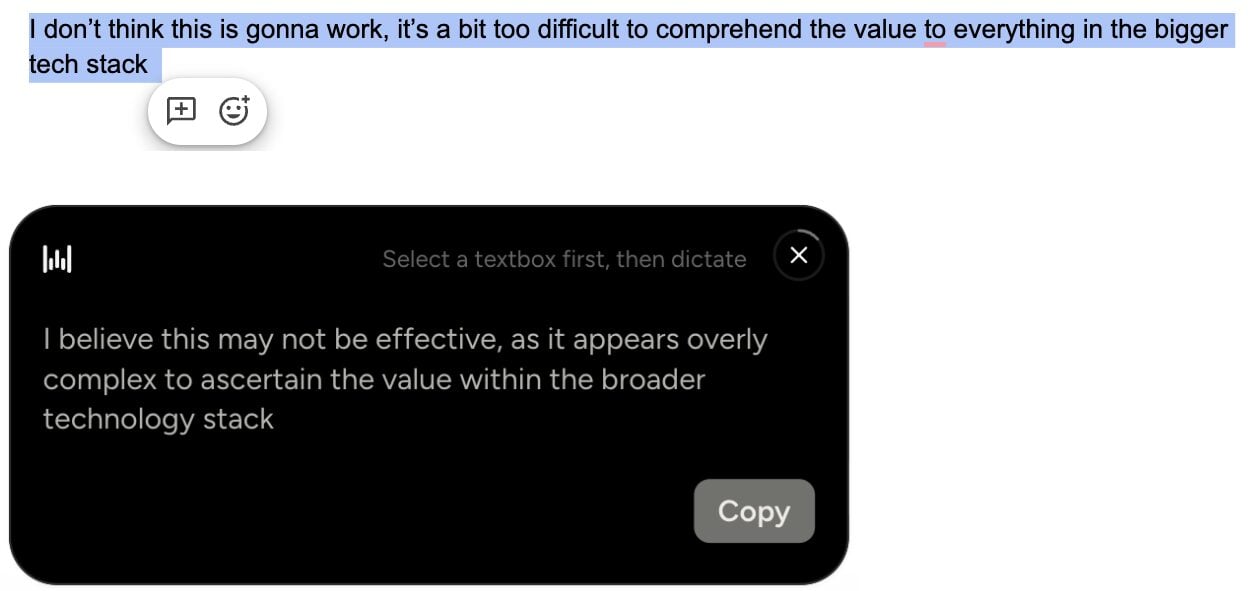
You can also use it to search. Ask a question in Command Mode on desktop and it opens Perplexity with your selected text added to the query.
Pour tous ceux qui écrivent beaucoup et qui utilisent également des outils d'IA tels que ChatGPT ou Perplexity, la possibilité d’envoyer des invites directement par la voix est vraiment utile. Un créateur qui a testé Wispr Flow a décrit son utilisation pour « envoyer des invites à ChatGPT et Perplexity AI directement par la voix » comme l’un de ses workflows quotidiens les plus utilisés. Je comprends pourquoi.
Watch this Command Mode demo if you want to see it in action before downloading.
Dictionnaire personnalisé et extraits de code
C'est une fonctionnalité discrète, mais très pratique.
Custom dictionary lets you teach Flow unusual words, names, or jargon it would otherwise mangle. If your company name is something like “Morepalooza” or you work in a field with technical terminology, you register it once and Flow spells it your way from then on. You can also use it to correct a word Flow keeps getting wrong.
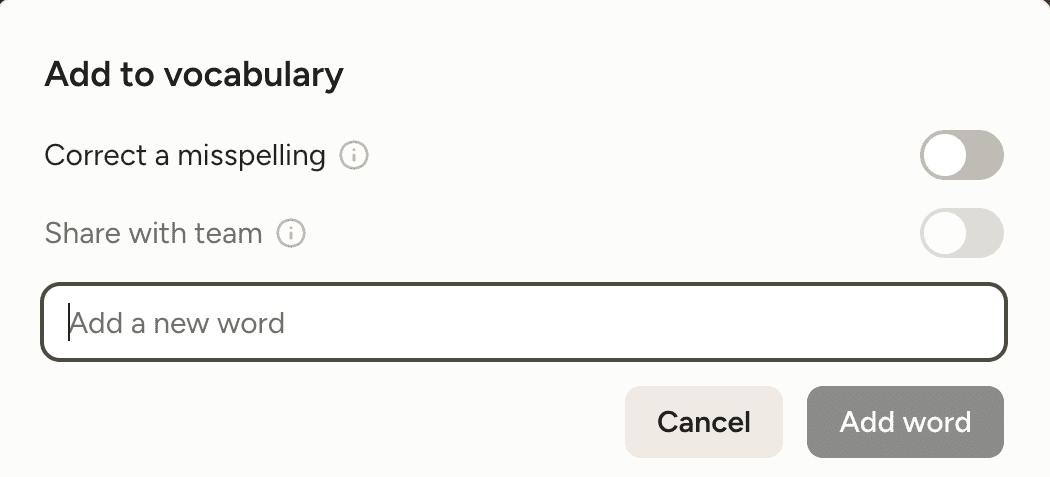
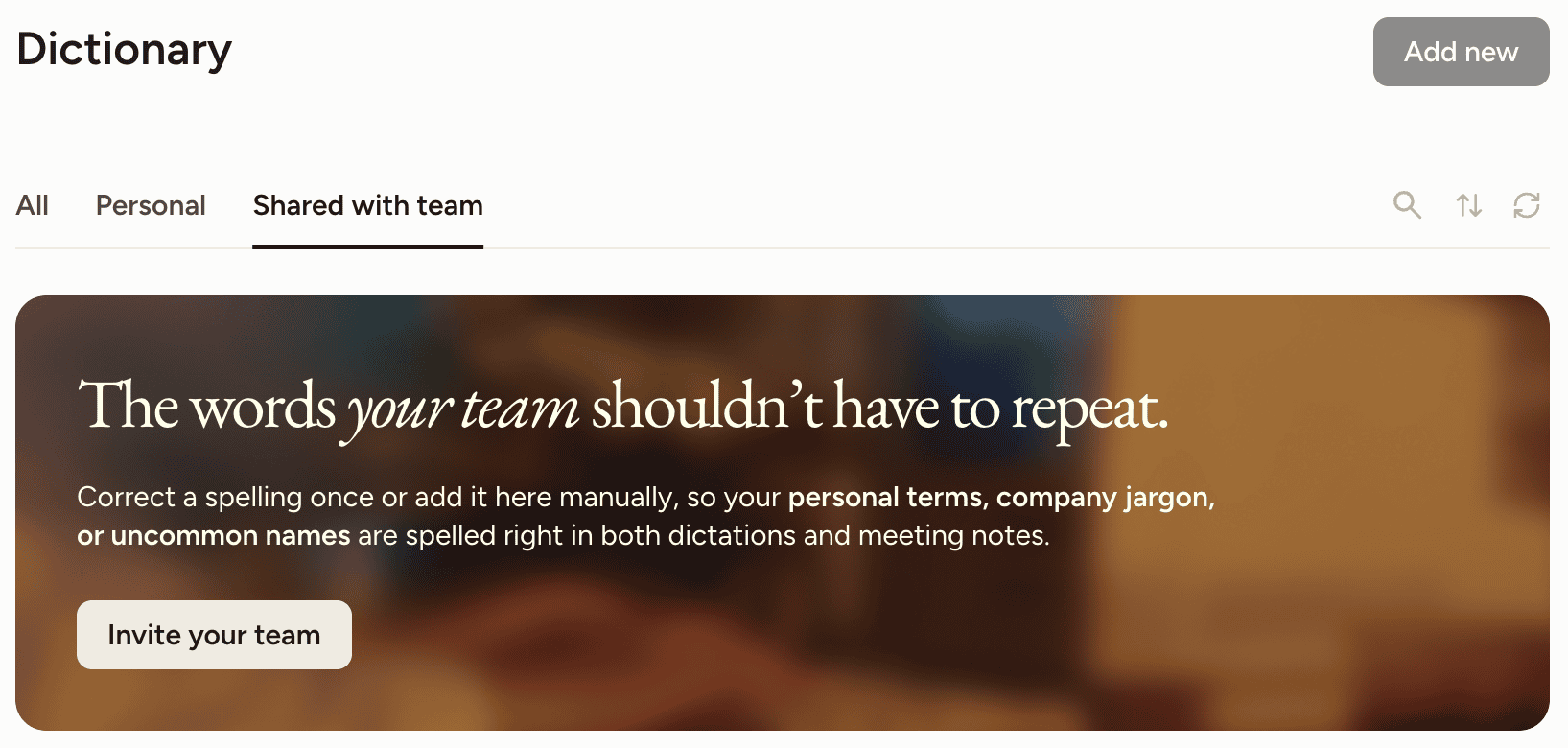
On a team, you can share dictionary words with everyone, so product names and client names are spelled the same way across the company, in both dictation and meeting notes.
Les extraits vous permettent de définir des raccourcis. Il suffit de prononcer une courte phrase pour qu'elle se transforme en un bloc de texte plus long que vous utilisez fréquemment, comme une formule de conclusion standard pour vos e-mails, un modèle d'invitation à une réunion ou une réponse d'assistance.
Ces deux éléments se synchronisent sur tous vos appareils, ce qui nous amène au point suivant.
Synchronisation multiplateforme : le principal avantage pratique de Wispr Flow
C'est véritablement cette fonctionnalité qui distingue Wispr Flow de la plupart de ses concurrents.
Votre dictionnaire personnalisé, vos extraits de texte, vos paramètres et vos statistiques d'utilisation se synchronisent sur Mac, Windows, iPhone et Android. Commencez une tâche sur votre Mac, poursuivez-la sur votre iPhone, puis passez à Windows au bureau. Tout reste cohérent et à jour.
SuperWhisper ne fonctionne que sur Mac et iOS. Si vous utilisez Windows, ce n'est tout simplement pas une option. Si vous avez un téléphone Android, c'est la même chose.
Pour les équipes et les utilisateurs qui passent d'un appareil à l'autre et d'un système d'exploitation à l'autre, cette compatibilité multiplateforme constitue l'avantage concurrentiel le plus marquant de Wispr Flow.
| Plateforme | Wispr Flow | SuperWhisper | Dictée Apple |
|---|---|---|---|
|
Mac |
Oui |
Oui |
Oui |
|
Windows |
Oui |
Non |
Non |
|
iPhone / iOS |
Oui |
Oui |
Oui |
|
Android |
Oui |
Non |
Non |
|
Fonctionne dans toutes les applications |
Oui |
Oui |
Principalement |
|
Mise en forme par l'IA |
Oui |
Oui |
Non |
|
Traitement hors ligne |
Non |
Oui |
Non |
Prise en charge de plus de 100 langues
Wispr Flow dictates in over 100 languages. With auto-detect switched on, it works out which language you’re speaking on Mac, Windows and iOS, choosing one language per dictation. Android doesn’t have auto-detect, so you pick the language yourself.
For multilingual teams or individuals who work across languages, this is a real feature rather than a checkbox. You can move between languages from one dictation to the next without changing settings, and Flow follows some local writing rules, such as French spacing before punctuation and Swiss German spelling. Two limits are worth knowing. You can’t mix languages inside a single dictation, and Flow’s Style settings, which control how formal or casual your text sounds, only work in English for now.
Wispr Flow Notetaker: What You Need to Know
Everything above is dictation. On August 5, 2026, Wispr shipped its first product beyond it. Wispr Flow Notetaker is a meeting recorder that captures audio on your computer with no bot joining the call. It launched on Mac, came to Windows on September 15, and now transcribes 21 languages. It’s included on the free plan, with a weekly meeting limit, and recordings under five minutes don’t count toward it.
The one thing it does that rivals can’t copy: your personal dictionary carries over from dictation. Every acronym and product name you’ve taught Flow over months of dictating gets applied to your meeting transcripts. You also get a live transcript, a cleaner second pass afterwards, summaries grouped by topic, a “What did I miss?” button, and MCP access to Claude, ChatGPT and Gemini on the free plan.
Consent is on you. No bot means no automatic notification that transcription is happening. Wispr says so in its own FAQ and puts the responsibility on the user. Twelve US states require all-party consent, and GDPR requires informed consent regardless. We covered this in bot-free recording legality.
We’ve since tested it hands-on, including speaker identification, memory use and what its MCP can actually reach. Read the full Wispr Flow Notetaker review.
Tarifs de Wispr Flow : le forfait Pro vaut-il vraiment 12 $ par mois ?
Wispr Flow has four plans (checked October 2026):
Flow Free
- 2 000 mots par semaine sur Mac ou Windows
- 1,000 words per week on mobile
- Dictionnaire personnalisé et extraits de code
- Prise en charge de plus de 100 langues
- The option to switch off model training
- Notetaker included (Mac and Windows) with speaker identification, ask-anything, and MCP access, subject to a weekly meeting limit (recordings under five minutes don’t count)
Flow Pro ($12 per user a month billed annually, or $15 on the monthly plan)
- Nombre illimité de mots sur toutes les plateformes
- Mode commande pour l'édition vocale
- Prioritized support and early access to new features
- Shared dictionary and snippets, a team workspace and centralized billing
- Free trial, no credit card required
- Higher Notetaker meeting limits and longer history
Flow Growth (contact Wispr for pricing)
- Everything in Pro plus SSO with SAML
- Organization-wide HIPAA enforcement with a signed BAA
- Admin control over model training and individual usage reporting
Flow Enterprise (nous contacter pour connaître les tarifs)
- Everything in Growth plus SCIM, audit logs, MDM, domain capture and admin controls
- Notetaker, with admin controls including required consent confirmation, and model training locked off for the whole organization
Quelques remarques concernant les tarifs. Tout d'abord, la limite de 2 000 mots par semaine de la formule gratuite est tout à fait suffisante pour un usage personnel modéré, mais vous atteindrez rapidement le plafond si vous l'utilisez dans le cadre professionnel. Avec mon volume d'utilisation (e-mails, notes, documents), j'atteignais la limite de la formule gratuite en deux ou trois jours.
Second, the 20% saving on the annual plan is real. $12/month versus $15/month adds up to $36 in savings per year. Not life-changing but worth taking if you know you’re going to use the tool regularly. UK subscribers pay the same figure in pounds: £15 a month, with annual billing saving £36 a year.
Third, and this is worth flagging: you can switch off model training on any plan, including free, so you don’t have to upgrade to stop your dictation being used to train Wispr’s models. If you need HIPAA-ready dictation, individuals can sign a Business Associate Agreement in the desktop app, and Growth and Enterprise admins can sign one for the whole organization. One catch: according to Wispr’s docs, signing the HIPAA agreement blocks Notetaker from recording, so you can’t have both.
For a more detailed breakdown of what each tier includes, Eesel AI has a good explainer on Wispr Flow’s pricing structure if you want a third-party take on it.
Le Wispr Flow est-il fiable ? Ce qu'en disent les utilisateurs de longue date
La question qu'il convient de se poser au sujet de n'importe quel outil par abonnement n'est pas de savoir quelle impression il donne au bout d'une semaine, mais plutôt au bout de douze mois. Wispr Flow compte désormais suffisamment d'utilisateurs de longue date pour répondre à cette question, et les avis sont partagés.
La plainte récurrente concerne la baisse progressive de la qualité de la dictée au fil du temps. Un utilisateur, qui a dicté plus de 350 000 mots depuis le début de l’année 2026, affirme que la qualité a « sensiblement baissé » et a écarté l’explication évidente : il utilise un Elgato Wave 3 sur son bureau, et non des AirPods. Il a transféré son abonnement chez un concurrent. Un autre utilisateur payant de longue date signale qu’il attend nettement plus longtemps que le texte s’affiche après avoir parlé, et soupçonne que les nouvelles fonctionnalités, telles que le nettoyage automatique du texte, augmentent la latence.
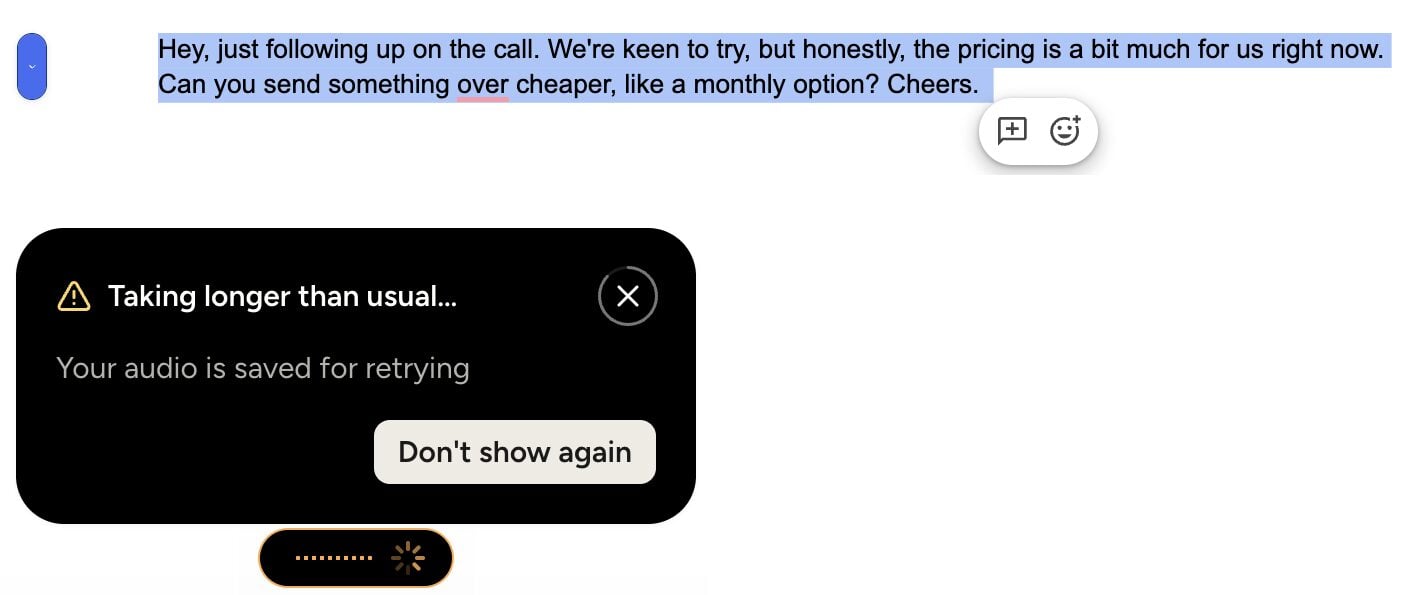
That complaint got louder in early October 2026, when a developer’s post on X saying Flow’s speech-to-text had become unusable drew hundreds of replies. Some paying users said they’d noticed the same drop. Others said they’d had no problems, and many recommended free, local alternatives instead. None of it is measured evidence, but it’s a pattern worth knowing about.
En revanche, ce phénomène n'est pas universel. Un utilisateur intensif depuis novembre 2025 ne signale pas une telle baisse. Cette divergence est importante, car elle indique qu'il s'agit d'un phénomène conditionnel (réseau, langue, charge de travail, combinaison de fonctionnalités) plutôt que d'une régression généralisée que tout le monde subit.
My read: the core product is strong and the complaints cluster around consistency at scale rather than capability. Wispr has grown fast, and latency creep is what fast growth tends to look like from the outside. Worth knowing before you commit to an annual plan, not a reason to avoid the tool.
Confidentialité et sécurité : Wispr Flow est-il fiable pour un usage professionnel ?
C'est la question qui revient le plus souvent à propos de Wispr Flow, et elle mérite une réponse claire.
Is Wispr Flow Secure? HIPAA and Wispr’s Data Settings
En bref : oui, mais il y a une réserve importante à prendre en compte.
Wispr Flow processes your audio in the cloud, and its security FAQ says it processes and stores customer data in the United States. That is not going to change. The company’s position is that cloud-based processing is what enables the fast, accurate, context-aware transcription that makes the product good. Local processing of the quality Wispr delivers is not yet practical at consumer scale.
Ce que vous pouvez contrôler, c'est ce qu'il advient de ces données après leur traitement.
What used to be called Privacy Mode is now two separate settings in Settings under Data and Privacy. “Improve the model for everyone” controls whether your audio, transcripts, and edits are used for model training. “Dictation cloud storage” controls whether your dictation data is stored on Wispr’s servers. Turning off one doesn’t turn off the other, so switch both off and you get zero data retention for dictation. Usage statistics (like word count) are still collected, but the actual content of what you said is not retained.
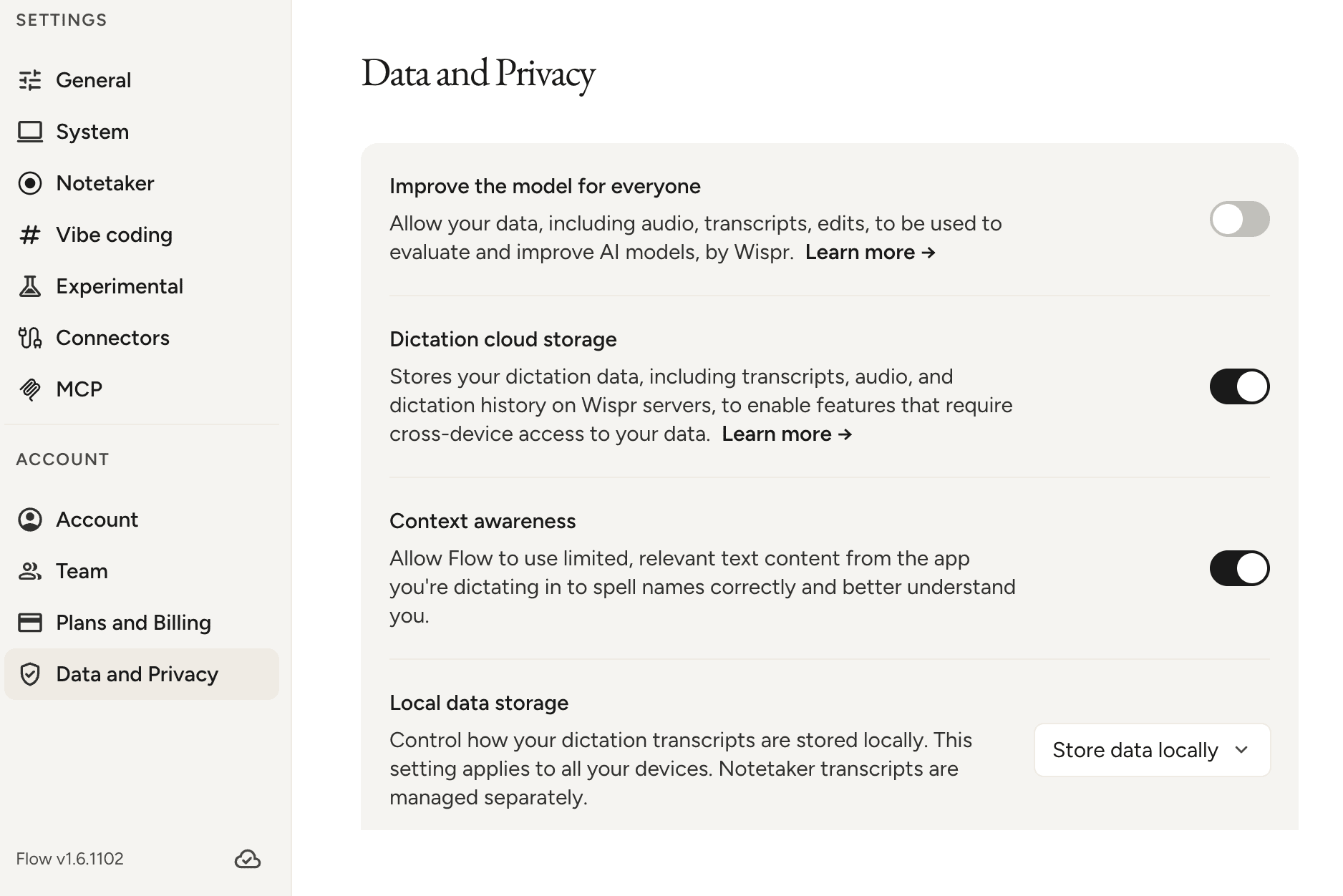
A newer setting, Local data storage, controls how your dictation transcripts are kept on your own devices, and applies across all of them. Notetaker transcripts are managed separately.
Watch the defaults. On the Free and Pro plans, “Improve the model for everyone” is on until you switch it off, so your dictation data can be used to improve Wispr’s models. On Enterprise, it’s off and locked.
Quelques autres faits à connaître en matière de sécurité :
- HIPAA-ready dictation requires a signed Business Associate Agreement (BAA). Individuals can sign one in the desktop app, and Growth and Enterprise admins can sign one for the whole organization. Signing permanently switches off model training and dictation cloud storage for the account. According to Wispr’s docs, it also blocks Notetaker from recording.
- Wispr ne vend jamais vos données. Son modèle économique repose sur les abonnements aux logiciels.
- Le statut de certification a considérablement évolué en mars 2026. Voir la section ci-dessous.
Le statut de certification de Wispr a changé en mars 2026
En mars 2026, une enquête menée à la suite d'une dénonciation a révélé que Delve, une start-up spécialisée dans l'automatisation de la conformité et soutenue par Y Combinator, aurait produit à grande échelle des rapports SOC 2 standardisés. Une feuille de calcul qui aurait fuité montrerait que 493 des 494 rapports d'audit étaient pratiquement identiques, comportant les mêmes paragraphes et les mêmes erreurs grammaticales, seul le nom de l'entreprise ayant été modifié. Y Combinator a retiré Delve de son annuaire début avril 2026.
Wispr s'est retrouvé pris dans la tourmente. Il faut toutefois reconnaître que sa réaction a été la bonne. Conformément à sa propre FAQ sur la sécurité, la société Wispr a, de manière proactive, annulé ses certifications SOC 2 Type II (Accorp Partners) et ISO 27001 (Gradient) existantes en mars 2026 « en raison de préoccupations concernant l’intégrité de la plateforme chez l’auditeur d’origine », puis a tout reconstruit à partir de zéro avec A-LIGN comme auditeur et Drata comme plateforme de conformité.
Where things stand as of October 2026:
- SOC 2 Type I : réalisé en avril 2026 par A-LIGN, avis sans réserve
- SOC 2 Type II and ISO 27001:2022: Wispr’s security FAQ now says both are available through its Trust Center. It doesn’t publish the issue dates or audit periods, so ask for them
- Scope: the audits cover Flow dictation. Wispr says Meeting Notetaker was not assessed
- HIPAA: BAA available for individuals and organizations. Signing it permanently switches off model training and dictation cloud storage, and blocks Notetaker from recording
- Tests d'intrusion : derniers tests effectués en novembre 2025 par BSK Security LLC, selon une méthodologie basée sur les recommandations de l'OWASP
Throwing out a certification you already hold because you don’t trust the auditor is the expensive, correct call, and most companies wouldn’t make it. One loose end: Wispr’s separate compliance help page still lists the old ACCORP Type II report and a Gradient ISO 27001 certificate that expired on September 7, 2026. If your procurement process needs a current SOC 2 Type II, request the new reports from Wispr’s Trust Center rather than relying on the help pages, and check whether Notetaker is in scope if you plan to use it.
Wispr Flow prend-il des captures d'écran de votre écran ?
This claim circulates widely, usually in the form “Wispr screenshots your active window every few seconds.” Wispr’s current documentation says otherwise.
Per Wispr’s Context Awareness help page (checked October 2026), the feature “works from text and does not take screenshots.” When it’s on, which it is by default, Flow reads text from the app you’re dictating in to improve formatting and proper-noun accuracy: the text around your cursor, on-screen text, file and variable names in coding apps, and conversation history. On a Mac it needs accessibility permissions.
Password field contents are never read, though Wispr notes that custom or web-based password fields may be treated as normal text. With model training and dictation cloud storage both switched off, any captured context is stripped server-side and not persisted.
So the accurate version: Wispr reads on-screen text by default and doesn’t take screenshots. That is still a meaningful amount of context leaving your machine, and if you work under NDA or handle privileged material you should turn Context Awareness off entirely in Settings under Data and Privacy. But “it silently screenshots you every few seconds” is not what the documentation describes, and several sites repeating that claim sell competing dictation tools.
One legitimate concern that third-party reviewers like Letterly have raised is that Wispr Flow’s early privacy policy was vague and created distrust, particularly around what “context collection” meant and which third-party providers were handling audio. Wispr has since made this much clearer, but if you’re in a regulated industry, it’s still worth reading the Privacy and Security docs before committing to a paid plan.
Qui garantit l'architecture de sécurité ?
À noter également : l’ancienne RSSI Rinki Sethi, qui a travaillé chez Bill.com, Twitter et Rubrik, a publiquement salué l’architecture de Wispr et affirme avoir déployé Flow à l’échelle de l’entreprise chez Upwind Security. Elle a justifié son choix en expliquant que « l’emplacement des données, leur circulation et les personnes autorisées à y accéder » étaient clairement identifiables, ce qui n’est pas la norme pour les outils d’IA. Il s’agit là d’un soutien significatif de la part d’une personne dont le métier consistait justement à dire « non » aux fournisseurs.
The honest summary for professionals: if you work in healthcare, law, or finance, switch off “Improve the model for everyone” and dictation cloud storage, sign the BAA (knowing it disables Notetaker), and turn off Context Awareness. If you’re a writer, marketer, or knowledge worker handling non-sensitive content, switching off model training on any plan is more than adequate.
Wispr Flow face à la concurrence
Wispr Flow vs SuperWhisper
Already covered in some depth above, but to give you the quick version for people skimming. For a full hands-on take, see our SuperWhisper review.
Choose Wispr Flow if: you use multiple devices or platforms, you want a tool that works out of the box, you need cross-platform sync, or you need HIPAA-ready dictation.
Optez pour SuperWhisper si : vous utilisez uniquement Mac et iOS, vous avez des exigences strictes en matière de souveraineté des données, vous souhaitez configurer vous-même les modèles d'IA, ou vous ne voulez vraiment aucune implication du cloud.
Vous pouvez également regarder cette vidéo de 20 minutes qui compare trois outils majeurs pour voir leur utilisation concrète côte à côte.
Wispr Flow vs. Dictée Apple
Ce n'est pas vraiment un combat à armes égales en 2026, mais cela vaut la peine d'aborder le sujet, car beaucoup de gens commencent par utiliser la dictée d'Apple et se demandent ce qu'ils manquent.
La dictée d'Apple vous fournit une transcription brute. Elle ne tient pas compte du contexte, ne supprime pas les mots de remplissage et ne fait pas la distinction entre un e-mail et un éditeur de code. Ce que vous dites correspond à peu près à ce que vous obtenez.
Wispr Flow met en forme le texte en fonction du contexte, nettoie les expressions idiomatiques et améliore activement le texte au fur et à mesure que vous parlez. Il s'agit d'une catégorie de produits fondamentalement différente. La seule raison de rester fidèle à la dictée Apple, c'est si vous n'utilisez que des appareils Apple, que vous dictez des textes très courts et que vous ne souhaitez rien payer.
Wispr Flow contre Otter.ai
Otter has been recording, transcribing and summarizing meetings for years, and Wispr Flow Notetaker is now doing that same job. The real difference is how each one gets into the room. Otter joins as a bot, which is clunkier but means everyone can see a recorder is present. Wispr Flow Notetaker captures locally and says nothing.
En matière de dictée, il n'y a pas photo, car Otter n'a jamais eu pour objectif de remplacer votre clavier. Et si ce sont les réunions qui constituent votre véritable travail, la compatibilité multiplateforme d'Otteret ses années de perfectionnement restent des atouts de taille.
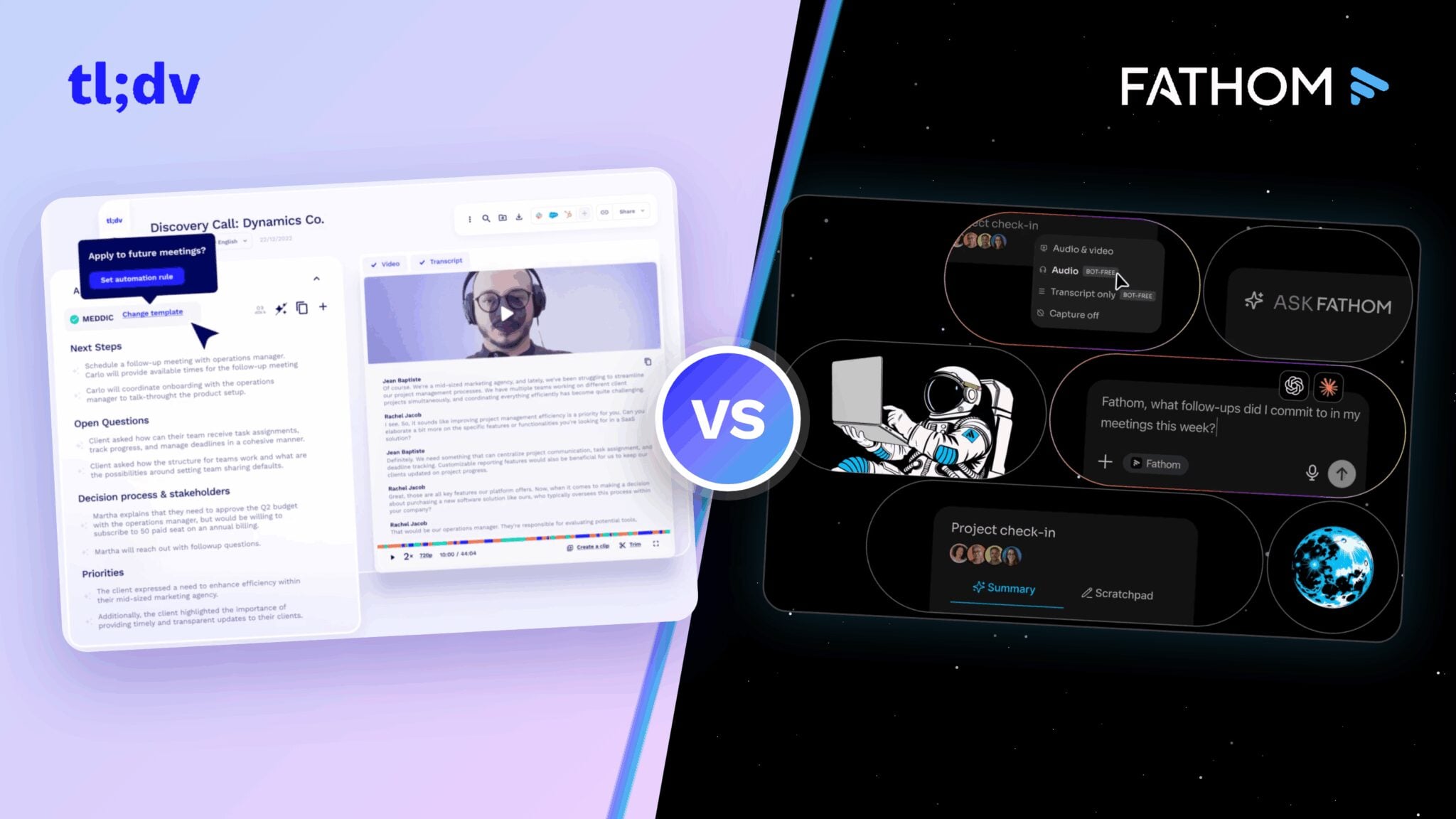
Wispr Flow vs. tl;dv: How They Compare in 2026
Wispr Flow Notetaker is a personal meeting recorder. It runs on your Mac or Windows PC, captures whatever audio is playing, and turns it into a transcript, a summary, and answers you can query later or pipe into Claude, ChatGPT and Gemini over MCP. It’s built for the person holding the laptop. For our hands-on test, including memory use and speaker identification, see the full Wispr Flow Notetaker review.
tl;dv meeting notetaker is built for the team around them. It records Zoom, Google Meet and Microsoft Teams in 30+ languages, as a bot or bot-free from the desktop app, and keeps the video and audio rather than the text alone. What it captures flows into HubSpot, Salesforce, Slack and 5,000+ other tools, and on the Business plan it scores calls against your sales playbook. It holds 4.7/5 on G2 from over 500 reviews and is used by more than 2 million users.
| Fonctionnalité | Wispr Flow Notetaker | tl;dv |
|---|---|---|
|
Plateforme |
Mac and Windows. No mobile app for meetings |
Mac, Windows, iOS and Android |
|
Capture sans bot |
Oui |
Oui |
|
Langues |
21 |
Plus de 30 avec détection automatique |
|
Transfert de vocabulaire |
Hérite de votre dictionnaire de dictée |
Vocabulaire personnalisé, à configurer séparément |
|
Enregistrement conservé |
Transcription et résumé |
Bibliothèque de fichiers vidéo et audio consultable |
|
Extraits horodatés et compilations des meilleurs moments |
Non |
Oui |
|
Notes d'information préalables à la réunion |
Oui, les réunions externes |
Non |
|
Analyse de la durée des appels |
Non |
Oui |
|
CRM |
Via MCP, à monter soi-même |
HubSpot natif, Salesforce, Pipedrive |
|
Encadrement et évaluation « playbook » |
Non |
Oui, plan d'affaires |
|
Recherche à l'échelle de l'équipe |
Non |
Oui |
|
Plan d'entreprise |
Oui |
Oui |
|
Localisation des données |
États-Unis |
EU |
|
Plan gratuit |
Limite hebdomadaire de réunions, MCP compris |
Unlimited recording, AI notes on 10 meetings |
Le Wispr Flow Notetaker est le modèle qui vous conviendra le mieux si :
- Work on Mac or Windows and mostly take notes for yourself
- Vous êtes déjà abonné à Flow et souhaitez bénéficier des comptes-rendus de réunion inclus sans frais supplémentaires ?
- Run your meetings in one of its 21 languages
- Souhaitez-vous recevoir des notes d'information avant les réunions concernant les appels externes ?
- Je préfère intégrer des notes dans Claude ou ChatGPT plutôt que d'utiliser un flux de travail intégré
tl;dv la solution la plus adaptée si :
- Need meetings covered on mobile as well as desktop
- Run calls in languages outside Wispr’s 21
- J'ai besoin de l'enregistrement lui-même, pas seulement d'une transcription
- Je souhaite que les champs CRM soient renseignés automatiquement plutôt que d'être exportés via MCP
- Vous avez besoin d'un accompagnement, d'une évaluation « playbook » ou d'un suivi des objections au sein d'une bibliothèque d'appels ?
- Need your data stored in the EU
Verdict final : à qui s'adresse le Wispr Flow ?
Après deux semaines d'essais, voici où j'en suis arrivé.
Wispr Flow started as a dictation tool, and on that job it’s good. The AI formatting works, the cross-platform sync works, and Command Mode is useful once you get the hang of it. If you want to stop typing emails and Slack messages, the free plan is enough to find out whether it suits you.
But with Notetaker, Wispr is no longer just a dictation tool. It now wants to record your meetings too, and that’s a different job with a much higher bar. Notetaker is built for one person taking their own notes. It keeps the transcript, not the recording. There’s no mobile app for meetings, no native CRM sync, and your data is processed and stored in the US. In our hands-on Notetaker review, it also slowed calls on an 8 GB Mac.
If your meetings matter to more people than the person who took the notes, you need the recording, a library your team can search, and your CRM updated without anyone remembering to do it. That’s the job tl;dv was built for. It records Zoom, Google Meet and Microsoft Teams in 30+ languages, with a bot or bot-free from the desktop app. It keeps the video from bot recordings, fills in HubSpot, Salesforce and Pipedrive automatically, and stores your data in the EU.
Use Wispr Flow to dictate. Use tl;dv to record and share your meetings. The free plan gives you unlimited recordings, so you can try it on your next call. Try tl;dv free.
FAQs About Wispr Flow
Wispr Flow est-il gratuit ?
Yes. Wispr Flow’s free plan includes 2,000 words a week on Mac or Windows and 1,000 words a week on mobile, plus the custom dictionary, snippets and Notetaker with a weekly meeting limit. You can switch off model training on the free plan. Pro removes the word limit for $12 a month billed annually, or $15 monthly.
Wispr Flow fonctionne-t-il sous Windows ?
Yes. Wispr Flow runs on Windows as well as Mac, iPhone and Android, and your dictionary, snippets and settings sync across all of them. That cross-platform support is one of its biggest advantages over SuperWhisper, which only runs on Mac and iOS. Like the Mac app, it works inside any app where you can type.
Qu'est-ce que le Wispr Flow Pro et est-ce que ça vaut le coup ?
Flow Pro costs $12 a month billed annually, or $15 monthly. It removes the weekly word limits, adds Command Mode for editing text by voice, raises Notetaker’s meeting limits and adds shared team dictionaries. If you dictate daily for work, you’ll hit the free limit within days, so Pro is worth it for regular users.
Wispr Flow est-il sûr et confidentiel ?
Wispr Flow processes audio in the cloud and stores data in the US, with no offline mode. You can switch off model training and dictation cloud storage in Data and Privacy settings. Model training is on by default on Free and Pro. Wispr’s security FAQ says its new SOC 2 Type II and ISO 27001 reports are available through its Trust Center.
Comment fonctionne le mode Commande dans Wispr Flow ?
Command Mode lets you edit text by voice. Switch it on under Settings, then Experimental, highlight some text, hold Fn + Ctrl on a Mac and say an instruction such as “make this more formal”. Flow rewrites the selection, or shows it to copy in apps like Google Docs. It needs a paid plan or an active trial.
Quelles langues Wispr Flow prend-il en charge ?
Wispr Flow dictates in over 100 languages. With auto-detect switched on, it identifies the language you’re speaking on Mac, Windows and iOS, choosing one language per dictation. Android needs you to pick the language yourself. Flow’s Style settings, which control how formal or casual your text sounds, currently only work in English.
L'application de prise de notes Wispr Flow fonctionne-t-elle sous Windows ?
Yes. Wispr Flow Notetaker launched on Mac on August 5, 2026, and came to Windows on September 15, 2026. It records meetings without a bot joining the call and transcribes 21 languages. There’s no mobile app for meetings. Notetaker is included on the free plan with a weekly meeting limit, and recordings under five minutes don’t count.