Pular para o conteúdo





⚡Resumo rápido (TL;DR)
What Wispr Flow is: An AI voice keyboard that works inside every app on Mac, Windows, iOS, and Android. Press a hotkey, speak naturally, and get clean, context-aware, formatted text wherever your cursor is sitting. No separate editor, no switching windows. It now also ships Wispr Flow Notetaker, a bot-free meeting recorder on Mac and Windows, which we’ve reviewed separately in our Wispr Flow Notetaker review.
Who it’s good for: Knowledge workers who write heavily across email, Slack, docs, and notes. Professionals who move between multiple devices or operating systems. Healthcare and legal teams who need HIPAA-ready dictation without paying enterprise prices. Anyone who already lives in AI tools like ChatGPT or Perplexity and wants to drive them by voice.
Who should avoid it: Users who need fully offline, on-device processing with zero cloud involvement. Mac-only power users who want to configure their own AI models (SuperWhisper is the better fit there). Very light users who won’t come close to the 2,000-word weekly free limit. Teams hoping the bundled notetaker will cover their meetings. It has no mobile app, trains on your data by default, and in our hands-on test it made calls lag on an 8 GB Mac. Dictation itself is unaffected.
The one thing you must know before subscribing: All transcription happens in the cloud, and Wispr processes and stores data in the United States, with no EU region. There is no offline mode. If sending audio to external servers is a hard no for your workflow, Wispr Flow is not the right tool regardless of plan.
Overall rating: 4.3 / 5: One of the most polished AI dictation tools available right now. The cloud-only architecture is the one very real caveat, but the “Improve the model for everyone” setting (formerly Privacy Mode) handles it well for most professional use cases, once you switch it off.
For businesses prioritizing strict data privacy and compliance across their entire workflow, exploring other GDPR-compliant enterprise AI platforms like Langdock can provide additional solutions.
Por que parei de digitar: minha experiência de duas semanas com o Wispr Flow Pro
Eu digito rápido. Sempre digitei. Então, quando um colega me disse para “tentar falar com o computador”, fiquei um pouco presunçoso com isso.
Então, experimentei o Wispr Flow por duas semanas, em um MacBook M3, um PC com Windows 11 e um iPhone 16 Pro. E tenho que ser sincero: já não volto tanto à digitação tradicional.
Essa não é uma afirmação feita à toa. Dirigir uma empresa como tl;dv, onde pensamos em voz e IA todos os dias, significa que é bem difícil me impressionar com promessas de tecnologia de voz. O Wispr Flow me impressionou mesmo assim.
Já usei o Dictation da Apple, já lutei com a entrada de voz do Google e passei uma tarde com o SuperWhisper convencido de que ele iria mudar tudo (mas não mudou, pelo menos para mim). O que o Wispr Flow faz de diferente é sutil, mas real: ele não se limita a transcrever o que você diz, ele descobre o que você pretendia escrever e formata de acordo com isso.
As mensagens no Slack soam informais. Os e-mails soam profissionais. Os comentários no código são exibidos sem todas aquelas palavras de preenchimento que você usa enquanto pensa. Ele é sensível ao contexto de uma forma que realmente me surpreendeu.
Então. Será que é mesmo a melhor ferramenta de ditado por IA para Mac, Windows e dispositivos móveis em 2026? Vamos analisar isso a fundo.
O que é o Wispr Flow? (E em que difere do SuperWhisper)
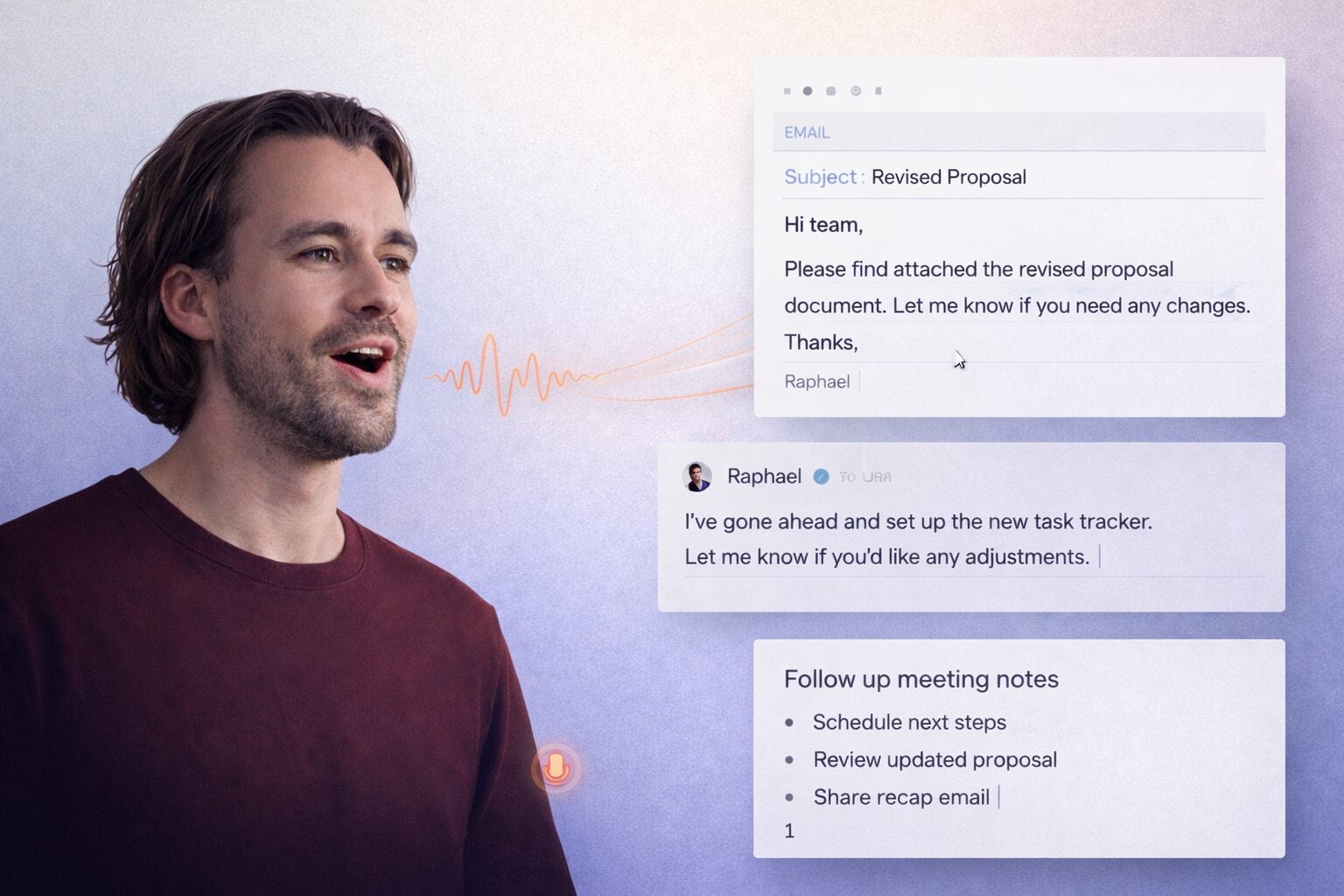
O Wispr Flow é um teclado de voz com IA que funciona em todos os aplicativos do seu dispositivo. Basta pressionar uma tecla de atalho, falar naturalmente e ele insere um texto limpo e bem formatado diretamente onde o cursor estiver, seja no Gmail, no Notion, no Slack, no VS Code ou em um formulário qualquer em um site.
A palavra-chave aqui é refinado. Não se trata de uma transcrição bruta. O Wispr Flow processa sua fala por meio de modelos de IA baseados na nuvem que entendem o contexto e removem automaticamente palavras de preenchimento, corrigem a estrutura das frases e formatam o resultado para qualquer aplicativo em que você esteja.
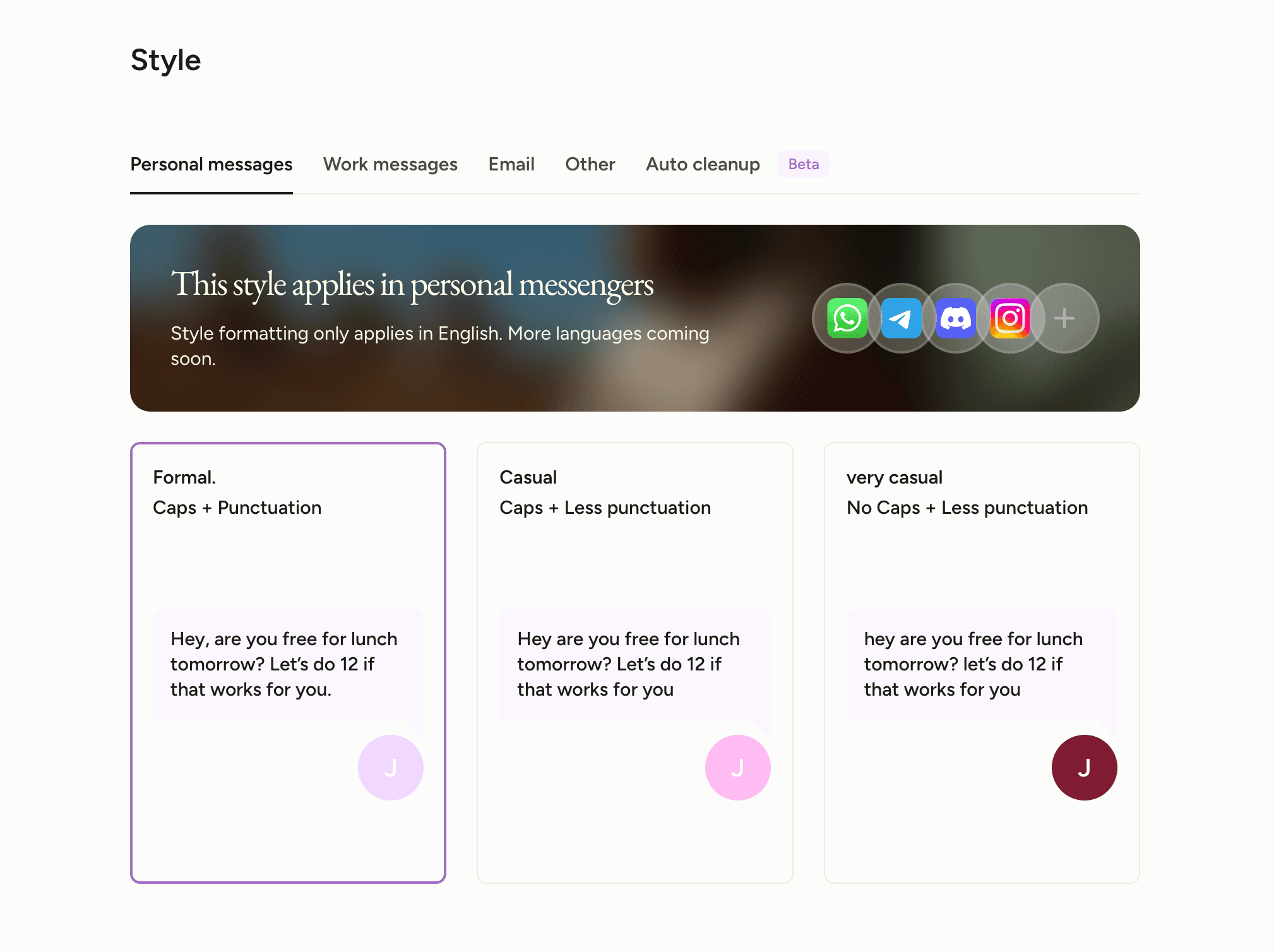
You control how that formatting behaves in Flow’s Style settings, with separate styles for personal messages, work messages, email and everything else, from formal to very casual.
A empresa afirma que o sistema é quatro vezes mais rápido do que digitar, o que equivale a cerca de 220 palavras por minuto, em comparação com a velocidade média de digitação de aproximadamente 45 ppm. Nas duas semanas em que testei o sistema, essa afirmação se confirmou para conteúdos mais longos, como e-mails e documentos. No caso de respostas curtas e diretas, a diferença é menor, mas ainda perceptível.
Então, em que difere do SuperWhisper?
Isso surge constantemente em qualquer conversa sobre ditado por IA, então vamos abordar o assunto com clareza.
O SuperWhisper funciona inteiramente offline no Apple Silicon. Seus dados de voz nunca saem do seu dispositivo. É uma ferramenta realmente poderosa para usuários avançados que desejam configurar seus próprios modelos de IA, escolher entre compromissos entre velocidade e precisão e manter tudo localmente. Se você é um usuário exclusivo de Mac que lida com trabalhos altamente confidenciais e não quer nenhum envolvimento com a nuvem, vale a pena considerar seriamente o SuperWhisper.
O Wispr Flow adota uma abordagem oposta. Ele é baseado na nuvem, o que significa um processamento mais rápido e um reconhecimento de contexto mais inteligente, mas também implica que seu áudio é enviado para servidores externos. Além disso, ele funciona em Mac, Windows, iOS e Android, ao contrário do SuperWhisper. Se você alterna entre dispositivos ou plataformas, essa sincronização multiplataforma, por si só, muda completamente o jogo.
The community consensus, backed up nicely by this head-to-head comparison from Willow Voice, is roughly this: Wispr Flow is the more polished, more accessible, better-designed product for most professionals. SuperWhisper is the privacy-first powerhouse for technical users who want control.
Um criador do YouTube com 18 mil inscritos, que comparou as três principais ferramentas, resumiu assim: o Wispr Flow “tem, de longe, a melhor interface de usuário”. Isso coincide com a minha experiência. Ele funciona assim que é instalado. Não requer configuração.
principais funcionalidades: explicando o que o Wispr Flow realmente faz
Teste de velocidade: você consegue mesmo escrever mais de 150 palavras por minuto?
A afirmação principal é que é quatro vezes mais rápido do que digitar. Com base nos meus testes, isso se aplica principalmente quando se escreve algo com mais de duas frases.
For email drafts, meeting notes, long Slack threads, or any kind of document work, speaking is dramatically faster than typing. Wispr puts the top end at around 220 words per minute, and how close you get depends on how freely you talk once you stop second-guessing yourself. The AI handles cleanup, so you don’t need to speak like you’re dictating to a court stenographer.
No caso de respostas muito curtas (uma resposta de duas palavras, uma reação rápida), o esforço necessário para ativar a tecla de atalho e falar torna o processo praticamente equivalente a digitar. Isso é aceitável. A ferramenta foi criada para lidar com grandes volumes.
Modo de Comando: o recurso que muda tudo
É no Modo de Comando que o Wispr Flow começa a se destacar das ferramentas básicas de ditado.
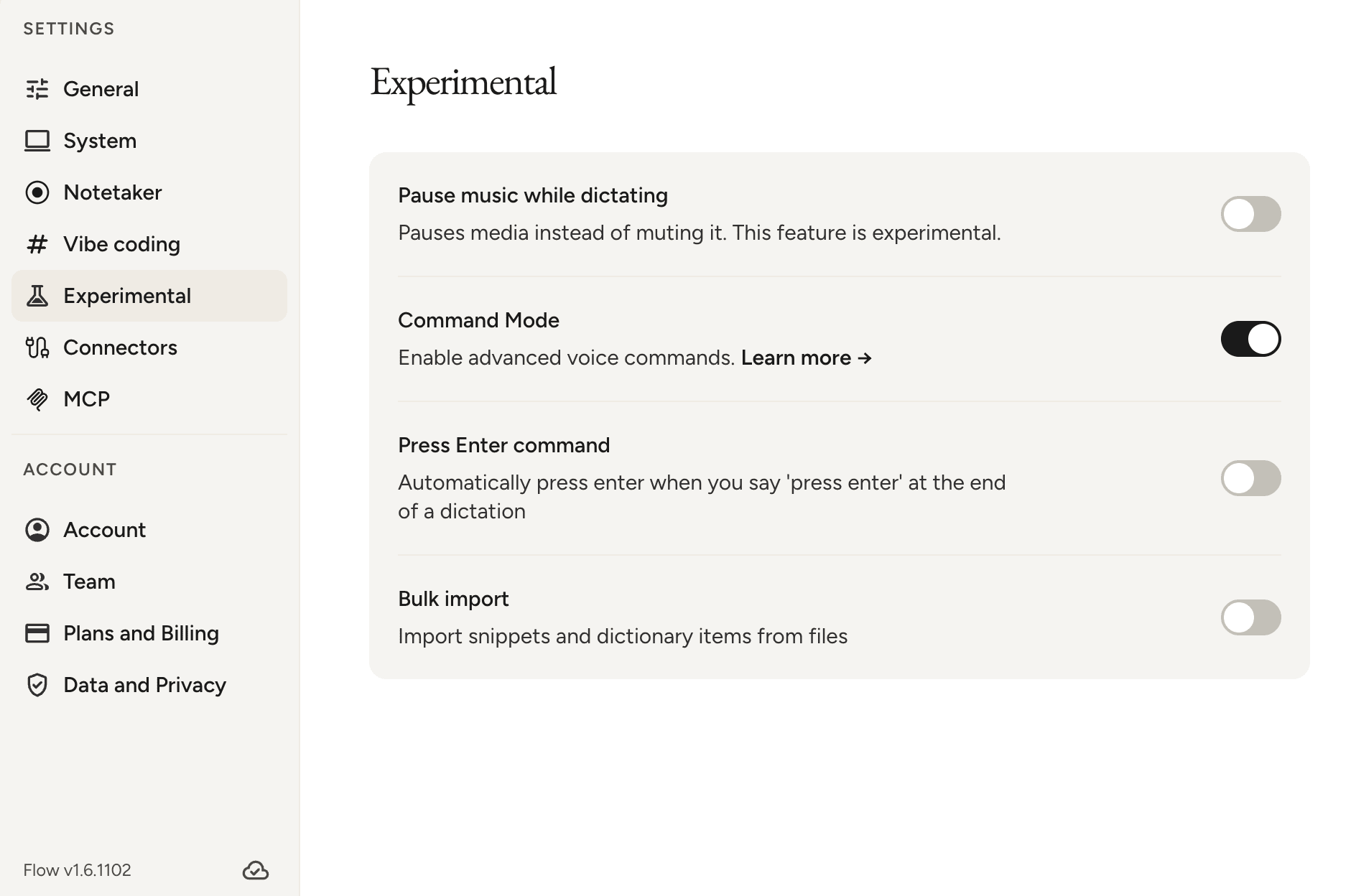
It’s switched off by default, so the first step is turning it on under Settings, then Experimental. It needs a paid plan or an active trial.
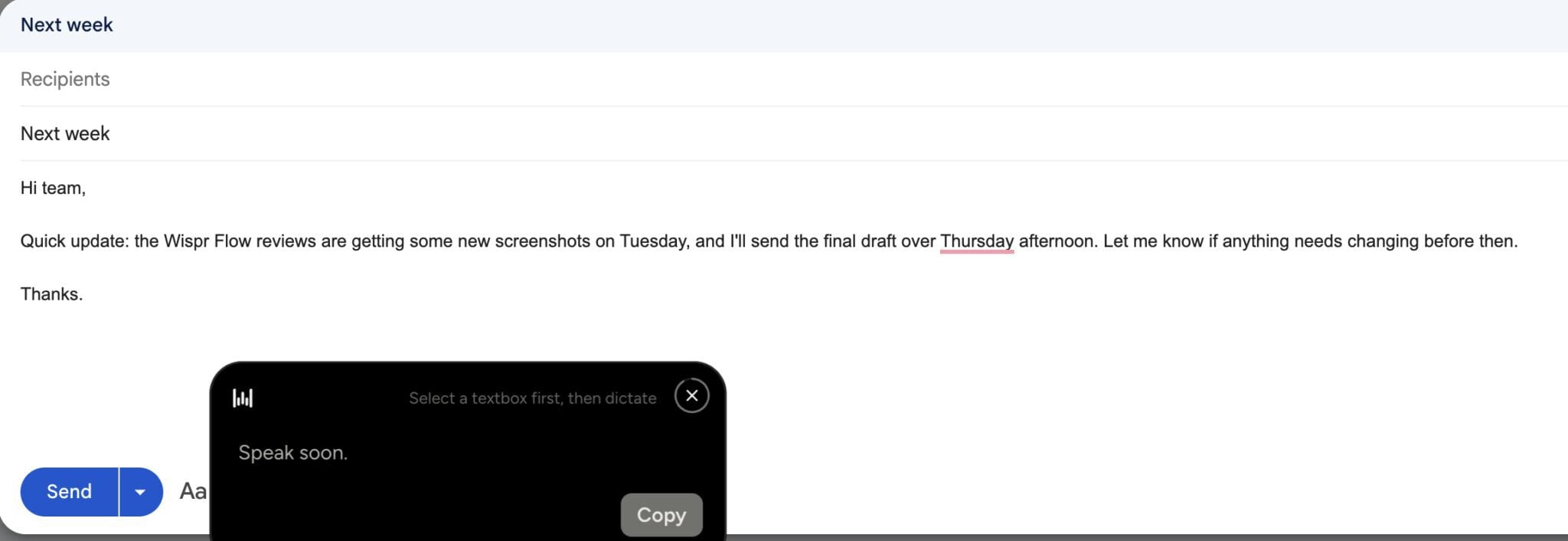
Here’s how it works: highlight some text, hold the Command Mode shortcut (Fn + Ctrl on a Mac), and say “make this more formal” or “translate this to Spanish” or “turn this into a bullet list.” Flow rewrites the selection. In apps where it can’t write back directly, such as Google Docs, it shows the new version in a popup for you to copy.
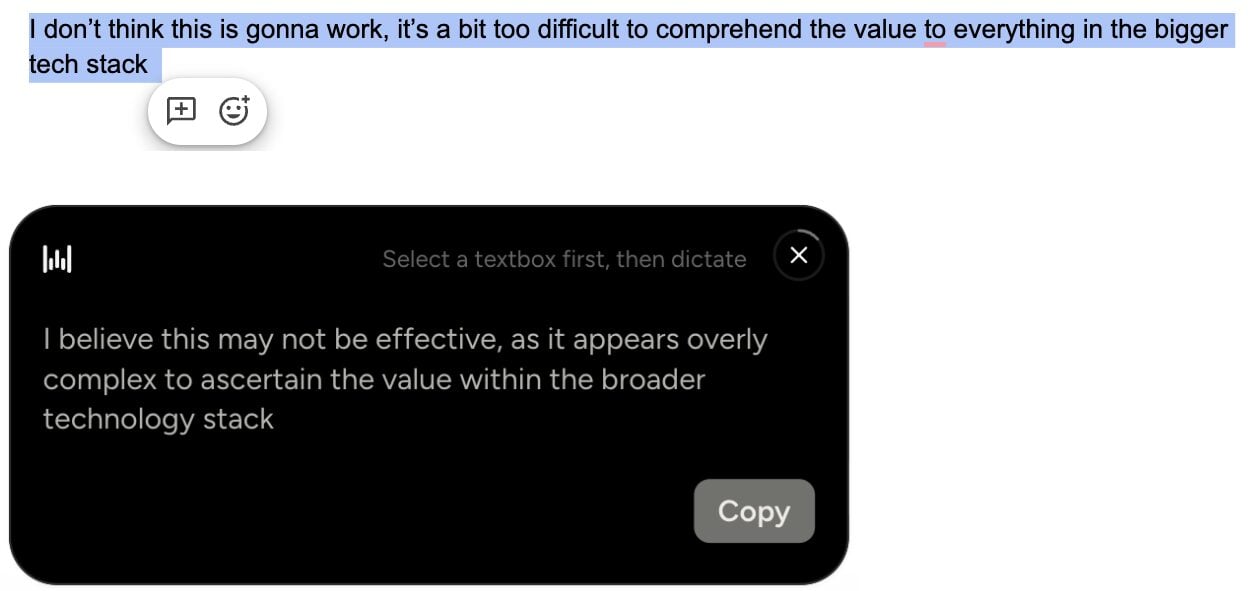
You can also use it to search. Ask a question in Command Mode on desktop and it opens Perplexity with your selected text added to the query.
Para quem escreve muito e também usa ferramentas de IA como o ChatGPT ou Perplexity, a capacidade de enviar comandos diretamente por voz é realmente útil. Um criador que avaliou o Wispr Flow descreveu o uso do aplicativo para “enviar comandos de IA ao ChatGPT e ao Perplexity diretamente por voz” como um de seus fluxos de trabalho diários mais utilizados. Eu entendo o porquê.
Watch this Command Mode demo if you want to see it in action before downloading.
Dicionário personalizado e trechos
Esse é um recurso discreto, mas muito prático.
Custom dictionary lets you teach Flow unusual words, names, or jargon it would otherwise mangle. If your company name is something like “Morepalooza” or you work in a field with technical terminology, you register it once and Flow spells it your way from then on. You can also use it to correct a word Flow keeps getting wrong.
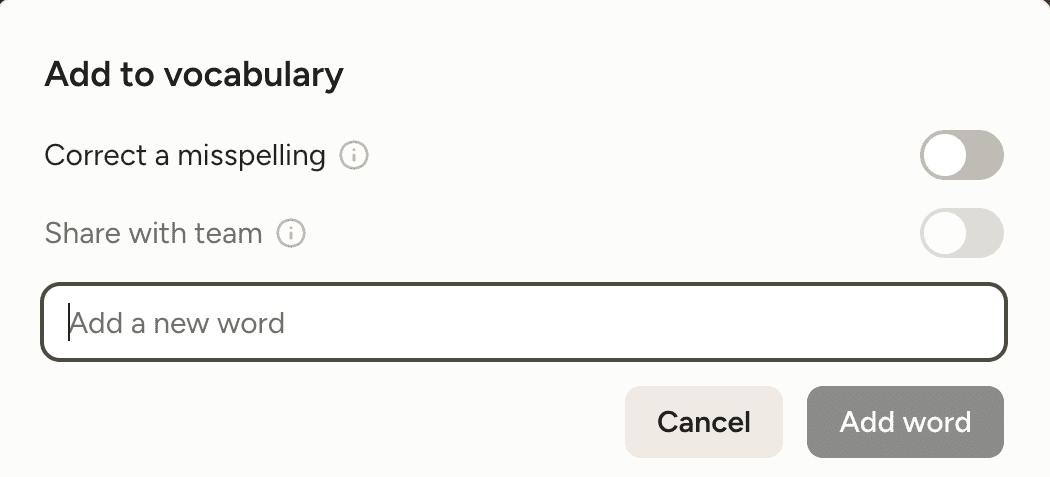
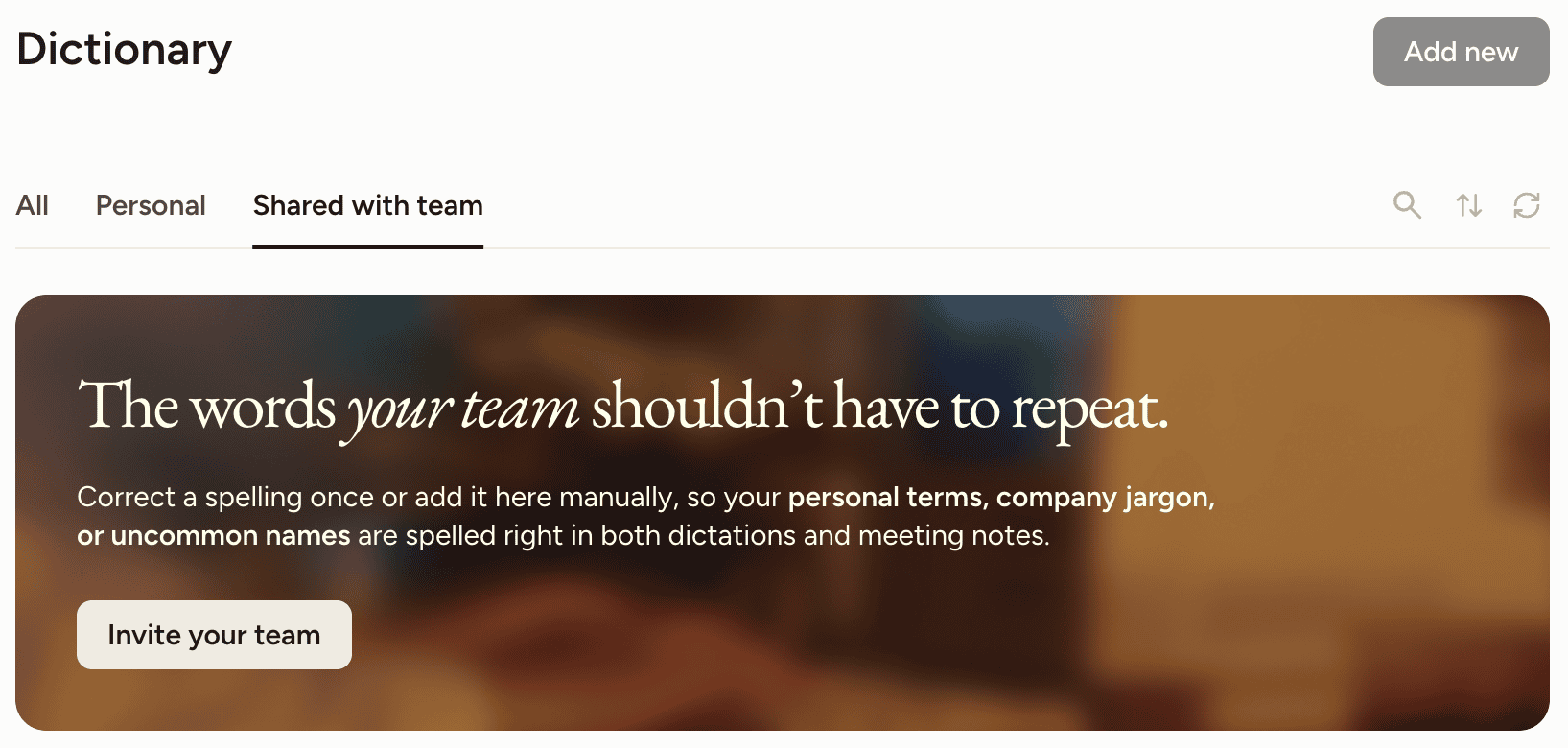
On a team, you can share dictionary words with everyone, so product names and client names are spelled the same way across the company, in both dictation and meeting notes.
Os trechos permitem definir atalhos. Basta dizer uma frase curta para que ela se transforme em um bloco de texto mais longo que você usa com frequência, como uma assinatura padrão de e-mail, um modelo de convite para reunião ou uma resposta de suporte.
Ambos se sincronizam entre seus dispositivos, o que nos leva ao próximo ponto.
Sincronização entre plataformas: a maior vantagem prática do Wispr Flow
Essa é, sem dúvida, a característica que diferencia o Wispr Flow da maioria dos concorrentes.
Seu dicionário personalizado, trechos de texto, configurações e estatísticas de uso são sincronizados entre Mac, Windows, iPhone e Android. Comece um fluxo de trabalho no seu Mac, continue-o no seu iPhone e mude para o Windows no escritório. Tudo fica consistente e atualizado.
O SuperWhisper funciona apenas no Mac e no iOS. Se você usa o Windows para qualquer coisa, simplesmente não é uma opção. Se você tem um celular Android, a situação é a mesma.
Para equipes e usuários que alternam entre dispositivos e sistemas operacionais, essa compatibilidade multiplataforma é a vantagem competitiva mais evidente do Wispr Flow.
| Plataforma | Wispr Flow | SuperWhisper | Dictation da Apple |
|---|---|---|---|
|
Mac |
Sim |
Sim |
Sim |
|
Janelas |
Sim |
Não |
Não |
|
iPhone / iOS |
Sim |
Sim |
Sim |
|
Android |
Sim |
Não |
Não |
|
Funciona em todos os aplicativos |
Sim |
Sim |
Principalmente |
|
Formatação por IA |
Sim |
Sim |
Não |
|
Processamento offline |
Não |
Sim |
Não |
Suporte para mais de 100 idiomas
Wispr Flow dictates in over 100 languages. With auto-detect switched on, it works out which language you’re speaking on Mac, Windows and iOS, choosing one language per dictation. Android doesn’t have auto-detect, so you pick the language yourself.
For multilingual teams or individuals who work across languages, this is a real feature rather than a checkbox. You can move between languages from one dictation to the next without changing settings, and Flow follows some local writing rules, such as French spacing before punctuation and Swiss German spelling. Two limits are worth knowing. You can’t mix languages inside a single dictation, and Flow’s Style settings, which control how formal or casual your text sounds, only work in English for now.
Wispr Flow Notetaker: What You Need to Know
Everything above is dictation. On August 5, 2026, Wispr shipped its first product beyond it. Wispr Flow Notetaker is a meeting recorder that captures audio on your computer with no bot joining the call. It launched on Mac, came to Windows on September 15, and now transcribes 21 languages. It’s included on the free plan, with a weekly meeting limit, and recordings under five minutes don’t count toward it.
The one thing it does that rivals can’t copy: your personal dictionary carries over from dictation. Every acronym and product name you’ve taught Flow over months of dictating gets applied to your meeting transcripts. You also get a live transcript, a cleaner second pass afterwards, summaries grouped by topic, a “What did I miss?” button, and MCP access to Claude, ChatGPT and Gemini on the free plan.
Consent is on you. No bot means no automatic notification that transcription is happening. Wispr says so in its own FAQ and puts the responsibility on the user. Twelve US states require all-party consent, and GDPR requires informed consent regardless. We covered this in bot-free recording legality.
We’ve since tested it hands-on, including speaker identification, memory use and what its MCP can actually reach. Read the full Wispr Flow Notetaker review.
Preços do Wispr Flow: o plano Pro vale US$ 12 por mês?
Wispr Flow has four plans (checked October 2026):
Flow Free
- 2.000 palavras por semana no Mac ou no Windows
- 1,000 words per week on mobile
- Dicionário personalizado e trechos
- Suporte para mais de 100 idiomas
- The option to switch off model training
- Notetaker included (Mac and Windows) with speaker identification, ask-anything, and MCP access, subject to a weekly meeting limit (recordings under five minutes don’t count)
Flow Pro ($12 per user a month billed annually, or $15 on the monthly plan)
- Sem limite de palavras em todas as plataformas
- Modo de comando para edição de voz
- Prioritized support and early access to new features
- Shared dictionary and snippets, a team workspace and centralized billing
- Free trial, no credit card required
- Higher Notetaker meeting limits and longer history
Flow Growth (contact Wispr for pricing)
- Everything in Pro plus SSO with SAML
- Organization-wide HIPAA enforcement with a signed BAA
- Admin control over model training and individual usage reporting
Flow Enterprise (entre em contato para obter informações sobre preços)
- Everything in Growth plus SCIM, audit logs, MDM, domain capture and admin controls
- Notetaker, with admin controls including required consent confirmation, and model training locked off for the whole organization
Algumas observações importantes sobre os preços. Primeiro, o limite de 2.000 palavras por semana do plano gratuito é realmente suficiente para um uso pessoal leve, mas você atingirá o limite rapidamente se o utilizar para o trabalho. Com o meu volume de uso (e-mails, notas, documentos), eu esgotava o limite gratuito em dois ou três dias.
Second, the 20% saving on the annual plan is real. $12/month versus $15/month adds up to $36 in savings per year. Not life-changing but worth taking if you know you’re going to use the tool regularly. UK subscribers pay the same figure in pounds: £15 a month, with annual billing saving £36 a year.
Third, and this is worth flagging: you can switch off model training on any plan, including free, so you don’t have to upgrade to stop your dictation being used to train Wispr’s models. If you need HIPAA-ready dictation, individuals can sign a Business Associate Agreement in the desktop app, and Growth and Enterprise admins can sign one for the whole organization. One catch: according to Wispr’s docs, signing the HIPAA agreement blocks Notetaker from recording, so you can’t have both.
For a more detailed breakdown of what each tier includes, Eesel AI has a good explainer on Wispr Flow’s pricing structure if you want a third-party take on it.
O Wispr Flow é confiável? O que dizem os usuários de longa data
A pergunta que vale a pena fazer sobre qualquer ferramenta de assinatura não é como ela se mostra na primeira semana. É como ela se mostra no décimo segundo mês. O Wispr Flow já conta com usuários de longo prazo suficientes para responder a essa pergunta, e a resposta é mista.
A reclamação recorrente é que a qualidade do reconhecimento de voz vem piorando com o tempo. Um usuário que já ditou mais de 350 mil palavras desde o início de 2026 afirma que a qualidade “diminuiu visivelmente” e descartou a explicação óbvia: ele usa um Elgato Wave 3 em sua mesa, e não AirPods. Ele transferiu sua assinatura para um concorrente. Outro usuário pagante de longa data relata que espera visivelmente mais tempo para que o texto seja exibido após falar e suspeita que recursos mais recentes, como a limpeza automática de texto, estejam aumentando a latência.
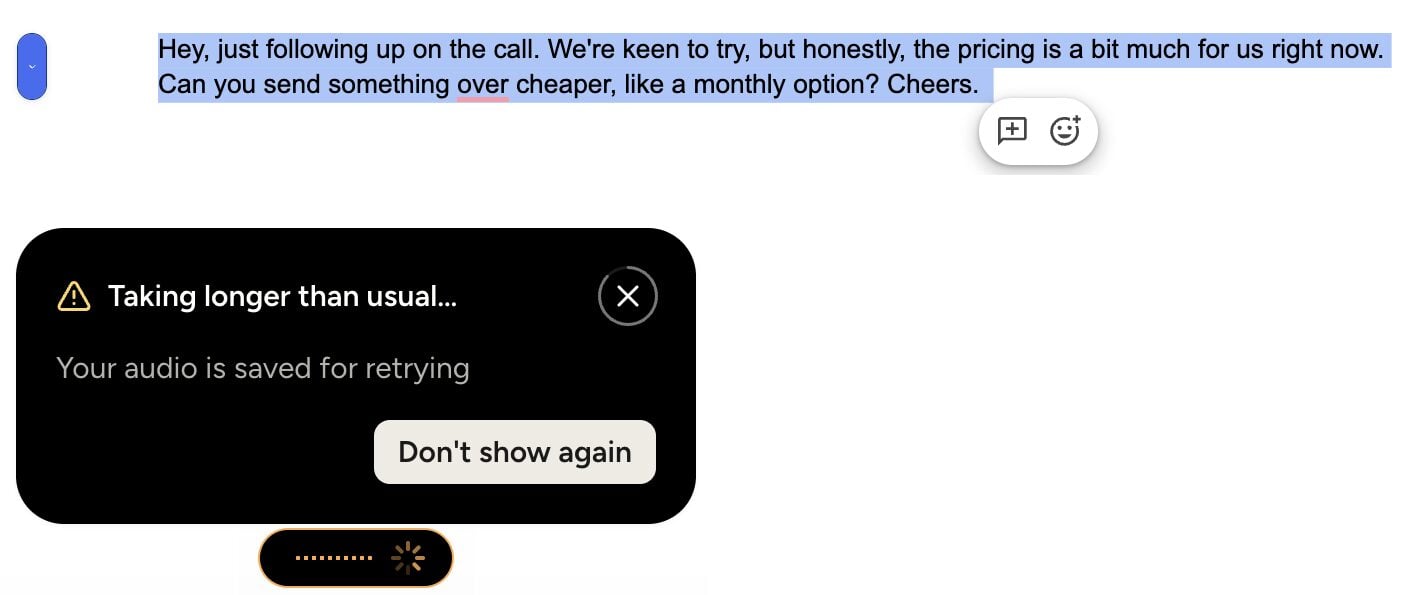
That complaint got louder in early October 2026, when a developer’s post on X saying Flow’s speech-to-text had become unusable drew hundreds of replies. Some paying users said they’d noticed the same drop. Others said they’d had no problems, and many recommended free, local alternatives instead. None of it is measured evidence, but it’s a pattern worth knowing about.
O outro lado da moeda é que isso não é uma regra geral. Um usuário assíduo desde novembro de 2025 não relata tal queda. Essa diferença é importante, pois aponta para algo condicional (rede, idioma, carga de trabalho, combinação de recursos) em vez de uma regressão generalizada que todos experimentam.
My read: the core product is strong and the complaints cluster around consistency at scale rather than capability. Wispr has grown fast, and latency creep is what fast growth tends to look like from the outside. Worth knowing before you commit to an annual plan, not a reason to avoid the tool.
Privacidade e segurança: o Wispr Flow é seguro para uso profissional?
Essa é a pergunta que mais se faz sobre o Wispr Flow, e ela merece uma resposta direta.
Is Wispr Flow Secure? HIPAA and Wispr’s Data Settings
Resumindo: sim, mas há uma ressalva importante que você precisa entender.
Wispr Flow processes your audio in the cloud, and its security FAQ says it processes and stores customer data in the United States. That is not going to change. The company’s position is that cloud-based processing is what enables the fast, accurate, context-aware transcription that makes the product good. Local processing of the quality Wispr delivers is not yet practical at consumer scale.
O que você pode controlar é o que acontece com esses dados após o processamento.
What used to be called Privacy Mode is now two separate settings in Settings under Data and Privacy. “Improve the model for everyone” controls whether your audio, transcripts, and edits are used for model training. “Dictation cloud storage” controls whether your dictation data is stored on Wispr’s servers. Turning off one doesn’t turn off the other, so switch both off and you get zero data retention for dictation. Usage statistics (like word count) are still collected, but the actual content of what you said is not retained.
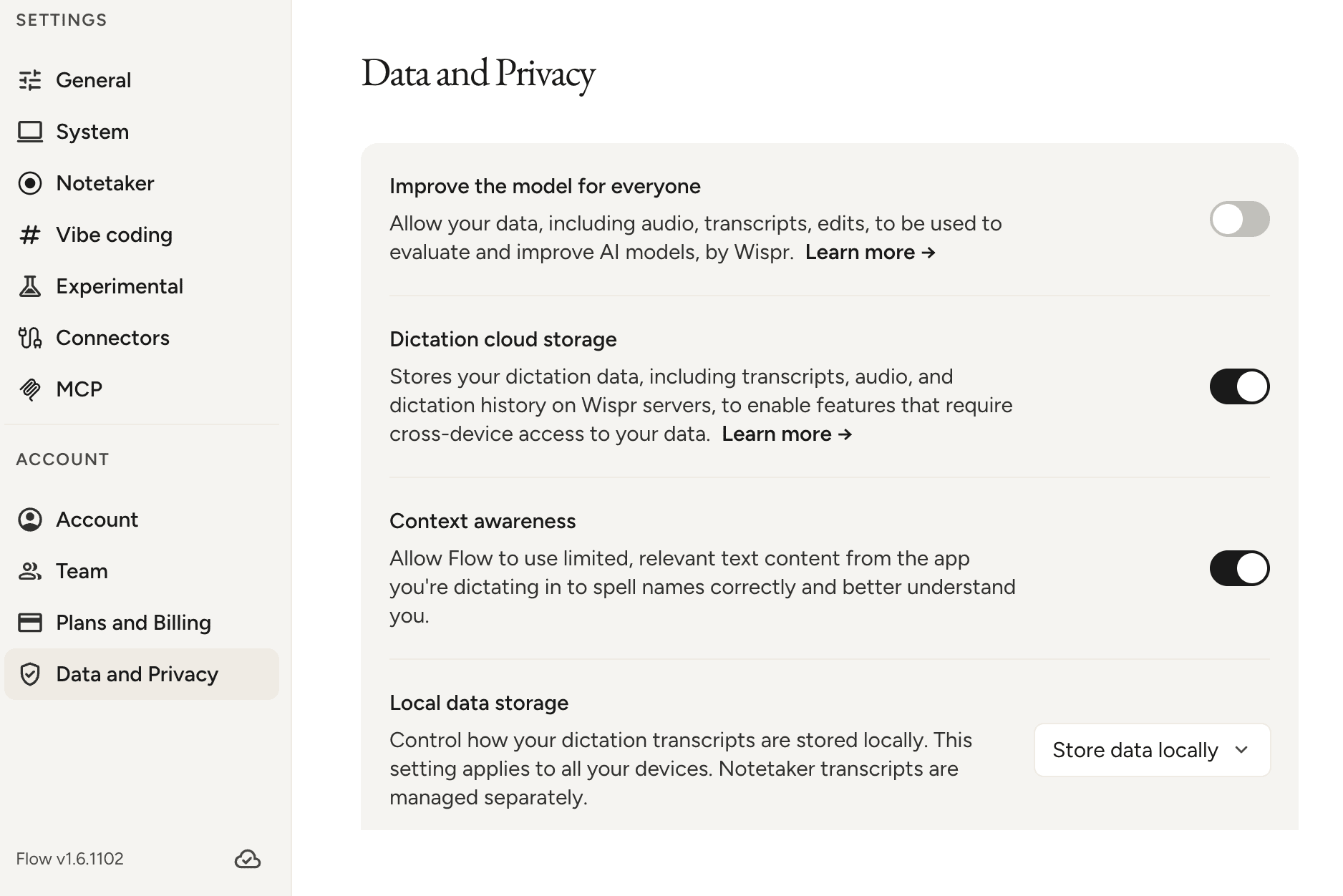
A newer setting, Local data storage, controls how your dictation transcripts are kept on your own devices, and applies across all of them. Notetaker transcripts are managed separately.
Watch the defaults. On the Free and Pro plans, “Improve the model for everyone” is on until you switch it off, so your dictation data can be used to improve Wispr’s models. On Enterprise, it’s off and locked.
Mais alguns fatos sobre segurança que vale a pena conhecer:
- HIPAA-ready dictation requires a signed Business Associate Agreement (BAA). Individuals can sign one in the desktop app, and Growth and Enterprise admins can sign one for the whole organization. Signing permanently switches off model training and dictation cloud storage for the account. According to Wispr’s docs, it also blocks Notetaker from recording.
- A Wispr nunca vende seus dados. O modelo de negócios da empresa baseia-se em assinaturas de software.
- A situação da certificação sofreu uma mudança significativa em março de 2026. Consulte a seção abaixo.
O status da certificação da Wispr mudou em março de 2026
Em março de 2026, uma investigação iniciada por um denunciante alegou que a Delve, uma startup de automação de conformidade apoiada pela Y Combinator, havia produzido relatórios SOC 2 padronizados em grande escala. Uma planilha vazada teria mostrado que 493 dos 494 relatórios de auditoria eram praticamente idênticos, contendo os mesmos parágrafos e os mesmos erros gramaticais, com apenas o nome da empresa alterado. A Y Combinator removeu a Delve de seu diretório no início de abril de 2026.
A Wispr foi atingida pelo impacto. Para seu crédito, a resposta foi a correta. De acordo com o próprio FAQ de segurança da Wispr, a empresa invalidou proativamente suas certificações SOC 2 Tipo II (Accorp Partners) e ISO 27001 (Gradient) em março de 2026 “devido a preocupações com a integridade da plataforma por parte do auditor original” e, em seguida, reconstruiu tudo do zero com a A-LIGN como auditora e a Drata como sua plataforma de conformidade.
Where things stand as of October 2026:
- SOC 2 Tipo I: concluído em abril de 2026 pela A-LIGN, parecer favorável sem ressalvas
- SOC 2 Type II and ISO 27001:2022: Wispr’s security FAQ now says both are available through its Trust Center. It doesn’t publish the issue dates or audit periods, so ask for them
- Scope: the audits cover Flow dictation. Wispr says Meeting Notetaker was not assessed
- HIPAA: BAA available for individuals and organizations. Signing it permanently switches off model training and dictation cloud storage, and blocks Notetaker from recording
- Testes de penetração: realizados pela última vez em novembro de 2025 pela BSK Security LLC, com base na metodologia da OWASP
Throwing out a certification you already hold because you don’t trust the auditor is the expensive, correct call, and most companies wouldn’t make it. One loose end: Wispr’s separate compliance help page still lists the old ACCORP Type II report and a Gradient ISO 27001 certificate that expired on September 7, 2026. If your procurement process needs a current SOC 2 Type II, request the new reports from Wispr’s Trust Center rather than relying on the help pages, and check whether Notetaker is in scope if you plan to use it.
O Wispr Flow captura imagens da sua tela?
This claim circulates widely, usually in the form “Wispr screenshots your active window every few seconds.” Wispr’s current documentation says otherwise.
Per Wispr’s Context Awareness help page (checked October 2026), the feature “works from text and does not take screenshots.” When it’s on, which it is by default, Flow reads text from the app you’re dictating in to improve formatting and proper-noun accuracy: the text around your cursor, on-screen text, file and variable names in coding apps, and conversation history. On a Mac it needs accessibility permissions.
Password field contents are never read, though Wispr notes that custom or web-based password fields may be treated as normal text. With model training and dictation cloud storage both switched off, any captured context is stripped server-side and not persisted.
So the accurate version: Wispr reads on-screen text by default and doesn’t take screenshots. That is still a meaningful amount of context leaving your machine, and if you work under NDA or handle privileged material you should turn Context Awareness off entirely in Settings under Data and Privacy. But “it silently screenshots you every few seconds” is not what the documentation describes, and several sites repeating that claim sell competing dictation tools.
One legitimate concern that third-party reviewers like Letterly have raised is that Wispr Flow’s early privacy policy was vague and created distrust, particularly around what “context collection” meant and which third-party providers were handling audio. Wispr has since made this much clearer, but if you’re in a regulated industry, it’s still worth reading the Privacy and Security docs before committing to a paid plan.
Quem garante a arquitetura de segurança?
Vale a pena destacar também o outro lado da moeda: a ex-CISO Rinki Sethi, que já trabalhou na Bill.com, no Twitter e na Rubrik, endossou publicamente a arquitetura da Wispr e afirma ter implantado o Flow em toda a organização na Upwind Security. O motivo que ela apresentou foi que “onde os dados estão armazenados, como se movimentam e quem pode acessá-los” eram questões que podiam ser respondidas com clareza, o que não é comum entre as ferramentas de IA. Esse é um apoio significativo vindo de alguém cujo trabalho consistia em dizer “não” aos fornecedores.
The honest summary for professionals: if you work in healthcare, law, or finance, switch off “Improve the model for everyone” and dictation cloud storage, sign the BAA (knowing it disables Notetaker), and turn off Context Awareness. If you’re a writer, marketer, or knowledge worker handling non-sensitive content, switching off model training on any plan is more than adequate.
Wispr Flow x a concorrência
Wispr Flow x SuperWhisper
Already covered in some depth above, but to give you the quick version for people skimming. For a full hands-on take, see our SuperWhisper review.
Choose Wispr Flow if: you use multiple devices or platforms, you want a tool that works out of the box, you need cross-platform sync, or you need HIPAA-ready dictation.
Escolha o SuperWhisper se: você usa apenas Mac e iOS, tem requisitos rigorosos de soberania de dados, deseja configurar modelos de IA por conta própria ou realmente não quer nenhum envolvimento da nuvem.
Você também pode assistir este vídeo de 20 minutos comparando as três principais ferramentas para ver o uso prático lado a lado.
Wispr Flow x Dictation da Apple
Não é bem uma comparação justa em 2026, mas vale a pena abordar o assunto, pois muitas pessoas começam usando o Dictation da Apple e se perguntam o que estão perdendo.
O Dictation da Apple fornece uma transcrição bruta. Ele não adapta a formatação ao contexto, não remove palavras de preenchimento e não distingue se você está escrevendo um e-mail ou em um editor de código. O que você diz é basicamente o que você recebe.
O Wispr Flow formata o texto de acordo com o contexto, refina os padrões de fala e aprimora ativamente o texto à medida que você fala. Trata-se de uma categoria de produto fundamentalmente diferente. A única razão para continuar usando o Dictation da Apple é se você utiliza exclusivamente dispositivos Apple, dita textos muito curtos e não quer pagar por nada.
Wispr Flow x Otter.ai
Otter has been recording, transcribing and summarizing meetings for years, and Wispr Flow Notetaker is now doing that same job. The real difference is how each one gets into the room. Otter joins as a bot, which is clunkier but means everyone can see a recorder is present. Wispr Flow Notetaker captures locally and says nothing.
No que diz respeito ao ditado, não há o que discutir, pois o Otter nunca teve a intenção de substituir seu teclado. E se o que você realmente precisa é dar conta do trabalho, a compatibilidade com várias plataformas e os anos de aperfeiçoamento do Otterainda são fatores muito importantes.
Wispr Flow vs. tl;dv: How They Compare in 2026
Wispr Flow Notetaker is a personal meeting recorder. It runs on your Mac or Windows PC, captures whatever audio is playing, and turns it into a transcript, a summary, and answers you can query later or pipe into Claude, ChatGPT and Gemini over MCP. It’s built for the person holding the laptop. For our hands-on test, including memory use and speaker identification, see the full Wispr Flow Notetaker review.
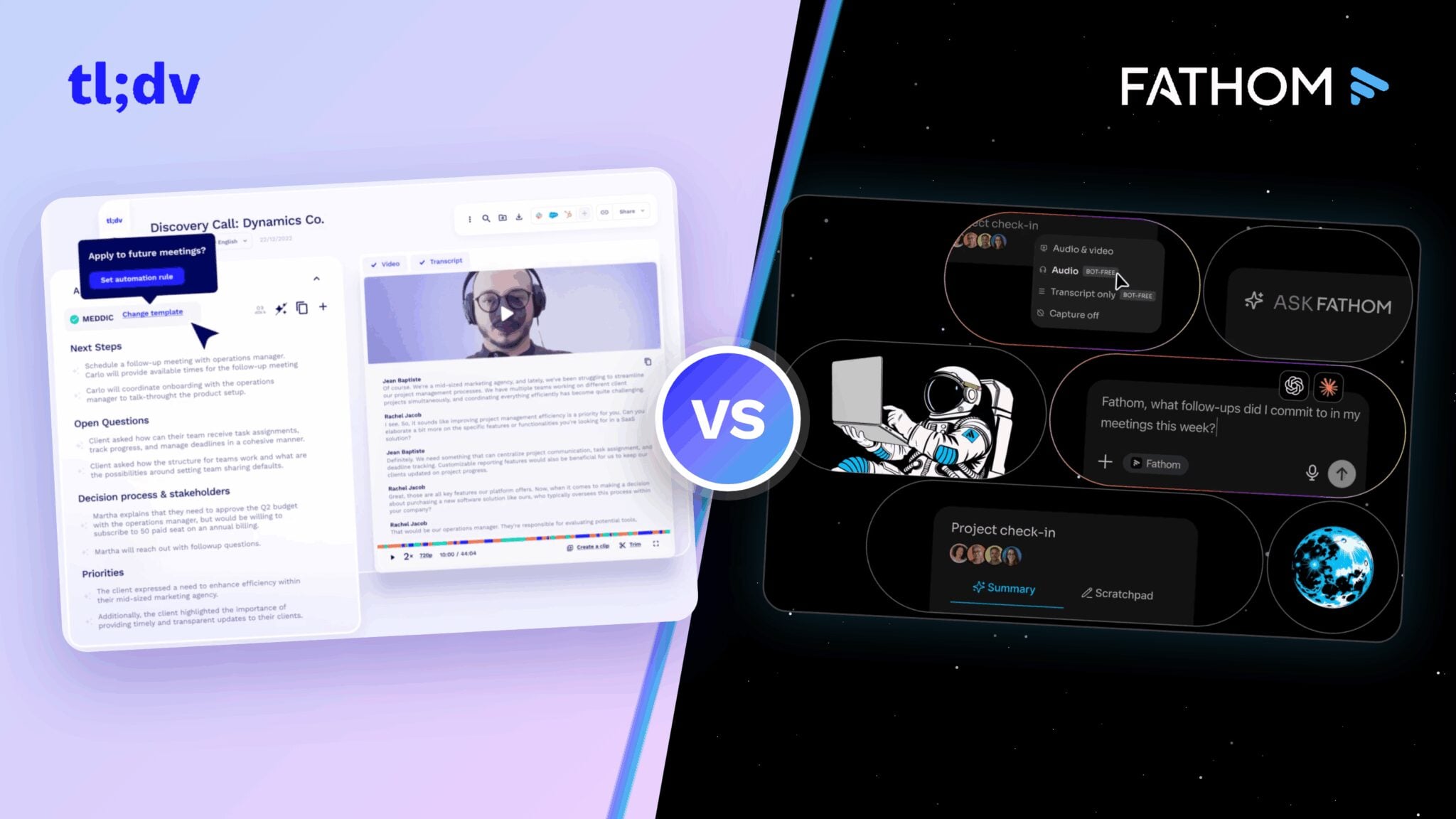
tl;dv meeting notetaker is built for the team around them. It records Zoom, Google Meet and Microsoft Teams in 30+ languages, as a bot or bot-free from the desktop app, and keeps the video and audio rather than the text alone. What it captures flows into HubSpot, Salesforce, Slack and 5,000+ other tools, and on the Business plan it scores calls against your sales playbook. It holds 4.7/5 on G2 from over 500 reviews and is used by more than 2 million users.
| Recurso | Wispr Flow Notetaker | tl;dv |
|---|---|---|
|
Plataforma |
Mac and Windows. No mobile app for meetings |
Mac, Windows, iOS and Android |
|
Captura sem bots |
Sim |
Sim |
|
Grave e transcreva reuniões em mais de 30 idiomas |
21 |
Mais de 30 com detecção automática |
|
Transferência de vocabulário |
Herda o seu dicionário de ditado |
Vocabulário personalizado, configurado separadamente |
|
Registro mantido |
Transcrição e resumo |
Vídeo e áudio, biblioteca com função de pesquisa |
|
Vídeos com marcação de tempo e compilações de melhores momentos |
Não |
Sim |
|
Resumos pré-reunião |
Sim, reuniões externas |
Não |
|
Análise do tempo de conversação |
Não |
Sim |
|
CRM |
Pelo MCP, monte você mesmo |
Native HubSpot, Salesforce, Pipedrive |
|
Coaching e a pontuação do “ playbook ” |
Não |
Sim, Plano de negócios |
|
Pesquisa em toda a equipe |
Não |
Sim |
|
Plano empresarial |
Sim |
Sim |
|
Residência de dados |
EUA |
EU |
|
Plano gratuito |
Limite semanal de reuniões, incluindo o MCP |
Unlimited recording, AI notes on 10 meetings |
O Wispr Flow Notetaker é a melhor opção se você:
- Work on Mac or Windows and mostly take notes for yourself
- Já é assinante do Flow e deseja ter as anotações das reuniões incluídas sem custo adicional
- Run your meetings in one of its 21 languages
- Gostaria de receber resumos antes das reuniões sobre chamadas externas
- Prefiro inserir notas no Claude ou no ChatGPT em vez de usar um fluxo de trabalho integrado
tl;dv a melhor opção se você:
- Need meetings covered on mobile as well as desktop
- Run calls in languages outside Wispr’s 21
- Preciso da gravação em si, não apenas da transcrição
- Gostaria que os campos do CRM fossem preenchidos automaticamente, em vez de serem exportados via MCP
- Precisa de pontuaçõ coaching, playbook ou acompanhamento de objeções em toda uma biblioteca de chamadas
- Need your data stored in the EU
O veredicto final: quem deve usar o Wispr Flow?
Depois de duas semanas de testes, eis a conclusão a que cheguei.
Wispr Flow started as a dictation tool, and on that job it’s good. The AI formatting works, the cross-platform sync works, and Command Mode is useful once you get the hang of it. If you want to stop typing emails and Slack messages, the free plan is enough to find out whether it suits you.
But with Notetaker, Wispr is no longer just a dictation tool. It now wants to record your meetings too, and that’s a different job with a much higher bar. Notetaker is built for one person taking their own notes. It keeps the transcript, not the recording. There’s no mobile app for meetings, no native CRM sync, and your data is processed and stored in the US. In our hands-on Notetaker review, it also slowed calls on an 8 GB Mac.
If your meetings matter to more people than the person who took the notes, you need the recording, a library your team can search, and your CRM updated without anyone remembering to do it. That’s the job tl;dv was built for. It records Zoom, Google Meet and Microsoft Teams in 30+ languages, with a bot or bot-free from the desktop app. It keeps the video from bot recordings, fills in HubSpot, Salesforce and Pipedrive automatically, and stores your data in the EU.
Use Wispr Flow to dictate. Use tl;dv to record and share your meetings. The free plan gives you unlimited recordings, so you can try it on your next call. Try tl;dv free.
FAQs About Wispr Flow
O Wispr Flow é gratuito?
Yes. Wispr Flow’s free plan includes 2,000 words a week on Mac or Windows and 1,000 words a week on mobile, plus the custom dictionary, snippets and Notetaker with a weekly meeting limit. You can switch off model training on the free plan. Pro removes the word limit for $12 a month billed annually, or $15 monthly.
O Wispr Flow funciona no Windows?
Yes. Wispr Flow runs on Windows as well as Mac, iPhone and Android, and your dictionary, snippets and settings sync across all of them. That cross-platform support is one of its biggest advantages over SuperWhisper, which only runs on Mac and iOS. Like the Mac app, it works inside any app where you can type.
O que é o Wispr Flow Pro e vale a pena comprá-lo?
Flow Pro costs $12 a month billed annually, or $15 monthly. It removes the weekly word limits, adds Command Mode for editing text by voice, raises Notetaker’s meeting limits and adds shared team dictionaries. If you dictate daily for work, you’ll hit the free limit within days, so Pro is worth it for regular users.
O Wispr Flow é seguro e confidenciais?
Wispr Flow processes audio in the cloud and stores data in the US, with no offline mode. You can switch off model training and dictation cloud storage in Data and Privacy settings. Model training is on by default on Free and Pro. Wispr’s security FAQ says its new SOC 2 Type II and ISO 27001 reports are available through its Trust Center.
Como funciona o Modo de Comando no Wispr Flow?
Command Mode lets you edit text by voice. Switch it on under Settings, then Experimental, highlight some text, hold Fn + Ctrl on a Mac and say an instruction such as “make this more formal”. Flow rewrites the selection, or shows it to copy in apps like Google Docs. It needs a paid plan or an active trial.
Quais idiomas o Wispr Flow suporta?
Wispr Flow dictates in over 100 languages. With auto-detect switched on, it identifies the language you’re speaking on Mac, Windows and iOS, choosing one language per dictation. Android needs you to pick the language yourself. Flow’s Style settings, which control how formal or casual your text sounds, currently only work in English.
O aplicativo de anotações Wispr Flow funciona no Windows?
Yes. Wispr Flow Notetaker launched on Mac on August 5, 2026, and came to Windows on September 15, 2026. It records meetings without a bot joining the call and transcribes 21 languages. There’s no mobile app for meetings. Notetaker is included on the free plan with a weekly meeting limit, and recordings under five minutes don’t count.