Passer au contenu






TL;DR: Get Started with Video Transcript Generators
A video transcript generator uses AI speech recognition to turn the spoken audio in a video into searchable, timestamped text, usually in minutes. Upload your MP4 or MOV (or record the meeting at the source), let it process, then edit and export.
Free tiers are fine for occasional videos; paid plans unlock bigger limits, downloads, and better accuracy. If you need subtitle files, pick a tool that exports SRT or VTT. If the video is confidential, check where it’s stored and whether it trains anyone’s AI before you hit upload.
tl;dv lets you upload 5 video (or audio) files for free, and the transcript comes with a timestamped summary. Transcribe your file here.
A video transcript generator turns the speech in a video into written text automatically, giving you a searchable transcript in minutes instead of an afternoon of typing. And it really is an afternoon: if you transcribe a meeting by hand, expect around four hours of work for every hour of audio.
I’ve done the manual version. Pause, rewind, squint, type “[inaudible]” for the fourth time, repeat until you want to claw your eyes out. It’s not fun.
The good news is that AI has made video to transcript conversion close to effortless. The less-good news is that “video transcript generator” now covers everything from free browser tools to open-source models on your laptop, and they’re not interchangeable. Some give you transcripts. Some give you subtitle files. Some store your video forever…
So here’s how they work, what they cost, how accurate they really are, and how to pick one without uploading your quarterly board meeting to a site you found on page four of Google.
What Is a Video Transcript Generator?
A video transcript generator is software that pulls the audio out of a video file and converts the spoken words into text using automatic speech recognition (ASR). The good ones also label who’s speaking, add timestamps, and let you search, edit, and export the result.
That’s the main difference from dictation apps, which are built for one person talking into a mic in real-time. A transcript generator is built for messy, finished recordings: multiple speakers, background noise, and someone’s dog that won’t stop barking.
How Does a Video Transcript Generator Work?
Most generators use the same set-up:
- Audio extraction. The tool strips the audio track out of your video. The pictures don’t matter to it; only the sound does.
- Speech recognition. An ASR model trained on huge amounts of multilingual speech converts the audio into words.
- Speaker diarization. The tool works out who spoke when and groups the text into “Speaker 1,” “Speaker 2,” and so on.
- Timestamping and formatting. Each line gets a timestamp, and the text is split into readable paragraphs.
Some tools add a fifth step: feeding the transcript to a large language model for summaries, action items, or Q&A. More on that later.
Transcripts vs. Captions vs. Subtitles: What’s the Difference?
A transcript is the full text of a video in one readable document, while captions and subtitles are timed text that appears on screen as the video plays. Captions include sound cues like [laughter] for viewers who can’t hear the audio, while subtitles usually assume you can hear it but don’t understand the language.
The W3C’s Web Accessibility Initiative notes that descriptive transcripts are needed for people who are both deaf and blind.
| Format | What it is | À qui s'adresse-t-il ? | Typical file |
|---|---|---|---|
| Transcription | The full text of everything said, in one document | Readers, researchers, anyone searching or quoting the video | TXT, DOCX, PDF |
| Captions | Timed on-screen text, including sound cues like [laughter] | Viewers who are deaf or hard of hearing, or watching on mute | SRT, VTT |
| Subtitles | Timed on-screen text of the dialogue, often translated | Viewers who don't speak the video's language | SRT, VTT |
How to Generate a Transcript from a Video
The fastest way to generate a transcript from a video is to upload the file to an AI transcription tool like tl;dv and let it process. This usually takes just a few minutes. However, the exact route depends on whether your video is stored locally or found online.
Uploading a Video File
Here’s the process in tl;dv, which is free to start (the steps are similar in most tools):
1. Create a free account and open your Meeting Library.

2. Click Manage uploads (see above), then Select files, and choose your video or audio file.
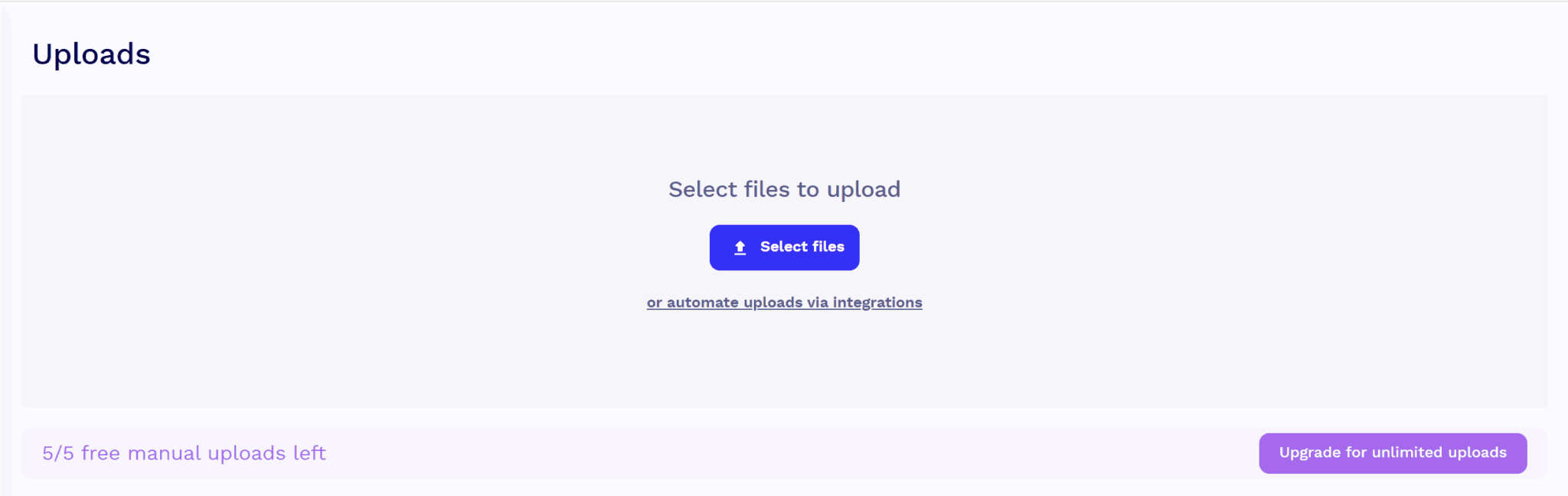
3. Wait for the file to upload. This usually takes a few minutes and then it’ll appear in your upload list.
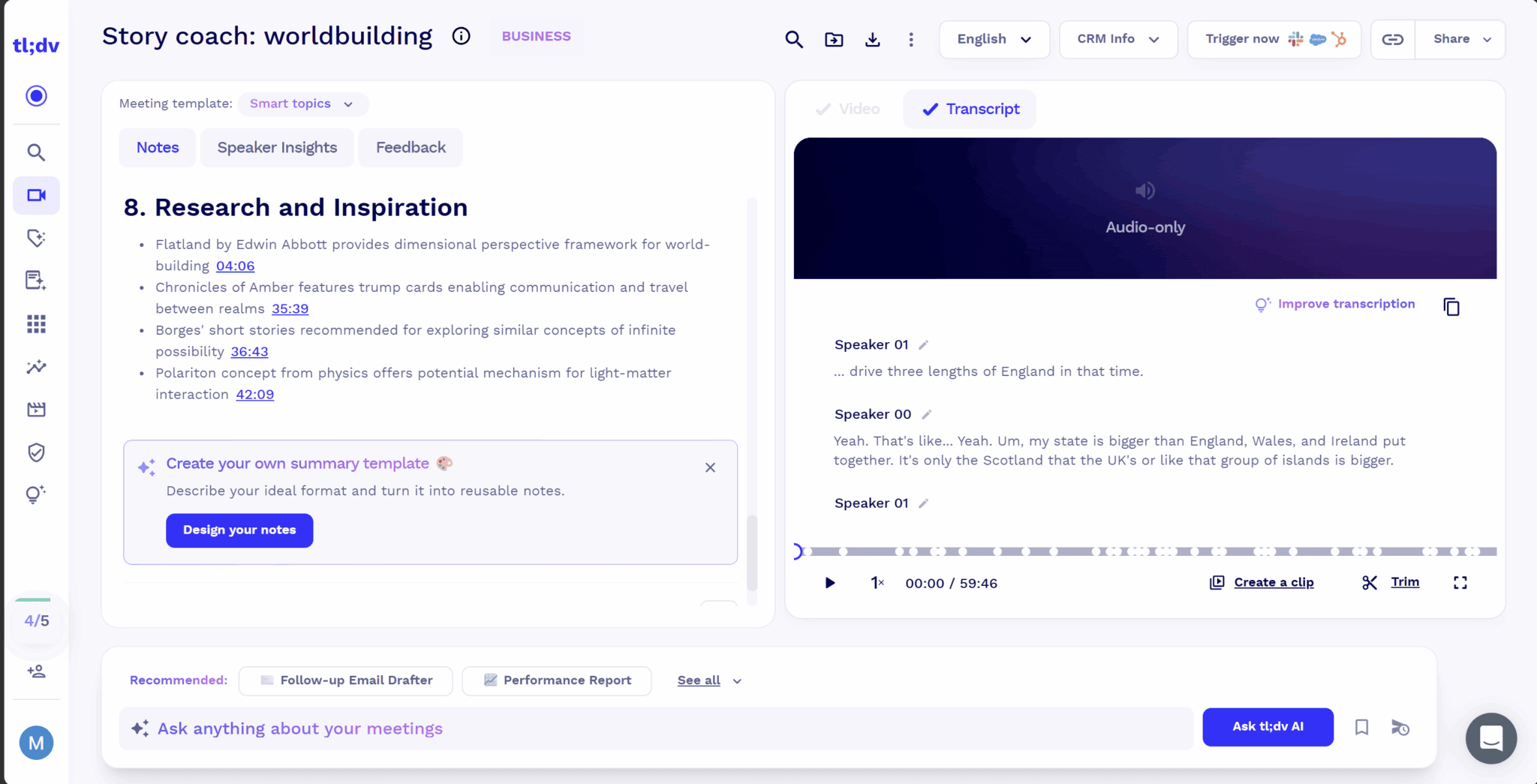
4. Open the recording to find your timestamped transcript, with AI notes on top.
If you’re working with a specific file type, I’ve written a more detailed walkthrough on how to convert MP4 to text, including free DIY methods that don’t need a sign-up.
Transcribing a YouTube or Other Online Video
If a YouTube video has captions, YouTube already has a transcript for you: open the video’s description, scroll down, and click Show transcript. It’s free and quick, but it only exists if captions do, and auto-generated ones can be rough on names and jargon.
For videos without captions, or on platforms like Vimeo, TikTok, or Instagram, you’ve got a few options. Some generators accept a URL directly. Otherwise, download a video you own or have permission to use and upload the file, or play it while a desktop recorder captures the audio. tl;dv’s desktop app records whatever audio your device plays, so it handles a YouTube tab as happily as a sales call, however, it’s focused towards productive meetings, not random chats.
Also remember that “it’s on the internet” doesn’t mean “I have the rights to it.”
Transcribing Zoom, Google Meet, and Teams Recordings
If the video is a meeting, skip the download-and-upload shuffle entirely and transcribe it at the source.
Meeting assistants record while the call happens, so the transcript is ready when the meeting ends. tl;dv handles Google Meet transcription, Zoom call transcripts, Teams with a recording bot (for video), or any device audio bot-free through the desktop app. You get AI notes before you’ve even closed the tab. Just make sure everyone knows they’re being recorded (more on that below).
Which Video Formats Can You Upload (and What Comes Out)?
Most video transcript generators accept MP4, MOV, AVI, MKV, and WebM, which covers nearly every video you’ll ever record. Output is where tools really differ: some give you plain text, others give you subtitle files, and a few give you both.
Input Formats, File Size, and Length Limits
tl;dv’s upload tool accepts MP4, MOV, AVI, MKV, FLV, WMV, MPEG, WebM, and 80+ other video formats, plus audio files like MP3, WAV, FLAC, and AAC. Uploads can be up to three hours long. The free plan includes up to five uploads, and Pro and above remove the cap entirely.
Other tools cap file size, monthly minutes, or both. If your video is too big, trim it or upload just the audio. The transcript doesn’t care that you shot it in 4K.
Output Formats: TXT, DOCX, SRT, and VTT
The right export format depends on what you’re doing with the transcript next:
| Export format | What it is | Meilleur pour | Horodatage |
|---|---|---|---|
| TXT | Plain text, no formatting | Pasting into docs, notes, or AI prompts | En option |
| DOCX / PDF | A formatted document | Sharing, editing, and archiving | En option |
| SRT | Numbered, timed caption blocks | Uploading captions to YouTube and social platforms | Oui |
| VTT | Web caption format with styling options | Captions for video players on your own website | Oui |
| JSON | Structured data with word-level timing | Developers, analysis, and automations | Oui |
If you’re thinking of using tl;dv, you should know it’s built for searchable transcripts of meetings and recordings, not subtitle files. On Pro and above, you can download or copy transcripts anywhere. But if you need SRT captions for a YouTube channel, a video editor or captioning tool is the better fit.
For a wider look at the options, see this guide to converting video to text.
How Accurate Are AI Video Transcript Generators?
On clear audio with one speaker, a good AI transcript generator gets the vast majority of words right. It’s usually 90%+. However, on messy audio with crosstalk, heavy accents, and jargon, accuracy drops noticeably.
The tool is important, but never as important as the recording itself.
What Affects Transcription Accuracy?
Five things do most of the damage:
- Audio quality. Laptop mics in echoey rooms are the worst. A cheap headset is often better.
- Overlapping speech. When two people talk at once, most models pick one and drop the other.
- Accents and dialects. Models do best on the speech they were trained on most. A Stanford study of systems from Amazon, Apple, Google, IBM, and Microsoft found they misheard 35% of words spoken by Black speakers versus 19% by white speakers. Models have improved since 2020, but uneven training data is still the root problem.
- Jargon and names. Product names, acronyms, and surnames often get mangled.
- Background noise and music. If there’s audible music with lyrics, it’s pretty much game over.
There are a few easy fixes for these problems: use a decent mic, avoid crosstalk or background music, set the language manually if auto-detect guesses wrong, and add recurring names to a custom vocabulary list if your tool has one.
Which Languages Are Supported?
Most major generators handle dozens of languages. tl;dv, for instance, transcribes in 40+. The real differences are whether the tool auto-detects the language, copes with a video that switches languages midway, and performs well outside English. On tl;dv, auto-detect and multi-language meetings are Business plan features.
If you work in other languages, tl;dv’s language-specific tests, like Spanish meeting transcription tools and Russian transcription accuracy, show how much results vary once you leave English.
Can It Tell Speakers Apart and Add Timestamps?
In 2026? Absolutely. Most modern generators do both automatically. Speaker diarization splits the transcript by voice, and timestamps mark when each line was said, so you can click to jump to that moment in the video.
Diarization is the feature most likely to wobble with similar-sounding voices or crosstalk, so look for a tool that lets you relabel speakers in a couple of clicks. tl;dv includes automatic speaker detection and manual speaker labeling on every plan, including free.
AI vs. Human Transcription: When Do You Need a Person?
For meetings, interviews, research, and content repurposing, AI is fast and cheap enough that a human transcriber rarely makes sense. Do a quick proofread and move on.
For legal proceedings, medical records, published quotes, and strict verbatim transcripts, use a human service or have a person review the AI’s work line by line. AI tends to tidy speech up, which is great for readability and terrible for court.
For side-by-side scores across tools, see tl;dv’s best transcription software accuracy test.
Is There a Free Video Transcript Generator?
Yeah, plenty of video transcript generators are free to start, but almost all of them cap something: minutes, uploads, exports, or file retention.
tl;dv’s free plan includes unlimited recordings and transcription, but this is only useful if you’re capturing the video/audio live. If you have a file you want to transcribe, tl;dv’s free plan will cap you at five video uploads, AI notes for 10 meetings, and 10 Ask AI queries. Recordings are kept for up to three months on free.
That’s plenty for occasional videos, but if you need more:
- Pro: $18 per seat per month billed annually. This adds unlimited uploads, unlimited AI notes, and unlimited downloads.
- Business: $29 per seat per month billed annually. Here you get premium transcription quality, multi-language meetings, and custom vocabulary.
Full details are on the tl;dv pricing page.

What Free Plans Usually Leave Out
When it comes to video transcript generators, here are the usual culprits for free plan fineprint:
- Minute caps. A monthly allowance that one long webinar can swallow whole.
- Export locks. You can read the transcript but not download it, or you can’t export subtitle files.
- Short retention. Files get deleted after a set period, so download anything you need.
- Weaker models. Some tools save their most accurate model for paying customers.
If you mostly need meeting transcripts, free AI note taking tools are often more generous than general-purpose generators, because they want you back every week.
Is It Safe to Upload Videos to a Transcript Generator?
Uploading to a reputable transcript generator is generally safe, but “reputable” is the key word. Before uploading anything confidential, check four things:
- Where your data is stored. EU-based storage matters if you’re working under GDPR.
- How long it’s kept. Look for retention settings and a clear way to delete files.
- Whether it trains AI models. Some free tools pay for themselves with your data. tl;dv does not use customer meeting data to train AI models, as covered in its guide to AI and privacy.
- Security certifications. GDPR compliance and SOC 2 are the baseline for business use.
For vendors that actually publish their data practices, see this roundup of GDPR compliant meeting assistants. If other people appear in your video, consent is your job. It’s worth checking whether it’s illegal to record someone without their permission where you live. As a general rule of thumb, just ask. It’s polite.
Can You Transcribe Videos Offline?
Yes. Open-source speech recognition models can run entirely on your own computer, so the video never leaves your machine. Tools like Vibe Transcribe, Transcribe Offline, or VoiceScriber all work on your device so sensitive recordings have maximum privacy.
As always, there are trade-offs when you want to do something offline. It depends on the specific tools, but usually you’ll need some technical know-how (command lines, Python packages), a reasonably powerful computer, and patience without a good GPU. These video transcript generators will also give you a raw transcript with no summaries, search, or sharing options.
Which Video Transcript Generator Should You Use?
The best video transcript generator depends on the video and what you’ll do with the transcript: AI meeting assistants are best for calls, video editors are great for captions, local models are the premium option for privacy, while humans are unbeatable for legal-grade accuracy.
Here’s how the main categories compare:
| Generator type | Meilleur pour | SRT/VTT export | Résumés créés par l'IA | Confidentialité | Price model |
|---|---|---|---|---|---|
| AI meeting assistants (e.g., tl;dv) | Meetings, interviews, recurring calls | Variable | Oui | Cloud; check retention and training policies | Free plan, then per seat |
| Video editors with transcription | YouTubers, podcasters, marketers | Oui | Variable | Nuage | Free plan, then subscription |
| Open-source local models | Sensitive footage, technical users | Oui | Non | Stays on your computer | Free (your hardware) |
| Platform built-ins (YouTube, Zoom, Teams) | Quick transcripts of content already on that platform | Variable | Variable | The platform's own policies | Included; AI extras often paid |
| Human transcription services | Legal, medical, verbatim, published quotes | Often | Non | Cloud; human reviewers see your files | Per minute of audio |
YouTuber who needs SRT files? A video editor is the obvious pick (Dani’s Descript review covers a popular one). Recording 15 customer calls a week? A meeting assistant skips the upload step entirely. Researcher with sensitive interviews? A local model or a GDPR-compliant tool with strict retention is worth the setup.
What to Look for Before You Upload Anything
- Formats in: Does it accept your file type and video length?
- Formats out: Do you need plain text, a document, or SRT/VTT captions?
- Languages: Does it support yours, and can it handle language switching?
- Speakers: Can it label speakers and let you fix mistakes?
- Limits: What’s capped on the free plan, and what does the next tier cost?
- Privacy: Where’s the data stored, for how long, and does it train models?
What Can You Do with a Video Transcript?
A transcript turns a video you have to watch into text you can search, skim, quote, and reuse. It pays off in a number of ways.
Accessibilité
Over 430 million people need rehabilitation for disabling hearing loss, according to the WHO, and that’s projected to pass 700 million by 2050. Transcripts and captions are how those viewers access your content. Under WCAG success criterion 1.2.1, a text alternative is required at Level A for prerecorded audio-only content, and a transcript is the standard way to provide it.
SEO and Content Repurposing
Search engines can’t skim a video the way they skim a page. Google’s video SEO best practices ask for unique titles, descriptions, and timestamped key moments, and a transcript is the fastest way to write all three. It’s also raw material for blog posts, show notes, social clips, and pull quotes.
Summaries, Action Items, and Ask AI
This is where transcript generators and AI meeting assistants start to merge. Once you have the text, AI can summarize it, pull out decisions and action items, or answer questions like “What did the client say about pricing?”
tl;dv’s video summarizer does this for uploaded and recorded videos, and its meeting recordings and transcriptions are searchable across every call, not one file at a time.
Conclusion
A video transcript generator does exactly what it promises: generates a transcript from your video. For most people, the choice comes down to three questions:
- What format do you need to export?
- How sensitive is the video?
- Do you want AI to do something useful with the transcript afterward?
If your videos are mostly meetings, interviews, or recorded calls, start with a free tool that records at the source and gives you notes on top. Need subtitle files? Pick an editor. If the footage is confidential, keep it local or read the vendor’s data policy first.
Either way, you’ll never have to manually transcribe a meeting again.
FAQs About Video Transcript Generators
How Long Does It Take to Generate a Transcript from a Video?
Usually a few minutes. Most AI generators process a video in a fraction of its running time. Uploading a large file often takes longer than transcribing it, so extracting the audio first can help.
Can a Video Transcript Generator Create SRT Subtitle Files?
Many can, but not all. Video editors, captioning tools, and open-source models commonly export SRT and VTT. Meeting-focused tools, including tl;dv, prioritize searchable text transcripts and AI notes instead, so check the export options before you commit.
Can AI Transcribe Videos in Real Time?
Yes. Meeting assistants and live captioning tools transcribe as people speak, so the transcript is ready when the call ends. For prerecorded videos, transcription after upload is the norm.
Can a Video Transcript Generator Translate the Transcript?
Many can. Some tools translate the finished transcript into another language, while others generate translated subtitles directly. Quality varies by language pair, so have a fluent speaker review anything you plan to publish.
Is There an API for Converting Video to Text?
Yes. Many speech-to-text providers offer APIs that return timestamped transcripts, which is handy for batch jobs. tl;dv also offers an API, webhooks, and an MCP server on Pro and above for piping transcripts into other apps.