Skip to content







A team of B2B marketing and sales DX specialists at FLUED achieved a reduction of 20 hours per person per month in meeting-related costs after adopting tl;dv. But as they soon discovered, the real value had nothing to do with saving time on meeting notes.
Table of Contents
About FLUED
FLUED Co., Ltd. is a specialist firm dedicated to B2B marketing and sales DX. The company provides comprehensive support across sales strategy, sales process design, and digital tool implementation.
Soichiro Matsunaga, Representative Director, first recognized the potential of CRM at a time when analog sales methods were still the norm — an experience that helped him more than double sales performance. After working at a major advertising agency’s marketing support subsidiary, he founded FLUED in 2019. Today, the firm has supported over 500 projects, ranging from startups to publicly listed companies.
FLUED’s meetings fall into two broad categories: client-facing meetings and internal meetings held to relay client discussions to engineers, designers, and other specialists. It was this structure that would eventually become a significant operational challenge.
A Problem That “Meeting Notes Tools” Could Not Solve
The core challenge FLUED faced can be summarized in a single phrase: ballooning meeting costs.
“In order to communicate what we’ve agreed with clients to our designers and engineers, internal meetings become unavoidable. And the cost of those meetings is anything but trivial,” says Matsunaga.
The problem was compounded by the fact that employees who did not need to attend were being included anyway. Consider a four-person team comprising a project manager, a lead consultant, an engineer, and a designer. If only one of five agenda items required the engineer’s input, all four team members still had to coordinate their schedules for the sake of that single item. This created what Matsunaga calls “scheduling costs.”
More significantly, team members who had no need to attend were physically present in meetings — generating “attendance costs” through the consumption of their own time. In practice, if only the project manager and lead consultant needed to participate and absorb the client discussion, the information could simply be passed on to the engineer and designer afterward. Eliminating this unnecessary participation could free up valuable time for other work.
Matsunaga’s own calculations indicated that excess meeting-related costs amounted to approximately 20 hours per person per month — equivalent to roughly 800,000 yen per employee per month.
There were qualitative challenges as well. CRM data entry quality was inconsistent across team members: “The level of detail varied enormously. Depending on who was reporting, the same client interaction might read as positive or neutral. Nuance simply wasn’t being conveyed.” This is a challenge familiar to many sales organizations.
Why FLUED Chose tl;dv
At the time, FLUED was evaluating existing voice transcription tools including Amptalk and MiiTel. Neither, however, led to adoption. The obstacles were difficulty integrating with their CRM of choice — HubSpot — and an unintuitive recording setup process.
That was when they discovered tl;dv.
“It integrates with Google Calendar for automatic recording, and syncs automatically with HubSpot. That’s what made us pull the trigger”, Matsunaga recalls.
Unlike the tools they had previously considered, tl;dv required no complex integration work and could be set up by non-technical staff with ease. It could be introduced seamlessly without disrupting the existing habits of the sales team.
tl;dv also addressed the CRM data consistency problem: “Getting information in a standardized format has been genuinely helpful. The variation in detail level and individual writing tendencies that used to creep in — that’s gone now,” says Matsunaga.
The Results: 20 Hours Per Person Per Month Recovered
The rollout was remarkably straightforward. A small group of three to four employees tried the free plan on their own initiative, confirmed its value, and then transitioned to a paid plan — all without any formal directive from Matsunaga. Full company adoption followed within approximately one month, with Google Calendar integration and the establishment of a few management guidelines being all that was required.
The quantitative impact was clear: 20 hours per person per month in meeting-related costs were eliminated, primarily through a reduction in internal meetings and faster catch-up on client meetings that certain team members no longer needed to attend in person.
But the more significant changes were behavioral.
Information access became dramatically faster: “Everyone started going to tl;dv first. Before messaging on Slack or raising something in a meeting, people would check tl;dv. Quick questions — when is the next meeting? Who was assigned that action item? — could be answered instantly using Ask tl;dv AI, without having to wait for someone to respond. That eliminated a lot of idle time and accelerated the pace of work.”
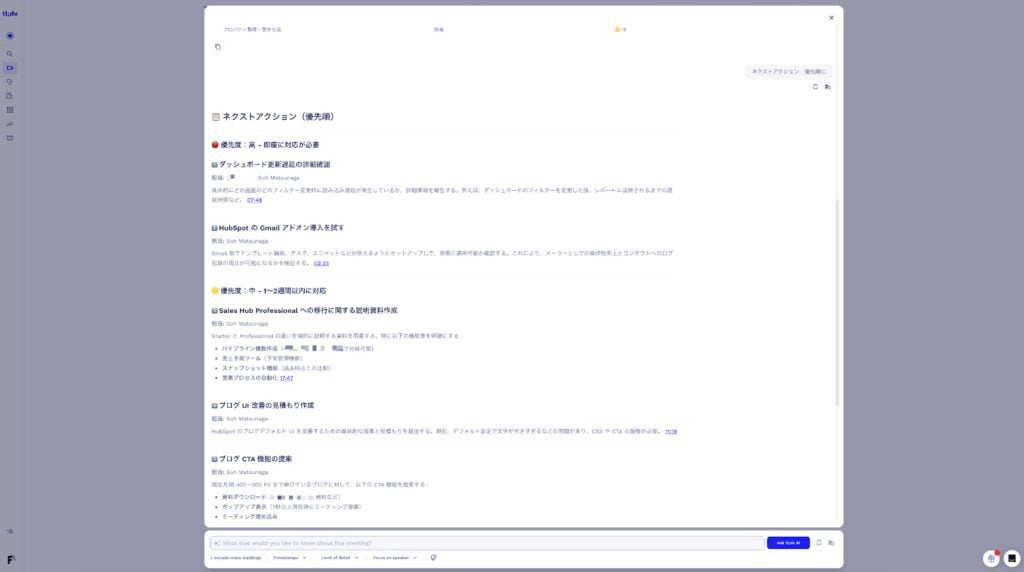
The clip feature also came into regular use. Team members began cutting out relevant sections of meetings — “this part covers the design discussion” — and sharing them internally. This enabled colleagues to access only the information they needed, reducing unnecessary review time.
Ambiguity in meetings decreased. Meeting behavior changed as well: “when it comes to next steps, people started consciously confirming: ‘So this is due by this date, and this person is responsible — correct?’ Vague conclusions became far less common.” The knowledge that everything was recorded and accessible to the entire organization brought greater clarity and accountability to how people communicated.
Proposals stopped being pushed to the next day. Perhaps the most impactful change for the business itself was this: “We record our client meetings with tl;dv, then use those notes to organize the proposal content and build the presentation slides. The speed of that process has clearly improved. The likelihood of it spilling over to the next day has dropped noticeably.”
In other words, tl;dv is not merely a reference tool for later review — it is actively enabling the team to prepare and submit client proposals on the same day. Faster response times are compressing the entire sales cycle.
Unexpected Use Cases
“Consultant A may have made a particular proposal to a client in the past. Consultant B has never done it before. Consultant A can say, ‘Take a look at how I handled it.’ That kind of knowledge sharing is now happening naturally through tl;dv.”
The sales and consulting teams have also used it to prevent “he said, she said” disputes. “Disagreements over what was originally discussed do come up. But with everything recorded, you can always go back and check. We’ve been able to prevent the misalignments between what was discussed during the sales process and what was understood during project delivery.”
It has also proven useful for business continuity when team members are unexpectedly absent. “If you look at the CRM and tl;dv logs, the full history of actions and conversations is there. Even without formal documentation, you can hand off a project just from that.”
The Essence of tl;dv: An Information Consolidation Platform
Matsunaga is explicit in rejecting the label of “meeting notes tool.”
“tl;dv is not simply a tool for recording the conversations of salespeople and consultants. I think of it as a tool that transforms conversation — unstructured data — into structured information through CRM integration, making it available for the entire organization to leverage.”
What tl;dv records is not merely the verbatim content of conversations. It extracts the relevant information — sales representative, deal stage, customer sentiment — and automatically stores it in the CRM. It consolidates scattered information in a single location, making it accessible and actionable for every member of the sales and consulting team. That, in Matsunaga’s view, is the true nature of tl;dv.
And this understanding is precisely what makes the next step clear.
Looking Ahead: Toward Data-Driven Sales DX
Matsunaga is currently exploring the use of agentic AI.
“We have recordings and transcripts accumulating in tl;dv. I want to build an agent that retrieves that data via Claude Code and automatically updates the CRM. I’m also considering an AI agent that sends an automatic Slack message when a salesperson forgets to ask about something critical — like an expected implementation timeline”.
On the subject of API utilization, Matsunaga reflects: “Honestly, we could have started on this six months ago. I wish we had moved sooner.” That sentiment speaks to just how much potential tl;dv holds.
A Message to Organizations Considering tl;dv
“If you think of it as just a ‘meeting notes tool,’ you’re capturing maybe a tenth of its value. tl;dv is a tool for structuring and consolidating customer conversation data. Try the free plan. The plan structure makes proof-of-concept straightforward — we’d strongly encourage you to give it a go.”
In Summary
FLUED adopted tl;dv in pursuit of seamless CRM integration. What they gained, however, went far beyond a reduction in meeting costs — it was the transformation of organizational conversation into a strategic information asset. Knowledge sharing, business continuity, dispute prevention, and now the expansion into agentic AI: the true value of tl;dv extends well beyond what the label “meeting notes tool” could ever capture.