Skip to content






TL;DR: tl;dv vs Krisp — Which is Better?
tl;dv is a meeting intelligence platform that records, transcribes, and summarizes meetings in 40+ languages, then turns them into searchable notes, CRM updates, and action items. Krisp started as real-time noise cancellation and has since added its own AI Note Taker and transcription, but as of writing, Krisp has dropped its permanent free plan in favor of a 7-day trial.
If your main problem is bad audio, Krisp handles that well. If your main problem is what happens after the meeting, tl;dv is built for that specifically.
tl;dv and Krisp get compared a lot, but they didn’t start out solving the same problem. Krisp began as noise cancellation software that scrubs barking dogs and background chatter out of your calls in real time. tl;dv began as an AI meeting assistant built to record, transcribe, and summarize meetings so nobody on the call has to type notes.
Krisp has since bolted on its own AI Note Taker, transcription, and meeting summaries, but the two products still lead with different strengths. Krisp dropped its standing free plan recently, while tl;dv’s free forever plan means what it says. That means that a lot of comparison content out there is out of date, still praising Krisp’s now non-existent free plan. For the most up-to-date comparison, read on.
tl;dv vs Krisp at a Glance
| Category | tl;dv | Krisp |
|---|---|---|
| Built for | Meeting intelligence: notes, summaries, CRM sync | Real-time noise cancellation + meeting notes |
| Recording method | Bot or bot-free desktop app (any audio source) | Bot or bot-free (Core plan and up) |
| Free access | Free plan unlimited recording, 10 AI-noted meetings/mo | 7-day trial no ongoing free tier |
| Entry paid plan (monthly) | $29/mo (Pro) | $16/mo (Core) |
| Entry paid plan (annual) | $18/mo billed annually ($216/yr) | $8/mo billed annually ($96/yr) |
| Transcription languages | 40+ | 16+ |
| Standout strength | Meeting summaries, multi-meeting search, MCP server | Real-time noise cancellation, accent conversion |
There are two key findings here. One is that Krisp has meeting notes and transcripts, but that’s not its primary use case. The main reason people go to Krisp is for audio quality.
The second important takeaway here is that Krisp’s entry paid plan, Core, is exactly that: core. It is Krisp’s earliest plan, meaning you must pay to use it once your trial is up. tl;dv provides unlimited meeting transcriptions for free, as well as 10 AI notes per month, and limited other features. Then, its Pro plan unlocks MCP (model context protocol), 5,000+ integrations, and unlimited AI notes.
What Is Each Tool Actually Built For?
tl;dv is an AI meeting assistant: it joins or listens to your meetings, transcribes them in 40+ languages, and turns the conversation into searchable notes, summaries, and action items that can push straight into a CRM. You can use multi-meeting intelligence to gather info from dozens of calls at once, or even monitor sales playbooks and train reps to close deals faster.
Krisp started as real-time noise cancellation that strips background noise out of any call — dogs barking, keyboards clacking, the upstairs renovation — regardless of which app you’re on, and has since bolted on its own transcription and AI notes.
So are they direct competitors? Only partially, and only recently. For years, Krisp’s entire job was making your audio sound clean; it never touched what happened with the words. tl;dv’s entire job was capturing and making sense of the words; it never touched the audio signal. This has changed, but each tool still has its own specialized focus.
This distinction matters more than most comparisons let on.
Noise Cancellation and Audio Quality
Krisp built its name on real-time noise cancellation, and it’s still the sharper tool for it: every plan, including the 7-day free trial, includes unlimited bidirectional noise removal that strips out background noise, echo, and voices from both your side of the call and the other person’s. tl;dv doesn’t do this at all — it has no real-time audio cleanup layer, so it works with whatever audio your meeting platform or microphone hands it.
You have to download Krisp for it to work, and it includes new mic settings. It runs as a virtual audio device at the OS level, so it filters noise in Zoom, a phone call, or Discord all the same. In fact, companies like Discord and Twilio licensed the tech directly rather than build their own. If your problem is a noisy office, that’s Krisp’s home turf.
Where it matters for tl;dv: transcription accuracy is only as good as the audio coming in. Bad source audio can drag it down, and tl;dv doesn’t have a built-in way to fix that upstream. The honest takeaway — and one we’ll come back to later — is that this isn’t strictly either/or. Krisp cleaning the signal and tl;dv making sense of what’s said afterward aren’t mutually exclusive jobs.
Recording Method: Bot and Bot-Free
Neither tool requires a visible bot to record a meeting. It’s a common assumption and it’s worth correcting before it becomes a hesitation point. tl;dv’s desktop app runs in bot-free mode by default, capturing device audio directly, and Krisp’s Core plan and above offer the same bot-free approach. Both also still support the traditional bot option if you want a named participant joining the call for video recording.
Both bot-free modes are able to record any audio source the device is playing. Think: Zoom, Teams, Google Meet, Webex, a browser-based call, even something like Preply or YouTube. It isn’t tied to recognizing specific meeting platforms because it records at the OS level.
Platform and Meeting Coverage
Functionally, both tools are platform-agnostic once you’re in bot-free mode. Neither depends on recognizing a specific video call app so you can effectively record anything anywhere on both tl;dv and Krisp.
Can Either Record In-Person Conversations?
Yes, on both sides. Krisp lists in-person meeting support across every plan tier, and tl;dv’s bot-free desktop app records whatever audio is coming through the device regardless of whether the other people in the room are on a call at all. If the buying question is specifically “can I record a conference-room conversation with no laptop in a Zoom window,” both tools answer yes — this isn’t a differentiator worth leading with either way.
Both tools also have mobile apps that make this possible.
Transcription Accuracy: Is tl;dv or Krisp Best?
Neither company publishes a head-to-head word-error-rate benchmark against the other, so this section is judgment based on what each product is built to optimize for.
tl;dv’s transcription is the core product; it’s the thing the entire platform is built around, tuned across 40+ languages with custom vocabulary support for jargon and proper nouns. Krisp’s transcription is a newer addition sitting on top of a noise-cancellation engine, which gives it a real advantage on messy audio. A cleaner signal generally means fewer transcription errors, especially in loud environments.
In quiet, well-mic’d conditions, that advantage narrows significantly. Both tools are transcribing clear speech at that point, and the difference comes down to language coverage and vocabulary handling rather than noise.
Language Support
tl;dv transcribes in 40+ languages and also detects new languages automatically. Krisp claims to have transcripts and summaries in 16+ languages, but from personal experience testing Krisp in Spanish, it’s not ideal. In fact, in a preliminary Spanish transcription test (before the rubric was fully settled), I tested several AI meeting assistants, including both tl;dv and Krisp, and Krisp was the only one of six tools to randomly insert Hebrew and Cyrilic characters into the Spanish language test. It also had the second weakest language accuracy of the lot on a transcription of a Spanish TED talk.
That’s not hard science, but it is my personal experience. For multilingual or non-English-first teams, that’s an important addition.
AI Meeting Notes, Summaries, and Action Items: How Do They Compare?
Both tools generate AI meeting summaries and action items, but the tiers where you actually get them differ. tl;dv’s free plan caps AI notes at 10 meetings a month; unlimited AI notes and action item assignment kick in on Pro ($18/mo).
Krisp doesn’t have any free plan. Its Core plan ($8/mo) lists AI Notes & Action Items as unlimited too — worth noting, though, that Krisp’s own comparison table shows “AI Summaries and Action Items” dropping from “Unlimited” on Core to “Custom” on Advanced and Enterprise, which reads like a plan-gated cap rather than a straightforward upgrade, and isn’t explained further on the pricing page.
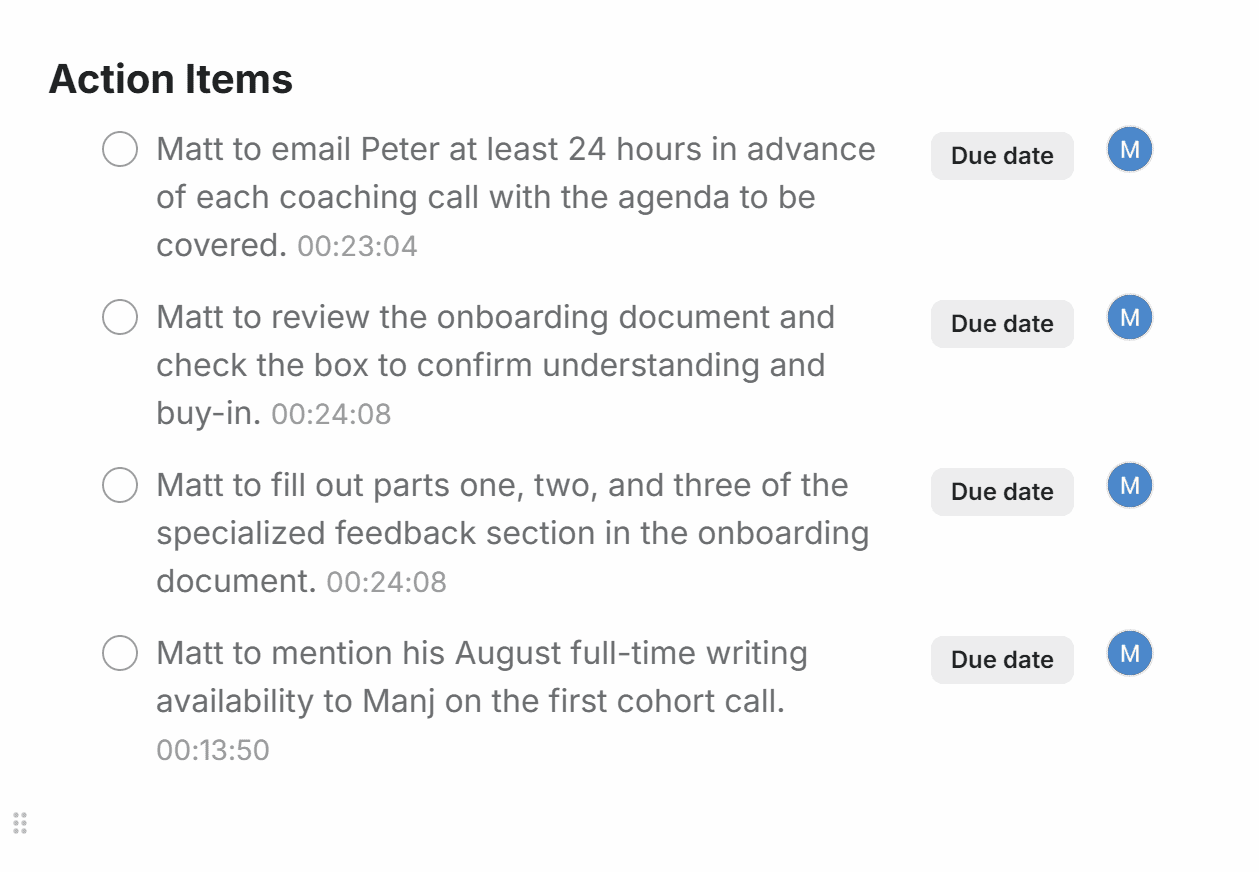
Talking of action items, during one of my tests, Krisp added a fourth action item that didn’t actually exist in real life. This came from a misinterpretation of what was said. I said that I’d already told Manoj and this created an action item to “tell Manj” (in the future).
Where tl;dv pulls ahead is depth beyond the single meeting: Business-tier and up adds multi-meeting AI insights, scheduled reports, playbook monitoring, and objection handling across a whole pipeline of calls, not just one single transcript.
Chatting With Your Meetings
Both list an “AI Chat” feature across their paid tiers, letting you ask questions about a meeting rather than reading the full transcript. tl;dv’s single-meeting Ask AI is available from Pro, with cross-meeting chat folded into the Business-tier multi-meeting insights above. That means you can hit up the AI directly, or through MCP, to get insights from dozens of calls at once, complete with timestamps and all.
Krisp’s AI chat is limited to one meeting at a time.
Multi-Meeting Search and Recurring Reports
This is tl;dv’s more built-out lane. Global transcript search ships from Pro, and Business adds scheduled AI reports and recurring insight generation across meetings. This is the kind of thing a sales manager would use to quickly spot patterns across twenty of the team’s calls, not just one.
Krisp doesn’t have an equivalent cross-meeting reporting feature, meaning each of your meetings have to be taken in isolation. This is a deal-breaker for those who’ve ever experienced the opposite.
Integrations and Workflow Automation
tl;dv connects to calendars and Slack from the free plan, with additional integrations unlocked in Pro ($18/mo), including all major CRMs natively and 5,000+ more via Zapier. This includes auto-sync so your CRMs are filled out without you needing to lift a finger. Every call. Every time. Pro also unlocks API, webhooks, and an MCP server (for connecting tl;dv’s data to Claude, ChatGPT, or custom agents).
Krisp’s Core ($8/mo) plan includes Slack, Zapier, Microsoft Teams, HubSpot, Pipedrive, and Affinity, plus its own MCP integration and webhook API. Salesforce and ConnectWise are gated to Advanced ($15/mo) and above.
The practical difference is less about integration count and more about what’s being synced. tl;dv’s CRM integrations are built around pushing meeting-derived data like call summaries, action items, deal notes directly into CRM records. This is the core use case for sales teams evaluating either tool. While both Krisp and tl;dv lean towards the same goal, tl;dv has more native integrations (HubSpot, Salesforce, Pipedrive, Zoho, etc.) which makes its auto-sync feature smoother than going through a third-party like Zapier.
Which Tool Fits Your Use Case?
Neither product is universally “better” — the right pick depends on which problem is actually costing you time. If it’s messy audio, Krisp’s noise cancellation is a great pick. Krisp also caters to call centers, especially those that are using English with heavy accents. It has a feature for correcting accents on the fly which makes it a good option there, but that’s an entirely different use case.
If you’re more bothered by what happens after the meeting: notes nobody wrote, action items nobody tracked, insights buried in a call from three weeks ago… tl;dv is built around exactly that.
Which is Best for Sales and Customer-Facing Teams?
Sales teams evaluating either tool are usually chasing CRM sync and pipeline-level insight, not just single-call notes. tl;dv has a number of features for exactly that: multi-meeting AI insights, CRM sync, objection handling, playbook monitoring, scheduled recurring reports across a whole deal cycle.
Krisp has sales features (manager view, company deal grouping, Salesforce sync) too, but they’re not on the same level for pulling actual insights from your meetings and organizing post-call workflows.
Which is Best for Noisy, Remote, or Multilingual Setups?
If your team works from cafes or busy co-working spaces with inconsistent audio, Krisp’s real-time noise cancellation is something to think about. For multilingual teams, though, tl;dv’s automatic language detection in 40+ languages against Krisp’s manually selected (one-at-a-time) 16+ makes tl;dv the stronger fit once the conversation moves past English. Noise cancellation means nothing if the transcript itself can’t keep up with the language being spoken.
tl;dv vs Krisp: Pricing Comparison in 2026
tl;dv has four plans:
- Free
- Pro at $29/mo monthly ($18/mo billed annually, $216/yr)
- Business at $39/mo monthly ($29/mo billed annually, $348/yr)
- Enterprise (custom)
Krisp has 3 plans and a free trial:
- 7-day free trial
- Core at $16/mo monthly ($8/mo billed annually, $96/yr)
- Advanced at $30/mo monthly ($15/mo billed annually, $180/yr)
- Enterprise (custom)
On the surface, Krisp looks like the cheaper tool, but anybody who’s ever shopped on Temu knows that cheaper isn’t always better. The real comparison isn’t how much each plan costs, but how much that money actually gets you in terms of features and usage.
They don’t gate the same things. tl;dv’s Pro tier is where CRM sync, unlimited AI notes, and global transcript search unlock. Krisp’s Core tier gets you unlimited noise cancellation and notes, but caps accent conversion at 1 hour a day and pushes Salesforce sync, manager view, and its own AI-summary ceiling up to Advanced.
Comparing sticker price alone misses which features are actually behind each price tag, so let’s take a closer look.
tl;dv’s Free Plan vs Krisp’s Free Trial
This is the sharpest distinction between the two. tl;dv’s free plan is free forever. You get unlimited recordings, unlimited transcription in 40+ languages, and AI notes for up to 10 meetings a month, indefinitely, no credit card required. That’s what makes it one of the best free AI notetakers.
Krisp’s “Free Trial” is exactly that — a 7-day window with full premium access, after which you’re on a paid plan or locked out. If an ongoing no-cost option matters to how your team evaluates tools, this comparison isn’t even remotely close.
tl;dv’s Paid Plans vs Krisp’s Paid Plans
At the entry tier, Krisp is cheaper at $8/mo annually versus tl;dv’s $18/mo. What that buys is different, though: Krisp Core unlocks unlimited transcription and summaries, something tl;dv already gives you for free. However, Krisp also gives you unlimited noise cancellation and access to most integrations (not Salesforce). tl;dv’s Pro plan unlocks all integrations and auto syncing, unlimited AI notes, global transcript search, unlimited file uploads, an MCP server, and priority customer support.
Krisp’s Advanced plan ($15/mo) will get you unlimited accent conversion, which is great in very niche circumstances but useless otherwise. It also unlocks the Salesforce integration and Manager View. By comparison, tl;dv’s Business plan ($29/mo) nets you premium transcripts, automatic language detection, custom vocabulary, unlimited multi-meeting insights, scheduled AI reports, sales playbook monitoring and objection handling, as well as team-wide integrations and automations.
For sales teams looking to squeeze the most value out of their meetings, tl;dv is the clear winner. For call centers located in places where accents are notoriously difficult to understand, Krisp is a wiser choice.
In terms of Enterprise, both tl;dv and Krisp offer custom pricing. Both include stronger compliance controls and better organizational management.
| Plan | tl;dv | Krisp |
|---|---|---|
| Free access | Free plan unlimited recording & transcript, 10 AI-noted meetings/mo, no credit card | 7-day trial no ongoing free tier |
| Entry paid (monthly) | $29/mo (Pro) | $16/mo (Core) |
| Entry paid (annual) | $18/mo billed annually ($216/yr) | $8/mo billed annually ($96/yr) |
| Mid paid (monthly) | $39/mo (Business) | $30/mo (Advanced) |
| Mid paid (annual) | $29/mo billed annually ($348/yr) | $15/mo billed annually ($180/yr) |
| Top tier | Custom Enterprise | Custom Enterprise |
| AI notes ceiling | Unlimited from Pro | Unlimited on Core, drops to "Custom" on Advanced+ |
| CRM sync starts at | Pro ($18/mo annually) | Advanced ($15/mo annually) for Salesforce |
Which is Best for Privacy, Security, and Compliance?
Both tools take security seriously, though they emphasize different things. tl;dv is GDPR-compliant (German-based) by default, SOC 2 (Type II) certified, and lets you choose whether your AI processing runs on European or US (or even Japanese) infrastructure. Data lives in ISO 27001-certified Google Cloud, AWS, and Hetzner facilities, and tl;dv states plainly that it never uses recordings or transcripts to train its models. It’s also explicitly compliant with the EU AI Act.
Krisp matches the GDPR and SOC 2 Type II certifications and adds AES-256 encryption at rest and TLS 1.3 in transit. It also has no model-training on customer data.
Does Either Process Audio On-Device?
Krisp does, but only on its Enterprise plan: “Private Transcription & Recordings (On-device)” is listed as an Enterprise-exclusive feature, meaning Core and Advanced users are still on cloud processing like everyone else. tl;dv is cloud-based across every tier, with no on-device option. For most teams this won’t matter; for organizations with strict data-residency rules that require audio never leaving the device, Krisp’s Enterprise tier is the only one of the two that offers it at all.
Reliability, Support, and Reviews
tl;dv holds a 4.7 out of 5 on G2 from 526 reviews (as of July 16th, 2026). Jonathan called it “super easy to use” and loves that you can ask the AI any question about your meetings.
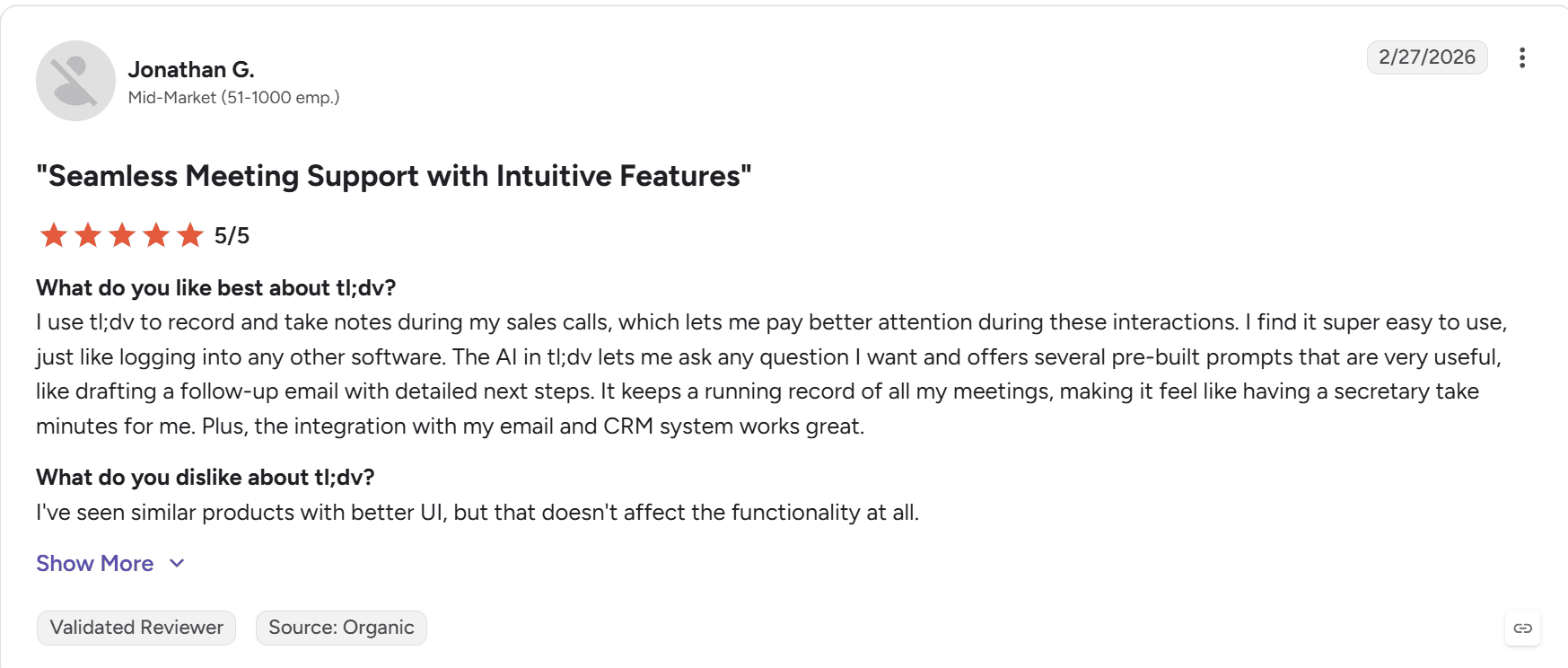
Jose said he was able to go from 4-6 daily meetings to 10-12 because of how useful tl;dv was, while Melissa appreciates the fact you can download videos and share with colleagues.
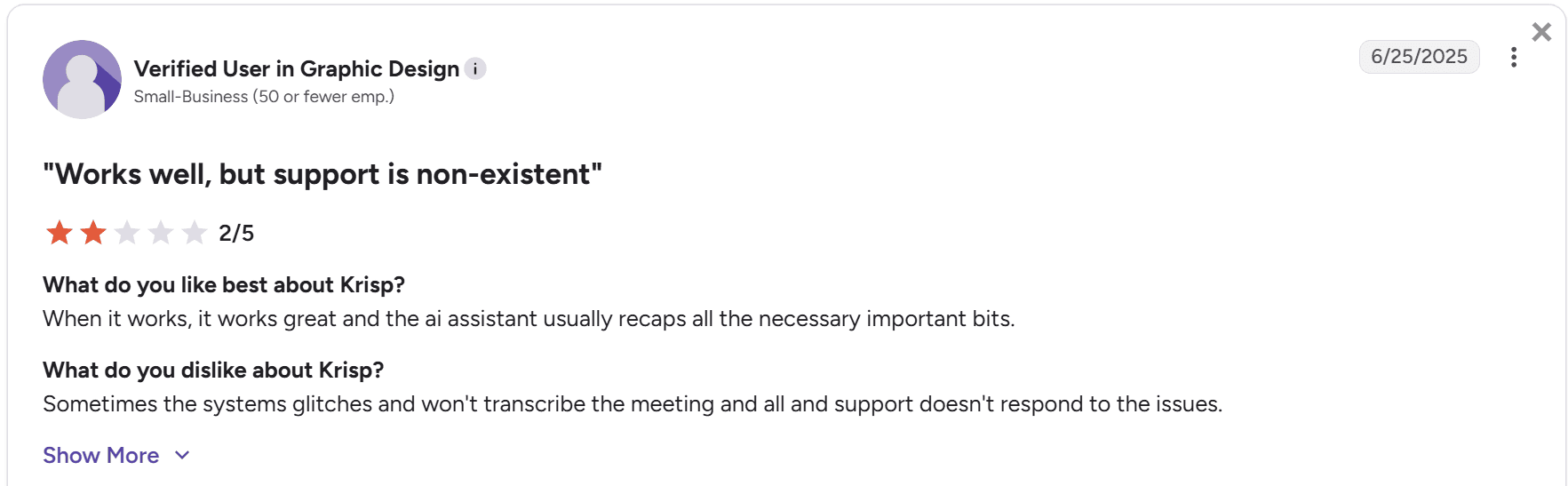
Krisp also scores 4.7 out of 5 on G2, where reviewers most often praise the noise cancellation itself and how simple it is to set up. Just yesterday, John said that Krisp helped reduce background noise during calls, while another verified user loves the CRM sync function (which tl;dv also offers) but claims the noise cancellation actually needs more work as it sometimes cuts or mutes sound unexpectedly.
Common Complaints About Each Tool
The complaints diverge more usefully than the scores do. tl;dv’s G2 reviewers most often flag free-plan recording caps and occasional speaker misassignment in larger meetings. Krisp’s reviewers report choppy audio or latency in some setups, along with transcription accuracy dropping in non-English languages.
Krisp’s noise cancellation is reportedly spotty while its transcripts can fail to work altogether. A lot of reviewers concur that they only want noise cancellation and nothing else, and find the price steep for that as a single feature. One of tl;dv’s most common gripes is that the mobile app isn’t as good as the desktop version for viewing summaries.
Can You Use tl;dv and Krisp Together?
Yes. With Krisp, you can get rid of the Meeting Assistant entirely and keep just the audio layer, which means Krisp can sit underneath tl;dv as a virtual microphone instead of competing with it for the notes.
In practice, that means Krisp cleans the signal at the OS level, stripping background noise before it ever reaches your meeting app, while tl;dv (bot or bot-free) handles the recording, transcription, and summary on top of that cleaner audio. It’s a complementary stack for anyone working from an inconsistent home setup who also wants tl;dv’s CRM sync and multi-meeting search with Krisp’s clearer audio.
The catch is cost: since Krisp no longer has a standing free plan, running both means paying for two subscriptions rather than one. This pairing only makes sense if audio quality is a real, ongoing problem, not a one-off annoyance.
Final Verdict: Which Should You Choose in 2026?
There no clear winner here. It all really depends on what exactly you need. Krisp built its reputation on real-time noise cancellation, and it’s still the stronger tool for that specific job. tl;dv built its reputation on what happens after the meeting: multi-meeting intelligence, automatic syncing with CRMs and other tools, sales playbook monitoring, scheduled reports, and more.
Pick Krisp if your bottleneck is genuinely audio or if you’re running a call center that needs accent adjustments. Pick tl;dv if your bottleneck is what happens after the conversation: sales teams chasing CRM-ready insights, teams that need searchable meeting history, anyone who’s tired of writing their own notes. And if it’s both, running Krisp underneath tl;dv is a game-changer.
FAQs About tl;dv vs Krisp
Does tl;dv need third-party noise suppression?
tl;dv has no built-in noise cancellation, so if bad audio is a recurring problem, it doesn’t fix it. Pairing it with a dedicated audio tool, like Krisp, is the practical answer.
Does either tool affect CPU, RAM, or battery life?
Krisp runs continuous real-time audio processing in the background, which is inherently more resource-intensive than passive recording. tl;dv doesn’t manipulate audio in real time, so it’s lighter on that specific front, though both apps run continuously while active either way.
Some reviewers claim Krisp slows down their computer, but I have to admit that this isn’t something I experienced personally.
What are the closest alternatives to tl;dv and Krisp?
For tl;dv, the closest comparisons are Fathom, Fireflies, and Otter — all AI meeting assistants competing on the same summary-and-transcription ground. Though tl;dv excels above them with its deeper sales features and multi-meeting intelligence.
Krisp doesn’t have a direct one-for-one competitor combining noise cancellation and meeting notes at the same maturity; on pure noise cancellation, the nearest Krisp alternatives are OS-level suppression built into Zoom or Teams and dedicated tools like NVIDIA Broadcast.
Which operating systems and conferencing platforms are best supported?
Both run desktop apps on Windows and Mac, plus mobile apps on iOS and Android. Krisp’s mobile app is transcription-only. Noise cancellation isn’t available on mobile. Since both work at the bot-free, OS-audio or device level rather than through platform-specific plugins, neither is meaningfully restricted to particular conferencing apps.
Does either offer SSO, SCIM, or audit logs?
Yes, both — but only at the top tier. tl;dv includes SCIM provisioning, custom SSO, and organization activity logs on Enterprise. Krisp lists SSO/SCIM as an Enterprise-exclusive feature too.
Can transcripts be shared with external guests or edited collaboratively?
Both support workspace-level sharing. Krisp’s Advanced tier adds commenting, tagging, and trim-and-comment on recordings; tl;dv supports shared clips and team-wide notes sharing from its paid tiers. tl;dv recordings can also be downloaded and shared externally, or you can also invite guests to view on the app itself.