Skip to content







I’ll be honest: when I started researching this article, I thought there were maybe five or six AI agent builders worth knowing about. There are dozens. Possibly hundreds. Every automation tool, cloud platform, and app builder has bolted the word “agent” onto something in the last eighteen months, and they all claim to be your next digital employee.
So rather than reviewing feature pages (which all say the same thing, beautifully), I went where the builders actually complain: Reddit threads, community forums, and reviews from agencies running this stuff in production. I compared the top contenders on pricing, ease of use, integrations, and how much coding they actually require. Spoiler: sometimes “no-code” means “no-code until it breaks.”
Here’s the short version. Full breakdowns, honest catches, and what real users say below.
TL;DR: The 10 best AI agent builders in 2026
- n8n – best for technical teams that want full control (and self-hosting)
- Zapier AI Builder – best for connecting your agents to everything you already use
- Make – best for complex visual workflows
- Microsoft Copilot Studio – best for enterprises living in the Microsoft ecosystem
- Relay.app – best for small teams that want human-in-the-loop safety
- Relevance AI – best for building an entire AI workforce
- OutSystems Agent Workbench – best for governed enterprise deployment
- Google AI Studio – best free starting point for beginners
- Gemini Enterprise Agent Platform – best for developers building on Google Cloud
- Bubble AI – best for building agents inside your own app
Want to know what an AI agent actually is, or whether you need no-code, low-code, or full-code? I cover all of that further down. If you just want the tools, keep reading.
What is an AI Agent Builder?
An AI agent builder is a platform that lets you create, customize, and deploy AI agents without building the machinery yourself. Instead of wiring up LLM APIs, memory, integrations, and error handling from scratch (a weekend I would not wish on anyone), you get a visual canvas or a prompt box where you define what your agent should do, which tools it can use, and when a human needs to step in.
The good ones handle the unglamorous parts: connecting to your apps, keeping your data where it belongs, and logging what the agent did and why. The differences between platforms mostly come down to one question: how much control do you want, and how much complexity can you stomach to get it?
That question has three answers, and picking the wrong one is expensive.
No-Code vs. Low-Code vs. Full-Code AI Agent Builders
No-code builders let you create agents through visual interfaces and plain-English prompts. Fastest to start, easiest to hit a ceiling. Best for non-technical teams automating well-defined tasks. On this list: Relay.app, Google AI Studio, Bubble.
Low-code platforms give you the visual builder plus an escape hatch into real code when you need custom logic. This is the sweet spot for most teams with at least one technical person on the payroll. On this list: n8n, Make, Copilot Studio, OutSystems.
Full-code frameworks like LangChain and CrewAI give developers total control and zero training wheels. Maximum customization, maximum effort. The only viable option for genuinely unique requirements, and overkill for everything else.
Top 10 AI Agent Builders in 2026
1. n8n

n8n is the one the technical crowd swears by, and it doesn’t take long to see why. It’s a source-available workflow automation platform where you build agents on a visual canvas, then drop into JavaScript or Python the moment drag-and-drop runs out of road. Founded in Berlin in 2019, it now has 230,000+ active users and 3,000+ enterprise customers including Vodafone and SoftBank. This is not somebody’s side project.
Two things set it apart from everything else here. First, self-hosting: run the free Community Edition on your own servers and every byte of data stays with you. One agency I came across runs a full email triage system for a 22-person consultancy on a 12 EUR/month server, hitting 94% classification accuracy and saving the team 11 hours a week. Eleven hours. For the price of three coffees. Second, execution-based pricing: a 30-step workflow costs the same as a 3-step one per run, which keeps costs predictable as your workflows grow more ambitious, and is a big part of why high-volume teams gravitate here.
The AI side isn’t an afterthought either: native nodes for OpenAI, Anthropic, and others, RAG pipelines, vector databases, and an Evaluations feature for testing AI workflows with real data before you unleash them.
One dose of realism before you dive in: the pattern that actually works in production is an LLM sandwiched between a deterministic trigger and a human review step. Pure autonomous agent loops are still too unpredictable for operations where a 5% error rate costs real money. n8n happens to be brilliant at exactly that sandwich.
Best for: technical teams building complex, high-volume, or privacy-sensitive agents.
The good:
- Execution-based pricing gets dramatically cheaper than per-task rivals as workflows grow
- Free self-hosting with unlimited executions and full data control
- Visual debugging shows every node’s input and output, so you can see exactly where things broke
- 9,000+ community templates, and workflow limits were removed across all plans in 2026
The catch: the learning curve is the whole conversation. The most-watched n8n video on YouTube is literally titled “Seriously, please watch this before you start learning n8n.” A quarter of a million people watched it. That’s not a coincidence. Expect 4-10 hours before your first real workflow, versus under an hour on Zapier. Workflows can also take seconds to minutes to run, which rules out real-time stuff like live chat. And mind the cloud tiers: one polling trigger checking every five minutes burns roughly 8,640 executions a month on its own, and there’s a sizeable jump from Pro ($60/month) to Business ($800/month), so map your growth path before you commit.
Pricing: free self-hosted Community Edition. Cloud from $24/month; Pro $60/month; Business $800/month.
2. Zapier AI Builder
Zapier is the OG of automation, and its pitch for the agent era is disarmingly simple: your agents can already talk to 9,000+ apps, because Zapier spent fifteen years building those connections before AI agents were a thing. You describe the agent you want, Zapier’s Copilot starts assembling it, and built-in guardrails scan for sensitive data and prompt injection before anything touches a downstream app.
Zapier’s strengths are wonderfully unambiguous. It’s unbeatable for fast setup and mainstream integrations, it welcomes non-technical users in a way the others don’t, and once a Zap is set up properly it just runs, quietly, without demanding your attention. Ask why Zapier over a cheaper rival and the answer is usually one word: integrations. The trade-off: at higher volumes the pricing adds up quickly, and if you need deep custom logic you’ll want one of the low-code options further down.
The sharpest framing I found: Zapier is app-to-app plumbing, and it’s the best plumbing there is. Where it strains is as an agent brain. Long-running context, durable state, and complex branching are not its natural habitat, and per-task billing punishes exactly the high-volume autonomy that agents are supposed to deliver. One thread did the maths: 100 leads a day can mean 24,000 tasks a month before you’ve done anything clever with them.
Best for: teams that need agents connected to everything, including that one ancient tool nobody else supports.
The good:
- 9,000+ integrations, actively maintained rather than left to rot
- Genuinely the easiest starting point for non-technical teams
- AI guardrails, human approval steps, and SOC 2 Type II compliance
- Zapier MCP lets tools like Claude and ChatGPT tap those integrations directly
The catch: task-based pricing scales with your success, in the wrong direction. The agent features are newer than the core product and still maturing. Brilliant for predictable, rule-based workflows with clean inputs; plan a little patience for the messier ones.
Pricing: free plan available. Paid from $19.99/month billed annually; AI agent usage priced separately.
3. Make

Make (formerly Integromat) is the visual power tool of this list. You build on a canvas by connecting modules, and you can see exactly how data flows through every branch, filter, router, and iterator. Its AI Agents live directly inside the scenario builder with a reasoning panel that shows, step by step, why the agent did what it did. Transparency I’d frankly like from every AI tool. And several colleagues.
And the feel of it is genuinely pleasant. The Lego-block interface is underrated, it connects happily to the everyday stack, and for MVPs or a handful of automations a year, it’s more than enough, at a price that starts near pocket change.
The caveats show up at scale. Every scenario looks simple in a tutorial, right up until real-world data and error handling enter the picture. Costs that felt trivial at low volume grow with your ambitions. And here’s the ceiling in one line: learning Make properly is like learning a programming language. The bubbles are friendly. The arrays underneath are not.
Best for: visual thinkers building complex multi-step workflows who want to see the logic laid out like a subway map.
The good:
- 3,000+ app integrations plus 400+ AI app connections
- Advanced branching, error handling, and array processing that simpler tools can’t touch
- More operations per dollar than Zapier at volume, and unused credits roll over
- The agent reasoning panel makes AI decisions auditable instead of mysterious
The catch: deceptively complex. Budget 10-20 hours before routers and iterators stop feeling like a foreign language, and don’t trust any tutorial that skips error handling. Cloud-only, no self-hosting, and the credit-based pricing takes a spreadsheet to forecast. It’s also an integration tool, not an app builder; if you need a front end, you’ll be pairing it with something else.
Pricing: free plan with 1,000 operations/month. Core from around $9-12/month billed annually.
4. Microsoft Copilot Studio

If your company runs on Teams, SharePoint, and Dynamics, Copilot Studio is the path of least resistance. It’s Microsoft’s low-code agent builder, and its superpower is native access to your Microsoft Graph data: emails, files, chats, calendars, all of it. If you’re heavily in the M365 ecosystem, integration is dramatically easier, and agents inherit your existing permissions instead of you rebuilding security from scratch.
That grounding is the real enterprise sell: the LLM reasons over data that already lives in your environment, reducing hallucination while respecting who’s allowed to see what. The savvier deployments treat Copilot Studio as an orchestration layer that triggers Power Automate flows and other tools, rather than a standalone chatbot. It’s also had a genuinely good year: the deep reasoning features that left preview in March 2026 let agents work through multi-step problems instead of face-planting on step two.
A few things to know going in. Getting consistent agent behavior takes real prompt and topic tuning, more than the low-code branding implies. Deployed agents can also feel slower than M365 Copilot for similar tasks, and between the evolving UI, security options, and Microsoft’s licensing structure, budget proper time for the learning curve. This is a builder’s tool, not a toy.
Best for: enterprises already standardized on Microsoft, with IT capacity to keep an eye on it.
The good:
- The deepest possible integration with Teams, SharePoint, Dynamics 365, and Power Platform
- Enterprise-grade governance and data grounding out of the box
- Multi-agent orchestration plus meaningful reasoning upgrades in 2026
The catch: a steeper learning curve than the low-code branding suggests, agent behavior that rewards careful tuning, and less shine outside the Microsoft garden. Message-based billing on top of per-seat licensing also makes cost forecasting its own little project.
Pricing: included with Microsoft 365 Copilot plans (~$21/user/month billed annually for Business tier); standalone message-based pricing for deployed agents. Verify current tiers. Microsoft updates these regularly.
5. Relay.app

Relay.app is what happens when a former Gmail and Google Calendar product lead decides automation tools are too hard to use. It’s an AI agent builder obsessed with one thing: being the easiest way to build an agent you can trust. You describe what you want in plain English, Relay builds the visual workflow, and you’re running in minutes rather than weekends.
Its genuinely distinctive feature is human-in-the-loop control. Any step can require a human approval, review, or data entry before the agent proceeds, which turns “I hope the AI doesn’t email the wrong client” into “the AI drafts, I tap approve.” One competitive analysis framed Relay’s whole strategy neatly: it isn’t competing on integration count, it’s competing on making AI agents feel safe enough for a non-technical ops team to actually run. A 4.9 rating across 85+ G2 reviews suggests the bet is landing.
Best for: small teams and non-technical operators who want a working agent this afternoon, with a human hand on the brake.
The good:
- The smoothest onboarding in the category: name the agent, describe the job, done
- Best-in-class human approval steps for anything you don’t fully trust the AI with yet
- Universal AI credits across OpenAI, Anthropic, and Google models, no API keys required
- A free plan that includes all features, so you can evaluate properly before paying
The catch: around 200 native integrations versus Zapier’s 9,000+, so niche tools mean rolling up your sleeves with custom API calls. It’s also missing power features like step-level filters and advanced error handling, and enterprise governance is thin. Watch the step and credit meters too; they’re easy to ignore until you hit them. A great entry point that scaling teams may eventually outgrow.
Pricing: free plan (200 steps/month). Professional from $19/month billed annually; Team from $59/month.
6. Relevance AI

Relevance AI wants you to stop building agents and start building an AI workforce: teams of specialized agents where one researches, another verifies, and a third writes the output. It’s aimed squarely at sales and GTM teams, with pre-built templates for BDR outreach, lead qualification, and inbound handling. The “Invent” builder lets you describe an agent in plain English and watch it take shape, which is exactly as satisfying as it sounds.
And it deserves real credit here: Relevance is one of the few platforms that actually delivers multi-agent handoffs with shared context, which most tools promise and then quietly don’t. It’s also quick for practical one-off agents, like scraping and aggregating competitor reviews, when you just want something running by lunch. That same approach can be used to monitor AI visibility, checking how often and accurately a brand appears in AI-generated answers.
A couple of caveats. Once you leave the templates, expect to need a bit more technical know-how than the marketing suggests, and integration quirks can take some debugging when they crop up. The pricing is also a dual meter: since late 2025, Relevance bills Actions (what agents do) and Vendor Credits (AI model costs) separately. Honest, but a forecasting exercise, especially if you’re running multiple client environments.
Best for: sales and go-to-market teams automating entire functions rather than single tasks.
The good:
- Multi-agent workforces that hand tasks off with shared context, and actually mean it
- 1,000+ native integrations including HubSpot, Salesforce, Slack, and Gmail
- Model routing across Anthropic, OpenAI, and others, with approval gates for low-confidence moments
- Enterprise governance: role-based access, SSO, audit logs, automatic PII masking
The catch: “no-code” comes with an asterisk once things get complex, credit consumption escalates at scale, and the most serious features live behind enterprise pricing.
Pricing: free tier (200 actions/month). Pro from $19/month billed annually; Team ~$234/month; enterprise custom.
7. OutSystems Agent Workbench
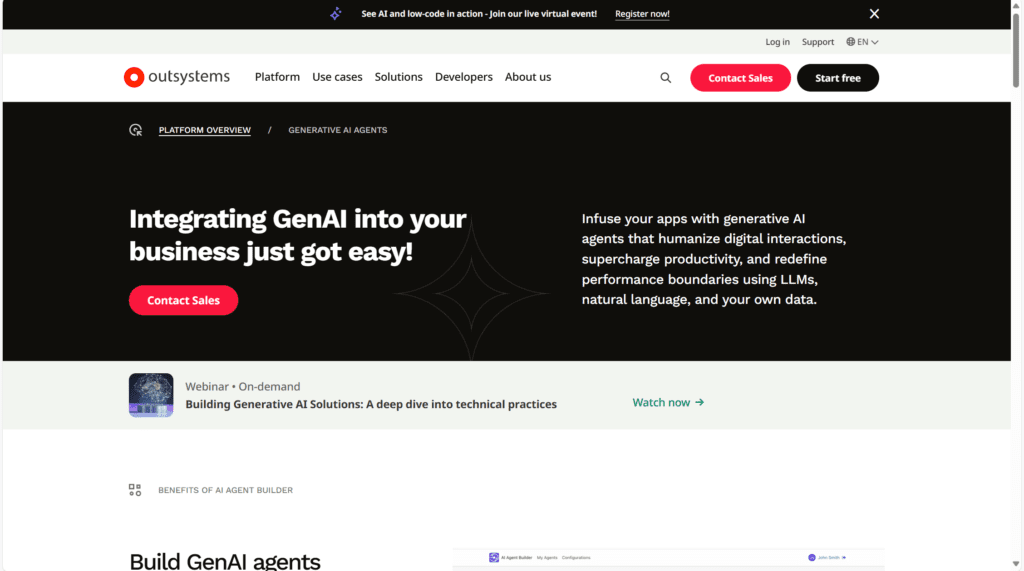
OutSystems has been at the AI game since 2018, back when “agent” still mostly meant someone who books actors. Agent Workbench is its dedicated environment for building, testing, and deploying AI agents inside the enterprise, and it earned Leader status in G2’s Spring 2026 AI Agent Builders grid, scoring 95% customer satisfaction for contextual awareness and 91% for data privacy. The enterprise crowd is clearly buying what it’s selling.
The standout is grounding: agents built with retrieval-augmented generation (RAG) answer from your company’s own data instead of confidently making things up, with built-in guardrails, support for major AI models, and MCP support for connecting agents to external tools. Real customers use it for unglamorous, high-value work like analyzing error logs and automating data entry from documents. Nobody’s putting that in a keynote, but it’s where the money is.
Its philosophy is worth understanding before you buy: agentic coding tools help you write code fast, while OutSystems helps you bring enterprise apps to production fast. Governance, security, and deployment are the actual product. Worth knowing: the platform optimizes for that governed path over raw speed, so developers used to freewheeling AI coding tools should expect a more deliberate pace, and the Mentor AI features are at their best on well-defined work.
Best for: enterprises that want governed, secure agents in production, and will happily trade raw speed for that.
The good:
- Multi-agent orchestration with the governance layer large enterprises actually require
- RAG-grounded agents plus a library of quick-start generative AI apps
- Slots into existing enterprise infrastructure and third-party systems
The catch: enterprise software at enterprise prices, sold the enterprise way (talk to sales, bring a colleague, block out an afternoon). It prioritizes governed deployment over raw development speed, which is exactly the right trade for its audience and a mismatch for everyone else. If you’re a two-person startup, this is a sledgehammer for a drawing pin.
Pricing: custom quotes. Budget for enterprise-tier spend.
8. Google AI Studio

Google AI Studio is the friendliest and cheapest on-ramp on this list: a free web platform for building with Google’s Gemini models, no credit card required. And it grew real muscles this year. Build mode, unveiled at Google I/O in May 2026, generates working apps from plain-English descriptions, and the Agents capability lets you assemble simple agentic workflows without code.
The success stories are genuinely charming: people with no coding experience building working MVPs in an afternoon, or shipping full book-tracking apps that install on your phone. For beginners, it’s simply an awesome place to start. As someone whose peak technical achievement remains a customized Myspace page, I respect this deeply.
Be clear-eyed about the ceiling, though. AI Studio is for prototyping rather than daily production use, and apps are best graduated out of it as they grow. Agent workflows cap at 10 steps, web access works from search snippets rather than full browsing, and quota limits can interrupt heavier sessions. The free tier’s terms have also shifted a few times, so treat today’s limits as a snapshot.
Best for: beginners, prototypers, and anyone validating an idea before spending actual money.
The good:
- Free to start, with the lowest barrier to entry in the category: describe it, get something working
- Build mode turns prompts into working apps in an afternoon
- Great for brainstorming, docs, and quick experiments thanks to the huge context window
The catch: a sandbox by design. The 10-step agent ceiling and snippet-only web access rule out production agents, and you’re locked to Gemini models. Prototype here, graduate elsewhere.
Pricing: free with usage limits. You pay standard Gemini API rates as you scale.
9. Gemini Enterprise Agent Platform (formerly Vertex AI Agent Builder)
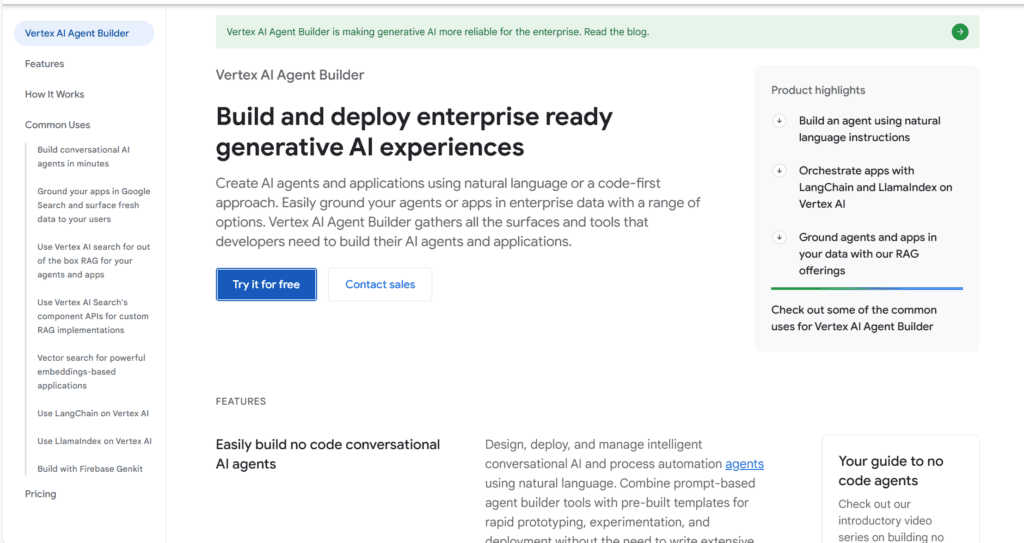
Here’s the biggest shake-up on this list: at Google Cloud Next 2026, Google retired the Vertex AI brand and relaunched it as the Gemini Enterprise Agent Platform, folding in Agentspace and organizing everything around Build, Scale, Govern, and Optimize. Existing Vertex workloads carry over, but the product you’re evaluating today is this one. If you see both names in the wild for a while, that’s why.
Naming aside, this is Google Cloud’s serious, production-grade agent platform, and it’s more open than you’d guess: access to 200+ models including Gemini, Gemma, and third-party options like Anthropic’s Claude, so you can plug in whichever LLM you want. The new Agent Designer gives you a low-code canvas for orchestrating agents and subagents, then exports the logic straight to the Agent Development Kit for code-level refinement. Add a fully-enabled RAG system behind a single API call and you can see why enterprises with 150-seat teams are picking it to keep their GCP security posture while getting frontier-model capabilities.
Best for: enterprises and dev teams building governed, high-performance agents on Google Cloud.
The good:
- 200+ models including third-party LLMs, so no single-vendor lock-in at the model layer
- Agent Designer canvas for low-code orchestration, with a clean export path to full code
- Built-in RAG, enterprise governance, and the compliance story regulated industries need
- Real production use: email parsing and drafting, lead research, reporting agents at scale
The catch: licensing is a meaningful investment that makes most sense at scale, implementation takes real effort, especially connecting existing SaaS data, and the GCP learning curve remains steep. And as ever with LLM agents: verify the outputs. Always. Non-technical folks should start with AI Studio and work up.
Pricing: platform access via Google Cloud; you pay for model usage, storage, and compute at GCP rates, plus enterprise licensing. Get a quote before promising your CFO anything.
10. Bubble AI
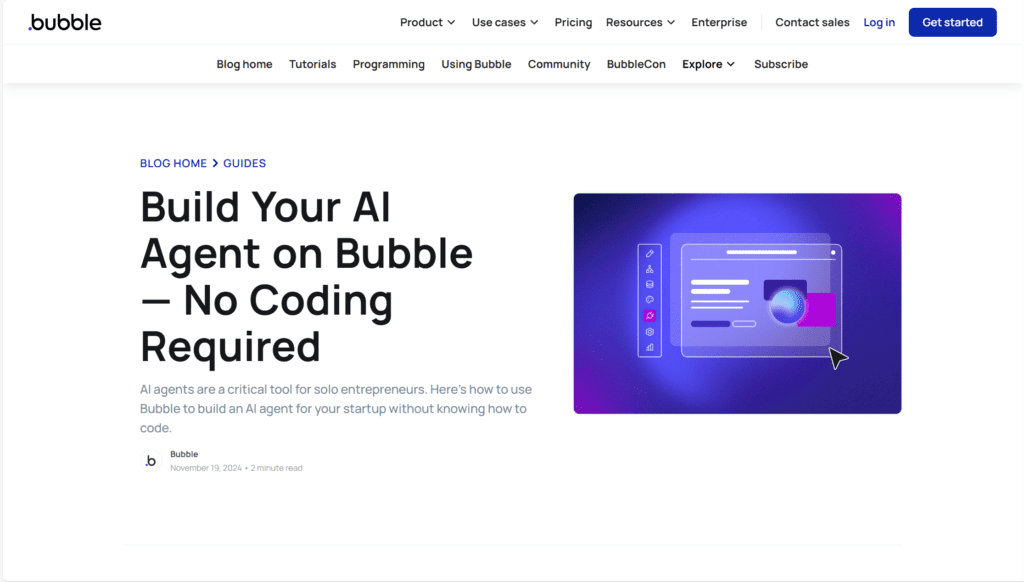
Bubble made its name letting non-coders build full web apps, and its AI story leveled up in late 2025 with the Bubble AI Agent: describe what you want and it scaffolds the app, the workflows, and the logic, inside a platform that already handles your database, design, and hosting.
The honest framing: Bubble is an AI-powered app builder more than a pure agent builder. Its advantage is context. Because your agent lives inside a product you built, it has native access to that app’s data and workflows, which nothing else on this list can offer. If your dream is “an AI agent inside my own SaaS,” this is the shortest path that doesn’t involve hiring developers or becoming one.
Best for: founders and makers who want AI-driven workflows embedded inside their own app.
The good:
- Genuinely no-code from app scaffold to workflow logic, with the AI Agent doing the heavy lifting
- One platform for the app and the automation instead of duct-taping two tools together
- Mature ecosystem: templates, plugins, agencies, and a big community for when you get stuck
The catch: the AI Agent currently only works on apps originally created with Bubble AI, so it won’t retrofit the app you lovingly hand-built in 2023. It handles one change per prompt, there’s no source code export, and Workload Unit pricing scales with usage, which can punish automation-heavy apps as they grow. If you don’t need an app around your agent, Bubble is the scenic route.
Pricing: free plan for learning. Paid from ~$29-32/month billed annually, plus Workload Units at scale.
Comparison table
| Tool | Code level | Best for | Free plan | Starting Price* |
|---|---|---|---|---|
|
n8n |
Low-code |
Technical teams, self-hosting |
Yes (self-hosted) |
$24/mo cloud |
|
Zapier AI Builder |
No/low-code |
Maximum integrations |
Yes |
$19.99/mo |
|
Make |
Low-code |
Complex visual workflows |
Yes |
$9/mo |
|
Copilot Studio |
Low-code |
Microsoft-first enterprises |
Trial |
$21/user/mo |
|
Relay.app |
No-code |
Human-in-the-loop safety |
Yes |
$19/mo |
|
Relevance AI |
No-code |
AI workforces for GTM teams |
Yes |
$19/mo |
|
OutSystems Agent Workbench |
Low-code |
Governed enterprise agents |
No |
Custom |
|
Google AI Studio |
No-code |
Free prototyping |
Yes |
Free (API rates at scale) |
|
Gemini Enterprise Agent Platform |
Low-to-full-code |
Google Cloud enterprises |
No |
Usage-based |
|
Bubble AI |
No-code |
Agents inside your own app |
Yes |
$29/mo |
*Annual billing. Agent-platform pricing changes roughly as often as the weather, so check before you commit.
Building an agent for meetings? You might not need a builder at all. If the workflow you’re trying to automate starts with a meeting (notes, follow-ups, CRM updates, coaching), that agent already exists, and I may be biased but it’s rather good. tl;dv records your Zoom, Google Meet, and Microsoft Teams calls, drafts the follow-ups, syncs to your CRM, and briefs you before the next one. Build agents for the workflows unique to your business; buy the one that’s already solved. More on meeting agents below.
Other noteworthy AI agent builders
Despite already listing ten, there are plenty more. Some are wrappers around the big LLM providers; others are serious platforms in their own right:
- Microsoft Foundry. Microsoft’s developer-grade agent platform, with extensive memory, ready-to-go integrations, and flexible model choice beyond just OpenAI.
- OpenAI Agents SDK. OpenAI’s toolkit for building custom agents on its latest GPT models, with built-in support for tools, handoffs, and guardrails.
- IBM watsonx Orchestrate. The successor to Watson Assistant, built for automating business workflows with pre-built skills and enterprise-grade governance.
- LangChain and CrewAI. The open-source, code-first frameworks developers reach for when they want full control. Maximum flexibility, maximum learning curve.
A reality check before you build
One pattern kept showing up everywhere I researched, and it’s worth more than any individual tool review. The AI agents actually running in production at small and mid-sized businesses aren’t autonomous robots making judgment calls. They’re workflows with an LLM as one very smart node, sandwiched between a deterministic trigger and a human review step. Email triage with a confidence threshold. Invoice extraction with a human checking the shaky fields. Cold email drafts paused for a 25-second human review before anything sends.
That sandwich is the shape that works. Fully autonomous agent loops are still too unpredictable for operations where a 5% error rate costs real money. So whichever builder you pick, design for human-in-the-loop first and autonomy second. Your error rate will thank you. So will your clients.
What is an AI Agent?
AI agents are intelligent software systems that perform tasks autonomously based on their goals, environment, and user input. Think of them as a highly specialized ChatGPT that can act independently toward longer-term goals: an agent doesn’t just answer your question, it books the meeting, updates the CRM, and drafts the follow-up while you make a coffee. If you want to see what a fully autonomous general-purpose agent looks like in the wild, warts and all, I put Manus AI through its paces here. Powerful, chaotic, and a useful preview of where all this is heading.
Types of AI Agents
Under the hood, agents range from simple to genuinely clever. The classic taxonomy runs five deep:
- Simple reflex agents react to what’s in front of them with if-this-then-that rules. A spam filter, essentially.
- Model-based reflex agents keep an internal picture of the world, so they can handle situations they can’t fully see.
- Goal-based agents plan sequences of actions to reach a defined outcome, weighing different paths before acting.
- Utility-based agents go a step further and pick the best path, scoring options against preferences like speed, cost, or accuracy.
- Learning agents improve with experience, refining their behavior based on what worked last time.
Most business agents you’ll build with the platforms above are goal-based or utility-based with a learning layer, wrapped in guardrails so they don’t get creative with your customer data.
AI Agent Use Cases in Business
AI agents are moving from hype into real workflows, but the adoption story is still uneven. According to McKinsey’s 2025 State of AI survey, 88% of organizations are now using AI in at least one business function, while 62% are at least experimenting with AI agents. Only 23%, however, say they are actually scaling agentic AI systems. In other words: businesses are interested, but the winners are the ones redesigning workflows instead of just dropping a chatbot on top of an old process.
Let’s take a look at different areas of business to see where AI agents are already making an impact.
AI Agents for Meetings
AI agents for meetings can automate note-taking, summarize discussions, and schedule tasks like follow-ups. They tend to record, transcribe, and summarize online meetings to condense insights into easily skimmable summaries that save time catching up on meetings.
The best AI agents for meetings, however, take this automation to the next level. To visualize this at work, imagine being able to search through all your team’s meetings to find each and every mention of a competitor. In sales calls, you can use it to highlight recurring objections. In customer success calls, you can use it to identify common complaints and proactively resolve them.
Additionally, tl;dv streamlines your post-call workflows. Need to update your CRM following a sales call? It’s taken care of. Want to keep everyone on the same page by sharing the summary and meeting notes? It’s done automatically.

AI Agents for Sales
Incorporating AI agents in sales is going to provide a massive improvement to the efficiency of your team. It can automate and improve your lead qualification, outreach automation, and follow-ups.
To use tl;dv as an example again, imagine how much extra time your sales reps would have if they were able to automatically sync their meeting notes to CRMs instead of having to manually do it. All that extra time can be put towards your sales reps’ strengths: selling!
Additionally, tl;dv’s speaker analytics dashboard lets managers track sales team performance and ensure your reps are following their sales scripts. It can also monitor playbooks, ranging from the popular ones like BANT, SPIN, and MEDDIC, to your own unique invention through customizable note templates.
Finally, the recurring reports feature empowers sales managers to receive regular reports about all your reps’ sales calls. You can schedule the reports to be in your inbox every Monday morning. They’ll be accompanied by timestamps so you can quickly jump through the important bits if you’re interested. More importantly, these reports can be tailored to your specific needs. Want to hear how your reps are handling objections relating to price? Get a report about it.
AI Agents for Customer Success
Customer success is one of the clearest use cases for AI agents. Support teams deal with high-volume, repetitive questions, lots of company-specific knowledge, and customers who expect fast answers at any hour. An AI agent trained on help docs, product data, account history, and previous support interactions can resolve simple queries quickly and route the messy ones to the right human.
Klarna is the obvious example, but it’s worth framing carefully. The Swedish payments company reported that its AI assistant cut average issue resolution time from 11 minutes to under 2 minutes and handled work equivalent to 700 full-time agents, according to Reuters. That sounds dramatic, but the better takeaway isn’t “AI replaces customer success teams.” It’s that AI can absorb huge amounts of repetitive support volume, while humans remain essential for complex, emotional, or high-stakes customer issues.
Done well, AI agents for customer success provide efficient, 24/7 support while personalizing interactions based on past experiences, user preferences, account context, and even user sentiment. That makes them powerful for improving customer happiness, as long as there are clear escalation paths when the customer needs a person.
Zendesk AI is a strong example of a customer success platform trained on billions of real service interactions. It helps teams offer personalized support from day one, manage demand with AI agents, and resolve interactions faster without leaving customers stranded in automation loops.
AI Agents for Project Management
By using AI agents for project management, you can automate task assignment, track progress quickly, and streamline complex workflows. These AI agents can also proactively assess risk, re-prioritizing tasks in the most efficient way possible.
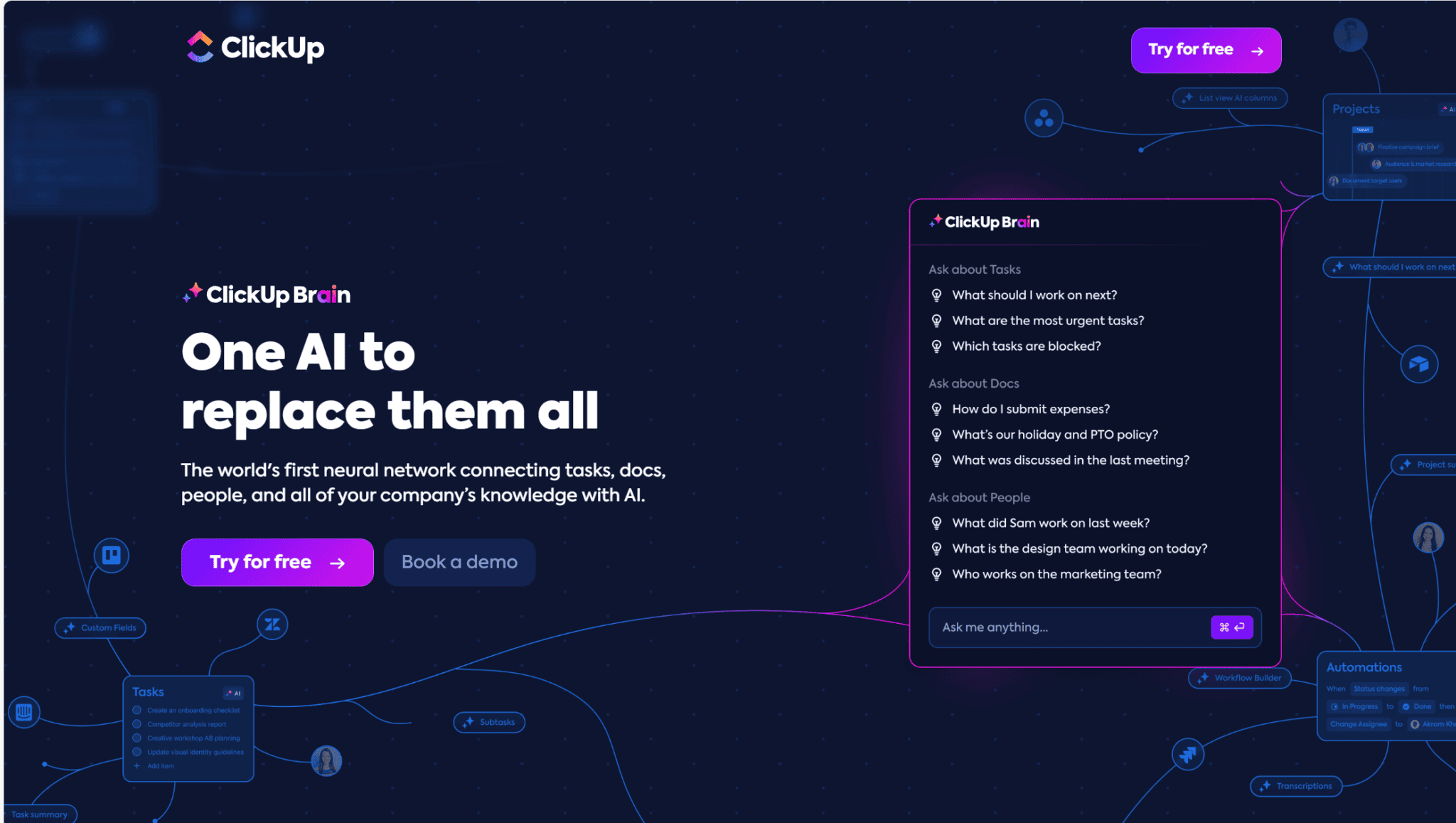
ClickUp’s AI allows you to bring together all of the knowledge from your work apps into one centralized AI agent. ClickUp Brain gives you instant, accurate answers on any question about your work, pulling information from all your connected work sources. It also automates project summaries and updates, and even crafts text for web pages, emails, or task templates.
How Can I Create My Own Agent?
Creating your own AI agent is easier than ever, thanks to AI agent builders that allow both developers and non-technical users to build custom solutions. The process can range from simple to complex depending on your needs and skill level. If you’re new to building agents, an AI agent course can help you understand the core concepts and choose the right tools before getting started. Generally, you’ll want to do the following:- Define the Purpose. Start by deciding what you want your AI agent to do. This could be anything from automating customer support to managing project workflows. Clearly defining the task will guide the development process.
- Choose a Platform or Framework. Several platforms make it easy to create AI agents. Some AI agent builders offer no-code solutions, while others provide more robust platforms that require programming knowledge. Some popular platforms include Google AI Studio, OutSystems Agent Workbench, and Gemini Enterprise Agent Platform (formerly Vertex AI Agent Builder).
- Train Your AI Agent. Once the platform is selected, you’ll need to feed the agent with data relevant to its task. For example, if it’s a customer service bot, you’d input previous customer queries and responses. Some platforms offer pre-trained models to make this step easier.
- Integrate Tools. Most AI agents work best when they have access to multiple tools or APIs. For instance, integrating a payment gateway, database, or communication tool will enable the agent to perform more advanced tasks.
- Test and Improve. Once your agent is built, testing is key. Monitor its performance, identify any gaps in its functionality, and continuously improve its learning model for better results.
Whichever route you take, steal the pattern that actually survives contact with production: a clear trigger, an LLM doing one job well, and a human checkpoint before anything irreversible happens.
FAQ: Common AI Agent Questions
How much does it cost to build an AI agent? Anywhere from free to “talk to sales.” You can prototype at no cost on Google AI Studio or self-hosted n8n. Production agents on no-code platforms typically run $19-100/month depending on volume. Enterprise platforms like OutSystems and Gemini Enterprise are custom-quoted. The hidden cost across all of them is AI model usage, which scales with how much your agents actually do.
What’s the best free AI agent builder? Google AI Studio for prototyping (free, no card required, capped at 10-step workflows), or self-hosted n8n if you’re technical (free software, unlimited executions, you supply the server). Relay.app and Zapier both have free tiers generous enough to build something real before paying a penny.
Can I build an AI agent without coding? Yes, genuinely. Relay.app, Relevance AI, and Google AI Studio all let you describe an agent in plain English and get something working. The honest caveat: no-code gets you the first 80%. Complex logic, messy data, and custom integrations still tend to need a technical hand for the last stretch.
Do AI agents replace human employees? The 2026 answer, backed by some very expensive experiments: they replace tasks, not roles. Even Klarna, the poster child for AI-first support, ended up rehiring humans after over-rotating. The pattern that works is agents handling volume and humans handling judgment.
Finding the Right AI Agent Builder for You
After all that research, the decision comes down to three questions.
How technical are you? No developer in sight: start with Relay.app or Google AI Studio. One technical person: n8n or Make will repay the learning curve many times over. A full IT department: Copilot Studio, OutSystems, or Gemini Enterprise, depending on whose cloud you already live in.
What are you automating? Single tasks between apps: Zapier or Make. Entire functions like outbound sales: Relevance AI. An agent inside your own product: Bubble.
How wrong can it afford to be? This is the question people skip, and it’s the one that matters. If an error costs you a customer, pick a platform with strong human-in-the-loop controls (Relay.app and n8n shine here) and design the checkpoint in from day one.
And if the work you want to automate revolves around meetings, you may not need to build anything at all. tl;dv is an AI meeting agent that already does the sandwich: it records and transcribes your calls, drafts the follow-ups, updates your CRM, and briefs you before the next meeting, with you approving what matters. It works with Zoom, Google Meet, and Microsoft Teams, and the free plan lets you test it on your next call. Sometimes the best agent is the one you don’t have to build.