Skip to content






tl;dr of Russian Transcription Tools & Accuracy
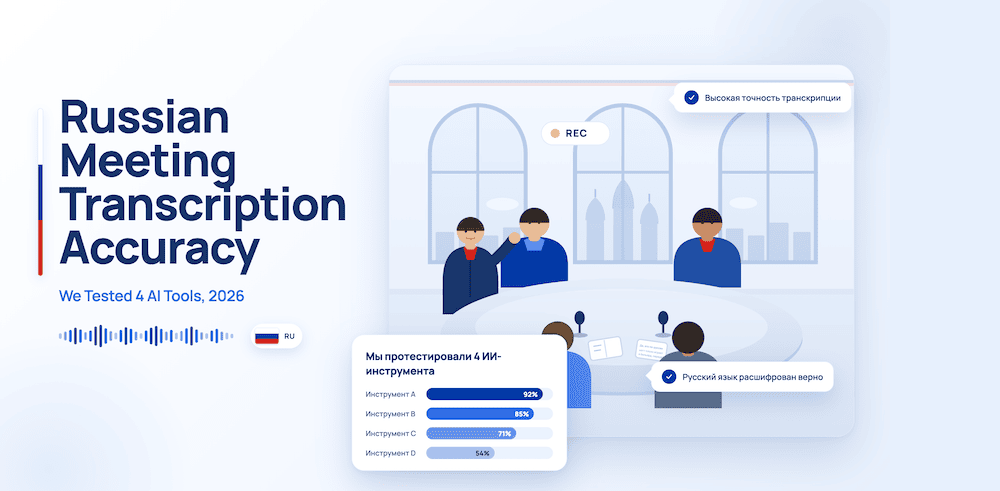
tl;dv came out top in our Russian meeting transcription test with a score of 168 out of 200. HappyScribe came second with 126, Fireflies with 110, and Fathom 83. It was scored blind, with the tools anonymized during scoring rounds with LLMs and a native speaker.
tl;dv was strongest on the accuracy tier with a 17-point lead. It was the only tool that correctly identified the proper nouns across all three meetings and held consistency across all the runs. On hearing Russian, nothing came close.
Here is the scoring for each tool based on the sections we tested it against.
| Tier | Max | tl;dv | Fireflies | Fathom | HappyScribe |
|---|---|---|---|---|---|
| Transcription & accuracy | 65 | 52/65 | 22/65 | 14/65 | 35/65 |
| Real-world meeting quality | 45 | 37/45 | 16/45 | 15/45 | 29/45 |
| Capabilities and features | 72 | 61/72 | 54/72 | 42/72 | 44/72 |
| Trust, security and value | 18 | 18/18 | 18/18 | 12/18 | 18/18 |
| Overall score | 200 | 168/200 | 110/200 | 83/200 | 126/200 |
| Rank | 1 | 3 | 4 | 2 |
Russian meeting transcription accuracy has offered a more differentiated result than our previous tests on French, Spanish, and Portuguese. tl;dv scored the highest with 168 points with HappyScribe finishing on 126.
The margins were not spread evenly either. In the transcription tier, tl;dv led by a total of 17 points compared to the nearest tool, with scores on entity detection deviating quite dramatically. Proper nouns are where the other tools on this list really struggled.
Russian is a language that can really highlight small errors in a way that English doesn’t. In Russian, nouns and adjectives carry case endings, so as single syllable slip can change who did what to whom instead of producing what would be a more obvious typo. Business Russian also switches between English loanwords into Cyrillic sentences as well. Each tool we tested had to decide whether to transliterate things like brand names, leave it in Latin script, or just make a choice based on what it thought. Three out of four seemed to guess, and one of these tools even turned the head of a regional government into the chief demon.
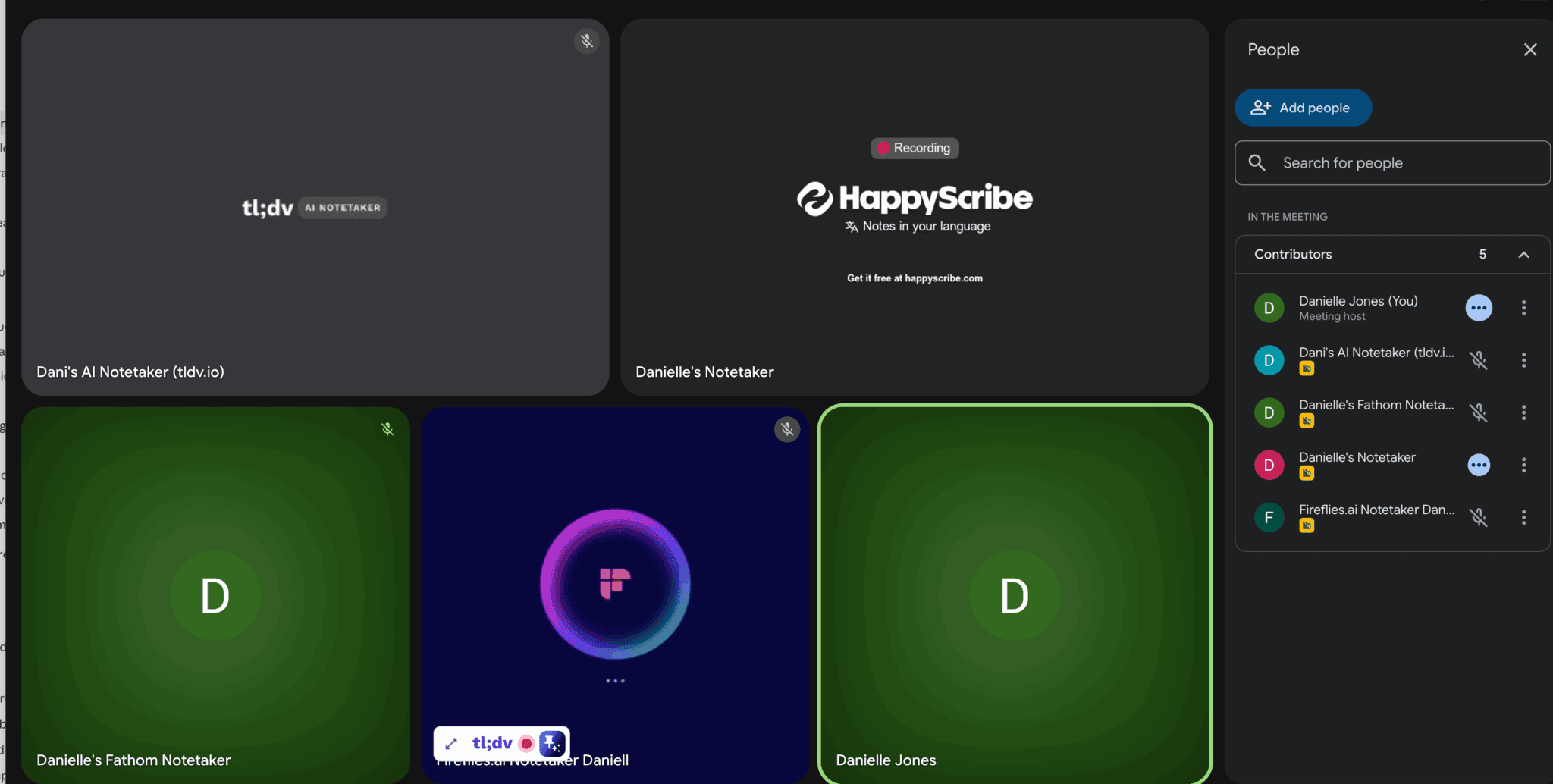
To run our test we took three real Russian language meetings and ran them through:
The types of meeting were mixed, with a session on the difference between growth and development, a corporate communications panel and a session on urban development in Kazan.
In our testing we would normally try and include Google Gemini, as this is a common tool in people’s workspace, but Gemini doesn’t currently support Russian, so was omitted.
To achieve the fairest results possible, the scoring ran blind. Two LLMs graded each output with the tool names removed, and a native Russian speaker checked areas where the tools struggled or diverged from each other.
Russian Meeting Transcription & Accuracy
In our testing the transcription and accuracy section carries the most weight, because everything flows from this. Out of a total of 65 points, tl;dv garnered 52, with Fathom achieving just 14.
These were scored by LLMs (Anthropic’s Claude and OpenAI’s ChatGPT) and then confirmed based on a blind native-speaker assessment, with the tool names hidden.
| Metric | How scored | tl;dv | Fireflies | Fathom | HappyScribe |
|---|---|---|---|---|---|
| Language accuracy | Blind native-speaker severity rating on in-language accuracy | 15/20 | 7/20 | 5/20 | 12/20 |
| Language-specific handling | Cyrillic orthography, case endings, punctuation, code-switching | 15/20 | 7/20 | 4/20 | 9/20 |
| Plainly-wrong word rate | Share of tokens that are self-evidently wrong: fabricated or non-Russian insertions and repetition loops | 5/5 | 2/5 | 0/5 | 4/5 |
| Entity detection | Names, companies and places across the cast | 5/5 | 1/5 | 0/5 | 2/5 |
| Numbers, dates and currency | Figures, dates and amounts formatted correctly in-language | 4/5 | 2/5 | 2/5 | 3/5 |
| Technical term raw recognition | Industry terms and acronyms before custom training | 4/5 | 1/5 | 1/5 | 2/5 |
| Punctuation and segmentation | Sentence breaks and paragraphing in test-run output | 4/5 | 2/5 | 2/5 | 3/5 |
| Transcription & accuracy subtotal | 52/65 | 22/65 | 14/65 | 35/65 |
Entity Detection
The biggest divergence in scoring was when it came to entity detection. tl;dv was scored 5 out of 5, and Fathom received 0.
Russian proper nouns are trickier than they are in English. For example. Brand names need to be transliterated into Cyrillic, and a tool cannot fall back on spelling out what it captured. Two examples where tl;dv did well and the other tools struggled were where it captured Проктер энд Гэмбл correctly and expanded CBD to Customer Business Development. None of the other tools managed this.
One of the worst misses was the brand name Wrike. tl;dv was able to name it correctly. The other three described a product with 30,000 users and left the product name out of the sentence completely. If a person were to read those transcripts and try to decide what tool the speaker was recommending, they would not be able to find that specific detail.
In the Kazan session, this happened again with МЕГА, Баухауз and Проспект Универсиады. tl;dv was the only tool to take full marks on this row in all three tests.
Language Accuracy
Nobody scored perfectly on this line, which was out of 20, and is about how much of the meeting survived the transcription process. tl;dv was the strongest with 15 points.
Fathom only received 5 points and this was a specific failure that was uncovered, rather than it just being mishearings. On one clip it generated English sentences that were never spoken, created entities that were simply not mentioned in the audio. Our native speaker did say that what it did transcribe was reasonable, but ultimately it added a lot that didn’t exist.
Fireflies also scored a total of 7, and had a slightly more dangerous output. The errors it made were Russian words, correctly spelt, in the wrong places. For example, it turned главы региона, the head of the regional government, into главного демона, the chief demon. In the same passage Проспект Универсиады became Проспект Грузиады, which is not a street in Kazan or anywhere else.
This means that someone reading the Fathom output would be able to easily look and think “That’s wrong”, while Fireflies would look more coherent on first glance, with major errors.
Language-Specific Handling
tl;dv scored 15 here as well, leading the pack
As we mentioned before, Russian business speech can sometimes have English codeswitching, and happens mid-sentence. Each tool had to transcribe and assess what to do in these situations, and whether to place an English word within a Cyrillic clause. Tl;dv and Fathom were able to keep whatever was in Latin script. Fireflies wrote things out phonetically, such as вот эвер, which our native speaker marked incorrect.
Word Error Rate
tl;dv scored 5 here with Fathom at the bottom with 0.
In our testing, we did not have a verified verbatim speaker transcript, so we looked to see how each tool managed and how many words were quite clearly just wrong. Things like non-Russian characters, repetition loops, and anything that is just incorrect. tl;dv’s output on the first clip contained none effectively. Fathom’s contained around one word in eight.
Numbers, Dates And Currency
In an area that data must be correct or it can create real errors further down the line, tl;dv took the top score here with 4.
One of the largest errors from the cohort was HappyScribe. A speaker described a specific period of years десять лет (ten years). HappyScribe instead logged десять миллионов, ten million. If you were glancing over the text that wouldn’t look immediately incorrect as a transcription error, but the difference between ten years and ten million is fairly large.
On the corporate communications panel all four tools managed to render all the numbers correctly. This included figures, dates and percentages.
Technical Term Raw Recognition
tl;dv scored 4, HappyScribe 2, Fireflies 1 and Fathom 1.
tl;dv was able to capture the technical jargon and terminology best on this row, without any custom vocabulary input. The other tools struggled a little with the specific word персонализация (personalization).
HappyScribe heard реализация (realization or implementation). Fireflies heard кристаллизация (crystallization). These are both real Russian words, but they are also incorrect and different from each other.
Real-World Meeting Quality
Transcription accuracy is the spine that runs through everything; if this is incorrect, everything below it risks issues.
In this section, we look at some of the additional elements of the transcription, as well as the output and how useful this can be when taken into real business meetings and into your workflows.
tl;dv got the highest mark here with 37, the lowest mark was Fathom with 15.
| Metric | How scored | tl;dv | Fireflies | Fathom | HappyScribe |
|---|---|---|---|---|---|
| Diarization quality | Correct speaker count and turn attribution vs known cast | 10/10 | 0/10 | 0/10 | 10/10 |
| Behavioral stability | Behavioral stability across session types | 9/10 | 3/10 | 1/10 | 5/10 |
| Summary quality | Usefulness of the summary and whether it stayed in the source language, with allowances for loanwords | 5/5 | 4/5 | 5/5 | 2/5 |
| Hallucination / insertion rate | Invented, looped or duplicated text not present in the audio. Mishearings and truncation excluded | 8/10 | 0/10 | 0/10 | 10/10 |
| Action item extraction | Quality of tasks and follow-ups pulled from the meeting | 0/5 | 5/5 | 5/5 | 0/5 |
| Auto chapters / sectioning | Does the summary break the meeting into useful sections | 5/5 | 4/5 | 4/5 | 2/5 |
| Real-world meeting quality subtotal | 37/45 | 16/45 | 15/45 | 29/45 |
Summary Quality
tl;dv and Fathom scored 5, Fireflies 4, HappyScribe 2.
Fireflies completely changed the geography of one meeting. In the Kazan session, its summary has a section that reads Градостроительная политика и инновации в Москве, urban planning policy and innovation in Moscow. The thing is the entire meeting is about Kazan, a solid 800km away from Moscow. In the body of that summary section, it refers to the area being “near the center of Moscow”.
HappyScribe also scored lower with 2, but for another reason. In one meeting, despite transcribing the meeting, it could not produce a summary. It rendered “No speech detected”, despite it transcribing a fairly OK version.
As we mentioned above, Fathom actually scored very well here. Despite fabricating English sentences, the summary came in clean, on-topic, and fully in Russian. None of the invented material made it into the summary.
Hallucination And Insertion Rate
HappyScribe scored 10, tl;dv 8, Fireflies and Fathom 0.
This is one of the only areas where tl;dv did not take the crown, and it was a single section where two Japanese characters appeared. It was easy to spot and would have easily been picked up by a reader, but was an insertion nonetheless.
Fireflies produced some major loops in two of the three tests. In one recording it repeated с людьми (with people) twenty-four times. In the Kazan session it repeated Я не знаю eight times (I don’t know). Our native speaker picked these up as transcription glitches.
Fireflies inserted Продолжение следует, to be continued, after a discussion had finished. It is a stock closing caption rather than anything spoken in the room.
Diarization Quality
tl;dv and HappyScribe scored 10, Fireflies and Fathom 0.
Because the core testing is run as a single audio source through Google Meet, to score this, we run another round of tests by uploading the content directly to the platform to see how well it can identify and label speakers. See our MP4 to text guide to replicate the test if you wish. Both tl;dv and HappyScribe get full marks here. Fathom has no way of uploading audio or video to its platform.
Fireflies was handed the same audio and failed. On one audio that contained a single speaker, it logged it as three and switched them twenty-two times across twenty-four segments, often halfway through sentences. In one instance, a single sentence is attributed to three separate speakers.
Behavioral Stability
tl;dv scored 9, HappyScribe 5, Fireflies 3 and Fathom 1.
Here we look at how well a tool performs consistently across all the sessions. tl;dv was the most stable across the board, Fathom swung the most.
Action Item Extraction
In this area tl;dv did not score, and there is a solid reason for this. In each of the summaries, Fireflies and Fathom assigned tasks to people based on the output.
tl;dv did not do this on any of the three runs, and there is a reason for this. There were no action items to log.
So where Fireflies and Fathom produced action items, they produced them from nothing. These were three round-table discussions. Nobody assigned anybody anything, nobody agreed to deliver anything, and no follow-up was set. There was no list to extract, so both tools generated one.
So while tl;dv scored nothing here, take this with a pinch of salt.
Auto Chapters And Sectioning
tl;dv scored 5, Fireflies and Fathom 4, HappyScribe 2.
tl;dv was able to break each meeting into numbered thematic sessions, consistently, with each bullet carrying a linked timestamp for verification. None of the other tools timestamped a this level, and while they were able to segment the quality and number varied more depending on the tool. We used the standardized summary for each of these, for fairness.
Capabilities & Features
In this section, we look at the tools as a whole, what features they provide, as well as some baseline results on areas such as processing speed and timestamp accuracy.
If the previous sections were about assessing how well the tool performs this is about how many ways that data can be used within a business. It’s a pretty close section and tl;dv takes top marks with 61, with a 19 point gap between all the tools.
| Metric | How scored | tl;dv | Fireflies | Fathom | HappyScribe |
|---|---|---|---|---|---|
| Speaker naming out of the box | Auto-names real speakers on Meet, Zoom, Teams | 5/5 | 5/5 | 5/5 | 0/5 |
| Voice printing | Availability of voice-print training for the user’s own voice | 5/5 | 0/5 | 0/5 | 0/5 |
| Bot-free recording | Records via system audio without sending a bot into the call | 5/5 | 5/5 | 5/5 | 5/5 |
| CRM sync | Native and auto-sync | 3/3 | 3/3 | 3/3 | 0/3 |
| Custom notes / templates | Customizable summary formats vs a fixed output | 3/3 | 3/3 | 3/3 | 3/3 |
| Custom vocab / entity training | Teach industry terms and acronyms | 5/5 | 5/5 | 0/5 | 5/5 |
| Russian UI localization | Whether the product interface itself is available in Russian | 0/5 | 0/5 | 0/5 | 0/5 |
| Integrations breadth | Slack, calendar, Zapier, API | 3/3 | 3/3 | 3/3 | 3/3 |
| Processing speed | Arrival order of the finished transcript after the meeting ended | 3/3 | 3/3 | 3/3 | 2/3 |
| Filler-word tracking | Tracks filler words without stutter-doubling, rather than over-smoothing the transcript | 3/3 | 0/3 | 0/3 | 0/3 |
| Timestamp accuracy | Spot-check that timestamps land on the right moment | 3/3 | 1/3 | 0/3 | 0/3 |
| Translation availability | Can it translate the meeting notes, and into how many languages | 3/3 | 0/3 | 0/3 | 3/3 |
| Search within transcript | Search across a meeting and across the library | 3/3 | 3/3 | 3/3 | 3/3 |
| Transcript editing UI | Can you correct the transcript easily after the fact | 3/3 | 3/3 | 3/3 | 3/3 |
| Export formats | SRT, VTT, TXT, DOCX and similar | 0/3 | 3/3 | 0/3 | 3/3 |
| Live / real-time transcript | Is a transcript shown live during the meeting | 0/3 | 3/3 | 3/3 | 0/3 |
| Meeting platform coverage | Zoom, Meet, Teams, Webex coverage | 3/3 | 3/3 | 3/3 | 3/3 |
| Mobile app capture | Can it record in-person meetings via a mobile app | 3/3 | 3/3 | 0/3 | 3/3 |
| Native MCP server | Native first-party server letting AI assistants query the meeting library | 5/5 | 5/5 | 5/5 | 5/5 |
| Speaker label editing | Can you rename and reassign speakers after the fact | 3/3 | 3/3 | 3/3 | 3/3 |
| Capabilities and features subtotal | 61/72 | 54/72 | 42/72 | 44/72 |
Voice Printing
Voice printing is a feature that trains a system on a user’s own voice, when opted-into, so it can be recognized across all meetings without the need for relabelling. This score is based on whether or not it’s a feature that is available, and tl;dv is the only one that has this feature.
Filler-Word Tracking
One of the reasons that tl;dv performed so well on transcription is that it offers filler-word tracking rather than removal. This means that the tool identifies the truest version of the transcript, keeping hesitations rather than smoothing them away. While the other three tools may deliver a cleaner version of the meeting overall, they effectively edit the meeting.
Translation Availability
tl;dv and HappyScribe scored 3. Fireflies and Fathom scored 0.
I was able to go into the transcript on tl;dv and HappyScribe, press a button and convert the Russian transcript into English. This is incredibly useful for multinational companies that run meetings in different languages. Fathom I was able to do this on the summary, but not the transcription itself, as a result they don’t get a score because we have already identified there were issues between the transcript and the summary itself.
Speaker Naming Out Of The Box
tl;dv, Fireflies and Fathom scored 5. HappyScribe scored 0.
Most of the tools are able to take the labels from Google Meet, Zoom and Teams and apply them to the transcript automatically. HappyScribe does not, so speakers arrive as generic labels, and you then need to put in the names afterward.
CRM Sync
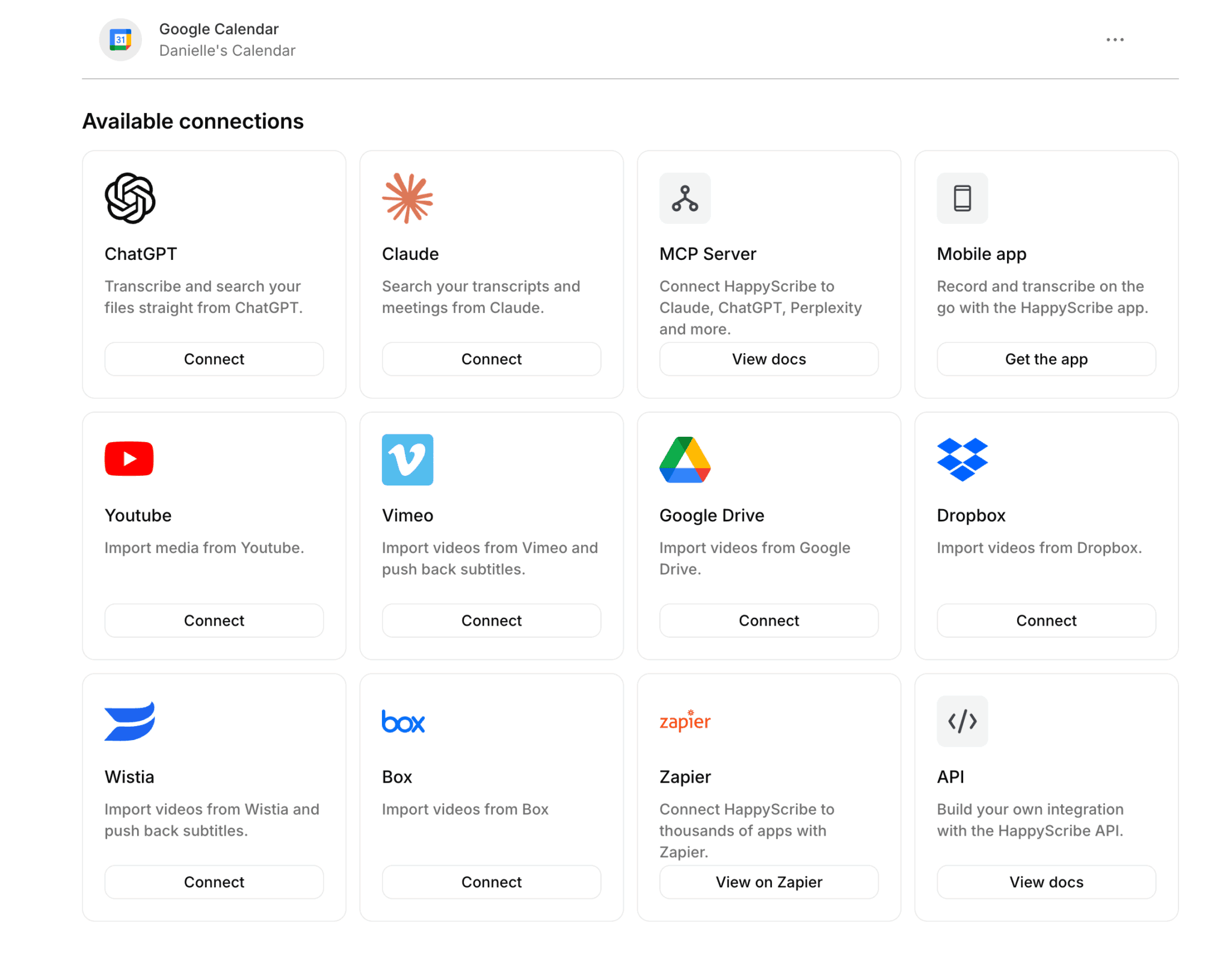
HappyScribe is the only tool that does not have a native CRM sync. It’s integrations run to various options, but there is no direct line into a CRM.
It can be done with Zapier, but will require additional setup and maintenance of a workflow.
All three of the other tools are able to push notes directly to the CRM automatically, saving time, energy, and resources.
Processing Speed
tl;dv, Fireflies and Fathom scored 3. HappyScribe scored 2.
This section measured how quickly the transcript and summaries were available after the meeting. Tl;dv and Fathom arrived immediately after, followed by Fireflies. HappyScribe took the longest of all the tools.
This Section Is Close
Compared to where we scored on the raw transcription accuracy, there was less difference between the scores here. Each of the tools has some genuinely good features, and as a result many things like bot-free recording, platform coverage and MCP server are equal.
These four products are close in what they can do, but the actual transcription element shows that when it comes to Russian transcription, they are not close.
Trust, Security & Value
This section is centered around the security and trustworthiness of each platform. All the tools featured have excellent security features and are clearly aware of what responsibilities they hold in 2026 when it comes to ensuring data security.
tl;dv, Fireflies and HappyScribe all take full marks, with Fathom dropping points on two rows for very specific reasons.
| Metric | How scored | tl;dv | Fireflies | Fathom | HappyScribe |
|---|---|---|---|---|---|
| Data residency / regional hosting | Regional hosting options, e.g. EU hosting on demand | 3/3 | 3/3 | 0/3 | 3/3 |
| Security and compliance | SOC2, ISO 27001, GDPR | 3/3 | 3/3 | 3/3 | 3/3 |
| AI training on user audio | Does it avoid training AI on your audio (no training scores full marks) | 3/3 | 3/3 | 0/3 | 3/3 |
| Data retention controls | Control over how long recordings and transcripts are kept | 3/3 | 3/3 | 3/3 | 3/3 |
| Price transparency | Plan prices are published rather than quote-only | 3/3 | 3/3 | 3/3 | 3/3 |
| Free tier / limits | Free plan availability (a free trial alone scores 0) | 3/3 | 3/3 | 3/3 | 3/3 |
| Trust, security and value subtotal | 18/18 | 18/18 | 12/18 | 18/18 |
Data Residency And Regional Hosting
tl;dv, Fireflies and HappyScribe scored 3. Fathom scored 0.
This is the first gap where the three tools pull away from Fathom. And is fairly consequential. Customers are able to select where their data is held, which is key for EU firms, and those who operate in very specific areas. The grading here is done based on availability of choice.
UK and European teams in particular will have hosting commitments, and many businesses will not be able to store data in specific geographical locations.
Fathom does not offer options with this, and all its data is stored in the US. They do state that for EU/UK suppliers they can be GDPR compliant and will sign a DPA on request.
AI Training On User Audio
tl;dv, Fireflies and HappyScribe scored 3. Fathom scored 0.
This section awards marks on not training AI on customer data. Three of the four tools state that they do not.
Fathom’s position is more layered. Its AI sub-processors, which it names as Anthropic, OpenAI and Google, are contractually barred from training on user data. Fathom states that it uses de-identified customer data to improve its own models, and that setting is on by default.
It can be turned off, and team admins can turn it off for a whole organization. But I only found it after scrolling through the settings, and a control that has to be found is a different proposition from one that has to be enabled.
Russian Meeting Accuracy Test: Methodology
Our comparison is built on a controlled, like-for-like test designed to give every tool the same conditions.
The Test Set
To ensure a wide range of opportunities for the testing, three unrelated Russian round-table discussions were chosen. These were sourced from public recordings and we ran all testing through identical conditions, wherever possible.
The first is a business discussion on the difference between growth and development, covering organizational structure, staff turnover and risk.
The second is a corporate communications panel, heavy with English loanwords, brand names and user numbers.
The third is a discussion of urban development, tourism and property in Kazan, dense with local place names.
The clips ran at around 7 minutes, which should have enough content to establish a solid pattern and identify weak areas. The tools all joined the same Google Meet call and recorded simultaneously. The audio they received was identical and through an identical situation.
We also ran a separate upload run, where possible, to score the diarization row. This was the same audio, uploaded directly, to bypass the call.
The Review
In the first instance, transcription and meeting quality were scored blind. The tools output was put into a document and anonymized using letters A to D. Neither the LLMs, nor our native speaker, were able to ascertain which transcription belonged to which tool.
We ran two independent LLM passes, grading against the scoring rubric. This was fulfilled by Claude and one by ChatGPT. They were done in isolated projects, and did not see each other’s results.
Where the two tools disagreed, we leaned on the one that gave the most evidence, rather than averaging. This means that the reconciled scoring traces to specific lines in specific transcripts, rather than as a whole.
We then asked a native Russian speaker to review the outputs, isolating the areas of particular difficulty and where the tools diverged on their output. They were given the links to the original audio to compare. These marks were used to confirm the output of the LLMs, and introduce specific examples that a real Russian speaker would notice.
Capabilities and trust were scored afterward, based on the current documentation at the time to testing. These rows were verified from the vendors directly, rather than a third-party site.
The Tool Set
Tools were selected for one reason, they claim on their marketing that they are able to transcribe Russian.
Engine & Plan Breakdown
The engine of the tools is what does the transcription work, and this isn’t always publicly available. For our testing tl;dv used ElevenLabs; Fireflies uses licenses rather than builds but does not name a provider. Fathom and HappyScribe disclose nothing.| Tool | Underlying engine / vendor | In-house or licensed | Engine type | Plan |
|---|---|---|---|---|
| tl;dv | ElevenLabs Scribe | Licensed, publicly disclosed | Dedicated ASR | Business |
| Fireflies | Not disclosed | Licensed. CEO Krish Ramineni has said the company never wanted to be an API company and that transcription is a means to an end, pointing to third-party ASR providers | Third-party ASR with an LLM layer over the top | Pro |
| Fathom | Not disclosed | Not disclosed | Not disclosed | Free |
| HappyScribe | Not disclosed | Not disclosed | Not disclosed | Lite Plan |
Scope & Caveats
For each recording session, there were no verified verbatim transcripts. We tested YouTube’s own auto-captions as a reference and rejected them: measured against those captions, every tool scored above 100% error. Diarization ran as a direct file upload rather than a live call. Fathom has no upload path, so its 0 on that row records an absent capability rather than a failed test. Every score in this article was fixed before any tool was named.What Is The Best Meeting Transcription Software For Russian
tl;dv came out with the highest score of all four tools we tested, at 168 out of 200, and the gap that made this was the accuracy of the transcription rather than features. While all these tools do the same thing, they do not hear and record Russian equally.
The real core failing of many of these tools compared to tl;dv was the ability to detect and correctly report on proper nouns. Entity detection was the single biggest gap on the scorecard. Brands, places and acronyms need to be transliterated into Cyrillic. If the tool tries to guess, you can end up with a transcript that looks correct, but is factually incorrect.
That pattern holds across the series. We have run the same 200-point test in Japanese, Spanish, French, German, Italian, Portuguese, Swedish and Finnish. Different languages, different competitors, the same scoring framework each time. If you work in one of those languages, start there rather than with an English-language benchmark.
The features in this article can be worked around, and tl;dv has most of them already, but a transcript that misnames the client isn’t able to. Run tl;dv on your next Russian meeting, free, see for yourself and see what a better quality of output can do to all your work downstream.
FAQs About Russian Meeting Transcription
What is the most accurate AI transcription tool for Russian?
tl;dv is the most accurate, scoring 52 out of 65 on transcription quality in our 2026 blind test. HappyScribe came second on 35, Fireflies took 22 and Fathom 14. The gap was widest on entity detection, where tl;dv scored 5 out of 5 against 2, 1 and 0. Proper nouns are where Russian transcription tools separate.
Which AI meeting assistants support Russian?
tl;dv, Fireflies, Fathom and HappyScribe all produce Russian transcripts. None of the four offers a Russian-language interface, so the product around the transcript stays in English. Google Gemini does not support Russian meeting transcription at all. Gemini covers eight languages: English, French, German, Italian, Japanese, Korean, Portuguese and Spanish.
Why do AI transcription tools hallucinate in Russian?
Transcription models can insert stock text when audio goes quiet or noisy, rather than returning nothing. In our 2026 test, Fathom produced a subtitle credit line that appears in no part of the audio. Fireflies produced Продолжение следует, a stock closing caption. Both are text patterns widely reported in models trained on subtitled video.
How accurate is AI transcription for Russian compared with English?
Accuracy varies far more in Russian than published English benchmarks suggest. In our 2026 test, the four tools scored between 14 and 52 out of 65 on the same three meetings. The failures were not small slips. They included fabricated English sentences, a phrase repeated twenty-four times, and ten years transcribed as ten million.
Can AI notetakers handle Russian and English in the same meeting?
All four tools we tested in 2026 transcribe code-switched Russian, with mixed results. tl;dv and Fathom kept the English word whatever in Latin script. Fireflies wrote it phonetically as вот эвер, which our native speaker marked incorrect. Transliteration caused more damage than the switching itself. Only tl;dv rendered Проктер энд Гэмбл and CBD correctly.