Skip to content




tl;dr on AI meeting tools for German transcription
The best AI meeting tools for German transcription in 2026 are tl;dv, Sembly, and HappyScribe, which tied at 48 out of 50 in a controlled test of ten tools on the same German video.
Each won a different way: tl;dv kept the transcript and summary in German end to end, Sembly posted the highest raw accuracy, and HappyScribe produced the deepest written record.
A native German speaker, marking every transcript blind with no tool names attached, put the same three at the top, and rated Spinach right alongside them on raw transcription alone.
The gap between best and worst was 42 points on the same nine-minute audio. Grain scored 6, returning phonetic English gibberish instead of German. Otter scored 30 and dropped the language entirely on one run with no warning. Every tool tested claims German support on its website, so “supports German” and “is good at German” are clearly not the same promise.
I had every transcript checked against two LLMs and a native German speaker who saw no tool names.
Bottom line: for German from start to finish, use tl;dv.
AI meeting tools for German meetings should handle the language as well as they handle English. Whatever the language, the promise from most AI meeting assistants is that they can do a lot nowadays, from capturing live meetings to giving AI overviews and sales coaching, and with MCP integration, the opportunity to use that content is close to endless. But all of it relies on one thing.
Accuracy.
Before we get started, I want to state that I am a native English speaker. I can speak pretty OK French, but unlike a lot of the team at tl;dv, I am no polyglot. And that matters, because I have to hold my hands up and admit there is a certain native-English-speaker privilege that comes with this. Things just “work” when I use software. Everything is geared towards my language, and I have been known to get annoyed when something turns up in the wrong spelling or a translation is slightly off.
I can only begin to imagine what it is like when English isn’t your first language, and the thing in front of you is simply wrong. Not to mention, in business, the cost of a wrong capture or a botched translation is real.
So, with a certain amount of curiosity, a little anxiety and with fairness in mind, I set up an experiment. The vast majority of AI tools we test here at tl;dv claim to have serious language skills. Some even claim 100+ languages. A truly globalized world. But is it?
Two of our founders are German, we are headquartered in Germany, and Germany is a great center of business, commerce and AI. So I set tl;dv and its competitors a task. How accurate are AI notetakers at German, really?
The results? Well, they are surprising.
And as ever, I write for tl;dv and they pay me. But everything you read afterwards I have stress-tested against multiple LLMs, and even enlisted a native German speaker with no tl;dv connection.
How I tested the AI meeting assistants for German transcription accuracy in 2026
I tested ten AI meeting tools on the same nine-minute German video, three times each, and scored every transcript that was generated against a fixed 50-point rubric measuring accuracy, German-specific quality, output, and reliability.
I think we can all agree, no matter what language we speak, that “proper” language is a myth. People talk and write in different ways. The language lessons you received at school are NOT the language you speak daily. My French GCSE oral exam was proof of that; I was marked down for using too much slang.
Anyway, metaphorical scientific white-coat on, control established, it was time to run the experiment.
The source I selected had to be hard. It could not be a “simple learn German” because that was a) too easy b) fell into the trap of it being “proper” German and not how people speak.
I decided on a Kurzgesagt video, nine minutes and forty-three seconds of fast, technical narration stuffed with the kind of compound words German is famous for. The name itself is a built-in trap. “Kurzgesagt” is one word, but it is “kurz gesagt” (briefly put) fused together, so any tool that splits it back into two has told on itself before you read another line.
That makes it the single fastest test in the whole experiment. Keep “Kurzgesagt” as one word and you have shown, in one word, that you are processing German rather than guessing at it. Split it into “kurz gesagt” and you have shown the opposite. One word, an instant read on whether a tool actually understands the language or is just approximating it.
Added bonus? There was also an English version of the same video, which gave me a clean point of comparison if I needed it.
The AI meeting tools I tested
Ten tools, in no particular order:
We have reviewed or written about several of these in more depth elsewhere, so where there is a deeper dive to link to, you will find it linked above.
Why three runs?
Three runs each, thirty captures in total. And a quick word on why three: I could say because I was trying to be thorough, and I was, but also because the first run was a learning curve.
For Run 1, I recorded all the meeting assistants at once, sat in the same meeting together.
That was a bad idea.
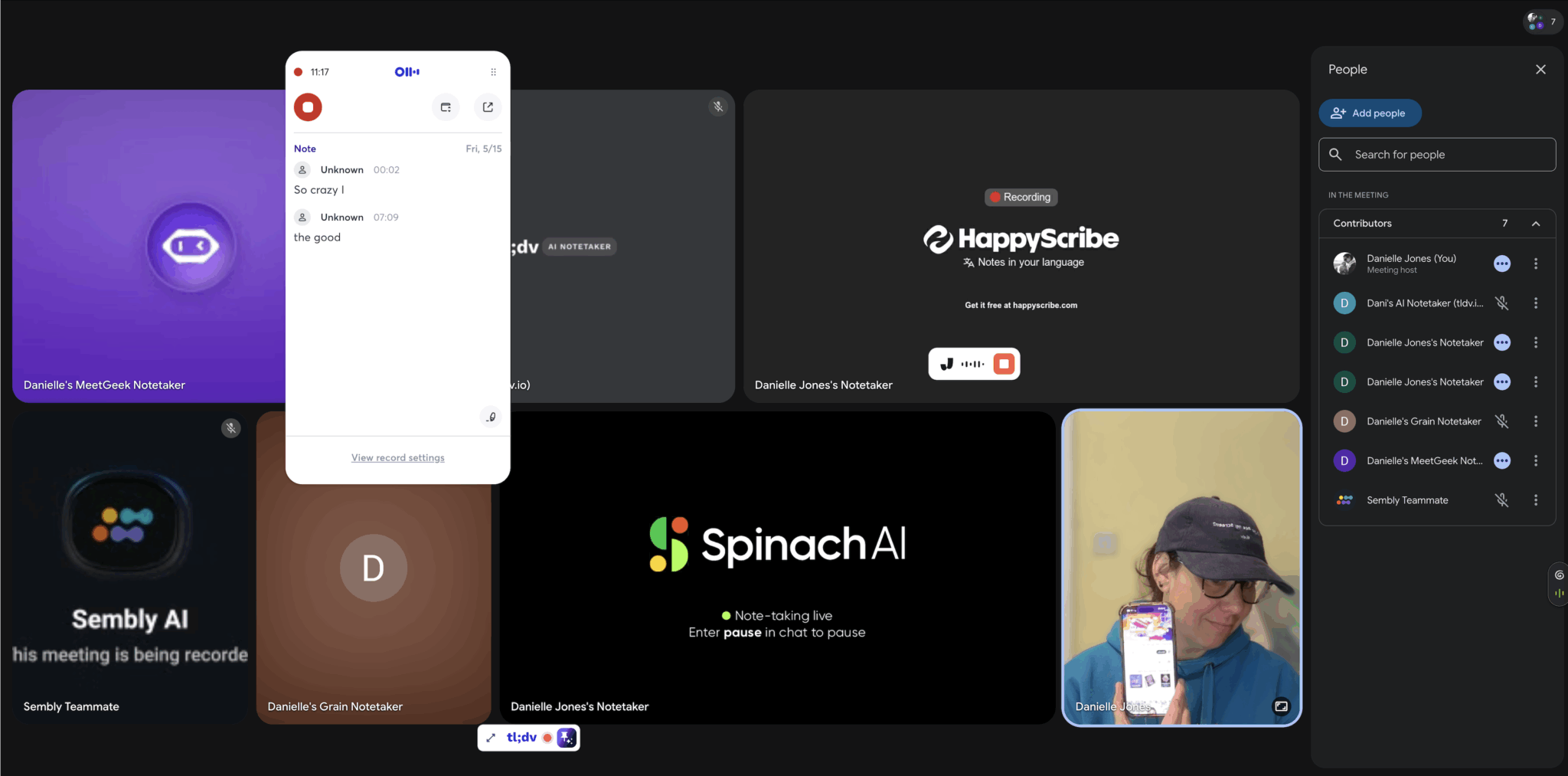
The bots tripped over each other, fought for audio, and some of the captures came out messy and inconsistent. Not all of them, but I will get to that in the results. So I scrapped that approach for the next two runs.
As a result, run 2 became the primary scoring run, with each tool recorded in its own individual session, no other bots in the room. Run 3 was the consistency check. If a tool nailed it once and flubbed it twice, that tells you more than a single lucky capture ever could.
That first failed run is worth keeping in mind on its own, by the way. If you have ever tried to put three notetakers in one meeting, you will know they do not always play nicely together.
A fair word on the limits of this test
I ran this in good faith and tried to control what I could.
Same video, same baseline, each tool recorded in its own session for the primary scoring.
But I want to be straight with you about what a test like this can and cannot tell you.
These tools run on live audio in real conditions, and conditions change. Network drops, a slightly different audio path, a model updated quietly on the vendor’s end, server load at the time of day I happened to run it, any of that can move a result. A tool that stumbled on my runs might nail yours, and a tool that aced mine could have an off day on yours. That is the nature of speech-to-text in 2026. The output is probabilistic, and it shifts.
So treat what follows as a strong signal, not a guarantee. The reason I ran three passes rather than one was exactly this: a pattern that repeats across every run is something I would stake something on, where a single good or bad capture I would weigh more lightly. I have flagged the one-offs where they happened, so you can tell the consistent results from the lucky or unlucky ones.
The real takeaway is not any single score. It is this: test it yourself on your own German audio before you trust it with anything that matters. My nine minutes are a useful guide. Your meeting is the actual proof.
The results: how the ten tools scored on German transcription
I ran the tests and here are the results from the LLM scoring. Three tools tied for first at 48 out of 50: tl;dv, Sembly, and HappyScribe. Grain came last at 6.
The full breakdown is below.
| Rank | Tool | Accuracy /20 | German /15 | Output /9 | Reliability /6 | Total /50 | Verdict |
|---|---|---|---|---|---|---|---|
| 1 | tl;dv | 18 | 15 | 9 | 6 | 48 | Top tier |
| 1 | Sembly | 19 | 15 | 8 | 6 | 48 | Top tier |
| 1 | HappyScribe | 18 | 15 | 9 | 6 | 48 | Top tier |
| 4 | Fathom | 17 | 12 | 9 | 6 | 44 | Strong |
| 5 | Jamie | 17 | 11 | 8 | 6 | 42 | Strong |
| 6 | Spinach | 15 | 11 | 8 | 6 | 40 | Solid |
| 7 | Fireflies | 15 | 9 | 8 | 3 | 35 | Inconsistent |
| 7 | MeetGeek | 14 | 10 | 8 | 3 | 35 | Inconsistent |
| 9 | Otter | 11 | 9 | 8 | 2 | 30 | Unreliable |
| 10 | Grain | 0 | 0 | 0 | 6 | 6 | Failed |
As much as I had hoped tl;dv would have blown away all the competition and won outright, it didn’t.
It DID, however, tie at the top. The three each winning on slightly different areas. Sembly was the “best” in terms of the raw accuracy with 19 out of 20, tl;dv and HappyScribe were able to easily match it on the German-specific handling that the whole test was devised to measure.
It was then a clear four-point drop to Fathom, a genuinely strong tool that just could not keep pace on German compound words and proper nouns.
Below the top four, the floor falls away. But here is the kicker. Forty-two points separated the best tool from the worst, on the same nine-minute video, in the same language. “Supports German” and “is good at German” turn out to be very different claims.
Before I ran a single test, I made sure to check that I was actually testing tools that could back this. Below is what every one of these tools says about German on its own website.
| Tool | Claims German support? |
|---|---|
| tl;dv | Yes. German is one of 40+ transcription languages, and the platform itself is localized in German. |
| Fathom | Yes. German listed among 38 languages, with auto-translated German summaries. |
| Fireflies | Yes. Has a dedicated German transcription page claiming over 90% accuracy. |
| Sembly | Yes. German listed across all language pages. |
| Jamie | Yes. German-founded, German listed, claims 100+ languages. |
| HappyScribe | Yes. Dedicated German and Swiss German transcription pages. |
| Otter | Yes. Help center lists German as a supported transcription language. |
| MeetGeek | Yes. German listed across help center, apps, and API. |
| Grain | Yes. German listed in its top “Common” accuracy tier. |
| Spinach | Yes. German listed; claims 100+ languages. |
Every single tool that was selected states explicitly on their site that they offer German transcription.
I just want you to remember that fact.
We asked the AIs, then we asked a human
That’s a pretty interesting set of data, I think you’ll agree, but I bet you’re wondering:
“But Dani, you don’t speak German? How did you work out what was accurate and what wasn’t?”
I’m glad you asked. And to be frank, not being a German speaker did have its restrictions. I couldn’t just listen, read the output, and go “oh, that’s wrong.” But it also let me come at this with a useful kind of distance. I had no ear to trust and no instinct to flatter, so I had to build a method instead.
Personally, I think German is genuinely hard, by the way. My mum was a polyglot. French, Arabic, even Greek, on top of English. German was the one that stumped her, for the very reason that regional differences and accents could change everything. That is less of a case nowadays, in a world so connected that a lot of regional nuance gets smoothed over, but there are still differences.
So if I couldn’t judge the German myself, I needed judges who could. I used three.
First, I asked the AIs. I scored every transcript against my rubric using Claude, and ran a second read-through with ChatGPT. I tried to isolate the transcripts away and ensure that they were impartial; how impartial they are is anybody’s guess nowadays, but I did explicitly ask for a neutral, unbiased output. The interesting thing is that they didn’t fully agree with each other.
Claude did the first rigorous pass, locked to the 50-point rubric with the test passages fixed before scoring. It would not hand tl;dv a clean win. It put tl;dv joint top with Sembly and HappyScribe. A tie, not a victory.
ChatGPT actually struggled a bit, probably because I recently cancelled my ChatGPT subscription, and it was annoyed with me. When I finally managed to get it to read all the raw input, it declared tl;dv the out-and-out winner. I was slightly suspicious, and I did push back and ask it to be totally neutral, impartial, don’t protect my feelings, but it was fairly confident. I mean, we’ll take it, but it was a lot less thorough than Claude was.
Then I asked a human. Two AIs running on my brief still cannot mark my client’s homework, so I brought in a native German speaker with no tl;dv connection, no labels attached to each transcript, and no reason to care how it placed.
After telling me that her “eyes started to bleed” after reading all the output, she was fairly pointed and gave some blistering feedback on some of the anonymized outputs. Her feedback broadly tracked the LLM scores, with one striking exception I’ll come to.
What she actually caught, the specific German howlers and the one thing that made me quite surprised, I will get to further down.
Tool-by-tool: how each tool fared on the German LLM test
I’m not just going to give you the numbers and be done with it. Here is a more detailed breakdown of what each LLM judge gave me per tool. The good, the bad, and the downright “What on earth is going on here?”
A quick note on how to read this. I’ve pulled out the highlights for each, and one of the things that was interesting to note was not just how well the tool managed the transcription itself, but how it delivered it. There were some notable anomalies where the tool did a fairly OK job at doing the transcription, then generated the summary in English, or an email in English.
1) tl;dv German Transcription
tl;dv was the only tool that kept everything in German from start to finish. Transcript, dashboard, and the summary email all came back in the language the meeting was actually in. No quiet switch to English at the summary stage, which, as you will see, several others could not manage.
The transcription itself was clean and well punctuated, and it handled the compound words and the Kurzgesagt word without fuss. The summary was structured rather than a wall of text, which matters when you are scanning a recap rather than reading a transcript line by line.
The one consistent crack: “AI-Slop,” the video’s central phrase, came out as “AI-Slog” on every single run. Not a German-specific failure, more an English-loanword stumble, but it was reliably wrong three times out of three.
I want to add another little caveat in here. Working for tl;dv I can use the Business level of the account. What does that mean? It means I don’t have any gates in the way of transcription or anything that is behind a pay-wall. Many of the tools below were run through using their free trial, which offered the same level of functionality. So, for the second run of tl;dv I actually used a Free account, not linked to my tl;dv. I did this on purpose, so my level of access couldn’t hand me a better output. The result? I got a shorter transcript output but it was still accurate in German, which clearly shows that even on the free tier, the quality of the transcription held up.
Result? A strong, consistent performer, and the only tool that wouldn’t have made me switch languages to read my own results.
2) Sembly German Transcription
Sembly posted the single best transcription score in the whole test, 19 out of 20. Word for word, it was the most accurate capture of the German according to the LLMs, edging even the joint winners it tied with overall.
Two cracks kept it from running away with it. First, the summary email arrived in English even though the meeting was in German, the exact deliver-it-in-the-wrong-language quirk I mentioned up top. Second, and stranger, in Run 2 it censored the word “Mist.” For German speakers, that is a mild word, somewhere around “rubbish” or “darn.” Sembly starred it out anyway, “****,” which is a profanity filter firing on a word that probably does not warrant it.
Result? If raw transcription accuracy is your single priority, Sembly is arguably the pick. Just know the recap may land in a different language than your meeting.
3) HappyScribe German Transcription
HappyScribe was the tool that never once tripped on the built-in trap. “Kurzgesagt” came back as one word on all three runs, where most of the field split it into “kurz gesagt” at least once. It also produced one of the deepest, most detailed summaries of any tool tested, with clean timestamps and speaker labels throughout.
There is a reason for that: HappyScribe started a transcription-first product. The meeting-assistant layer sits on top of a core business built around getting audio into accurate text, including a dedicated German transcription service and even a Swiss German one. So strong German handling is not a happy accident; it is the thing the company was built to do.
Result? If your priority is the written record itself, the transcript and a thorough recap rather than the live-meeting bells and whistles, HappyScribe is hard to beat.
4) Fathom German Transcription
Fathom is a genuinely strong tool that landed just outside the top three, four points back at 44. Its transcription was good rather than top-tier, but where it did best was output. It scored a perfect 9 out of 9 on summary quality, turning a slightly weaker capture into a clean, useful recap.
Where it slipped was the German-specific handling. It split the Kurzgesagt word on the sign-off, and stumbled on a few compound words and proper nouns that the top three handled cleanly.
Result? Strong all-rounder, and proof that a great summary can paper over a merely good transcript, but not quite a German specialist.
5) Jamie German Transcription
Jamie was actually the tool that I thought might give us the strongest run for our money. It’s a German-based company, HQed in Germany… It’s very German.
Broadly it delivered, landing solidly mid-table at 42. It captured the trickier passages well, including the July 2025 hidden-text finding from the video that tripped weaker tools.
Two flags. It rendered numbers as written-out words rather than digits, “zweitausendfünfundzwanzig” instead of 2025, which is technically not wrong but a pain to scan. And in Run 1, it produced the single oddest number error in the whole test, turning the video’s “72%” into “270%.”
Result? A solid, privacy-first option that mostly lives up to its home-turf advantage. Number error is a big concern though.
6) Spinach German Transcription
Spinach captured the German cleanly enough, although not as well as others according to the LLMs (remember that bit!), landing at 40, with clean per-line timestamps throughout. But every single run, the summary came back in English. A German meeting in, an English recap out, three times out of three.
Like several others, it also stumbled on the English loanword “AI-Slop,” rendering it variously as “AI-Slob” and “AI-Slot” across the runs. Not a German failure as such, more a wobble on the borrowed English term sitting inside the German.
Result? Fine on raw capture, but the English summaries make it a harder sell for German-speaking teams who want their recap in their own language.
7) Fireflies German Transcription
Fireflies is the clearest evidence for why I scrapped recording everything at once. In Run 1, with every bot crammed into one meeting, its German came back heavily garbled. Run 2, recorded alone, was dramatically cleaner, its best showing by a distance. Then Run 3 slid back into garble.
That swing is why it scored low on reliability. A tool that needs a perfectly quiet, single-bot room to perform is hard to count on, because real meetings rarely are one. It also turned “Bots” into “Sport” in one summary, which tells you plenty about the audio it was working from.
Result? Capable when conditions are perfect, shaky when they are not.
8) MeetGeek German Transcription
MeetGeek’s headline problem was Run 1, where it rendered the entire German video as English. Not translated, transcribed phonetically as English approximations of what it heard, which is its own special kind of wrong. “AI.S.Mob, overfluted the net” is roughly where it landed.
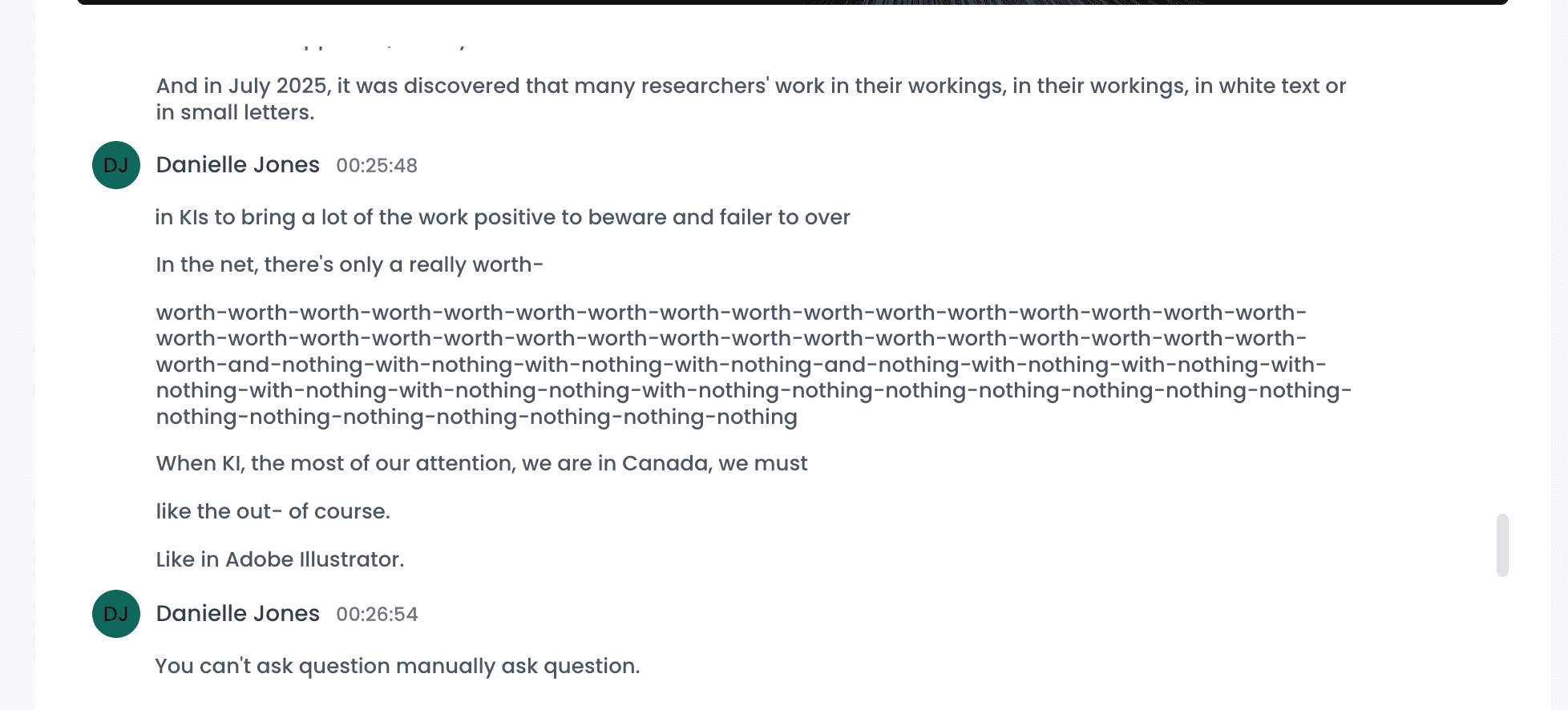
Runs 2 and 3 recovered to real, usable German, but both opened with the first chunk truncated, missing the very start of the video.
Result? Two decent runs out of three, undercut by a total language collapse on the first and clipped openings on the rest.
9) Otter German Transcription
After the first run, I actually went back to check that Otter even covered German. The output was so far off, phonetic English mush where the German should have been, “We’re a ice lot to again height” being a real line from it, that I genuinely assumed I had made a mistake and picked an English-only tool. I had not. Otter’s help center lists German plainly, and I had selected it correctly. The tool just fell apart that badly.
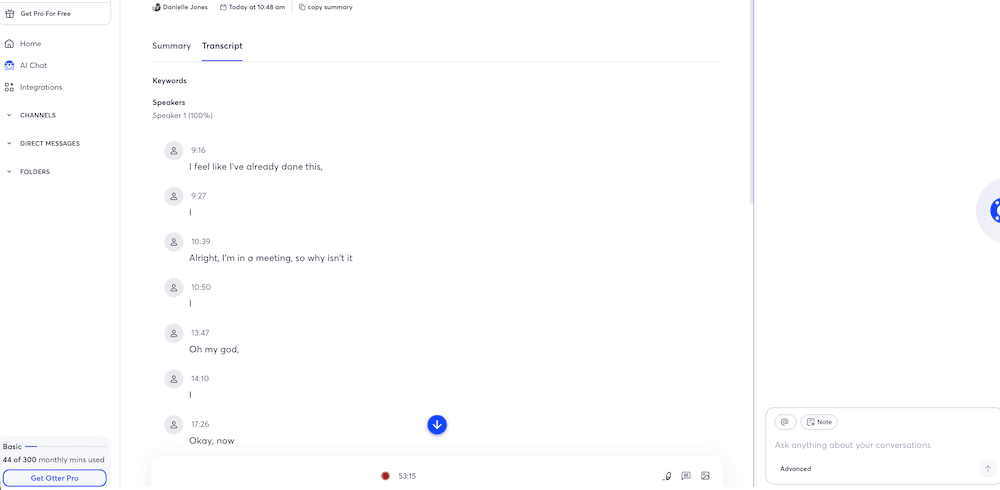
The other runs did produce German, scrambled but recognizably German, which somehow makes it worse. A tool that drops the language you selected, with no warning, no error, no flag, is harder to trust than one that is honestly bad, because you would not catch it unless you spoke the language and were watching closely. It also mangled the video’s key statistic, rendering “over 1,200” as a garbled “eins 200.”
Result? Claims German support, delivers it sometimes, and abandons it without telling you. Trust accordingly.
10) Grain German Transcription
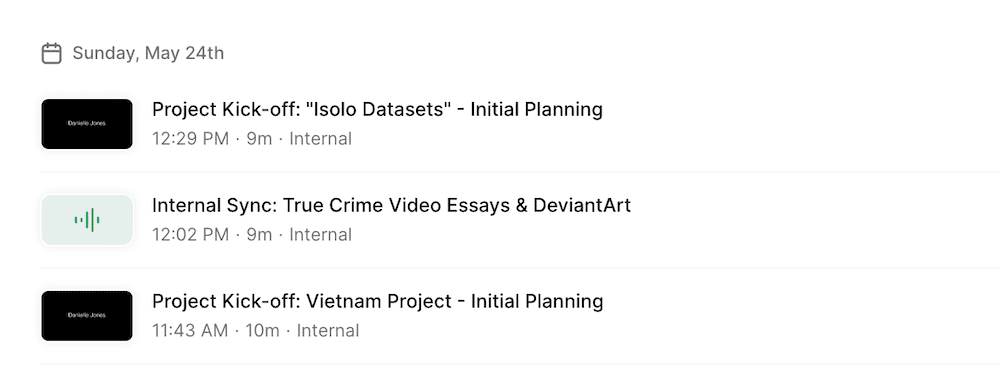
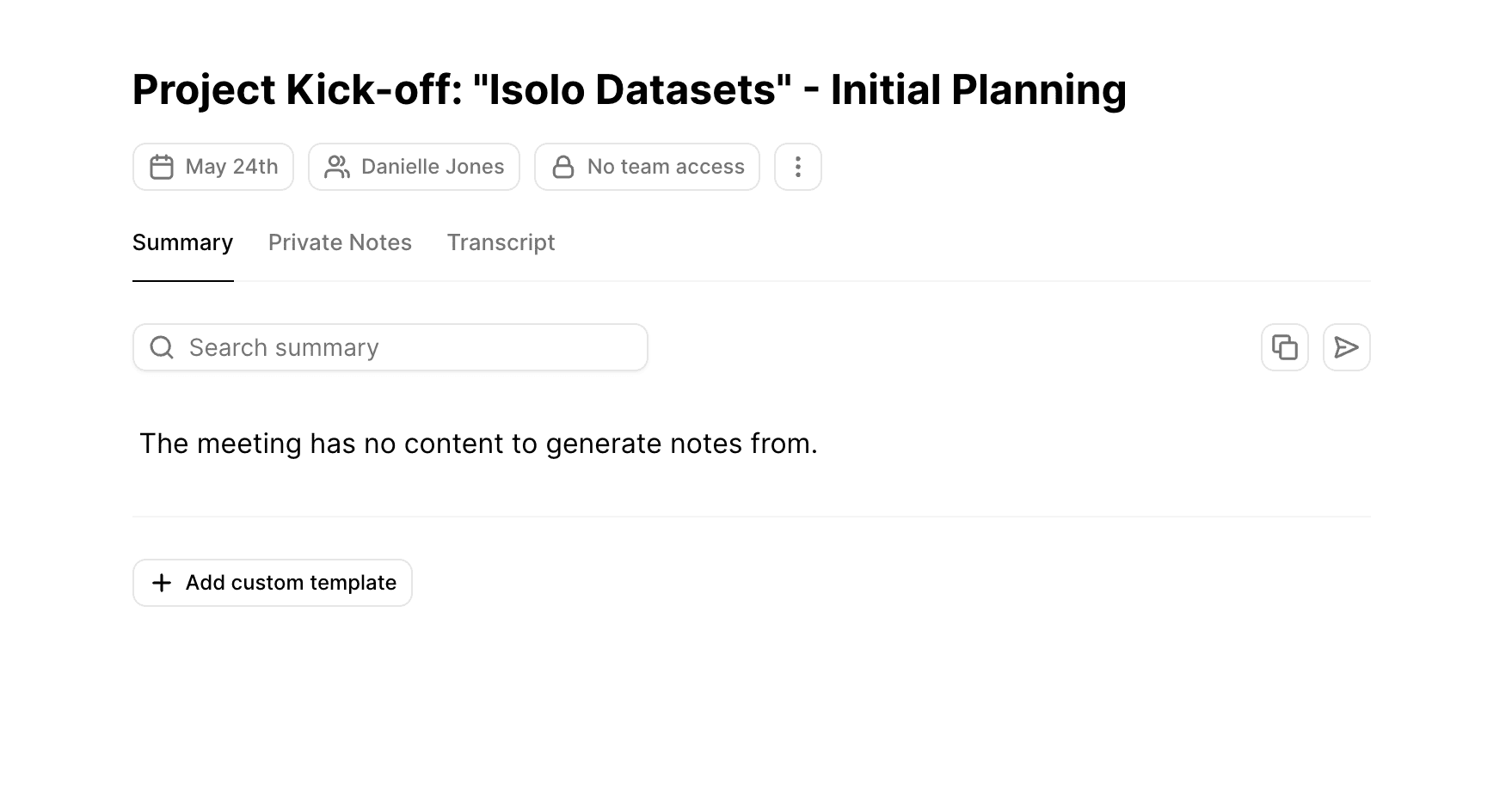
Just, wow! Grain didn’t even give me a proper transcript to begin with. Where the other tools at least produced something in German, good, bad, or scrambled, Grain returned so little usable text that on one run it told me there was “no content to generate notes from.” It could not summarise the meeting because it had not managed to transcribe it.
What it did produce, across all three runs, was not German and not even bad German. It was phonetic English gibberish. “Google AI fast website Suzanne” is a real line it generated from the German audio. It named its own recording sessions after the garble, so the nonsense propagated into the file names too.
Grain’s own support page lists German not just as supported, but in its top “Common” accuracy tier, the one it describes as extremely accurate for word detection, punctuation, and proper nouns.
Result? The gap between that claim and what landed in front of me is the widest in the entire test. On this audio, Grain did not transcribe German. It hallucinated English and gave up.
What did our German speaker think of the outputs?
So the LLMs gave a pretty detailed breakdown of how each tool fared against the rubric. But there is nuance here. The video was chosen to mimic a real meeting: background noise, fast speakers, conditions that are never quite perfect. A score out of fifty is one thing.
What a person who actually speaks the language makes of the output is another.
So for this part of the test, I sent our German speaker a raw document of the transcript outputs with every tool name stripped out. No labels, no scores, no idea which one was tl;dv or which was the one that failed. I asked her to mark each for accuracy out of ten and give me her unfiltered comments.
The results were pretty funny. They were also more revealing than any number I assigned. Here is what German actually looked like coming out the other end.
Four tools came out clean. HappyScribe, tl;dv, Sembly and Spinach all scored in her top band, mostly 9s and 10s, sentence after sentence marked correct with barely a note in the margin. Three of those four I expected. They were the same names sitting at the top of my fifty-point rubric. But Spinach? That was the most interesting result in this whole test.
In the middle section it was pretty similar, Jamie held together, 8s and 9s, dinged mainly for turning “72 Prozent” into “zweihundsiebzig Prozent.”
Fathom was messier. Her scores swung from 3 to 10 depending on the sentence, and the margin filled up: “that is not a word,” “who is ‘she’?”, “the last sentence is weird.” At one point Fathom typed its own name into the transcript, “Der Fathom von Menschen für Menschen gemacht,” which earned a baffled “is ‘kurz gesagt’ the Software? or what is it supposed to mean?”
And then the floor. Otter, MeetGeek, Fireflies and Grain were where her patience clearly ran out, and you can watch it happen in the notes. Otter got a flat “too many mistakes and half English words,” then a 1/10 on the next run with “also this is just gibberish words thrown together,” then a third run that abandoned German entirely and came back in broken English. Fireflies earned “most of this is just gibberish.” MeetGeek dissolved into a loop of “I’m sorry, I’m sorry, I’m sorry.” Grain never produced German at all. It produced something phonetic and English-shaped and genuinely hard to read aloud without laughing.
She did not rank tl;dv first. She put HappyScribe and Spinach right up there with it. The tool I write for came through the blind test clean, scoring 9, 8, 9 across the runs with no complaints in the margin, but it did not walk away the runaway winner. That is exactly what I wanted from this part of the test. A judge who cannot see the logos cannot do me any favors.
Now, Spinach.
On my fifty-point rubric, Spinach finished mid-table. On her blind read, it sat with the winners. That gap is not an error, but it is worth explaining properly.
Spinach transcribes real-life German beautifully, but it just does almost nothing useful with it afterward. Every run, it captured the audio cleanly, then handed back a summary in English. My rubric scored the whole product, the transcript and the summary and the delivery a German team would actually open on a Monday morning, so Spinach lost points in all the columns she never saw. She was only ever looking at the raw text. And the raw text was excellent.
So you get two honest verdicts for the same tool. Strip it back to the transcript and Spinach is near flawless. Judge it as a thing you would actually run your German meetings through, and it slides to the middle. Same software, two different answers, depending entirely on what you decide to measure.
Grain proves it from one end: fail the transcript and you fail everything downstream. Spinach proves it from the other: nail the transcript and you can still come up short as a German tool.
Below you can see some of the fun hot-takes our German speaker put against the transcripts.






Why German broke so many of them
So here is the question the scores leave you with. If all ten tools claim German, and German is not some obscure language; it is one of the most widely spoken first languages in Europe, how do you get a 42-point spread on the same nine-minute video? Part of the answer is the engine each tool runs underneath.| Tool | Transcription engine | Stated accuracy for German |
|---|---|---|
| tl;dv | Proprietary model by default, with Whisper on Business and Enterprise plans | No German-specific figure. tl;dv claims 96% accuracy overall, not broken out by language. |
| Sembly | Deepgram | No German-specific figure published. |
| HappyScribe | Proprietary in-house model | ~85% for AI German, up to 99% with human review. Its own claim, on its German page. |
| Fathom | Not publicly disclosed | No German-specific figure. Around 95% claimed generally. |
| Jamie | ElevenLabs Scribe | No German-specific figure. Markets “highly accurate” across 100+ languages. |
| Spinach | Not publicly disclosed | No accuracy figure published. |
| Fireflies | AssemblyAI | No German-specific figure published. |
| MeetGeek | Proprietary (recently upgraded engine) | No German-specific figure published. |
| Otter | Proprietary in-house model (AISense) | No German-specific figure. Markets English first, and German support is limited. |
| Grain | AssemblyAI | No accuracy figure published. |
Is this a location-based bias?
I did, at this point, pause to consider whether or not where the companies were based had any impact on this. Again, leaning into that “English speaking privilege,” I did wonder if the top-performing tools were all European, and that the ones that did poorly were US-based. Privacy and security are certainly areas where we tend to see a divide between US and European tools, but it wasn’t the case here. Two of the three top tools are European, tl;dv and HappyScribe, and both German-built tools, tl;dv and Jamie, landed well. So the theory had legs at first glance. But it fell apart fast. Sembly is American, headquartered in New York, and it posted the single highest accuracy score in the entire test. MeetGeek is European, built in Romania, and it sat near the bottom of the table. One of my best performers was US-based and one of my worst was European, so “European tools do German better” simply does not hold. So it is not about where a company is from. It is about whether the tool was built with non-English speakers genuinely in mind. Being European is one route to that. Being built for global enterprise, the way Sembly is, is another. The tools that assumed English and treated everything else as an add-on were the ones that fell down, wherever their office happened to be.| Tool | Headquarters | Region |
|---|---|---|
| tl;dv | Germany | Europe |
| Sembly | New York, USA | US |
| HappyScribe | Barcelona, Spain | Europe |
| Fathom | San Francisco, USA | US |
| Jamie | Germany | Europe |
| Spinach | Nashville, USA | US |
| Fireflies | San Francisco, USA | US |
| MeetGeek | Bucharest, Romania | Europe |
| Otter | Mountain View, USA | US |
| Grain | San Francisco, USA | US |
Which German transcription tools are GDPR compliant?
Every German transcription tool I tested claims GDPR compliance, which tells you almost nothing. It is the participation trophy of data privacy. The two questions that actually decide whether a tool is safe for a German team are the quieter ones: where does your data get processed, and does the tool use your meetings to train its AI?
Most of the US tools answer the first question with “America” and hope you never ask the second.
| Tool | Where data is processed | Trains AI on your data? | Certifications |
|---|---|---|---|
| tl;dv | EU (German company, EU data centers) | No | GDPR; SOC 2 / ISO 27001 |
| Sembly | EU residency option (US company) | Enterprise excluded; lower tiers opt-out | SOC 2 Type II, GDPR (no ISO 27001) |
| HappyScribe | EU only (Barcelona, EU data center) | Not publicly stated | SOC 2 Type II, GDPR; ISO 27001 data center |
| Fathom | US | Yes, de-identified (opt-out available) | SOC 2 Type II, GDPR, HIPAA (no ISO 27001) |
| Jamie | EU only (Frankfurt, Germany) | No | ISO 27001, GDPR, DORA (no public SOC 2) |
| Spinach | Not publicly confirmed | Not publicly confirmed | Could not verify publicly |
| Fireflies | US by default (EU private storage on Enterprise) | No (zero-day retention with vendors) | SOC 2 Type II, GDPR, HIPAA |
| MeetGeek | US or EU (residency option) | No | SOC 2 Type II, GDPR |
| Otter.ai | US | Yes, de-identified | SOC 2 Type II, GDPR |
| Grain | US (AWS) | Not publicly confirmed | SOC 2 Type II, GDPR |
Two rows deserve a second look. Otter and Fathom both train on customer data. They de-identify it first, and Fathom lets you opt out, but the default setting is that your meetings help improve their models. For a German call covering anything a competitor would love to read, that is the kind of line a data protection officer circles in red.
tl;dv, Jamie, Fireflies, and MeetGeek take the opposite stance and do not train on your content. Jamie and tl;dv go furthest by keeping processing inside the EU, Jamie in Frankfurt and tl;dv as a German company on EU infrastructure. Fireflies leaves you on US servers unless you pay for Enterprise private storage. If your shortlist is “EU data, no AI training, audited,” it comes down to tl;dv, Jamie, and HappyScribe.
Then there is consent, which Germany does not treat as a formality. Recording someone’s spoken word without their agreement can be a criminal matter under German law, so “the bot just joins” is not a strategy. Most of these tools announce themselves or offer a consent prompt. Fewer build consent collection in as an actual feature rather than leaving it as the thing you forgot to do.
One caveat, said plainly. “GDPR compliant” and “EU residency” shift with pricing tiers and get quietly updated, so treat this table as a snapshot and check the vendor’s own trust center before you commit. I did.
German-specific findings: the patterns to watch for
If you are running this kind of test yourself (personally I wouldn’t, it was incredibly stressful!), or just reading your own German transcripts with a more critical eye, these are the specific failure patterns that separated the top of the table from the bottom. Each one showed up across more than one tool, so treat them as your first checks.
The compound-word tell
German welds words together, and “Kurzgesagt” is the cleanest single test in this experiment. It is “kurz gesagt” (briefly put) fused into one word, so any tool that hands it back as two has shown you where its German runs out. The top three kept it intact. Most of the field split it at least once. The same fault line shows up in everyday compounds: one tool turned the script’s “Pro-Accounts” (professional accounts) into “pro Account” (per account), which is not a spelling slip; it is a different meaning entirely. Find a compound word and check whether it survives. It is a thirty-second read on a tool’s German.
Umlauts and the Eszett
The dots and the ß are the first sign of whether a tool is processing German or approximating it. A missed umlaut is not cosmetic; it can change the word, and ae/oe/ue or ss substitutions are the giveaway that an engine is reaching for an English keyboard. The strong tools preserved them throughout. The weak ones treated them as optional.
The profanity-filter misfire
One tool censored the word “Mist” to “****.” For a German speaker that is mild, closer to “rubbish” than anything you would bleep. An English-tuned filter firing on an inoffensive German word tells you the tool is being policed by rules it never switched off. Watch for asterisks no German speaker would expect.
Numbers as words, and the inversion
One tool wrote numbers out longhand, “zweitausendfünfundzwanzig” instead of 2025, correct but miserable to scan. Worse was the run that turned the script’s “72 Prozent” into “270 Prozent,” and the one that mangled “über 1200” into “eins 200.” Those are factual errors, not transcription wobbles, and they survive into summaries and then into decisions. Check every number by hand.
The root cause: English-first engines pointed at German
Almost every pattern above traces to one thing. An engine that assumes English by default keeps reaching for English habits, the profanity filter, the loanword guess, the phonetic fallback when it loses the thread. That is why “AI-Slop” came back as “Slog,” “Slob,” and “Slot” across different tools. The German around it was fine. The English instinct underneath kept surfacing.
How to choose an AI meeting tool for German meetings
This test matters most if you run meetings in German and need the record to hold up: German-speaking teams, EU companies working in their own language, anyone delivering transcripts or summaries back to German-speaking clients, and GDPR-conscious buyers who already care where their data goes. It matters least to one group, the people who assumed every tool handles German because it handles English. That assumption is exactly what the bottom of the table punishes.
For everyone else, the pick comes down to what you most need to get right, because the four winners each earned the top score a different way.
Need German from end to end? tl;dv is the one to beat. It was the only tool that stayed in German the whole way through, transcript, summary, and dashboard, with no quiet switch to English at the recap stage. That is the tool that pays me, and it still had to tie rather than win, so take the recommendation for what it is.
Need the most accurate raw capture? Sembly posted the highest word-for-word score in the test.** Just know the summary email may arrive in English even when the meeting was not.
Need the deepest written record? HappyScribe is hard to beat. It came from a transcription-first background and produced the most detailed, best-labelled summaries of anything tested, which is what you want when the text itself is the deliverable.
Need the truest natural form of German? Then, based on our testing, Spinach is your pick; the only problem is within the transcript is where it stays. It could be a case of when I signed up I selected “English”; I don’t think I did, though, as I made a point of selecting German (Deutsch for the ones that were really thinking about it, we see you!) when I onboarded, but clearly the interface was keen for me to see things in English.
Three tied scores and one native-speaker verdict: four different jobs. Match the tool to yours.
Best AI meeting tools for German meetings: the verdict
Four tools came out on top in our testing, and the key part is that they did not tie by being the same. tl;dv for German from start to finish, Sembly for the most accurate raw capture, HappyScribe for the deepest written record, Spinach got the nod from our German speaker. There is no single best AI meeting tool for German meetings. There is the right one for the job in front of you, and a clear bottom of the table to avoid.
I write for tl;dv, they pay me, and I went in hoping they would win outright. They did not. The strictest judge in the whole test, a native German speaker who could not see a single logo, did not rank them first outright. A test that cannot embarrass the client is not a test, it is an ad. This one kept its teeth, and that is the only reason the result is worth anything to you.
If German-everywhere is what you need, that is tl;dv’s case, and the free plan lets you test it on a real meeting before you commit. Try it on your next German call and see if the recap comes back in the right language. Nine minutes of real audio will tell you more than any feature page.
FAQ: AI meeting tools for German transcription
What is the best AI meeting tool for German meetings?
The best AI meeting tools for German meetings are tl;dv, Sembly, and HappyScribe, which tied at 48 out of 50 in a controlled test of ten tools on the same German video.
tl;dv was the only tool to keep the transcript and summary in German end to end.
Do AI meeting tools work as well in German as in English?
Based on our experiment, not all of them were consistent. In this test, ten tools that all advertise German support showed a 42-point spread on the same nine-minute German video, scored out of 50. Some captured German almost flawlessly. Others returned phonetic English gibberish or switched language entirely. Supporting German and being accurate in German are not the same thing, and a tool’s reputation in English tells you very little about how it handles German.
Which meeting tools failed at German transcription?
Grain and Otter performed worst in testing. Grain scored 6 out of 50, producing phonetic English nonsense instead of German and, on one run, reporting it had no content to summarize. Otter scored 30 and abandoned German entirely on one run, returning broken English with no error or warning. Both list German as a supported language.
Can AI transcription handle German compound words and umlauts?
The strongest tools can, but many cannot do it reliably. German fuses words into single long compounds, and the brand name “Kurzgesagt” became a clean test: weaker tools split it into “kurz gesagt,” exposing a shallow German model. Umlauts (ä, ö, ü) and the Eszett (ß) are a second tell, since tools that substitute ae, oe, ue, or ss are approximating German rather than processing it.
Why did some AI meeting tools switch to English?
Tools switched to English because their underlying speech engine defaults to English and treats other languages as a setting layered on top. When the engine lost confidence in the German audio, it fell back on English habits, transcribing phonetically, applying English profanity filters, or producing the summary in English even when the transcript was German. This English-first design, not the difficulty of German itself, explains most of the failures in testing.
Is tl;dv good for German transcription?
Yes. In this test tl;dv tied for first at 48 out of 50 and was the only tool of the ten to keep the transcript, summary, and dashboard in German from start to finish, with no switch to English at the recap stage.
A native German speaker scoring the transcripts blind, with no tool names visible, placed it in her top band alongside HappyScribe and Spinach.
Do you need a paid plan for good German transcription?
Not necessarily.
When tl;dv was tested on a free account rather than a paid one, the transcript came back shorter but still accurate in German, so the quality of the core transcription held up without a subscription. Several other tools in this test were also run on free trials offering the same functionality. Plan tier affected length and features more than raw German accuracy, though availability changes often, so check the current free plan before relying on it.
Can you transcribe German for free?
Yes. Most of the tools I tested record and transcribe German on a free plan, but the caps are where the catch lives. tl;dv’s free plan records and transcribes German. Fathom is the most generous on raw recording, free and uncapped, though your data sits in the US and helps train its models by default. The free tiers from Fireflies (800 minutes of storage), MeetGeek (three hours a month), and Otter fill up faster than you would like. For a German team that wants free, EU-based, and no AI training in one place, tl;dv is the only free plan that ticks all three.
Do speaker labels and timestamps work in German transcripts?
Timestamps held up across every tool that produced usable German output, so that part is reliable. The three tools that handled German cleanly, tl;dv, Sembly, and HappyScribe, returned properly timestamped German transcripts with no formatting drift. If accurate speaker separation in German is a hard requirement, test it on your own multi-speaker call first.
Does AI transcription handle Swiss German and Austrian dialects?
Not as reliably as it handles standard German, and Swiss German is where most tools start guessing. My test used standard High German narration, so I did not score dialects directly. Published benchmarks put Austrian German around 91 to 93 percent accuracy and Swiss German down at 80 to 87 percent, which is roughly the point where you stop trusting the transcript. HappyScribe is the only tool of the ten that markets dedicated Swiss German support as a named feature, though that is their claim, not my test result.
Which German transcription tool is the best value?
It depends on what you are buying. tl;dv, Sembly, and HappyScribe tied for top accuracy in my test, so on raw German quality you are not paying for a difference between them. The value split comes down to priorities: pick tl;dv if you want strong German, a usable free plan, EU processing, and no AI training together. Pick Fathom if free, uncapped recording matters more than where your data lives. Pick HappyScribe if you need the widest language and dialect coverage. There is no single best-value winner here, only the best fit for what you weight most.