Skip to content




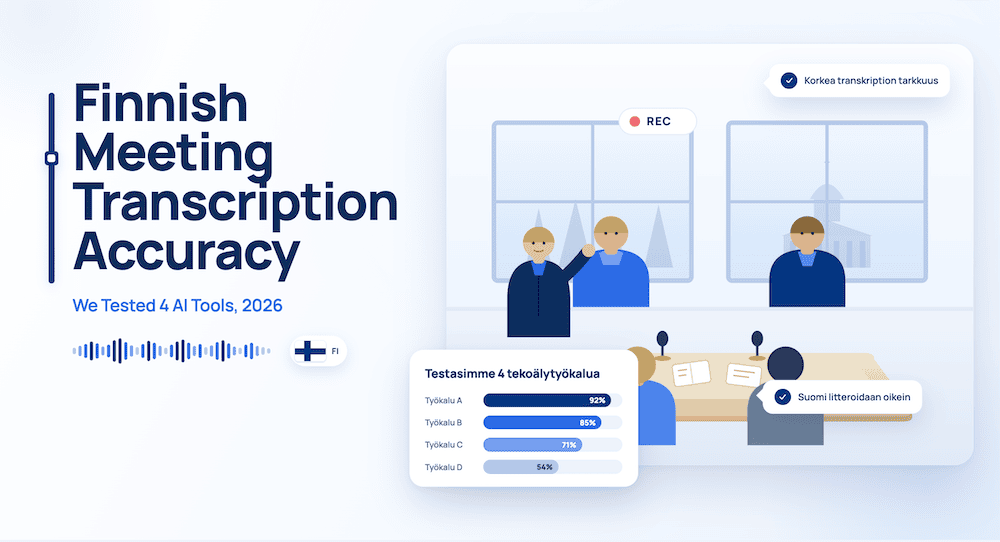

tl;dr of Finnish Meeting Transcription Accuracy
With Finnish meeting transcription, our testing revealed that tl;dv is the most accurate AI meeting transcription tool for Finnish, scoring 173 out of 200 in our 2026 benchmark.
We tested four AI meeting assistants on native Finnish: tl;dv, Fireflies, Noota, and Fathom. Noota finished second with 149 out of 200. Fireflies finished third with 148 out of 200. Fathom finished fourth with 94 out of 200.
Each tool was scored across four tiers: transcription accuracy, real-world meeting quality, capabilities and features, and trust, security, and value. tl;dv led three of the four tiers outright.
From all the tools, tl;dv scored the lowest word error rate (WER) of the four tools tested. tl;dv was also the only tool to correctly transcribe every proper noun, figure, and technical term we checked across three Finnish parliamentary sessions.
Fathom delivered its Finnish meeting summaries entirely in English, which fails the in-language requirement and scored zero on the summary rows. Fathom was also the only tool that trains AI on user audio by default.
The test used three question-time sessions from the Eduskunta, Finland’s parliament. All outputs were anonymized and scored blind by two LLMs, Anthropic’s Claude and OpenAI’s ChatGPT. A blind native-speaker confirmation pass is to follow.
Finnish meeting transcription tools are easy to find. Many AI meeting assistants list Finnish among their language claims, but claiming to transcribe Finnish and actually doing it are two different things.
Finnish stacks meaning at the end of a single word. leikkaussalivalmiutta carries a whole English phrase inside it, and one dropped ending changes the sentence.
Many tools that offer Finnish are English-first, built around English speakers with other languages bolted on, and our testing shows it.
We tested tl;dv against three others on rapid, native Finnish in a formal setting:
- Fireflies
- Noota
- Fathom
We would normally include Google’s Gemini in our tests, as many businesses and sales teams already have it in their business workspaces. But Gemini only supports eight languages, and Finnish is not one.
Outputs were anonymized and scored blind across four sections, two of them from each tool’s documentation and marketing:
The scoring was done by two LLMs: Anthropic’s Claude and OpenAI’s ChatGPT, in anonymized, ring-fenced projects to ensure no bias. A native-speaker confirmation pass is to follow.
In the results, tl;dv came out top with 173 out of 200. Noota and Fireflies finished behind it on 149 and 148, and Fathom trailed well back on 94.
| Tier | Max | tl;dv | Fireflies | Noota | Fathom |
|---|---|---|---|---|---|
| Transcription & accuracy | 65 | 59/65 | 39/65 | 41/65 | 27/65 |
| Real-world meeting quality | 45 | 36/45 | 33/45 | 33/45 | 9/45 |
| Capabilities and features | 72 | 60/72 | 58/72 | 57/72 | 46/72 |
| Trust, security and value | 18 | 18/18 | 18/18 | 18/18 | 12/18 |
| Overall score | 200 | 173/200 | 148/200 | 149/200 | 94/200 |
| Rank | 1 | 3 | 2 | 4 |
Finnish Meeting Transcription & Accuracy
We first looked at raw language accuracy, which is how each tool handled the Finnish language itself.
tl;dv came out top with a total score of 59 out of 65.
| Metric | How scored | tl;dv | Fireflies | Noota | Fathom |
|---|---|---|---|---|---|
| Language accuracy | Blind LLM consensus severity rating on in-language accuracy | 20/20 | 12/20 | 12/20 | 8/20 |
| Language-specific handling | Diacritics, punctuation, regional variants, code-switching | 16/20 | 12/20 | 12/20 | 8/20 |
| Word error rate scoring | Computed against an official transcript or reference text | 5/5 | 3/5 | 3/5 | 1/5 |
| Entity detection | Names, companies and places across the cast | 5/5 | 3/5 | 3/5 | 2/5 |
| Numbers, dates and currency | Figures, dates and amounts formatted correctly in-language | 5/5 | 3/5 | 3/5 | 3/5 |
| Technical term raw recognition | Industry terms and acronyms before custom training | 5/5 | 3/5 | 3/5 | 2/5 |
| Punctuation and segmentation | Sentence breaks and paragraphing in test-run output | 3/5 | 3/5 | 5/5 | 3/5 |
| Transcription & accuracy subtotal | 59/65 | 39/65 | 41/65 | 27/65 |
Language Accuracy
This is where tl;dv pulled ahead. It scored full marks on raw language accuracy, the only tool that captured the divergences of “real life” Finnish.
For example, one of the speakers genuinely said “tuomatta, tuomas, tuomalla” while correcting herself. The official record tidies that into one clean word. tl;dv wrote down what was said. The others smoothed it into cleaner output instead.
Word Error Rate
Word Error Rate (WER) is our most objective measure. We computed each tool’s output against the official Eduskunta record of each session. tl;dv had the lowest error rate by quite a wide margin: a mean of 9.6% compared to 14.1% for Fireflies, 14.4% for Noota, and 17.1% for Fathom.
The parliamentary record is not word-for-word, so every percentage sits above the true error rate. Even so, tl;dv was roughly a third more accurate than its nearest rival and held that lead across all three meetings.
Entity Detection
tl;dv scored full marks and was able to correctly capture Lindtman, Lohikoski, Oulaskankaan, and Danske Bank.
Fireflies and Noota both slipped to 3, turning Lindtman into “Lindman”, Lohikoski into “Lohjanski,” and Oulaskangas into “Oulunaskankaan”.
Fathom was the weakest at 2, and its errors are where the English-first problem shows most clearly: Prime Minister Orpo became “Orko”, Minister Multala became “Multola”, Minister Mykkänen became “Mynkkästä”, and Danske Bank came out as “Taski Pankin”.
Numbers, Dates, and Currency
The biggest number in the meeting, a nine billion euro adjustment, tripped most tools. Fireflies and Noota heard yhdeksän miljardin and wrote yhdeksän miljoonin, nine million. Both tl;dv and Fathom captured this correctly.
Fathom slipped in other areas, though, turning a “95 percent of entrepreneurs” into “95… 50 prosenttia” and dropping 2026 to “26”.
Technical Term Recognition
tl;dv was the only tool to score full marks. It was able to correctly capture and render Finnish technical terms vaihtoehtobudjetti, kehysriihi, päästökauppa, and the acronyms THL and EKP. Every other tool mistranscribed the same words repeatedly, turning vaihtoehtobudjetti into “vaihtoehtopudjetti” and kehysriihi into “kehysjärjestö”. Fathom, in particular, scored the lowest.
Real-World Meeting Quality
Out of 45, tl;dv scored the highest with 36 points, with Fireflies and Noota joint on 33; Fathom came in last with 9 for two specific reasons.
| Metric | How scored | tl;dv | Fireflies | Noota | Fathom |
|---|---|---|---|---|---|
| Diarization quality | Correct speaker count and turn attribution vs known cast | 7/10 | 7/10 | 6/10 | 0/10 |
| Behavioral stability | Behavioral stability across session types | 9/10 | 9/10 | 9/10 | 6/10 |
| Summary quality | Usefulness of the summary and whether it stayed in the source language, with allowances for loanwords | 4/5 | 5/5 | 5/5 | 0/5 |
| Hallucination / insertion rate | Invented, looped or duplicated text not present in the audio. Mishearings and truncation excluded | 9/10 | 6/10 | 8/10 | 3/10 |
| Action item extraction | Quality of tasks and follow-ups pulled from the meeting | 3/5 | 2/5 | 0/5 | 0/5 |
| Auto chapters / sectioning | Does the summary break the meeting into useful sections | 4/5 | 4/5 | 5/5 | 0/5 |
| Real-world meeting quality subtotal | 36/45 | 33/45 | 33/45 | 9/45 |
Diarization
Nobody took full marks for diarization because there was one particularly challenging part in which a question was folded into someone else’s speech across all tools. tl;dv and Fireflies tied on 7 out of 10, separating the four speakers otherwise, near perfect bar that error. Noota scored 6. It was able to isolate the speakers, but it made the same Mattila error and stopped short of the end despite receiving the full file. Fathom scored 0, as we were unable to upload files directly to the platform.
Hallucination and Insertion Rate
Across our testing, we have seen a few instances of hallucination with tools, specifically in the French testing.
tl;dv was cleanest at 9 out of 10, inventing nothing in the transcript, but adding a single action point that wasn’t 100%. Noota scored 8, it was grounded throughout, adding its own interpreted analysis into the summary, but no invented facts.
Fireflies were the worst of the working tools at 6. Its transcript was generally OK, but when the summary was generated from the transcript, it created action items and handed them to a person who was not in the meeting.
Fathom scored 3 for hallucinations based on its transcript. The tool started to generate English sentences nobody said and describing eight bankruptcies a day as “a post-war high”, a phrase that appears nowhere in the audio.
Summary Quality
Fathom scored 0 for summary quality, as it did in our Swedish test. Despite claiming to transcribe Finnish in its marketing, you are unable to get a Finnish summary. The call is transcribed into Finnish (to some extent, based on the above), but the summary and action items are all in English, with no option to translate.
Capabilities & Features
This tier looks at the features of each tool and how they fit into your stack.
tl;dv came out top with 60 out of 72, followed by Fireflies at 58, Noota at 57, and Fathom with 46.
| Metric | How scored | tl;dv | Fireflies | Noota | Fathom |
|---|---|---|---|---|---|
| Speaker naming out of the box | Auto-names real speakers on Meet, Zoom, Teams | 5/5 | 5/5 | 5/5 | 5/5 |
| Voice printing | Availability of voice-print training for the user’s own voice | 5/5 | 0/5 | 0/5 | 0/5 |
| Bot-free recording | Records via system audio without sending a bot into the call | 5/5 | 5/5 | 5/5 | 5/5 |
| CRM sync | Native and auto-sync | 3/3 | 3/3 | 3/3 | 3/3 |
| Custom notes / templates | Customizable summary formats vs a fixed output | 3/3 | 3/3 | 3/3 | 3/3 |
| Custom vocab / entity training | Teach industry terms and acronyms | 5/5 | 5/5 | 5/5 | 5/5 |
| Finnish UI localization | Whether the product interface itself is available in Finnish | 0/5 | 0/5 | 0/5 | 0/5 |
| Integrations breadth | Slack, calendar, Zapier, API | 3/3 | 3/3 | 3/3 | 3/3 |
| Processing speed | Time from meeting-end to finished transcript | 3/3 | 2/3 | 2/3 | 1/3 |
| Filler-word tracking | Filler word tracking – Tracks um, eh, este without stutter-doubling. Allows for full visibility of spoken transcripts rather than over-smoothing | 3/3 | 0/3 | 0/3 | 0/3 |
| Timestamp accuracy | Spot-check that timestamps land on the right moment | 2/3 | 3/3 | 2/3 | 1/3 |
| Translation availability | Can it translate the meeting notes, and into how many languages | 3/3 | 3/3 | 3/3 | 0/3 |
| Search within transcript | Search across a meeting and across the library | 3/3 | 3/3 | 3/3 | 3/3 |
| Transcript editing UI | Can you correct the transcript easily after the fact | 3/3 | 3/3 | 3/3 | 3/3 |
| Export formats | SRT, VTT, TXT, DOCX and similar | 0/3 | 3/3 | 3/3 | 0/3 |
| Live / real-time transcript | Is a transcript shown live during the meeting | 0/3 | 3/3 | 3/3 | 3/3 |
| Meeting platform coverage | Zoom, Meet, Teams, Webex coverage | 3/3 | 3/3 | 3/3 | 3/3 |
| Mobile app capture | Can it record in-person meetings via a mobile app | 3/3 | 3/3 | 3/3 | 0/3 |
| Native MCP server | Native first-party server letting AI assistants query the meeting library | 5/5 | 5/5 | 5/5 | 5/5 |
| Speaker label editing | Can you rename and reassign speakers after the fact | 3/3 | 3/3 | 3/3 | 3/3 |
| Capabilities and features subtotal | 60/72 | 58/72 | 57/72 | 46/72 |
Finnish Interface
None of these tools offer a native Finnish interface. They can transcribe and summarize Finnish, but none can be used in full Finnish at present.
Voice Printing
Voice printing is the one capability that separates tl;dv outright. If you opt in, it learns your voice. None of the other tools offer this as a feature.
Filler-Word Tracking
Plenty of tools strip out the “öö” and the “tota”. Rather than cleaning them out, tl;dv tracks them instead, and it was the only tool in the set to do so.
Where Fathom Loses It
Fathom holds the basics: bot-free recording, CRM sync, custom vocabulary, a native MCP server. What a non-English team needs is missing: no translation, no export formats, no mobile capture, no summary email on one meeting, and the least reliable timestamps.
Trust, Security & Value
For anyone working in Finland or Europe, compliance matters. tl;dv, Fireflies and Noota scored full marks. Fathom scored lower at 12.
| Metric | How scored | tl;dv | Fireflies | Noota | Fathom |
|---|---|---|---|---|---|
| Data residency / regional hosting | Whether you can choose where your data is hosted, e.g. EU hosting on demand | 3/3 | 3/3 | 3/3 | 0/3 |
| Security and compliance | Recognised security accreditations and GDPR posture (e.g. SOC2, ISO 27001) | 3/3 | 3/3 | 3/3 | 3/3 |
| AI training on user audio | Does it avoid training AI on your audio (no training scores full marks) | 3/3 | 3/3 | 3/3 | 0/3 |
| Data retention controls | Control over how long recordings and transcripts are kept | 3/3 | 3/3 | 3/3 | 3/3 |
| Price transparency | Plan prices are published rather than quote-only | 3/3 | 3/3 | 3/3 | 3/3 |
| Free tier / limits | Free plan availability (a free trial alone scores 0) | 3/3 | 3/3 | 3/3 | 3/3 |
| Trust, security and value subtotal | 18/18 | 18/18 | 18/18 | 12/18 |
AI Training on Your Audio
tl;dv, Fireflies and Noota do not train AI on your audio. Fathom does by default. You can switch it off, but the setting is buried, so your recordings feed a model unless you turn it off.
Choosing Where Your Data Lives
Being able to choose where your data lives is a solid trust metric. tl;dv, Fireflies and Noota all offer it. Fathom only stores data in the US.
Finnish Meeting Accuracy Test: Methodology
Our comparison is built on a controlled, like-for-like test designed to give every tool the same conditions.
The Test Set
We selected three question sessions from Finland’s parliament, the Eduskunta, recorded on 28 November, 5 December and 12 December 2024.
The question-session format gave multiple speakers, rapid turn-taking, unscripted Finnish, and plenty of technical vocabulary, names and figures, with each clip around 10 minutes.
Each tool got the same recordings under the same conditions: three live meetings and an upload run where possible.
Fathom does not accept file uploads, so it could not take this second run.
Accuracy and word error rate were measured against the official written record of each sitting, the Pöytäkirja.
The Review
Scoring was run blind, each tool’s output anonymized and ordered by letter, graded by two LLMs in independent, ring-fenced projects to avoid bias.
We will also implement a native speaker assessment in due course.
Two scoring rules applied: an unavailable feature scored zero, and output that reverted to English scored zero.
Feature data came from each company’s public documentation and was verified against actual outputs in our runs.
The Tool Set
Fireflies and Fathom were both selected because they are mainstream US companies.
Noota was our European option, so it is built with GDPR in mind.
Lingsoft came up in our research as the Finnish standard, but it is an ASR and language-services vendor rather than a self-serve notetaker, so it was not a like-for-like fit and stayed out of the scored set.
Engine & Plan Breakdown
The way that each tool works is that it is driven by an engine that processes the recording and turns it into a transcript.
| Tool | Underlying engine / vendor | In-house or licensed | Engine type | Plan |
|---|---|---|---|---|
| tl;dv | ElevenLabs | Licensed | Dedicated ASR | Business |
| Fireflies | Not publicly disclosed (reported hybrid: Deepgram + Whisper + in-house) | Mixed | ASR (hybrid) | Team |
| Noota | Not publicly disclosed | Not disclosed | Not disclosed | Free trial |
| Fathom | Not publicly disclosed | Not disclosed | Not disclosed | Free |
Scope & Caveats
- The Pöytäkirja is an edited record rather than a verbatim one. It tidies away false starts, repetitions, and the small corrections people make when speaking at pace. That means every word error rate figure sits above the true error rate.
- The native-speaker confirmation pass is pending.
- Fathom could not take the upload run, and its live output carried no speaker separation, so it scores zero on diarization under our unavailable-feature rule.
- Fathom’s third summary did not arrive within our measurement window, which is reflected in its processing speed score.
- Public-domain feature data reflects what was published at the time of testing and is subject to change.
What Is The Best Meeting Transcription Software For Finnish
The best meeting transcription software for Finnish is tl;dv, which won our benchmark with 173 out of 200. Noota finished second on 149, with Fireflies a single point behind on 148, and Fathom well back on 94.
tl;dv led three of the four tiers and tied the fourth, and it pulled ahead exactly where Finnish gets hard. It had the lowest word error rate of the four. It was the only tool to get every name, every figure, and every technical term right. It never once fell out of Finnish. And it was the only tool offering voice printing and filler-word tracking, both of which serve the same instinct that won it the accuracy tiers: report what was said rather than tidy it up.
So it comes down to what you need the transcript for. If you need the record right, the names spelled correctly, the figures intact, and nothing invented, on this evidence, it is tl;dv.
If you are running meetings in Finnish and need an AI meeting assistant you can trust to get the details right, try tl;dv today.
FAQs About Finnish Meeting Transcription
What does tl;dv do?
- tl;dv (stands for “too long, didn’t view”) is an AI notetaker that goes beyond the simple recording, transcribing and summarizing your team’s meetings.
- tl;dv provides insights from meetings that are relevant across various teams and individuals within your organization. It seamlessly integrates with Customer Relationship Management systems (CRMs), ticketing systems, knowledge management platforms, and over 5000 other tools.
What is an AI Notetaker?
An AI note taker is a software tool that uses artificial intelligence to assist in the process of taking notes during meetings, lectures, or any other scenario where information needs to be captured textually. These tools are designed to make the note-taking process more efficient and accurate, leveraging AI capabilities to understand spoken language, transcribe it into text, and often summarize key points or actions. Here are some of the core features and benefits of AI note takers:
Speech Recognition and Transcription: They can listen to audio inputs and transcribe spoken words into written text with high accuracy. This feature is particularly useful in meetings or lectures where manually taking down every word can be challenging.
Summarization: Many AI note takers (tl;dv included) can summarize long pieces of text into concise, actionable points, or breaking it down into topics or themes of your choice. This helps users quickly grasp the essential information without needing to parse through extensive notes.
Keyword and Phrase Highlighting: AI algorithms can identify and highlight key terms, phrases, or action items, making it easier for users to reference important points later.
Integration with Other Tools: These tools often integrate with calendar apps, email, and project management software, enabling users to easily organize, access, and share notes.
Language Understanding: Beyond mere transcription, some AI note takers can understand context, distinguish between different speakers, and even respond to commands or questions. tl;dv is one of them, leveraging this understanding to answer questions you have about your meeting, or help you generate insights across multiple meetings.
Accessibility and Efficiency: They provide a way for people who have difficulties with traditional note-taking to keep records of important discussions and for all users to save time and increase productivity.
AI note takers are becoming increasingly popular in both professional and educational settings, offering a way to improve record-keeping accuracy and efficiency while allowing participants to focus more on the discussion at hand rather than on taking notes.
Which languages are supported?
tl;dv supports transcription in over 30 different languages.
To ensure it is suitable for non-english speaking audience, tl;dv is localised in 7 languages.
Can I try tl;dv for free?
Definitely. tl;dv offers a very generous free plan that lets you test all its features without a time limit.
Which meeting platforms does it work with?
tl;dv supports Google Meet, Zoom and Microsoft Teams.
Can I record meetings on mobile?
tl;dv does not have a native mobile app yet, but you can record, transcribe & summarize meetings that you join on mobile with auto-recording.
Can I upload audio or a video file?
You can indeed.
For a quick way to test tl;dv, or to bring in some of your previously recorded meetings, you can upload video or audio files directly.
Unlike other meeting note takers, tl;dv doesn’t set a limit on the number of files you can upload.
FAQs About Finnish Meeting Transcript
Which AI meeting transcription tool is most accurate for Finnish?
tl;dv is the most accurate AI meeting transcription tool for Finnish, scoring 173 out of 200 in our 2026 benchmark. Noota finished second on 149, Fireflies third on 148 and Fathom fourth on 94. tl;dv had the lowest word error rate of the four.
Why is my Finnish meeting summary in English?
Some notetakers transcribe in Finnish but summarize in English. In our 2026 benchmark, Fathom returned every summary and action item in English with no option to change it, scoring zero on summary quality. tl;dv, Fireflies and Noota all summarised in Finnish.
Which AI transcription tool makes the fewest errors with Finnish names?
Do AI transcription tools hallucinate in Finnish?
Yes, and it varies sharply. In our 2026 benchmark, Fathom scored 3 out of 10, generating English sentences nobody spoke. Fireflies scored 6, inventing action items for two ministers who were not in the meeting. tl;dv was cleanest at 9, inventing nothing.