Skip to content





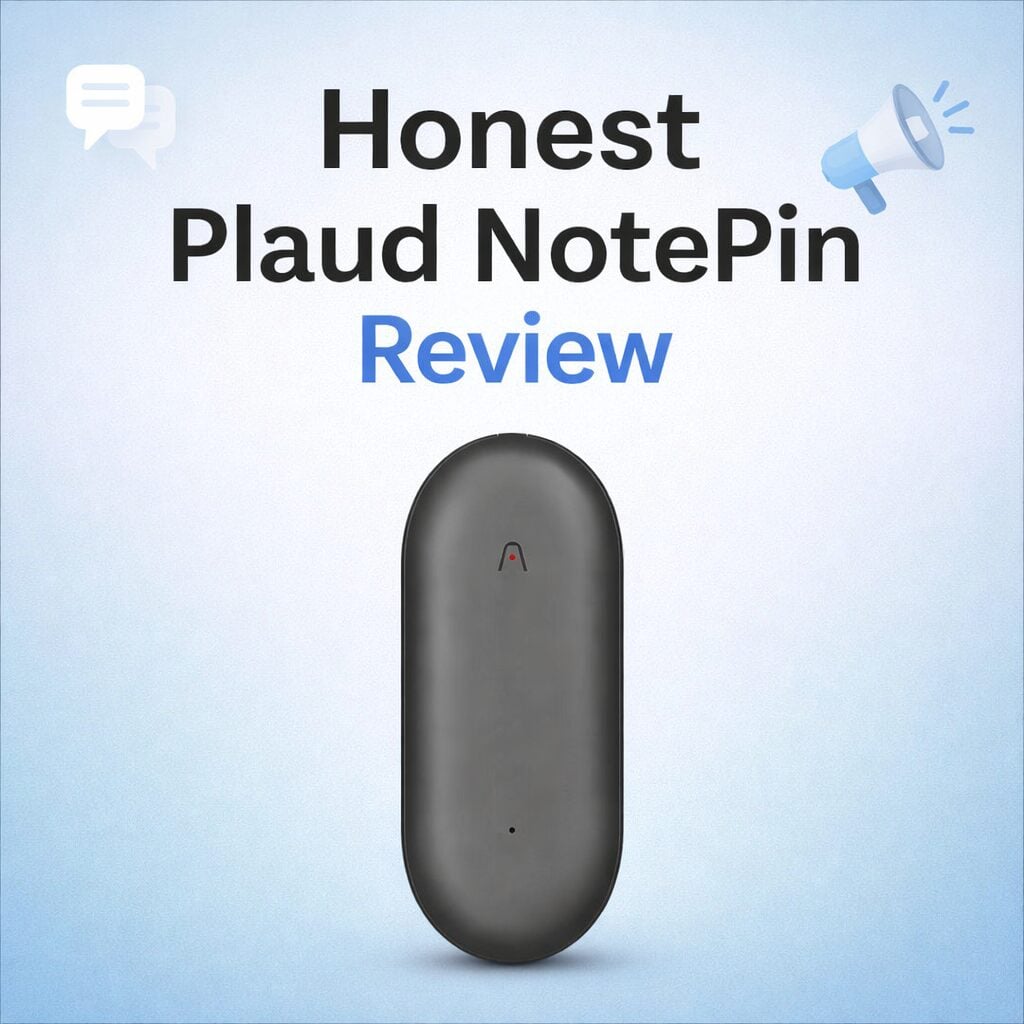

The Plaud NotePin is one of those products that immediately makes you pause. It’s a tiny, wearable AI voice recorder that promises to capture conversations, transcribe them, and turn them into structured notes. And the best part, you don’t even need your phone. On paper, it sounds like a busy professional’s wet dream.
That said, I want to be upfront: I haven’t personally tested the Plaud NotePin. Instead, this review is based on a deep dive into third-party sources, including Reddit threads, customer reviews, retailer feedback, and independent coverage. I’ve gathered a lot of reviews from users that have actually used the Plaud NotePin and synthesized them into one easy-to-skim article. That gives us something arguably just as valuable as a short hands-on test: a variety of unfiltered user experiences.
In this review, I’ll break down what the Plaud NotePin is, where it seems to shine, where users consistently run into issues, how pricing and subscriptions work, and whether a physical AI recording device like this actually makes sense in 2026. Before I wrap it up, I’ll cover some of the best Plaud NotePin alternatives for if you’re still on the fence.
TL;DR: Is Plaud NotePin Worth It in 2026?
Plaud NotePin is a tiny wearable AI recorder that captures and transcribes in-person conversations hands-free. It shines in spontaneity and convenience, but has drawbacks like finicky controls, syncing issues, and extra subscription costs.
If most of your meetings are online or you want hassle-free reliability, software options like tl;dv or Otter.ai are often better. For in-person, always-on recording, NotePin can be a powerful productivity tool, but only if you’re comfortable with the trade-offs.
Best for: Users that need a physical device to record in-person conversations that’s sleek, stylish, and discreet.
Avoid if: Most of your calls are online or if you’re looking for a living brain for your conversations. Plaud’s AI doesn’t go that deep.
The Verdict: Plaud NotePin is an excellent idea, and some users do find it incredibly useful. However, reliability is a big concern, especially for professionals.
Read on for more details, or if you want to work out how much Plaud will cost you, considering the device cost, software subscription, and any additional users, jump straight to our Plaud pricing calculator.
What is the Plaud NotePin?
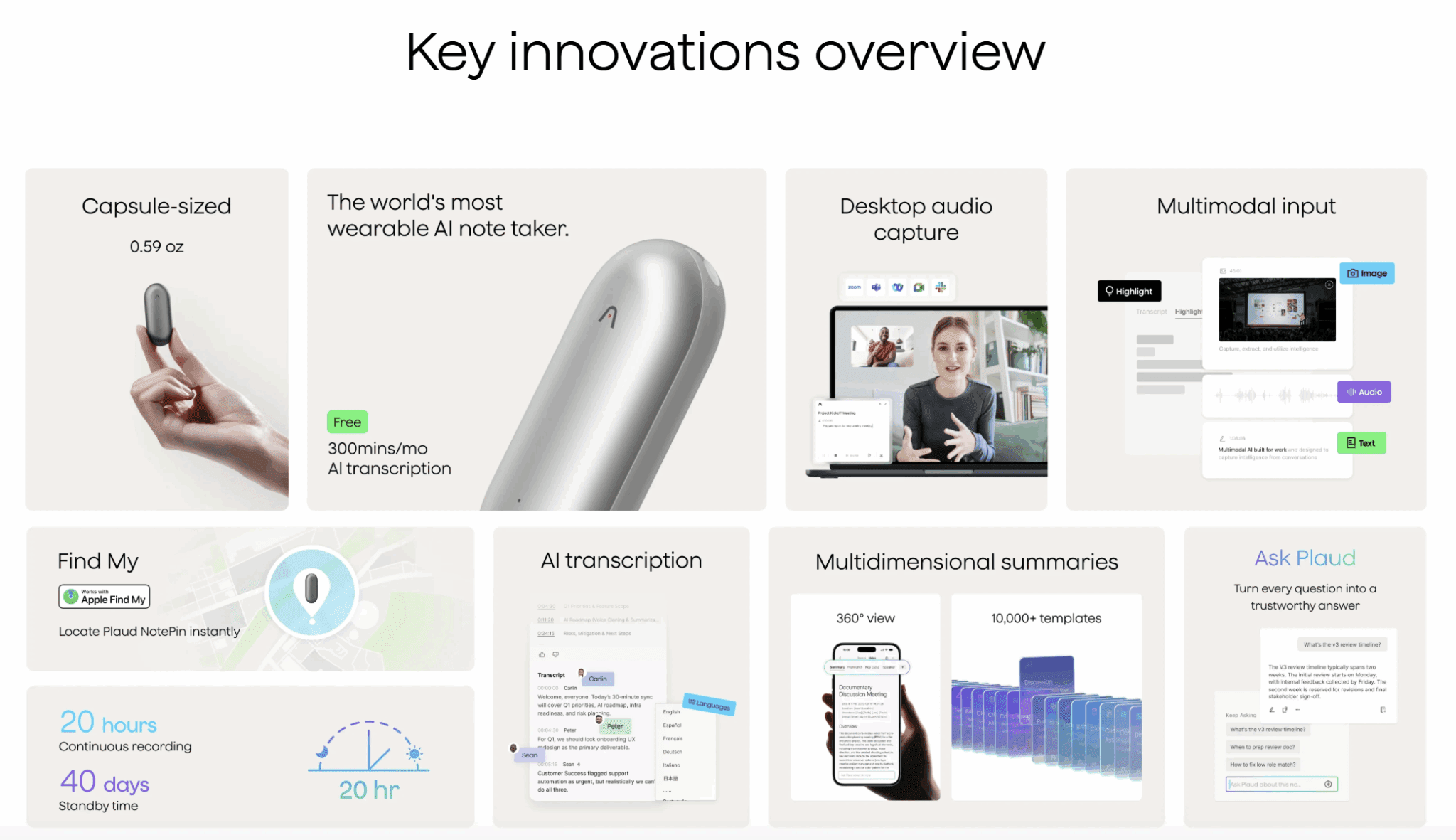
The Plaud NotePin is a wearable AI voice recorder designed to capture conversations and turn them into searchable, structured notes. Unlike mobile apps or online meeting recorders, the NotePin is a small, lightweight physical device you wear on your body. It can be clipped to clothing, worn as a necklace, or even used as a pin (the clue is in the name). Wherever it is, it can be activated in a flash to start recording whatever you want it to.
From a design perspective, the NotePin is intentionally minimal. There’s no screen, no complex interface, and very limited on-device controls. This has clearly worked in its favor as it won the Red Dot Design Award in the Product Design category for 2025. It also won the “best wearable” in the Tom’s Guide AI Awards for 2025.
The idea is that you press (or tap) the device to start recording, wear it discreetly during meetings or conversations, and then let the Plaud app handle everything else. Once synced, recordings are uploaded to the cloud, where Plaud’s AI transcribes the audio and generates summaries, highlights, and action items, just as you’d expect from a software-based notetaker.
In terms of flexibility, this is where the NotePin tries to stand out. The fact it can be worn in multiple ways makes it adaptable to different settings, whether that’s a work meeting, an interview, or an on-the-go voice note. That wearable aspect is central to the product’s pitch: it’s meant to be always available without feeling like you’re pulling out a phone or opening an app.
Feature-wise, the core experience revolves around:
Hands-free audio recording
AI-powered transcription and summarization
Cloud syncing via the Plaud app
Searchable notes and exports
The NotePin itself captures the recording, while your phone handles review, organization, and sharing.
Why Use a Physical AI Recorder Instead of a Phone App?
This is the big question. The answer really depends on how you work.
The obvious point to make here is that a physical AI recorder is only really useful for in-person meetings. If you’re in a lot of online calls, the Plaud NotePin is going to be less valuable. However, even just comparing it to a phone app for recording real-time conversations, it’s way simpler to actually use, not to mention more stylish and flexible.
A physical device like the Plaud NotePin makes sense for people who want to record more discreetly and consistently. Wearing a small pin or necklace can feel less intrusive than placing a phone on the table, and it removes friction around opening apps, checking battery drain, or managing notifications mid-conversation. It’s also inherently hands-free, which can be useful in fast-moving or informal discussions.
There’s also the argument around audio capture. Dedicated microphones, positioned closer to the speaker’s voice, often deliver cleaner recordings than a phone left in a pocket or bag. This improves transcription accuracy.
That said, a physical device is a trade-off. You’re carrying (and charging) another piece of hardware, and you’re locking yourself into a specific ecosystem rather than a flexible app you already have on your phone. The Plaud NotePin clearly isn’t trying to replace phone-based note-taking for everyone. It’s targeting a specific niche audience who value speed, discretion, and habit-forming capture over convenience.
In short, the Plaud NotePin helps you record and transcribe in-person conversations in a smarter way. It’s wearable, passive, and doesn’t need constant attention. You’re either recording, or you’re not.
Plaud NotePin Key Benefits: Why Do People Actually Use It?
Even without hands-on testing, there are a few areas where the Plaud NotePin consistently gets positive feedback from people who’ve used it long enough to form an opinion.
1. Truly Wearable (Not Just “Portable”)
This is the NotePin’s biggest differentiator. Unlike phone apps or pocket recorders, it’s designed to be worn, not carried. Users can clip it to clothing, wear it as a necklace, or use it as a pin, which makes it easy to start recording without interrupting the flow of a conversation.
Several reviewers mention that this alone changes how often they actually capture notes. When recording is something you wear rather than something you open, it becomes more habitual, especially in spontaneous discussions.
Cybernews’ YouTube review of Plaud NotePin actually calls it the “World’s Most Wearable AI.”
2. Hands-Free Recording That Removes Friction
A recurring theme in user feedback is how little effort it takes to start recording. There’s no unlocking a phone, finding the right app, or worrying about notifications popping up mid-meeting. For people who hate fiddling with tech in social or professional settings, this low-friction approach is a real win.
This also makes the NotePin appealing in situations where pulling out a phone would feel awkward or disruptive.
3. Solid Transcription and Summaries (When the Audio Is Clean)
When recordings are clear, users generally report accurate transcriptions and useful AI summaries. The Plaud app then builds upon that to extract structure, highlights, and action points, which is where the product starts to feel more like a productivity tool than a basic voice recorder.
This is especially valuable for people who want post-meeting clarity without replaying long audio files.
4. Cloud Syncing and Cross-Device Access
Because everything syncs through the Plaud app, recordings are available across devices once uploaded. Notes can be reviewed, exported, or shared after the fact, which aligns well with how most people already manage digital work today.
For users who live in their task managers, CRMs, or note-taking systems, this cloud-first setup is far more practical than dealing with local audio files.
5. A Focused Device That Does One Thing (and Does It Well)
Interestingly, some users see the NotePin’s limitations as a feature. There’s no screen, no apps, and no distractions. It exists solely to capture audio. For people who are easily pulled off-task by their phone, having a single-purpose recording device can feel refreshingly intentional.
In that sense, the Plaud NotePin isn’t trying to compete with smartphones feature-for-feature. It’s betting that a smaller, simpler, wearable tool can lead to better note-taking habits. For some users, that trade-off genuinely pays off.
Plaud NotePin’s Benefits Table
Here’s a quick overview of Plaud NotePin’s best features, why they’re important, and quotes from real users that support the claim.
| Best Feature | Why It Matters | Key Quotes | Source |
|---|---|---|---|
| Wearable and discreet | Can be worn as a pin, necklace, or bracelet, making recording feel natural and unobtrusive (Always remember to check local privacy laws and obtain consent before recording!) | “I bought the note because it attaches to the back of my phone and it’s discreet” | |
| Hands-free recording | No need to unlock a phone or open an app mid-conversation | “It’s clearly designed for solo users who just want a simple, hands-free way to capture notes in real time.” | |
| AI transcription & summaries | Turns raw audio into structured notes, highlights, and action items | “I use it in a noisy environment and the summaries it produces are spot on.” | |
| Cloud syncing & multiple devices | Access recordings and transcripts across different devices | “Transcription minutes are paired to your account, so pair however many devices you’d like. I have a Note Pro and a Pin paired to an unlimited plan with only one subscription.” |
Plaud NotePin Main Drawbacks: Where It Starts to Frustrate People
For all its promise, the Plaud NotePin isn’t a universally smooth experience. In fact, a lot of user feedback clusters around the same handful of frustrations. This is usually a sign of real product-level issues rather than edge cases.
1. Controls That Feel Unintuitive (and Sometimes Unreliable)
The most common complaint is the way recording is started and stopped. Multiple users describe the touch-based controls as finicky, overly sensitive, or inconsistent. Some report accidental recordings, while others struggle to trigger recording when they actually want it to start.
This matters because the NotePin is supposed to reduce friction. When users aren’t confident that a tap actually did what they intended, the whole “wearable convenience” pitch starts to fall apart.
To Plaud’s credit, firmware updates and newer hardware revisions appear to address some of this, but the fact that control reliability comes up so often is hard to ignore.
2. Syncing and Connectivity Issues
Another recurring theme is unreliable syncing between the device and the app. Some users report recordings that fail to upload, delays before files appear, or connection issues that require restarting the app or device.
For a product that depends on cloud transcription, this is a weak point. If recordings don’t reliably make it into the app, the AI features don’t matter. Users are left wondering whether an important conversation was actually saved.
3. Hardware Quality Concerns Over Time
A smaller but still notable group of users mention hardware problems after a few months of use. These range from battery issues to devices that stop responding entirely.
Not everyone runs into this, but it’s worth calling out, especially given the NotePin’s price ($127). When you’re buying a dedicated piece of hardware, long-term reliability matters more than it would with a disposable app subscription.
4. Charging and Accessory Frustrations
Some users aren’t fans of the charging setup, which relies on a dock rather than a standard cable. That’s not a dealbreaker on its own, but it does add another proprietary accessory you need to keep track of, as well as another potential point of failure.
Accessories like straps and clips have also been described as feeling cheaper than expected, which can clash with the otherwise premium positioning of the product.
5. Customer Support and Logistics Can Be Hit or Miss
Beyond the device itself, there are scattered reports of slow shipping, delayed responses, or inconsistent support experiences. While some users praise Plaud’s customer service, others describe long waits or unclear communication when something goes wrong.
This kind of mixed support feedback is especially relevant for hardware products, where returns, replacements, and warranty handling are part of the buying decision.
Plaud NotePin’s Drawbacks Table
Here’s a quick overview of the negative points, how frequently they occur, and key quotes from real users.
| Negative Point | Frequency / Impact | Key Quotes | Source |
|---|---|---|---|
| Struggling to start/stop recording | Common; affects confidence in starting/stopping recordings | 1. “I think it might be easier to use my phone instead.” 2. “Starting and stopping recording on it is the worst thing ever.” | Reddit (1) and Reddit (2) |
| Syncing & connectivity issues | Frequent; recordings may fail to upload or connect to the app | Even after Plaud released multiple firmware updates, “I still have frequent connectivity problems with my phone.” | |
| Customer support | Moderate; some users report quick replies while others don’t hear back for weeks | “It’s been two weeks since they “expedited” my request. I emailed them again and have gotten no response.” | |
| Charging / hardware reliability | Occasional; dock or accessory problems prevent charging | “I’ve had my Plaud note for like 8-9 months [but] now it’s not charging or connecting.” | |
| Logistics & deliveries | Occasional to moderate; some lengthy delays in shipping with minimal support | “I can’t recommend this company as their shipping is awful.” | |
| Battery life issues | Occasional; some users report shorter-than-expected battery life | “I fully charged it and used it during a 30-minute meeting, and a couple of hours later, the app showed the battery level was low and that it needed to be charged.” |
Plaud NotePin Pricing: How Much Does It Cost in 2026?

Plaud NotePin has a flat cost of $127.20 on their website (and big third-party platforms like Amazon). This is supposedly down from $159.
However, Plaud NotePin is just the recorder. To actually get access to the features that make this worth the price (otherwise why not just use your phone?), you’ll need a software subscription too. We talked about the price of Plaud in our dedicated Plaud article, but let’s cover it again here.
How Much Does Plaud Cost in Total in 2026?
The quickest and easiest way to work out how much Plaud will cost you in total is to use the Plaud pricing calculator below. First, choose your device, then choose how many you need (is it just for you, or for a team?). Finally, select your preferred billing method and subscription plan (which alters how many transcription minutes per month you get). The estimates, accurate as of January 2026, will appear underneath. Feel free to play around with some hypotheticals too.
Plaud Pricing Calculator
How Much Are Plaud’s Subscription Tiers in 2026?
Plaud has three plans:
- Starter: $0.
- Pro: $99.99 per year, or $17.99 per month.
- Unlimited: $239.99 per year, or $29.99 per month.

All plans give you access to the basic recording features (of the NotePin that you already paid $127 for — how generous of them!). They all also include speaker identification and custom vocabulary so Plaud’s AI can pick up on industry-specific terminology. Additionally, all plans get summaries (including 10,000+ professional templates), access to the AskPlaud chatbot, and even AutoFlow, the feature which allows you to automatically summarize meetings and send them as emails.
So what’s the actual difference between Starter, Pro, and Unlimited, besides the price? Just one thing:
- Starter provides you with 300 minutes of transcription per month.
- Pro gets you 1,200 minutes per month.
- Unlimited unlocks — you guessed it — unlimited transcription minutes per month.
What About Other Plaud Devices? How Much Do They Cost?
The Plaud NotePin isn’t the only physical device that Plaud sells. There are four total:
- Plaud Note Pro: $189
- Plaud Note: $159
- Plaud NotePin S: $179
- Plaud NotePin: $127.20

The Plaud Note series varies from the Plaud NotePin series in design. The Plaud Note is designed for “professionals needing clarity in larger spaces,” while the NotePin is “ideal for hands-free, in-person conversations.”
The Note Pro picks up audio from over 16 feet away, while the other three max out at 9.8 feet. The Note Pro also has four microphones as opposed to the other devices’ two.
It’s worth noting that the Plaud Note, Note Pro, and NotePin S all have the ability to highlight parts of the transcript in real-time if you simply press them. However, the Plaud NotePin is not capable of such a function.
The battery life of the Note Pro is almost double the NotePin, with the Note and NotePin S sitting somewhere in between. Storage is 64 GB on all models.
The main benefit of the NotePin and NotePin S over the other two are their ability to be worn. They’re smaller, more discreet, and can be worn with a magnetic pin, clip, lanyard, or wristband. The Note and Note Pro can only be carried or magnetically attached to your mobile phone.
What Do Real Everyday Users Think of the Plaud NotePin?
I covered a lot of the Reddit feedback for Plaud, and specifically the NotePin, in the benefits and drawbacks sections. However, Reddit is a goldmine that still has more to give. It’s full of real users who like to vent about the problems they’re suffering in a language we can understand.
Take U/InThroughMyOutdoor for example. He said, “PLAUD absolutely RUINED the NotePin with the most recent firmware update!“

The user goes on to say that it was previously working flawlessly, but since the update, they’re getting less than one third of their recordings. It got so bad that he reverted back to an old device.
Another user, U/thatjokewasdry, said, in late 2025, that Plaud was an “expensive regret.”

The user expressed particular frustration at the NotePin’s inability to record, which is supposed to be its basic function. I did mention that users frequently found this to be an issue with the Plaud NotePin. However, this user’s vent helps potential buyers see exactly how big of an issue this is: it’s “near impossible to trigger.”
Additionally, the user had heard about the problem before buying, and hoped that it wouldn’t still be a problem in late 2025. It was. They describe it as a “frustrating experience” and say they were disgusted.
Even worse, every time the user opens the Plaud app, Plaud is advertising the Pro plan and pitching an upgrade. The user goes on to say that the NotePin’s “$160 price tag and lack of acknowledgement from the company has really soured it for me and I don’t even want to consider the Pro.”
These aren’t stand-alone edge cases. It’s a consistent pattern within the Plaud forums. Another user tested the Plaud NotePin in a professional setting, only to find after a two-hour recorded conversation that it didn’t pick up a single syllable. He says that due to the device cost and subscription model, he expected a certain level of reliability that simply was not met.
So, you get it: Reddit has a lot of frustrated users. A few of them do have some nice things to say, but overall, the sentiment is fairly negative. But enough of Reddit. What about other platforms?
What Do Non-Redditors Think of Plaud NotePin?
One popular place for Plaud NotePin reviews is Amazon. As the NotePin is a physical device, many people order it from Amazon to avoid Plaud’s logistical issues (it’s rarely in stock and can take weeks to arrive). Let’s take a look at a few Plaud NotePin reviews from the U.S version of Amazon.

Now we get to the good stuff. At the time of writing (Jan 28th, 2026), this was the most recent review. Titled, “If I Could Give It 10 Stars I Would,” this reviewer clearly loved Plaud NotePin.
The user has been using it for 2 months and is “very pleased” with the purchase. They wear it on their wrist like a watch and found that it’s easy to record. They don’t suffer from the same difficulty of getting it to start and stop like other users have.
And then we have another 5-star review from Amazon, also in December 2025, which also claims they “would comment 10 stars if I could.” Weirdly similar review, but I’m willing to give it the benefit of the doubt.

K Z also intends to get the $30 per month Unlimited plan, calling Plaud NotePin “LIFE CHANGING!!!!” Not once. Not twice. But THREE times. Quite the sensationalist.
Another user docked it a star because it doesn’t include a RAW audio WAV option. Others call it “brilliant,” “wonderful,” and “better than expected.”
Another review from Dec 2025, says it has “disconnected notes, weak summaries, and high cost.” They genuinely loved the idea, but found that the summaries and notes weren’t strong enough, the audio quality was “underwhelming,” and the AI doesn’t learn, making it frustrating to have to prompt over and over again.
Overall though, Amazon sentiment is high. Plaud NotePin scores 4.3/5 from 1,060 reviews.
Over on TrustPilot, Plaud scores an even better 4.6/5 from 899 reviews.
Elisa heaped praise upon Plaud’s NotePin, titling her review: “Game‑Changing Tech and Outstanding, Personal Customer Service & Support“

Elisa’s review, from January 16th 2026, explores her positive experience with the NotePin, as well as her mother’s experience with the Plaud Note. She says, “I am genuinely blown away” and that “both devices have made a tremendous impact on [their] productivity at work.”
From the 21 reviews that specifically talk about Plaud’s NotePin device, only two scored 4/5. All nineteen of the others scored straight 5/5s. This is particularly interesting as TrustPilot is usually where the most negative reviews appear. In other honest reviews I’ve done of different AI note taker tools, it tends to be here where the real juicy stuff comes out.
When it comes to Plaud, and specifically the NotePin, it seems that people are genuinely happy with it. So let’s end this with another positive one, this time highlighting the customer support.

This user bought a NotePin and was “100% satisfied” with it. However, there was a defect that meant it would start recording on its own at unintended moments.
Not to worry, however, because the support team took his concern very seriously, handling it with sincerity by sending a replacement unit. This is not the first time I read about Plaud NotePin sending replacements for faulty devices. It seems to be common practice if something goes wrong. However, having said that, some Redditors did claim to not hear back from Plaud for weeks so it could be hit or miss.
An incentivized review on BestBuy shows that not everyone is fully satisfied. Rating it just 2/5, the reviewer says the “lack of integrated USB-C port” was a deal-breaker. You’ll need to use Plaud’s proprietary charger to keep the battery topped up. The reviewer was also disappointed by the record button which must be pressed very hard to activate.

Plaud NotePin Alternatives (Wearables and Software Options)
If the idea of a wearable AI recorder appeals to you, but the Plaud NotePin feels too risky, limited, or expensive, you do have alternatives. Broadly, they fall into two camps: other physical devices and pure software solutions.
Wearable & Physical Alternatives
These are best for people who genuinely want a dedicated device like Plaud’s NotePin, not just another app.
1. Mobvoi TicNote

While the TicNote isn’t a wearable as such, it is a portable recording device that is linked to an AI intelligence on the backend. It can record, transcribe, mindmap, and synthesize your conversations so you don’t need to worry about taking notes.
Even crazier, on January 17th 2026, TicNote exploded past its fundraising campaign to launch TicNote Pods: the world’s first AI note-taking earbuds. They only intended to raise $5,000, but hit $529,696!
So if you like TicNote, but want something truly wearable like Plaud NotePin, stay tuned. Earbuds are on the way.
Best for: Users that want a portable AI-powered device for recording, transcribing, and summarizing conversations on the go.
Not ideal if: You want something wearable immediately, though TicNote Pods are coming soon.
2. Smartwatches with Voice Recording
Some users use Apple Watch or Wear OS devices as lightweight voice recorders. While not purpose-built for long recordings, they can capture short notes hands-free and sync quickly to a phone. You’ll have to manually copy/paste transcripts into your LLM of choice to get summaries or action items which makes this option less viable for those that love Plaud NotePin’s AI intelligence.
This sits somewhere between a wearable recorder and a phone app. They’re convenient, but not designed for long meetings or continuous capture.
Best for: Short notes and reminders
Not ideal if: You need long-form meeting recordings
Software-Based Alternatives (No Extra Hardware)
For many people, this is where the smarter trade-offs live.
1. tl;dv
If your primary use case is meetings, tl;dv removes the need for a physical recorder entirely. It automatically records, transcribes, and summarizes meetings across tools like Zoom, Google Meet, and Microsoft Teams.
Unlike wearable devices, there’s no extra hardware to charge, no syncing issues, and no uncertainty about whether recording actually started. You get unlimited searchable transcripts (for free), highlights, AI summaries, multi-meeting memory, and even automatically recurring reports, all without wearing anything or remembering to press a button.
This makes tl;dv especially compelling if most of your conversations already happen online. And for those that are in-person, tl;dv can still work in the office. However, it is not as discreet as Plaud NotePin.
Best for: Remote and hybrid meetings
Not ideal if: You need to record offline, in-person conversations
2. Otter.ai
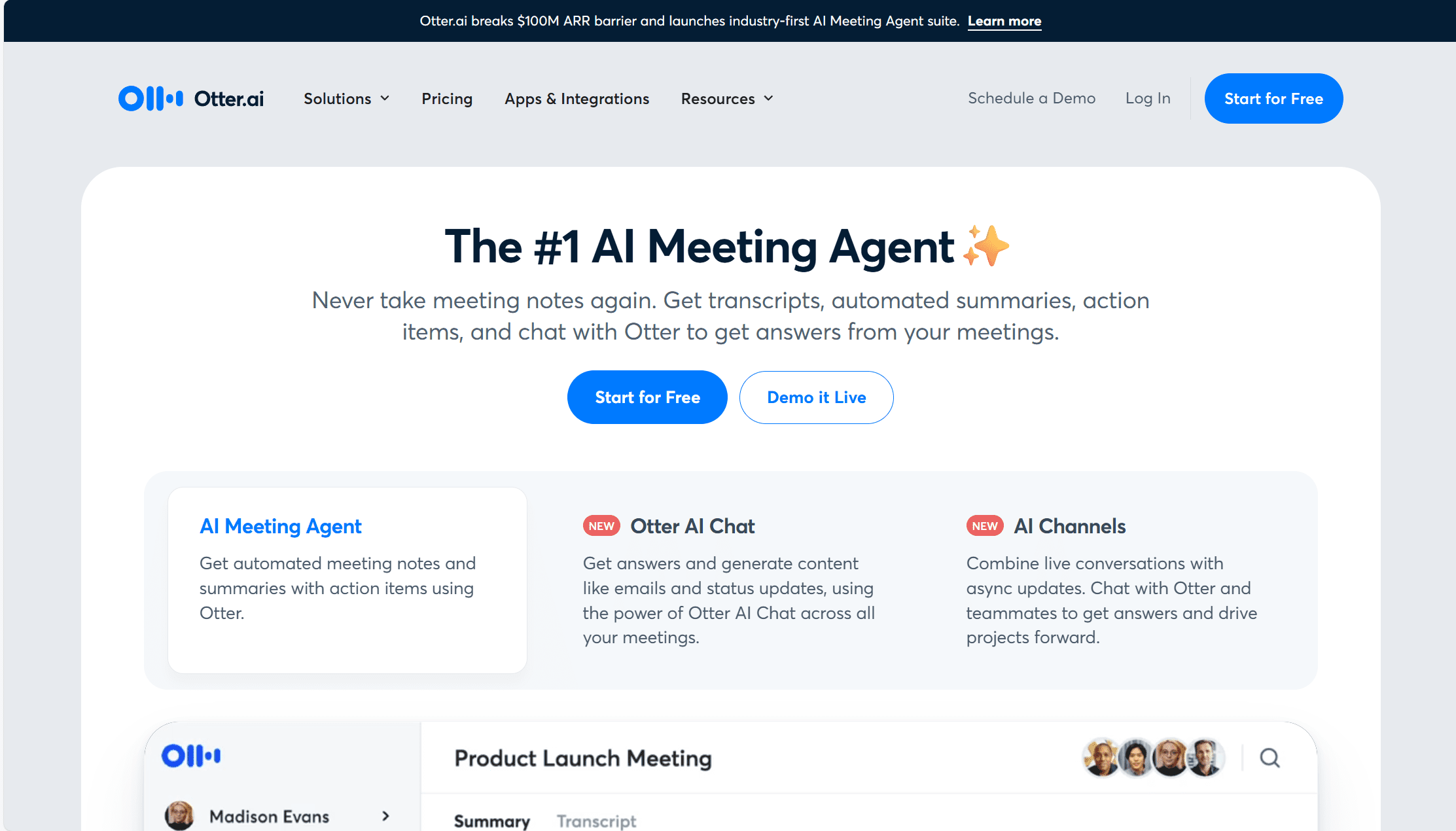
Otter is one of the most established AI transcription tools. It works well for both live meetings and uploaded recordings, and it’s easy to use.
The downside is that it still relies on a phone, laptop, or manual uploads. It doesn’t solve the “I forgot to hit record” problem that wearables try to address.
Best for: Reliable transcription across many contexts
Not ideal if: You want hands-free, always-on capture
3. Fireflies, Fathom, and similar tools
There’s a growing category of AI note-taking software that integrates with meeting tools or processes uploaded audio. These are often cheaper and more flexible than hardware solutions, but they all assume you’re okay living entirely in software.
For many users, that’s a relief rather than a drawback. If you need to record your online meetings, you have plenty of options: Fireflies, Fathom, Tactiq, Granola, and more.
So… Wearable or Software?
This really comes down to habit and context.
If you have lots of in-person conversations and genuinely want something you can wear all day, a physical recorder like the Plaud NotePin can make sense, assuming you’re comfortable with the trade-offs.
If most of your important conversations happen online, or you want reliability without extra hardware, purpose-built meeting assistants like tl;dv are usually the cleaner, lower-friction choice.
In other words: the Plaud NotePin isn’t competing with everything here. It’s competing with a very specific slice of how people actually work.
Is Plaud NotePin Right For You in 2026?
The Plaud NotePin occupies an interesting niche in 2026’s AI note-taking landscape. For professionals who live in the moment, jumping from meetings, interviews, or spontaneous discussions, the wearable design and hands-free recording offer a unique convenience that traditional apps or phone-based solutions can’t match. When it works well, the transcription accuracy, AI-generated summaries, and cross-device cloud syncing make it a genuine productivity booster. Its simplicity and focus on a single task can also help users stay more intentional and less distracted compared to smartphones or multi-functional devices.
That said, the NotePin isn’t without trade-offs. Control reliability, syncing quirks, hardware limitations, and dependence on a proprietary subscription model can frustrate even dedicated users. Reddit feedback highlights these inconsistencies more than Amazon or TrustPilot, which tend to skew positive. For those who mostly meet online, or who prioritize guaranteed reliability over wearable convenience, software-first solutions like tl;dv will be a smarter choice.
Ultimately, the Plaud NotePin is best viewed as a specialized tool for a specific workflow rather than a universal AI recorder. If that workflow matches yours, it can be a game-changer; if not, alternatives offer lower-friction ways to capture and summarize conversations.
FAQs About Plaud NotePin
What is the Plaud NotePin?
It’s a wearable AI voice recorder designed to capture in-person conversations and automatically transcribe them into searchable, structured notes via the Plaud app. It can be worn as a pin, necklace, or clip.
Do I need a subscription to use Plaud NotePin?
Yes. The device ($127.20 for the NotePin) records audio, but transcription, AI summaries, and cloud syncing require a Plaud subscription.
Plaud has three plans:
- Starter: $0 (300 transcription minutes per month).
- Pro: $99.99 per year, or $17.99 per month (1,200 transcription minutes per month).
- Unlimited: $239.99 per year, or $29.99 per month (unlimited transcription minutes per month).
Can I use the NotePin for online meetings?
Not directly. The NotePin is intended for in-person conversations. For online meetings, software solutions like tl;dv or Otter.ai are usually better suited.
How reliable is the recording?
When audio is clear, transcriptions are generally accurate. Some users report issues with starting/stopping recordings, connectivity, and syncing. Firmware updates have improved reliability, but results vary.
How long does the battery last?
Battery life depends on the device model. The NotePin generally lasts several hours, but frequent use or continuous recording may require recharging via its proprietary dock.
Are there alternatives if I don’t want a wearable device?
Yes. Software alternatives like tl;dv, Otter.ai, Fireflies, and Fathom offer automatic transcription and AI summaries without extra hardware. Smartwatches and portable recorders are other options for hybrid approaches.
Is Plaud NotePin worth the price?
It depends on your workflow. For frequent in-person meetings, its wearable design and hands-free recording can be highly convenient. For online-heavy workflows, cheaper or simpler software alternatives may offer better value.
Does Plaud provide customer support?
Yes, though experiences vary. Many users report responsive support and replacement units for defective devices, but some Reddit reviews indicate delays or inconsistent responses.
How do I choose between Plaud devices?
NotePin and NotePin S are small, wearable, and ideal for hands-free in-person recording. Note and Note Pro are larger, carry longer-range microphones, and focus on professional settings but aren’t wearable.