Skip to content





TL;DR
Zoho MCP lets an MCP-compatible AI client use approved tools across Zoho apps and connected services. Depending on the tools you add, Claude, ChatGPT, or another client can search CRM records, update data, send emails, and work across several Zoho products from the same conversation.
You choose exactly which tools are available for this. Zoho also has pre-configured servers for common workflows.
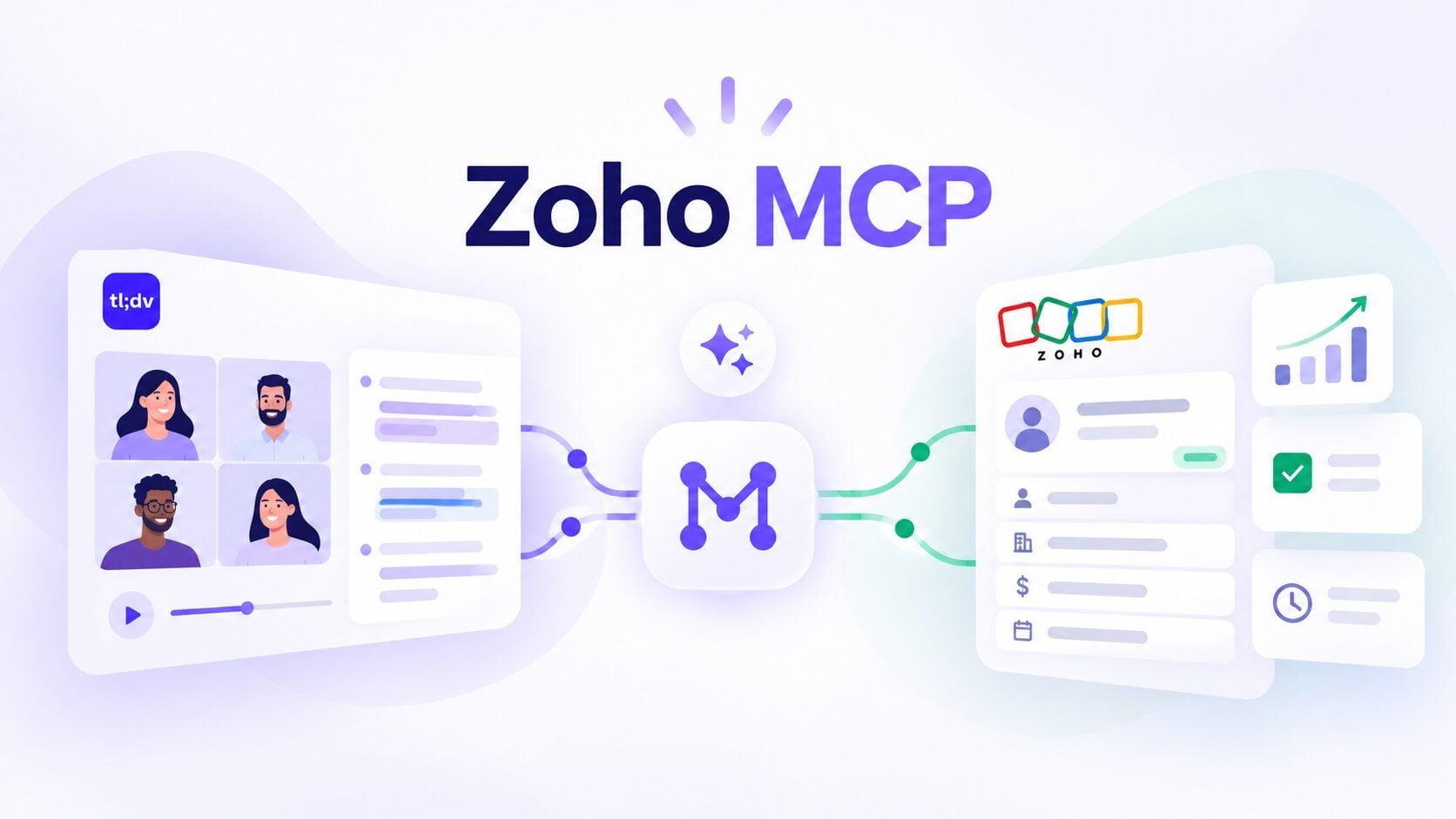
You can automate Zoho CRM updates after every meeting, or connect tl;dv MCP and Zoho MCP to the same AI client so it can check CRM data against what customers actually said on calls.
Table of Contents
What Exactly Does Zoho MCP Do?
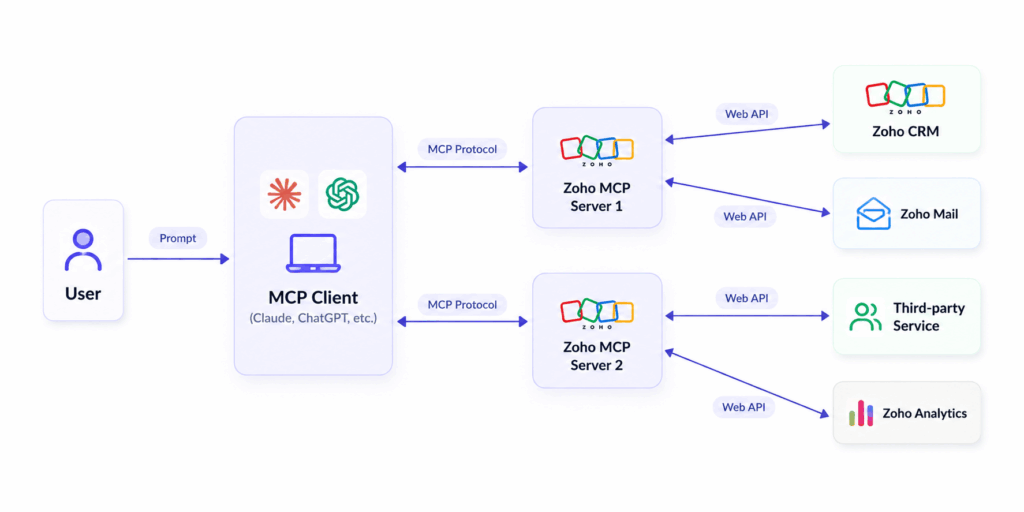
Zoho MCP gives an AI client controlled access to specific actions inside Zoho and other connected services.
Claude, ChatGPT, or another MCP client handles the request. Zoho MCP gives that client access to the tools you have enabled, whether that means searching CRM records, updating a contact, sending an email, or pulling information from another Zoho app.
What the AI can do depends on the tools available on the server. If a tool is not exposed through MCP, you cannot use that action just because the feature exists inside Zoho. CRM tools such as GetRecords, SearchRecords, MassUpdateRecords, and UpdateNotes are some examples.
If MCP itself is new to you, our complete guide to Model Context Protocol goes deeper into how the protocol works.
1. It Can Read Data
For CRM work, you can use configured tools to search and retrieve records such as Leads, Contacts, Accounts, and Deals.
If you’re a sales manager, you could use it to pull open Deals matching a specific set of criteria without opening Zoho CRM and filtering the pipeline manually.
The same approach extends beyond CRM. Zoho’s current services catalogue includes Mail, Books, Desk, Projects, Calendar, WorkDrive, Meeting, Analytics, Recruit, and many other Zoho products. It also supports tools from third-party services.
You can check the current list in Zoho’s supported services directory.
2. It Can Take Actions
Some Zoho MCP tools can write back to the source application.
In CRM, that can include updating records or adding notes when the corresponding tool is enabled. MassUpdateRecords and UpdateNotes are examples of CRM tools exposed through MCP.
The permissions still come from the tools and the Zoho account behind the connection. Giving the server access to search records does not automatically give it access to update them.
3. It Can Work Across Several Apps
You can add tools from several Zoho services to one MCP server.
Zoho gives an example involving Mail, CRM, Desk, and Cliq. A complaint email is identified in Mail, customer information is retrieved from CRM, a support ticket is created in Desk, the ticket is shared in Cliq, and an email is sent back to the customer.
For a smaller sales workflow, CRM and Mail could be enough. Zoho’s quick-start documentation shows a workflow that finds Leads with the status “Not Contacted” and uses Mail to reach them.
If you want to see how Zoho compares with other available servers, our guide to the best MCP servers looks at the actual tool access behind each option.
Zoho MCP and Zoho CRM’s Built-In MCP
There are a few different ways you can work with MCP inside Zoho, so it helps to separate them.
Zoho MCP is the broader service. You can create your own MCP server, choose the tools you want to expose, and combine different Zoho products or supported third-party services in the same setup.
Zoho also offers a library of pre-configured MCP servers for specific jobs. A lot of these are built around common CRM workflows, including CRM data and metadata operations, activities and engagement, automation and workflows, lead management, contact management, deal tracking, account management, and email follow-up.
There are pre-configured servers for other Zoho products too. For example, the current library also includes options for Zoho Apptics covering app health, engagement analytics, crash investigation, rollout validation, and user journey analysis.
If one of these already matches the job you need to do, you can start with it instead of building a server from scratch.
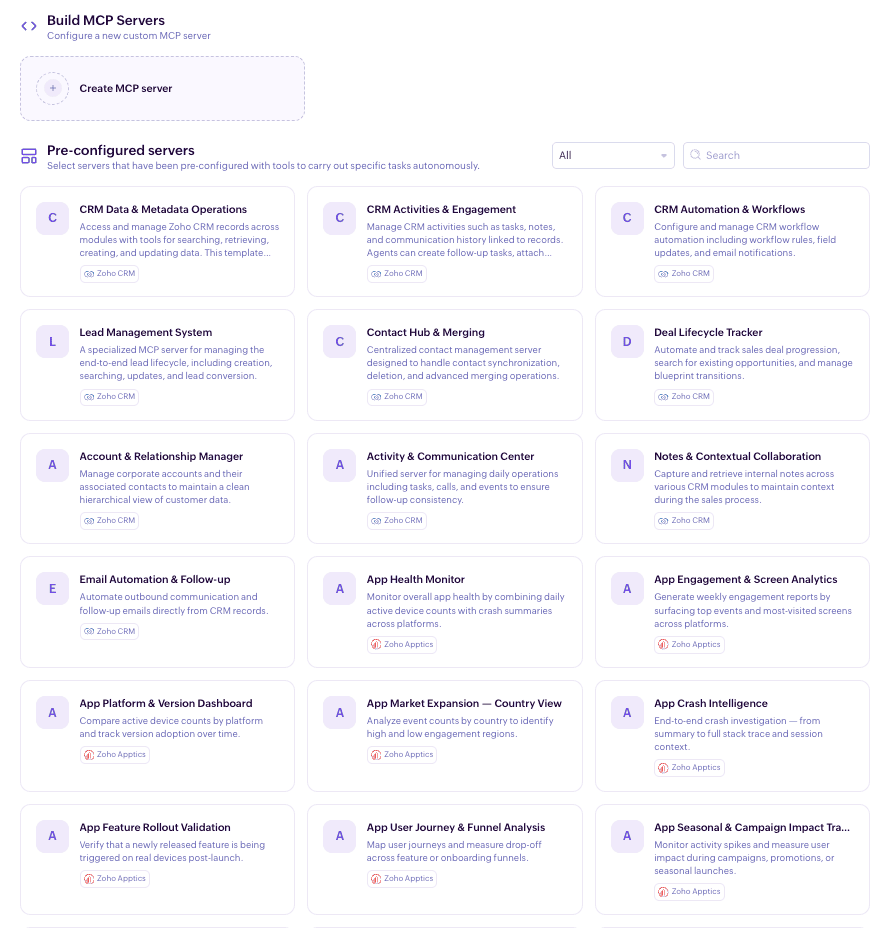
Zoho CRM also has MCP support built directly into the CRM. You can find it under General > Developer Hub > MCP for AI agents, where Zoho provides CRM-focused servers for areas such as data operations, insights, customization, and workflow automation.
If your work stays inside CRM, one of the built-in options may already cover it. A custom Zoho MCP server is more needed when the job involves CRM alongside Mail, Books, Desk, or another system.
How to Set Up Zoho MCP
You can create and configure a server from the Zoho MCP Console without building the MCP server yourself. Zoho’s current implementation flow covers server creation, tool selection, authorization, and connecting the server to an MCP client.
For the latest UI and supported options, keep Zoho’s official MCP implementation guide open while setting it up.
Step 1: Create a Server or Choose a Pre-Configured One
Open the Zoho MCP Console and select Create MCP Server. Give the server a name that tells you what it is for.
Since Zoho offers plenty of pre-configured servers for common workflows, you can start with one of those instead of creating a custom server from scratch, then adjust the included tools if needed.

Step 2: Add the Tools the Workflow Needs
Open the Tools section and choose Add Tools.
Select the Zoho service, then choose the individual actions the AI client should be able to use.
For pre-configured servers, the tools are already selected and grouped for that workflow, and you’re allowed to add more.
Be specific here.
If your sales workflow only needs to search Deals, retrieve Contacts, and add notes, give it those capabilities. There is no benefit in loading the server with unrelated CRM actions.
Zoho recommends grouping services by workflow and limiting the number of tools on a server. Its implementation guide currently recommends staying at 300 tools or fewer, while the guidance for multi-service servers also suggests creating another server if the tool list becomes too large.

The same principle applies to the CRM itself. Before automating record updates, it helps to know which object owns each piece of information and how records are matched. Our guide to CRM integration covers that side in more detail.
Step 3: Authorize the Tools
Zoho uses OAuth 2.1 when tools are authorized.
Authorization on Demand is the default for Zoho tools. Each user authenticates through their own account.
Zoho also supports Authorization via Connection, which allows a Super Admin to configure organization-level authorization for trusted members. Zoho says this is commonly used for third-party tools, although its authorization options can be configured based on the organization’s requirements.
For a sales team, user-level authorization is easier to reason about when different people already have different CRM permissions.
Step 4: Copy the MCP Server URL
Open the Connect section and copy the MCP URL.
Keep it private. Zoho describes the MCP URL as an access URL to the services configured on that server and recommends treating it with the same care as a password. If it is exposed, you can regenerate the API key from the MCP Console.
Step 5: Connect Zoho MCP to Your AI Client
Zoho currently documents setup for Claude, ChatGPT, Cursor, Windsurf, and VS Code.
For Claude, the current setup is:
Zoho currently documents setup for Claude, ChatGPT, Cursor, Windsurf, and VS Code.
For Claude, you can add Zoho MCP as a custom connector:
- Open
Customize. - Go to
Connectors. - Click
+ Connector, then chooseCustom connector. - Give the connector a name, such as
Zoho MCP. - Paste the MCP server URL you copied from Zoho.
- Click
Continue.

Claude will then detect the authentication method supported by the server. For Zoho MCP, you should see the OAuth sign-in flow appear. Complete the authentication so Claude can access the tools exposed through that server.

Once connected, the Zoho MCP server will appear in your Claude connectors list and Claude can use the tools available on that server.
If you are using Claude for several work tools, our guide to the best Claude connectors covers the current options for meetings, CRM, project management, files, and other sources.
For the MCP connection process itself, see our guide to connecting meeting notes to Claude with MCP.
Step 6: Test It With a Request You Can Check
Start with data you can verify directly in Zoho CRM.
A vague prompt such as “show me my important deals” leaves too much open to interpretation. Give it the module, filters, fields, and rules you expect it to follow.
For example:
Using Zoho CRM, find every open Deal with an Amount above $25,000 and a Closing Date within the next 60 days. Return the Deal Name, Account Name, Amount, Stage, Closing Date, Owner, and the date of the most recent logged activity. Sort the results by Closing Date, earliest first. Do not create, edit, or update any Zoho records. If a requested field is empty or unavailable, return “Not available”. Do not infer a missing CRM value.
Open Zoho CRM and compare a few results with the original records.
Once record matching and field retrieval are working properly, you can test a write action on one record that is easy to review.
How Zoho MCP and tl;dv Can Work Together
There are two useful ways to bring tl;dv and Zoho together.
The native tl;dv Zoho CRM workflow handles repeatable post-meeting actions automatically.
The MCP route is better suited to work where the AI has to search through meeting history, inspect CRM data, compare the sources, and then decide what needs attention.
For many sales teams, both can sit in the same process.
Use tl;dv’s Zoho CRM Workflow for Automatic Post-Meeting Updates
Take a discovery call.
The rep finishes the meeting, tl;dv processes the recording, and the same information would normally have to be copied into Zoho afterwards. The native workflow can take care of that step.
tl;dv currently has two Zoho CRM actions available in the Workflows Engine.
Create Activity in Zoho CRM
A workflow can run when a new recording is ready and create either a Call or Meeting in Zoho CRM.
tl;dv matches meeting participants by email and links the activity to the matching Deal, Contact, Lead, or Account. Start time, end time, and duration come from the meeting context, so the rep does not have to enter them manually.
The workflow can also attach a Note directly to the activity.
For example:
When a new recording is ready → Create Activity in Zoho CRM → Activity type: Meeting
A rep finishes a discovery call with a new prospect. tl;dv matches the prospect’s email to the relevant CRM record, creates the meeting activity, adds the timing, and attaches the configured meeting information.
The sales rep can open Zoho later and see that the conversation already happened without doing another round of admin.
Update Contact in Zoho CRM
The second V1 action updates the matching Contact.
After a recording is ready, tl;dv matches the external participant by email to the corresponding Zoho CRM Contact. The Contact can then be updated with meeting notes, AI-extracted insights, transcript context, or the information configured for that workflow. A Note can also be added directly to the Contact.
Update Lead, Update Account, and Update Deal are currently visible in the tl;dv workflow UI as upcoming actions.
If every discovery call should trigger the same CRM action, this is the simpler route. The rep does not need to open Claude after each meeting and ask it to update Zoho.
You can see the current tl;dv Zoho integration, or read our guide to automating CRM logging from sales calls for a closer look at activity logging, notes, structured CRM updates, and record matching.
Check the CRM Against the Call
Automatic logging covers work where you already know what should happen after the call.
Sometimes the problem is that you do not know which CRM fields are out of date.
A Deal might still have a close date from last month even though the customer pushed the purchase into the next quarter. The CRM may list one decision-maker even though procurement and legal joined the latest calls. A recurring objection may have come up three times without making it into the record.
tl;dv’s hosted MCP connector gives an AI client access to five read-only meeting tools:
search-meetingsget-meeting-transcriptget-meeting-notesget-meeting-metadataget-user-profile
The connector can search across the meeting library and retrieve full meeting context. It cannot create, edit, delete, or share meetings. tl;dv currently makes the hosted connector available from Pro upwards, and it is listed in the Claude and ChatGPT connector directories.
Connect Zoho MCP to the same AI client and it can use the meeting record alongside CRM data.
A CRM audit is a good example:
Find the three most recent external meetings with Acme Corp in my tl;dv library from the last 90 days. Use the full transcripts, not only the meeting summaries.
Extract information the customer explicitly stated about:
- commercial priorities
- objections
- competitors under consideration
- purchase timeline
- decision-makers and other stakeholders
- commitments made by their team
- next steps agreed with our team
For every finding, include the meeting title, date, speaker, and relevant transcript evidence.
Then find the matching Account and any open Deals for Acme Corp in Zoho CRM. Use participant email addresses and company information to confirm the correct CRM records before comparing them.
Return a table with: CRM record, field, current Zoho value, meeting evidence, source meeting and date, and recommended correction.
Do not update Zoho CRM. Do not turn an assumption into a CRM value. If two meetings conflict, show both versions and flag the field for review. If you cannot confidently match the CRM record, stop and tell me what information is missing.
The first pass only checks the CRM against the meeting evidence. Nothing changes until you review the suggested corrections.
Once you approve them, the next prompt can be much narrower:
Update only the Zoho CRM fields I explicitly approved in my previous message.
Do not change Deal Amount, Stage, Closing Date, Owner, or Contact details unless that exact field appears in my approved list.
For each update, add a note containing the tl;dv meeting title and meeting date used as the source.
When complete, return the CRM record, field changed, old value, new value, and source meeting.
If an approved change cannot be completed with the Zoho MCP tools or permissions currently available, leave that field unchanged and tell me what blocked it.
This is also useful before the next sales call. Our AI pre-call account research workflow uses meeting history alongside other account sources to find changes and gaps before the rep joins the call.
Native tl;dv Integration or MCP?
| What you need | Better route |
|---|---|
| Log every completed customer meeting in Zoho | tl;dv → Zoho CRM workflow |
| Update a matching Contact after each qualifying call | tl;dv → Zoho CRM workflow |
| Search several previous customer meetings | tl;dv MCP |
| Compare meeting evidence with current CRM fields | tl;dv MCP + Zoho MCP |
| Review suggested CRM changes before applying them | tl;dv MCP + Zoho MCP |
| Run the same post-call action without writing a prompt every time | tl;dv → Zoho CRM workflow |
If you already record customer calls with tl;dv, I would start with the native Zoho workflow for repetitive work. Logging the meeting and keeping the Contact current should happen without the rep thinking about it.
Add the MCP route when you want to ask harder questions across several conversations and CRM records.
That gives you a useful split: routine meeting admin runs automatically, while tl;dv MCP keeps the full conversation history available when the CRM alone does not tell the whole story.
Do You Really Need Zoho MCP?
Zoho MCP makes more sense once a job starts crossing records, apps, or sources.
Start with one workflow and a small set of tools. Check the output against Zoho before expanding what the client can change.
For teams using tl;dv, the two approaches work well together. Native Zoho workflows keep routine post-call CRM work moving automatically.
Connecting tl;dv MCP and Zoho MCP gives you another option when you need to go back to the conversations, compare them with the CRM, and work from the evidence instead of relying on whatever was entered into the record last time.Do
FAQs About Zoho MCP
Can Zoho MCP Update Zoho CRM Records?
Yes, provided the required CRM tools are configured and the account behind the connection has permission to perform the action. Zoho lists tools such as MassUpdateRecords and UpdateNotes among its CRM MCP examples.
Is Zoho MCP Free?
At the time of writing, Zoho says the MCP service itself is free. API calls made through MCP still use the normal API limits of the underlying Zoho service, and Zoho says users will be notified in advance if MCP pricing is introduced.
Does Zoho MCP Work With Claude and ChatGPT?
Yes. Zoho’s current implementation guide covers Claude and ChatGPT alongside Cursor, Windsurf, and VS Code. The options available inside each client can still depend on that client’s connector support and plan.
Is Zoho MCP the Same as a Normal Zoho Integration?
No. A normal integration usually follows a defined trigger and data flow. Zoho MCP exposes a set of tools to an AI client, which can select and invoke those tools while working through a prompt.
For a fixed action such as logging every completed meeting, a native workflow is often simpler. MCP becomes more useful when the next action depends on information the AI needs to retrieve and compare first.
Can I Use Zoho MCP With tl;dv?
Yes. tl;dv’s hosted MCP connector can give the same AI client access to meeting search, transcripts, notes, and meeting metadata, while Zoho MCP provides the configured Zoho tools. tl;dv’s hosted tools are read-only.
For automatic post-meeting CRM updates, you can also use tl;dv’s native Zoho CRM workflow without involving an MCP client.