Skip to content





TL;DR: How Useful is Zoom’s MCP?
Zoom MCP is Zoom’s official Model Context Protocol server, and yes, it’s real and live. It lets AI clients like Claude, ChatGPT, Cursor, and VS Code pull your Zoom meeting summaries, transcripts, recordings, notes, and action items into a conversation. Since the May 2026 expansion, it can run agentic search across Salesforce, Workday, and ServiceNow too.
The catch: it’s reactive. It only works when you open an AI client and ask, it needs a paid Zoom plan, and nothing runs on its own. For the same call, tl;dv’s MCP server reads transcripts and highlights across Zoom, Google Meet, Teams, and more in a single interface. Even better, tl;dv’s automatic layer keeps working after the call without anyone opening a chat.
What is Zoom MCP?
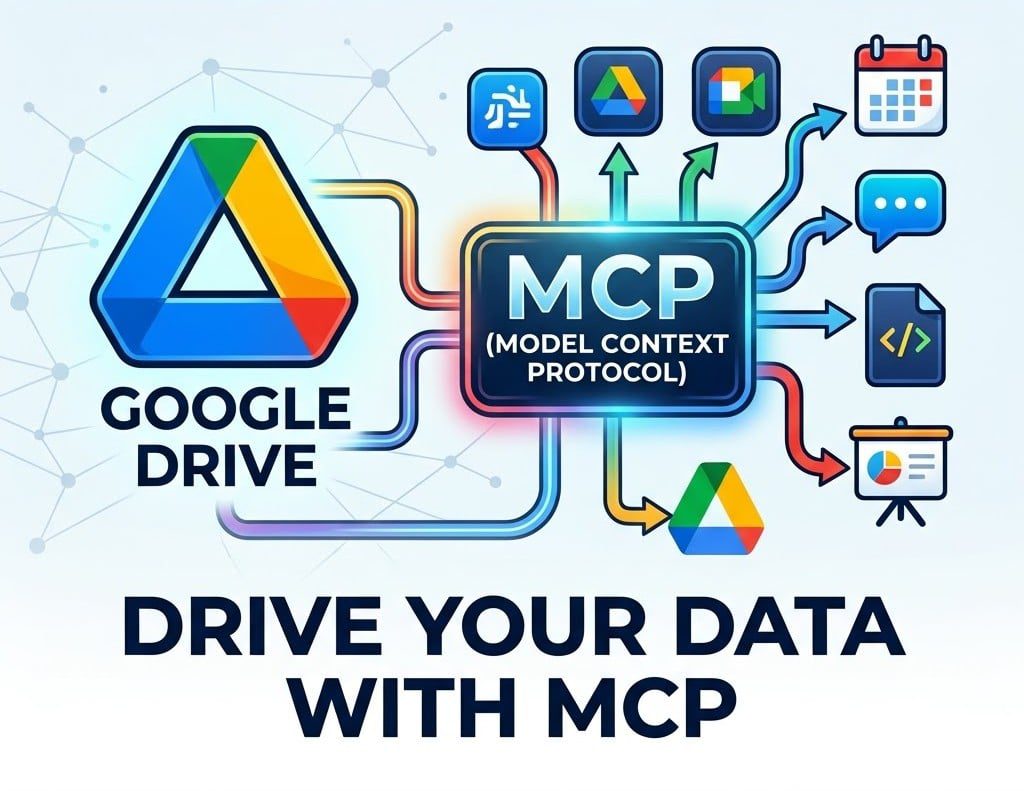
Zoom MCP is Zoom’s official Model Context Protocol server: a secure bridge that lets AI assistants like Claude and ChatGPT read your Zoom meeting data and act on it. Instead of building a custom integration for every AI tool you use, you point the tool at one standardized endpoint, and it can pull summaries, transcripts, recordings, and notes on request.
The Model Context Protocol itself is an open standard introduced by Anthropic in November 2024 — the same company behind Claude. Think of it as a universal adapter. As VentureBeat reported at launch, MCP gives AI systems a single, open way to connect to the tools where your data actually lives, instead of a tangle of one-off connectors. If HTTP standardized the web, MCP is trying to do the same for AI-to-app connections. For a beginner’s primer, tl;dv’s complete guide to the Model Context Protocol breaks the whole thing down.
Adoption moved fast. OpenAI backed MCP in early 2025, Google followed, and Microsoft partnered with Anthropic on an official C# SDK. By late 2025 the protocol had been handed to a neutral foundation with thousands of public servers live. In other words, MCP is becoming more and more commonplace, and now Zoom is plugged into it.
Is Zoom MCP Official?
Yes. Zoom hosts and documents its own MCP server, and it’s a first-party product, not a community hack. You’ll also find third-party Zoom MCP servers on GitHub (echelon-ai-labs and others), which are handy if you want to self-host or customize, but the official server is the one most people should reach for.
It’s worth separating Zoom MCP from Zoom AI Companion too: AI Companion is the assistant that generates the summaries and notes inside Zoom; MCP is the doorway that lets an outside AI (like Claude or ChatGPT) read those artifacts and use them.
How Zoom MCP Works
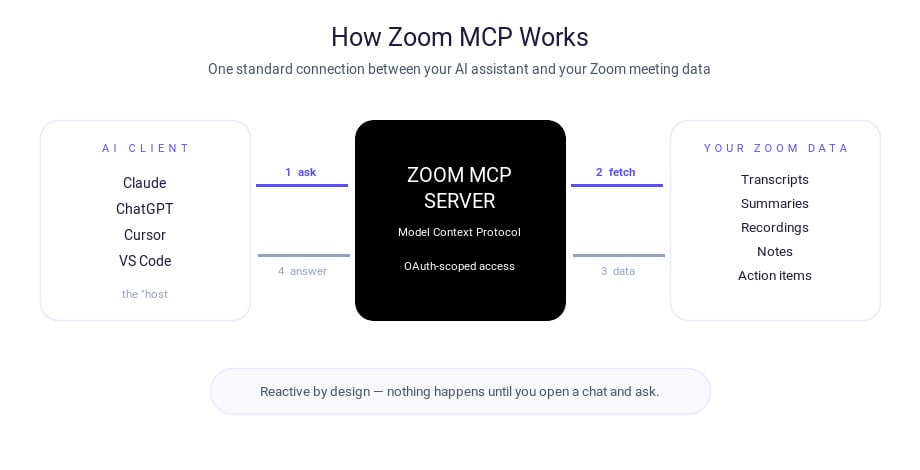
Zoom MCP follows a client–server model. If you don’t know what that means, worry not. It’s pretty simple. Your AI tool like Claude Desktop or Cursor runs an MCP client that opens a connection to Zoom’s MCP server. The server allows you to use a range of “tools” (list meetings, fetch a transcript, retrieve a summary), and the AI calls them as needed in plain language.
Communication happens over SSE/HTTP, with a local studio option for IDE setups, so cloud-hosted agents and desktop clients both work with no extra configuration. Behind the scenes, the server is still calling Zoom’s REST APIs — MCP just wraps them in a standard interface an AI can discover and use on its own. Tool discovery is automatic: connect the server, and the client sees which Zoom actions are available without you mapping anything by hand.
How Authentication Works
Zoom MCP uses OAuth, typically Server-to-Server OAuth 2.0 for hosted setups. You authorize the connection once, scope it to only the data the AI should see, and the server handles token refresh from there. Because access is permissioned and scoped, you decide whether a client can read transcripts, list meetings, or touch account settings, and you can revoke that access at any time. Grant the narrowest access that still gets the job done, and nothing more.
Does Zoom Have an Official MCP Server?
Yes. For a long stretch, Zoom said nothing about MCP. That’s over. Zoom now runs an official MCP server, and on May 18, 2026 it shipped a major expansion. According to Zoom’s announcement, the server brings Zoom AI Companion insights into outside AI environments including Anthropic’s Claude and OpenAI’s Codex.
The expansion added four things worth knowing:
- Conversation intelligence across AI tools: summaries, transcripts, recordings, notes, action items, and collaboration history, readable inside supported AI clients.
- Agentic search across enterprise systems: AI can reason across Zoom Meetings, Chat, Zoom Phone, and Canvas, plus Salesforce, Workday, ServiceNow, and more than 10 connected platforms.
- An OpenAI Codex plugin for pulling meeting context straight into coding workflows.
- My Notes across tools: Zoom’s personal notetaker now surfaces notes and action items inside Claude and ChatGPT, and it captures across Zoom, Teams, Google Meet, and in-person conversations.
If your sales team already lives in Zoom’s conversation-intelligence stack, note that Zoom Revenue Accelerator sits alongside this as a separate deal-analytics tool. MCP is just the access layer.
What Zoom MCP Can (and Can’t) Do
Here’s the honest version. Through MCP, an AI assistant can list and search your past meetings, fetch full transcripts, pull AI summaries and highlights, retrieve recordings, grab action items, and even create or update meetings. Ask Claude “what did we decide with Acme last month?” and it can search your Zoom history and answer from the actual transcript. A few example prompts that work well:
- “Summarize every call with this client this quarter.”
- “Find the action items I owe from yesterday’s sync.”
- “What objections came up in my last three demos?”
What Zoom MCP can’t do is act on its own. This is the single most important thing to understand about any MCP server, Zoom’s included: it gives you access from another platform, it doesn’t do it for you. Nothing watches your calendar for a meeting ending, nothing fires the moment a recording finishes processing, and nothing runs while the chat window is closed. MCP is reactive by design. It’s brilliant for “go find this,” useless for “do this every time, automatically, forever.”
There are practical limits, too. Zoom MCP requires a paid Zoom plan (Pro, Business, or Enterprise — the free Basic tier won’t cut it), and what any client can actually reach depends on the admin controls your organization sets. Check current Zoom pricing before you assume your plan qualifies.
Is Zoom MCP Secure?
For most teams, yes — with the usual caveat that you’re handing an AI client access to meeting data. Access runs through permissioned OAuth, all data stays governed by Zoom’s existing enterprise security, privacy, and access controls, and admins can audit and revoke connections.
Zoom’s platform carries the compliance certifications (GDPR, SOC 2) enterprises expect, and MCP access inherits those same controls rather than bypassing them. The real risk isn’t the protocol; it’s over-scoping. Grant a client read access to transcripts when that’s all it needs, not blanket account permissions.
How to Set Up Zoom MCP
You’ve got two routes: the hosted official server (easy) or a self-hosted community server (flexible).
Connecting the Official Hosted Server
For most people, this is the path. Zoom’s MCP server works out of the box with MCP-compatible clients including Claude, Claude Code, ChatGPT/OpenAI Codex, Cursor, and VS Code. You add Zoom as a connector in your client, authorize the OAuth connection, check the permissions, and you’re live.
Restart your client after adding the server, then confirm the Zoom tools appear before you rely on them. If they don’t show up, a failed OAuth handshake or a missing permission is almost always the culprit.
Self-Hosting a Community Server
If you want to customize behavior or run everything locally, community Zoom MCP servers on GitHub let you do exactly that. The tradeoff is setup. You register a Zoom OAuth app, configure scopes and a redirect URI, set your credentials as environment variables, and run the server via Node.js or Docker. It’s a walk in the park if you code, and a massive headache if you don’t. Then again, that’s the entire reason the hosted server exists.
Is Zoom MCP Free?
No. As mentioned above, Zoom MCP rides on Zoom’s API access, which requires a paid Zoom plan: Pro, Business, or Enterprise. The free Basic plan doesn’t include it. The MCP server itself doesn’t carry a separate license fee though. You’re paying for the underlying Zoom subscription and its API entitlements.
Best Use Cases for Zoom MCP
The best use case for Zoom MCP is when you want to pull a specific answer out of your meeting history without leaving the AI tool you’re already in. The strongest real-world uses:
- Pre-call prep. Before a renewal, ask your AI to summarize every prior call with the account so you walk in with the full history instead of skimming notes.
- Post-call CRM context. Pull the transcript and action items from a just-finished deal call to draft the recap and update fields, though you’ll still need to paste that yourself.
- Cross-meeting decisions. “What did we actually agree on shipping in Q3?” answered from the transcripts, not from memory or a Slack thread.
- Developer workflows. Via the Codex plugin, bring what was decided in a planning call directly into documentation or task tracking.
Notice the pattern: every one of these starts with you asking. That’s fine for research and recall. It’s not built for the repetitive, every-single-call work. That’s where the next section comes in.
Zoom MCP vs. the Zoom API and Webhooks
If you’re wondering why MCP exists when Zoom already has an API, the short answer is that MCP doesn’t replace the API — it sits on top of it. Zoom’s meeting APIs are for developers writing code. MCP lets an AI use those same capabilities through natural language.
Webhooks are the piece MCP lacks: they’re event-driven, firing automatically when something happens, like a recording completing or a meeting ending. That difference is exactly why MCP feels reactive. It answers questions on request, while webhooks trigger actions on their own.
Why tl;dv’s Conversational Intelligence Goes Further
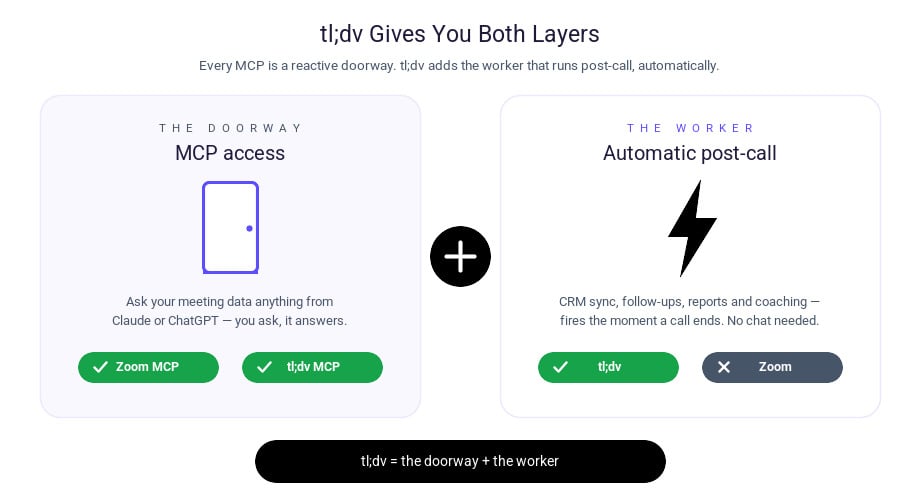
Zoom MCP is a genuinely good access layer. But if you record your Zoom calls with tl;dv, you get two things Zoom MCP can’t give you: a single cross-platform read layer, and — more importantly — an automatic workflow layer that never waits for you to open a chat.
tl;dv’s own MCP server reads the same call whether it happened on Zoom, Google Meet, Microsoft Teams, or any other video conferencing platform for that matter. And it all takes place through one interface: list meetings, fetch metadata, pull transcripts, retrieve AI highlights.
So here’s the head-to-head for a single Zoom call recorded with tl;dv:
| Same Zoom call — what you actually get | Zoom MCP | tl;dv |
|---|---|---|
| Pull transcript, summary & highlights | Yes | Yes |
| List & search your meeting history | Yes | Yes |
| Works across Zoom, Google Meet & Teams | Zoom only | All three |
| Clip & share key moments to Slack / CRM | Zoom calls only | Across all platforms |
| Auto-sync notes & action items to your CRM (HubSpot, Salesforce, Pipedrive) | Reads CRM, doesn't write | Automatic write-back |
| Sales coaching: playbook adoption & objection analytics | Via Revenue Accelerator | Built in |
| Agentic search across Salesforce, Workday, ServiceNow | Yes | No |
| Create / update meetings via AI | Yes | Read-focused |
| Runs automatically after the call — no AI chat open | No, reactive | Yes, automatic |
The row that matters is the last one. Zoom MCP is reactive. That’s not a knock, it’s simply what MCP is: it answers when you ask. tl;dv’s MCP is similar, but its real edge lives outside MCP entirely. It’s in the automatic pipeline that runs the moment a call ends:
- CRM that fills itself. tl;dv writes summaries and action items straight into HubSpot, Salesforce, or Pipedrive, with no rep opening an AI client to ask. It’s the difference between reading your CRM and updating it. Zoom can only read; tl;dv writes.
- Multi-meeting intelligence and speaker analytics. Ask across dozens of calls — “what objections came up most this quarter?” — and get talk-to-listen ratios, filler-word counts, and playbook adoption scoring for frameworks like BANT or SPIN.
- Recurring reports that fire on a schedule. Define the filter once; tl;dv delivers the digest to your inbox every week, whether or not anyone thinks to ask.
None of that needs an open chat window, which is precisely the gap in the reactive MCP model. And because tl;dv records Zoom without a bot through its desktop app, the same intelligence spans every call your team takes, not just the ones someone remembered to query. See tl;dv for Zoom to get started.
Why Zoom MCP Matters Now
Meetings were always where decisions got made and promptly forgotten. MCP finally makes that context queryable instead of buried in a recording nobody rewatches. With OpenAI, Google, and Microsoft all standardized on the protocol, the meeting-data silo is cracking open for good.
Zoom MCP is a strong way to reach into a single call and ask a question. tl;dv is how you make the work after every call happen on its own. Use the doorway (MCP) when you want to look something up; use the worker (tl;dv) when you want it handled.
FAQs About Zoom MCP
What is Zoom MCP?
Zoom MCP is Zoom’s official Model Context Protocol server, which lets AI clients like Claude and ChatGPT securely read Zoom meeting summaries, transcripts, recordings, notes, and action items, and run agentic search across connected enterprise systems.
Is Zoom MCP free?
No. It requires a paid Zoom plan (Pro, Business, or Enterprise). The free Basic plan doesn’t include the API access MCP depends on.
Which AI clients support Zoom MCP?
Claude, Claude Code, ChatGPT/OpenAI Codex, Cursor, and VS Code, among other MCP-compatible clients.
Can Zoom MCP access meeting transcripts?
Yes. It can list meetings and fetch full transcripts, summaries, recordings, notes, and action items for meetings you have access to.
Is Zoom MCP secure, and does it require OAuth?
Yes to both. It uses permissioned OAuth (typically Server-to-Server OAuth 2.0), scoped to only the data you approve, with tokens you can revoke. Data stays governed by Zoom’s existing security and access controls.
What are the limitations of Zoom MCP?
It’s reactive — it only works inside an active AI conversation. It doesn’t trigger actions automatically when a recording finishes or a meeting ends, and it requires a paid Zoom plan.
What's the difference between Zoom MCP and the Zoom API?
The Zoom API is for developers writing code. Zoom MCP wraps those same capabilities in a standard interface an AI can use through natural language, with no custom integration.
Is there an alternative for automatic, ongoing meeting intelligence?
Yes. tl;dv works across Zoom, Google Meet, and Microsoft Teams, and its automatic layer syncs CRMs, runs recurring reports, and scores sales playbooks without anyone opening an AI client — the work that MCP’s reactive model leaves on the table.