Skip to content






You don’t need another glossary of sales techniques. SPIN, Sandler, Challenger, “build rapport,” “listen more.” None of that tells you what to say on your next call.
This playbook does. Every technique here maps to a specific deal stage, comes with a script you can steal today, and is built around the one pattern separating reps who hit quota from those who don’t: knowing whether you’re fighting the status quo or buyer indecision.
Two definitions to anchor everything:
- Sales strategy: your plan for winning a market or deal type.
- Sales technique: a repeatable move (question, script, next step) that advances a specific deal.
Strategy picks the game. Techniques win each play.
Table of Contents
Quick Start: Match the Right Sales Technique to Your Deal Stage
| Stage | Buyer Barrier | Best Technique | Script Starter | KPI |
|---|---|---|---|---|
|
Content |
No awareness / urgency |
Signal-based outreach |
“Noticed [trigger]. Companies in your spot usually face [problem]. Worth 15 min?” |
Reply rate |
|
Discovery |
Unclear pain |
Teach-then-ask |
“Most teams underestimate [insight]. How does that compare to what you’re seeing?” |
Discovery-to-pipeline % |
|
Consensus |
Internal misalignment |
Multi-thread + champion enablement |
“What would [CFO name] need to see to feel confident?” |
Stakeholders mapped |
|
Closing |
Fear of wrong choice |
JOLT de-risking |
“Let’s design a rollout where you validate results before scaling.” |
Win rate on stalled deals |
Why Deals Die to “No Decision” (and What It Changes About Your Approach)
Your biggest competitor isn’t another vendor. It’s “no decision.”
Research behind The JOLT Effect (Dixon & McKenna) found that a massive share of qualified pipeline is lost not to competitors, but to buyers choosing to do nothing. The deal doesn’t get a “no.” It gets silence, a pushed timeline, an email that stops getting replies.
Most sales strategies and techniques fail here because they treat every stall identically. “Dial up the pain.” “Create FOMO.” That works against the status quo. It backfires against indecision.
Two failure modes kill deals:
- Status quo bias (early stage). The buyer doesn’t feel enough urgency. Cost of inaction seems low. Your job: disrupt that comfort with insight.
- Indecision (late stage). The buyer wants to change but fears choosing wrong. More pressure creates more fear, not momentum.
Your if/then playbook:
- If status quo → Lead with insight. Reframe their world. Build constructive tension. (“The way you handle X costs you Y. Here’s what works instead.”)
- If indecision → Reduce risk. Simplify choices. (“Let’s scope a pilot so you validate results before a full rollout.”)
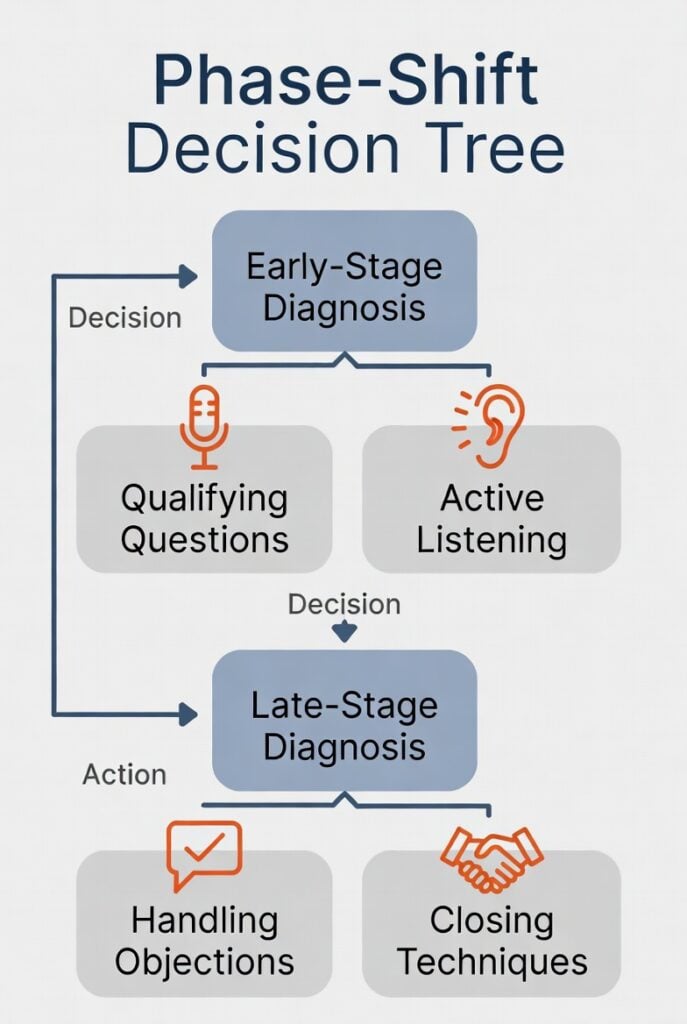
TL;DR: Challenge early, de-risk late. Challenger tactics on an indecisive buyer push the deal backward.
Sales Prospecting and Lead Generation Techniques
Buyers research solutions long before they talk to you. Effective outbound sales techniques in 2026 run on relevance and timing, not volume. To succeed in this landscape, sales teams must focus on crafting effective sales scripts for 2026 that resonate with potential clients’ evolving needs. These scripts should prioritize personalized communication and leverage data-driven insights to enhance engagement. As prospects continue to seek tailored solutions, the importance of adapting messaging to reflect their unique challenges will be paramount. Incorporating top sales techniques for 2026 requires a deep understanding of buyer behavior and preferences. This means leveraging data analytics to anticipate customer needs and tailor your approach accordingly. By doing so, sales teams can significantly increase their chances of closing deals effectively.
Signal-Based Outreach (Replace Static Lists)
Target people showing buying signals now instead of spraying messages at a list.
How to run it:
- Define ICP + build a trigger list. Triggers: job changes (new VP of Sales), funding rounds, tech adoption (installed a competitor), champion moves, event attendance.
- Write one “why now” line per trigger. “Saw you just brought on a new CRO. Teams in transition usually rethink their stack. Worth a quick conversation?”
- Multi-thread from the start. Hit 2-4 personas at the same account with the same trigger, different angle matching each role’s priorities.
Personalization formula (3 lines max): Trigger → Point of view → Ask.
Sales Techniques for Cold Calling (Openers and Branching)
Structure: Opener → Reason → Relevance → One question → Next step.
Gong’s analysis of millions of sales calls found that “How have you been?” significantly outperforms standard openers. Meanwhile, “Did I catch you at a bad time?” actively hurts conversion.
Script A (warm trigger):
“Hey [Name], [You] from [Company]. How’ve you been? Reason I’m calling: noticed [trigger]. We’ve been helping teams like yours [result]. Does that resonate?”
Script B (cold, direct):
“[Name], [You] from [Company]. Quick reason for the call: [one-line problem]. Is that something you’re dealing with, or am I off base?”
Objection branches:
- “Not interested.” → “Totally fair. Is that because you’ve solved [problem], or it’s just not priority right now?”
- “I’m busy.” → “Respect that. Can I send a 2-line email and you tell me if it’s worth 15 minutes next week?”
Voicemail tip: Gong’s data shows voicemails increase email reply rates even without callbacks. Leave a 15-second voicemail, then send a matching email within 5 minutes. Think of voicemail as an ad impression that makes the email feel familiar. They work as a pair.
TL;DR: Your opener’s job isn’t to sell. It’s to earn 20 more seconds.
Discovery Techniques: Sense-Making, Not Interrogation
Bad discovery feels like a police interrogation. Good discovery feels like a strategy session with a sharp consultant. This applies to software sales, services, or any B2B deal.
Set the Frame With an Up-Front Contract
Start every call with this (30 seconds):
“Thanks for the time, [Name]. I’ll share a quick observation about teams like yours, ask a few questions to see if it applies, and by the end we’ll know if there’s reason to keep talking. Sound good?”
Then use teach-then-ask: Share 1 insight → Ask 2 questions → Confirm the impact. This gives the buyer value before asking them to share information.
Question Stacks (SPIN + Challenger Hybrid)
Stack 1 (Current state):
- “Walk me through how your team handles [process] today.”
- “What tools are involved? Where do things slow down?”
Stack 2 (Consequences + metrics):
- “When that breaks, what’s the impact on [revenue/time/retention]?”
- “Have you quantified it? Even a rough number helps.”
Stack 3 (Change plan):
- “What would need to be true for you to move forward this quarter?”
- “Who else needs to weigh in before a decision?”
When to stop asking: If you’ve asked 8+ questions and answers get shorter, stop. Summarize what you’ve heard, confirm it back, propose a next step. Buyer fatigue is real.
Qualify the Decision Path, Not Just Pain
BANT was built for single-buyer decisions. In B2B consensus sales with 6-10 stakeholders per deal (Gartner), that model breaks.
MEDDPICC-lite for SDRs: Focus on Metrics, Pain, Process, People, Next step.
Full MEDDPICC for AEs: Add Champion, Competition, Economic Buyer.
The shift: qualify the path to a decision, not just whether pain exists. A deal with confirmed pain but no mapped decision process will stall. Every time.
Send a Recap Within the Hour
Three bullets after every discovery call:
- Problem: What they said is broken.
- Impact: The measurable cost.
- Next step + date: What happens, who owns it, when.
This sounds basic. Most reps skip it. Deals drift because nobody wrote down what was agreed. Tools like tl;dv auto-transcribe calls and draft meeting summaries, so the recap is done before you hang up.
TL;DR: If it isn’t written down, it isn’t real.
B2B Sales Techniques for Consensus Buying
One enthusiastic champion can’t close a deal alone when 6-10 stakeholders are involved. You need a system.
Map the Buying Group
| Role | What They Fear | What They Need |
|---|---|---|
|
Economic Buyer |
Wasted budget, poor ROI |
Business case + metrics |
|
Champion |
Looking bad internally |
Easy-to-share materials |
|
IT/Security |
Integration risk, data exposure |
Compliance docs, architecture review |
|
Procurement |
Vendor lock-in, bad terms |
Flexible terms, references |

Multi-Thread Without Chaos
One thread per persona. One clear reason for outreach. One specific next step.
Script (looping in security): “[Champion], to keep things moving, it’d help to connect with whoever handles security review. Would you intro me, or should I reach out directly? I’ll keep it to 15 minutes and bring compliance docs.”
Arm Your Champion to Sell Internally
Stop “following up.” Start equipping your champion with a one-slide problem/impact summary, an ROI line they can quote, an implementation timeline, risk controls, and a Mutual Action Plan.
TL;DR: Great reps don’t follow up. They arm champions.
Sales Objection Handling Techniques
Objections aren’t rejection. They’re buying signals wrapped in friction. Here are the four you’ll hear most, with scripts for each.
“It’s Too Expensive”
Don’t immediately discount. Do reframe value first.
Script A (value reframe): “I hear you. You mentioned [problem] costs roughly [X] per quarter. If we cut that by half, what does the math look like against the investment?”
Script B (scoped pilot): “What if we started with a focused pilot on [highest-impact use case] to validate ROI before scaling?”
“Send Me Info”
Never send a deck without a scheduled next step.
Script: “Happy to. So it lands on what matters to you, can we grab 15 minutes Thursday? I’ll tailor it to [their situation] instead of the generic version.”
“We’re Happy With Our Current Vendor”
Early stage (status quo): “Makes sense. Most teams felt the same before they realized [gap their vendor can’t cover]. Have you run into that?”
Late stage (indecision): “Switching is a real risk. What if we mapped a transition plan with rollback options so you’re never locked in?”
“No Budget”
Path A (prove the case): “Budget usually reflects priority. If we show [problem] costs [X] per quarter, does that change the conversation with finance?”
Path B (shrink the ask): “What if we started smaller, within discretionary budget, and expanded based on results?”

Sales Closing Techniques for High-Ticket Items
High-ticket closing in 2026 isn’t about pressure. It’s about reducing the buyer’s perceived downside.
Diagnose the Stall First
Before running any closing play, answer five questions:
- Is the decision process mapped? (Who signs, in what order?)
- Are all stakeholders aligned, or is someone quietly blocking?
- What specific risk worries the buyer?
- Is the timeline anchored to a real event or an arbitrary date?
- Are competing priorities pulling budget or attention away?
The Safety Net Menu (Close Without Discounting)
Based on JOLT Effect research: when buyers stall late-stage, they need risk reduction, not more reasons to buy.
| Safety Lever | When to Use | Example Language |
|---|---|---|
|
Pilot scope |
Unsure of ROI |
“Start with one team for 60 days.” |
|
Phased rollout |
High complexity |
“Phase 1 is [X]. Expand at [milestone].” |
|
Opt-out clause |
Risk-averse buyer |
“If we miss [metric] by month 3, you walk.” |
|
Implementation support |
Adoption worry |
“Dedicated onboarding lead for 90 days.” |
|
Exec sponsor check-ins |
Multi-stakeholder |
“Monthly check-ins with our VP of CS.” |
Build a Mutual Action Plan (MAP)
A MAP turns “we’ll get back to you” into a shared project with dates and owners.
Sections: Success criteria, stakeholders and roles, milestones with dates, security/procurement steps, target close date, mutual responsibilities.
Script: “Rather than guess at timelines, let’s build a MAP together. I’ll draft it from what we’ve discussed, and we refine on the next call.”

TL;DR: Late stage = reduce downside, not increase pressure.
Remote and Online Sales Techniques
Digital Body Language
Before: Camera on, lighting sorted, agenda shared. During: Share screen only when it adds value, pause after questions (silence on Zoom feels longer than it is). After: Recap with next steps and owners, sent within the hour.
Async Follow-Up Stack
Recap email (same day) → Short video clip of the key call moment (next day) → MAP link (day 3) → Calendar hold for next step.
Timestamped highlights from the actual conversation land better than generic videos. tl;dv auto-generates shareable clips and pushes notes to your CRM.
The AI Trust Paradox
A Washington State University study (2024) found that mentioning “artificial intelligence” in product descriptions reduced purchase intent. Use AI internally for coaching, call review, and personalization drafts. Externally, test “automation” or “smart workflows” instead of leading with “AI-powered.” Exception: technical buyers evaluating AI capabilities for an RFP will want the specifics.
Sales Coaching, Training, and Management Techniques
Skills and techniques don’t stick without feedback loops. Here’s how to make them repeatable.
Effective Coaching: Scorecards, Not Gut Feel
Loop: Pick 1 behavior (e.g., “sets a clear up-front contract”) → Review 3 calls → Score on a rubric → Give specific feedback → Next rep.
Rubric categories: Discovery quality | Clear next step set | Objection handling | Multi-threading attempted.
For coaching at scale, tl;dv’s conversational intelligence lets you spot patterns across calls and track playbook adherence without sitting in every meeting.
TL;DR: Coaching fails when feedback is vague. Score specific behaviors, not vibes.
Sales Forecasting Techniques (Evidence Over Gut)
Every “commit” deal needs MEDDPICC evidence attached: economic buyer identified, decision process documented, risks cataloged, close date anchored to a real event. If you can’t answer those questions with notes from actual conversations, the deal isn’t a commit. It’s a hope.
Sales Optimization: Buy Back Selling Time
The fastest way to sell more is to spend more time selling. Automate meeting notes, CRM updates, and follow-up drafts. Standardize templates. Reduce rework from inconsistent handoffs. Automating meeting capture alone frees meaningful selling time each week. Source: Salesforce reports sales reps spend 60% of their time on non-selling tasks (State of Sales, 2026).
30-Day Plan: Sales Techniques for Beginners
New to sales, or new to this approach? Here’s how to ramp without drowning.
- Week 1: Set up signal-based prospecting triggers. Practice cold call openers. Run the voicemail/email combo on 20 prospects.
- Week 2: Build your discovery agenda and up-front contract. Memorize the three question stacks. Qualify with MEDDPICC-lite.
- Week 3: Print the objection battlecards. Role-play “too expensive” and “send me info” with a teammate. Practice de-risk language.
- Week 4: Build your first MAP. Create a Safety Net Menu for your product. Multi-thread one active deal by reaching two new stakeholders.

Put These Sales Techniques to Work
The whole playbook reduces to one phase-shift: challenge early, de-risk late.
When buyers don’t see a reason to change, bring insight and constructive tension. When they want to change but fear choosing wrong, reduce the downside and simplify the path forward.
For successful sales techniques to stick across your team, you need visibility into what’s happening on calls: patterns spotted, specific behaviors coached, playbook adherence tracked. tl;dv handles this automatically (free to start) so you focus on selling, not note-taking.
Now go run a better call.
FAQs About Sales Techniques
What are good sales techniques?
It depends on the deal stage. During prospecting, signal-based outreach and strong cold call openers work best. In discovery, teach-then-ask questioning drives clarity. For closing, JOLT-style de-risking outperforms pressure tactics. Match technique to stage using the Technique Picker table above.
What are the 7 C's in sales?
Multiple frameworks use this label. One practical version for 2026: Connect (earn attention), Curiosity (ask the right questions), Context (teach before pitching), Confirm (validate pain and impact), Consensus (align stakeholders), Commit (secure a clear next step), Continue (follow through and deliver). Each maps to a deal stage.
What is the 3-3-3 rule in sales?
A prospecting efficiency rule: spend 3 minutes researching, write 3 sentences max, include 3 elements (trigger, point of view, ask). Example: “Saw your Series B close [trigger]. Teams at your stage often struggle scaling outbound [POV]. Worth 15 minutes to compare notes? [Ask].”
What are the four sales techniques?
Four technique categories by deal stage: (1) Prospecting (signal-based outreach, cold calling), (2) Discovery (teach-then-ask, MEDDPICC qualification), (3) Consensus building (multi-threading, champion enablement), (4) Closing (JOLT de-risking, Safety Net Menu, Mutual Action Plans).