Skip to content






TL;DR: Which AI Notetaker is Better in 2026, tl;dv or Jamie AI?
tl;dv and Jamie AI are both European, GDPR-first AI notetakers, but they’re built for different jobs. tl;dv records video and audio, works in the browser with a bot or bot-free through its desktop app, and layers team-wide meeting intelligence on top. Jamie is a desktop-only, audio-only personal notetaker with a privacy-first pitch and solid notes.
The short version:
- Jamie has no video recording. None. If you clip calls, coach reps, or share moments, that’s Jamie out of the race straight away.
- Jamie is desktop-app only; tl;dv runs in the browser and on desktop, with both bot and bot-free recording.
- tl;dv’s free plan includes unlimited recordings and transcripts. Jamie’s caps you at 10 meetings a month, 30 minutes each.
- Pricing is close at the top tiers, but tl;dv’s Pro ($18/month billed annually) undercuts Jamie’s Pro (€39/month billed annually) by half.
Meetings are ineffective 72% of the time, and 80% of workers say they’d be more productive with fewer of them, according to Atlassian’s Workplace Woes report. You can’t always kill the meeting, but you can decide what survives it. That’s the actual job of an AI notetaker, and it’s why picking between tl;dv and Jamie AI matters more than the feature checklists suggest.
One captures everything, video included, for the whole team. The other takes audio notes on your laptop for you only. Both tools promise to handle the work after the meeting. They just disagree, fundamentally, about what that work is. Here’s the honest breakdown.
What Are tl;dv and Jamie AI?
tl;dv is an AI meeting assistant that records, transcribes, and summarizes video calls, then turns them into team-wide intelligence: CRM updates, multi-meeting reports, and sales coaching.
Jamie AI is a bot-free, audio-only notetaker that runs as a desktop app and produces structured notes from any conversation your computer can hear.
Both are German-built. tl;dv came out of Aachen in 2020; Jamie was founded in Cologne in 2022. Both host data in the EU and treat GDPR as a baseline rather than a legal headache, though tl;dv does offer data hosting in the USA, Japan, and others. The philosophical split between tl;dv and Jamie is what they do with a meeting once it ends.
tl;dv treats each call as a data point in a larger pattern, something your whole team can search, clip, and act on. Jamie treats it as your personal record: clean notes, action items, done.
Who Is Each Tool Built For?
Jamie is built for individuals: consultants, founders, and solo operators who want invisible notetaking and don’t need anyone else in the workspace. tl;dv is built for teams: sales, customer success, product, and recruiting. Jamie added Team plans for 2-10 seats, but collaboration is an add-on to a personal tool, not the foundation. With tl;dv, shared libraries, playbooks, and org-wide automations are the point.
Bot vs. Bot-Free: What’s the Real Difference?
Jamie is bot-free only: it captures your device’s audio locally, so nothing ever joins the call. tl;dv gives you the best of both worlds: a bot that joins browser meetings and records full video, and a bot-free desktop app that captures any audio your computer plays, no bot required.
Invisible recording is smoother, but it shifts the entire consent burden onto you. Jamie handles this thoughtfully with an automatic consent email feature, which deserves credit. tl;dv also provides consent flows to ensure participants are aware they’re being recorded. However, tl;dv’s flexibility enables it to also record video. Still, the AP reported in July 2026 that AI notetakers raise real concerns about voiceprints, data retention, and meetings recorded without every participant’s knowledge. Whichever tool you pick, tell people you’re recording. It’s the law in plenty of places, and it’s basic manners everywhere else.
There’s also a reliability angle. Bot-free recording keeps working when the meeting moves: a Zoom call that becomes a phone call, a demo that jumps to an unsupported platform, a conversation that starts in the hallway. Jamie built its whole product on that insight. tl;dv absorbed it with the desktop app while keeping the bot for when video matters, which is why the “bot vs. bot-free” framing undersells the actual choice: it’s actually “bot-free only” vs. “both, pick per meeting.”
Which One Records Video?
tl;dv records full video; Jamie records no video at all, only audio and transcripts. This is the single biggest functional gap between the two tools, and Jamie’s website doesn’t exactly lead with it.
If your work ever requires seeing a meeting again, screen shares, product demos, a customer’s face when they hear the price, Jamie can’t help you. tl;dv gives you the recording plus timestamps, shareable clips, and highlight reels, so the moment a prospect says “budget’s approved” can travel to your manager without a 45-minute rewatch. If you absolutely do not need video, that gap won’t be too bad. Most teams find out they need it exactly once, and it’s always after the meeting ended.
Which Handles In-Person and Offline Meetings?
Both tools record in-person conversations through device audio. This was initially a big differentiator for Jamie. It was designed around the idea that meetings happen everywhere, not just in Zoom. It does the job well, but it’s no longer a stand-out feature.
tl;dv’s desktop app covers the exact same ground: it records any audio your device produces, whether that’s Webex, a phone call on speaker, a browser-based tool, or a conversation across the table. The difference is where the recording lands. With tl;dv, your in-person notes live in the same searchable workspace as your recorded video calls, so nothing splits across systems.
Transcription Accuracy and Language Support
tl;dv transcribes in 40+ languages with custom vocabulary support; Jamie advertises notes and transcripts in 99+ languages with custom vocabulary terms scaling from 50 on lower plans to 250 on Enterprise.
On raw language count, Jamie’s official number is bigger. In practice, both cover the languages most teams actually use, and transcript quality depends more on audio conditions, speaker overlap, and microphone quality than on how long the supported-languages page is. If a specific language is mission-critical for you, test it with a real meeting on both free plans before committing.
Multilingual capture is becoming increasingly important in the modern workspace. Microsoft’s Work Trend Index found that 30% of meetings now span multiple time zones, up 35% since 2021. If your team has people from Berlin, São Paulo, and Singapore, your notetaker needs to keep up. Both of these can.
Does Either Auto-Detect the Meeting Language?
tl;dv offers auto-detection of meeting language on Business plans, allowing users to change language mid-call. The transcript will accurately pick up all languages spoken in a single call.
With Jamie, you have to set your language in settings before the call. If you change language mid-way through, it’s not going to show on the transcript. It’ll most likely be transcribed as gibberish.
AI Features: Summaries, Search, and Multi-Meeting Intelligence
Both tools generate solid AI summaries with action items; but only tl;dv has an answer for those who want insights across dozens of meetings at once. tl;dv’s multi-meeting Ask AI answers questions spanning your entire meeting history, and Business plans add scheduled AI reports that land in your inbox on a cadence.
Jamie’s Ask Jamie chat can pull answers from past conversations, but it isn’t as capable at comparing and contrasting between them. It has no option for scheduled reports, meaning you can’t reliably receive insights from a batch of meetings at once.
When it comes to workflows, the gap gets even wider. tl;dv fires follow-up email drafts, assigns action items to people automatically, and runs recurring reports across every deal call your team made this week. Jamie surfaces what happened; tl;dv is built to trigger what happens next.
Search follows the same pattern. Both offer transcript search and cross-meeting AI questions, but tl;dv adds global transcript search across your whole workspace on every plan, plus filters by team, folder, and meeting template once you’re on paid tiers. When the question is “what did that customer say in March,” either tool answers. When it’s “what did every customer say about pricing this quarter,” you want the one built for teams: tl;dv.
Which Is Better for Sales Teams?
tl;dv, and it isn’t close. tl;dv’s Business plan includes playbook monitoring (MEDDICC, BANT, or your own), AI objection handling, speaker insights, and automatic CRM field generation.
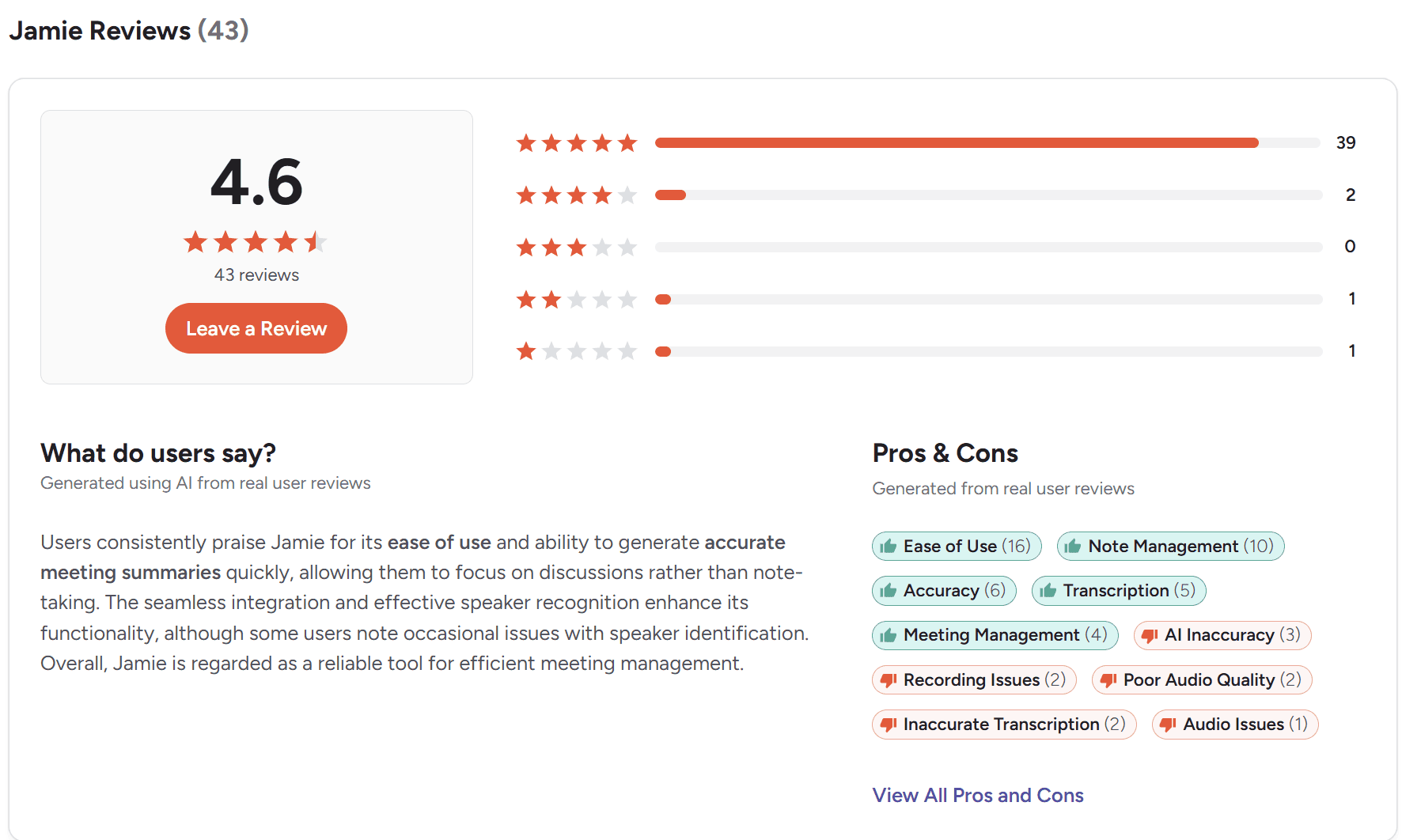
By contrast, Jamie has no sales coaching layer at all: no scorecards, no objection tracking, no talk-time analytics. However, this is Jamie’s desired position. It prefers to be a no-nonsense, easy-to-use notetaker. It never tried to be a pipeline management tool. In fact, over on G2, its biggest praise is for “ease of use”.
Jamie does integrate with Salesforce and HubSpot on its Pro plan, so notes can reach your CRM. But logging a call and coaching a rep are different jobs. If revenue runs through your meetings, tl;dv is the better tool.
Custom Templates and Note Formats
Both tools offer custom note templates. Jamie caps you at one template on Free and three on Plus, with unlimited from Pro up; tl;dv unlocks custom AI note templates on Pro. It’s worth noting though that Jamie’s Pro plan is more than twice the price of tl;dv’s.
Integrations and Workflow Fit
tl;dv connects to 5,000+ tools through native integrations and Zapier, with CRM sync unlocking at Pro and an MCP server on Pro and above for wiring meetings into AI tools like Claude.
Jamie keeps it minimal: Notion, Google Docs, and OneNote on every plan, with Salesforce, HubSpot, Asana, Pipedrive, and its own MCP support arriving at Pro. Calendar coverage is comparable: both hook into Google and Outlook calendars to detect meetings, and both offer mobile apps alongside their desktop presence.
Jamie’s lean stack is a fair fit for its audience: if your workflow is “meeting → notes → Notion,” you’re covered. But there’s no Zapier bridge and no webhook access below Pro, so anything custom means upgrading. tl;dv’s approach is all about automation: field mapping into your CRM, Slack digests, and workflows that run without you needing to touch them.
tl;dv vs Jamie AI Pricing: Which Costs Less in 2026?
tl;dv is cheaper at every comparable tier, and its free plan is dramatically more generous. Jamie only bills in euros, even for US customers, so the dollar figures below are approximate conversions.
| tl;dv | Jamie AI | |
|---|---|---|
| Free plan | $0 / €0 — unlimited recordings & transcripts, AI notes for 10 meetings/mo | €0 — 10 meetings/mo, 30-min cap per meeting |
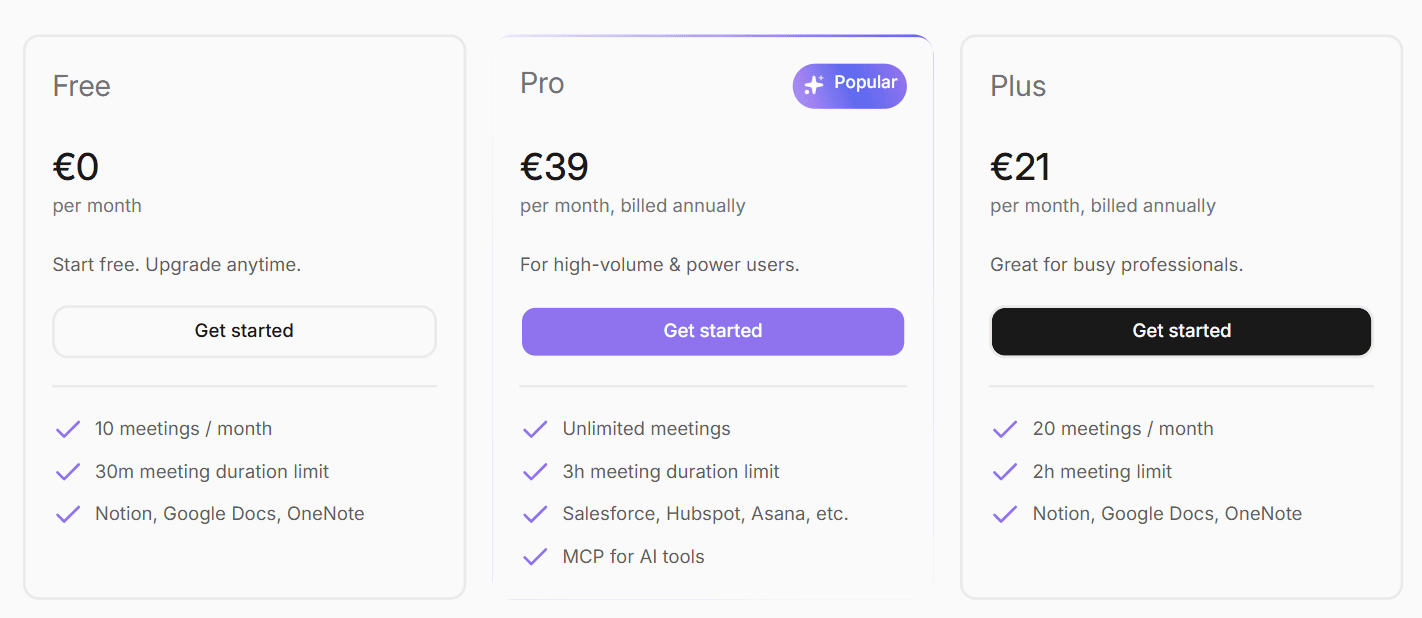
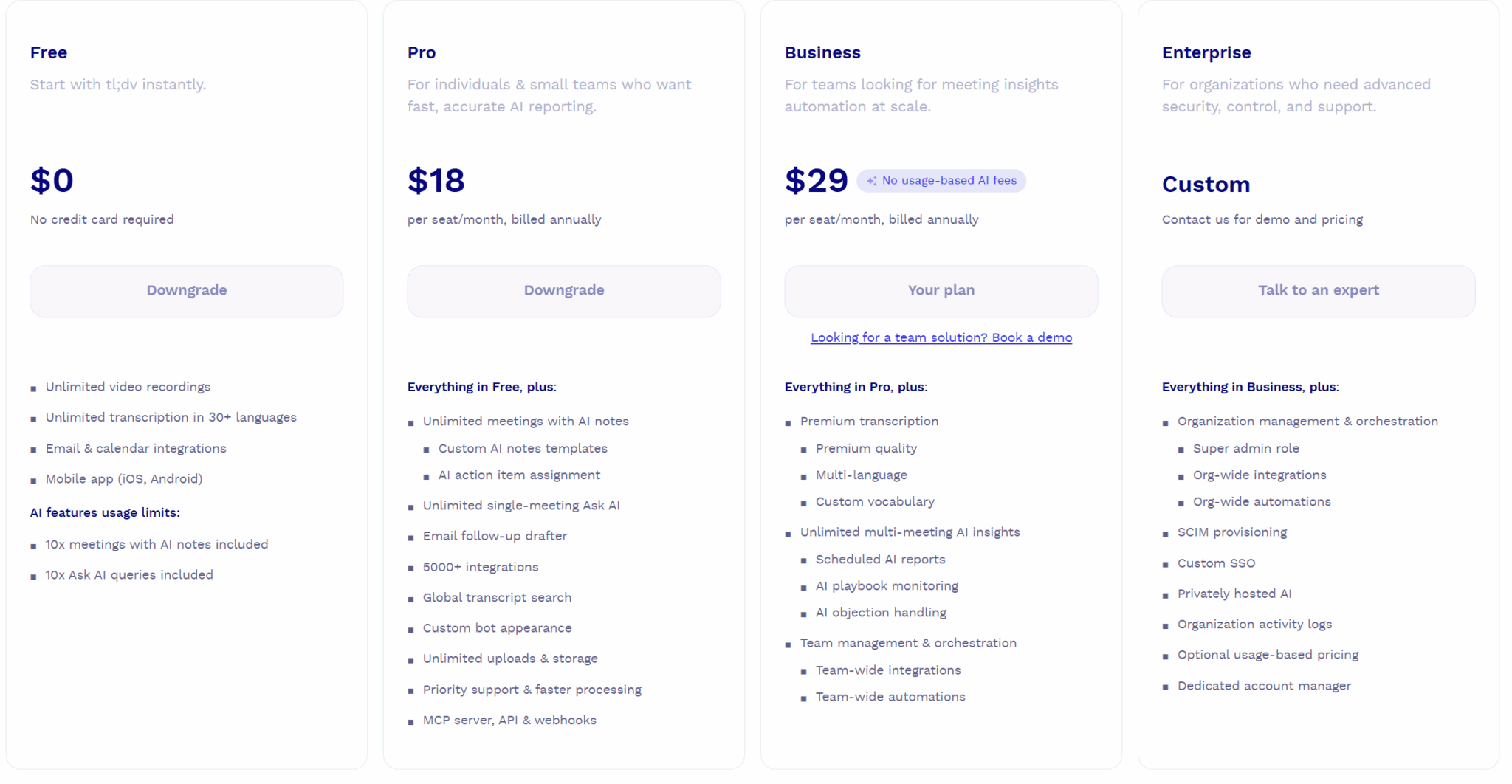
| Entry paid tier | Pro: $29/€29/mo monthly, or $18/€18/mo billed annually ($216/€216/yr) | Plus: €25/mo monthly (≈$29), or €21/mo (≈$24) billed annually (€252/$287/yr) — 20 meetings/mo, 2h cap |
| Top tier | Business: $39/€39/mo monthly, or $29/€29/mo billed annually ($348/€348/yr) | Pro: €47/mo monthly (≈$54), or €39/mo (≈$45) billed annually (€468/$533/yr) - Only now unlocks unlimited transcripts |
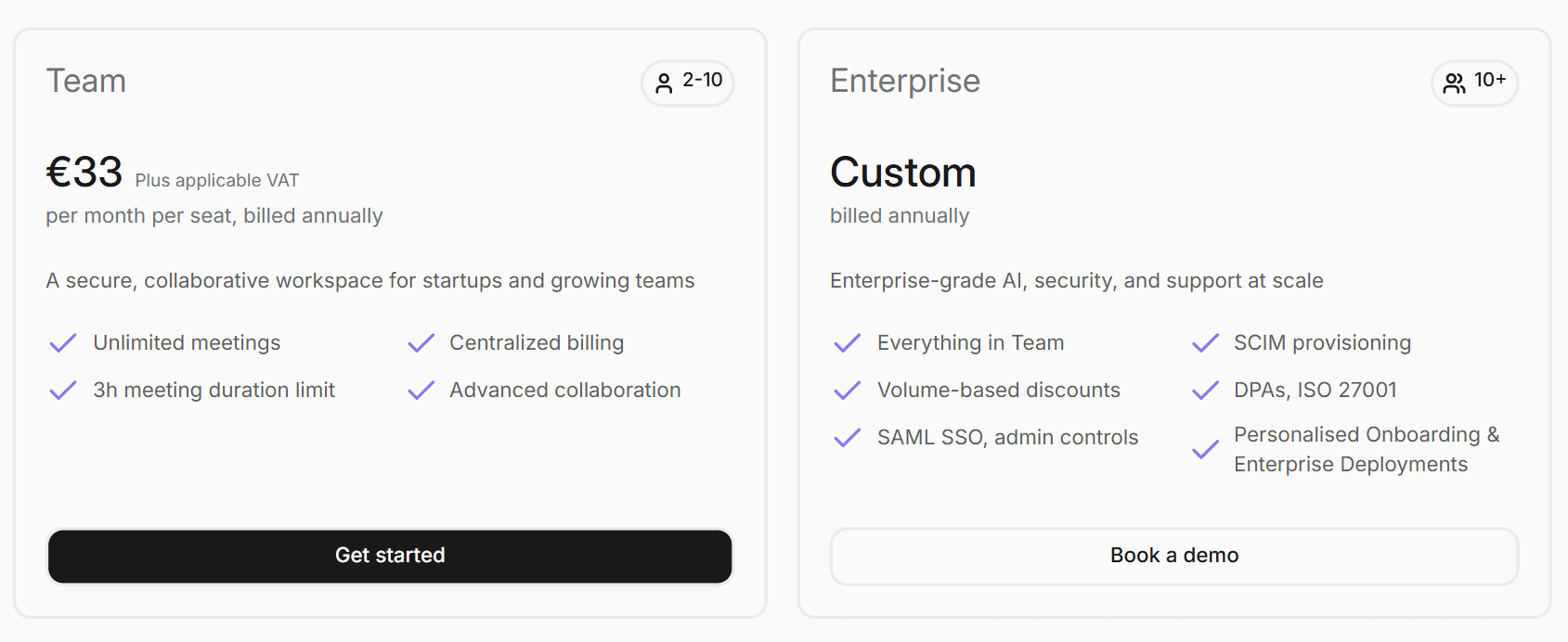
| Team pricing | Business per seat, no seat ceiling | Team: €39/seat/mo monthly, or €33/seat/mo billed annually (€396/yr) + VAT, 2–10 seats |
| Enterprise | Custom | Custom |
| Video recording | Yes | No |
| Bot-free recording | Yes — desktop app | Yes — desktop only |
| Browser recording (bot) | Yes | No |
| Billing currency | USD & EUR | EUR only |
| Prices verified July 20, 2026 via tldv.io/app/pricing and meetjamie.ai/pricing. Jamie bills in EUR only; USD figures are approximate conversions at time of writing. | ||
Unlimited recordings and transcripts on the free plan. No credit card required.
Try tl;dv FreeThe main difference between Jamie and tl;dv’s pricing structure is that Jamie meters meetings while tl;dv meters AI usage. Jamie’s Free plan allows 10 meetings a month at 30 minutes each; its Plus plan (€21/month billed annually) allows just 20 meetings at two hours. That’s more than €250 per year and you still don’t get unlimited transcripts — something tl;dv offers for free. tl;dv’s Free plan records and transcribes unlimited meetings forever and caps only AI notes at 10 meetings a month.
For teams, Jamie’s Team plan (2-10 seats) runs €33/month per seat billed annually, plus VAT, for unlimited meetings and a shared workspace. tl;dv Pro covers the equivalent team ground for €18/$18 per seat billed annually, and there’s no seat ceiling. The difference isn’t just in price, though.
At the top end, Jamie Pro runs €39/month billed annually, while tl;dv Business is $29/€29/month when billed annually. For Jamie, this unlocks unlimited transcripts, MCP, and integrations with Salesforce and other CRMs (all features that tl;dv provides in Pro for less than half the price). tl;dv’s Business unlocks sales playbook monitoring, unlimited multi-meeting intelligence, scheduled reports, objection handling, and more. All things that Jamie doesn’t offer on any tier, for cheaper.
Which Free Plan Is Better?
tl;dv’s, by a wide margin. It’s one of the best free AI notetakers out there. tl;dv Free includes unlimited video recordings and unlimited transcription, with AI notes for your first 10 meetings each month and no credit card required.
Jamie Free is 10 meetings a month total, capped at 30 minutes apiece, with one note template. Jamie’s free plan is a trial that doesn’t expire; tl;dv’s is a tool you could actually use indefinitely.
Privacy, Security, and EU Compliance
Both tools are EU-hosted, GDPR-compliant, and explicitly promise not to train AI models on your data. Jamie lists SOC 2 Type II as pending, where tl;dv is already fully SOC 2 certified. Jamie and tl;dv both offer consent workflows on every plan. Where Jamie is ISO 27001 certified, tl;dv runs on infrastructure certified to ISO 27001, PCI DSS Level 1, and SOC 1 and 2 standards. tl;dv is also fully compliant with the EU AI Act.
For EU buyers, either choice keeps your data on the right side of the Atlantic and your DPO off your back. The sharper question is consent culture. While Jamie does have consent emails that help, tl;dv gives workspaces recording consent settings and privacy defaults that admins can enforce across the team. This matters big-time once compliance becomes policy. Given that privacy concerns around AI notetakers are now making national news, “we’ll remember to mention it” is not a compliance strategy.
One more consideration for larger organizations: audit logs, SAML SSO, and custom data retention policies sit on Jamie’s Enterprise tier only, while tl;dv’s Enterprise adds SCIM provisioning, privately hosted AI, and organization activity logs. If your security team sends vendors a 40-page questionnaire, both companies have seen it before. Neither will be the reason procurement says no.
Which Should You Choose?
If you need video, teamwork, or revenue workflows, choose tl;dv. If you want invisible personal notes and nothing else, Jamie is a decent choice too.
Choose tl;dv If…
You need video recording, clips, or highlight reels. You run a sales, CS, or recruiting team that needs coaching, playbooks, and CRM automation. You want both bot and bot-free recording depending on the meeting. You want a free plan that records unlimited meetings. Or you’d simply rather pay $18 a month than €39 for the unlimited AI notes tier.
Choose Jamie If…
You work solo, your meetings are often in-person or off-platform, and you never need to see a recording again. Jamie’s notes are well-structured and its EU-privacy posture is on a par with tl;dv’s. It’s a good personal notetaker, it’s just not a team meeting platform. The big drawback with Jamie is the price.
Final Thoughts
The tl;dv vs Jamie AI decision comes down to one question: is a meeting something you personally remember, or something your team acts on? Jamie is built for the first job. tl;dv leans toward the second (but can do both), with video, coaching, and automation that Jamie simply doesn’t have, and all at a lower price.
Since tl;dv’s free plan has unlimited recording and no credit card requirement, the cheapest way to settle this is to try it on your next few meetings and see what survives.
FAQs About tl;dv vs Jamie AI
Does Jamie AI Record Video?
No. Jamie records audio only and produces transcripts and notes; there is no video recording on any plan. tl;dv records full video through its browser bot, plus audio-only through its bot-free desktop app.
Does tl;dv Work Without a Bot?
Yes. tl;dv’s desktop app records device audio bot-free from any source, including Webex, phone calls, browser tools, and in-person conversations. The bot remains available whenever you want video.
Is Jamie AI GDPR Compliant?
Yes. Jamie is hosted in the EU, is GDPR-compliant, holds ISO 27001 certification, and states that it does not train AI models on customer data. Its SOC 2 Type II certification is listed as pending.
Does Either Tool Have an API or MCP Server?
Both do, behind paywalls. tl;dv offers API, webhooks, and an MCP server from Pro ($18) upward. Jamie offers API, webhooks, and MCP support for tools like Claude and Cursor starting on its Pro ($40+) plan.
Can I Export Transcripts From Both Tools?
Yes. Both let you export transcripts and notes, and both sync to Google Docs and Notion. tl;dv additionally supports downloading the recordings themselves from Pro upward, which Jamie can’t match since there’s no video to download.
What Are the Best Alternatives to tl;dv and Jamie?
The usual suspects are Fireflies, Fathom, Otter, and Granola, each with different trade-offs on recording modes, pricing, and team features. Fireflies and Otter are bot-based like tl;dv’s browser mode; Granola, like Jamie, skips the bot entirely. If you’re weighing several, start with whether you need video and whether notes belong to you or your team; those two questions filter the field faster than any feature grid.
If you want Jamie’s bot-free approach from someone else, there are five Jamie AI alternatives worth a look.