Skip to content




Most sales teams automate the wrong things—bolt on tools, blast emails, and wonder why their CRM is a landfill and domain reputation is tanking.
Sales automation works only when engineered as a system, not stitched together as disconnected shortcuts. This guide gives you architecture, blueprints, and checklists to build sales automation that stays reliable, protects sender reputation, and converts pipeline:
- A six-layer system architecture (signals → data → decisions → actions → CRM → monitoring)
- 12 workflow blueprints with triggers, logic, and failure handling
- Operational checklists for deliverability, maintenance, and 30/60/90-day rollout
Up to 70% of reps missed quota in 2024 with average attainment around 43%. Over 81% of sales teams use AI, yet results keep declining. The tools aren’t the bottleneck. The system design is.
What Is Sales Automation (and What It Is Not)
Sales automation uses software, workflows, and rules to handle repeatable sales tasks—lead routing, follow-up sequencing, CRM updates, task creation, reporting—with triggers and logic that deliver speed, consistency, and fewer dropped balls across your pipeline.
The part most definitions skip: sales automation is not “set and forget.” Treat it as a production system requiring architecture, monitoring, and maintenance.
Sales Automation vs. Marketing Automation
Marketing automation handles pre-handoff demand: campaigns, nurture, scoring. Sales automation handles post-handoff execution: routing, next actions, follow-through, CRM hygiene. They share lifecycle definitions, routing rules, and intent signals—but must never duplicate sends to the same contact.
| Sales Automation | Marketing Automation | |
|---|---|---|
|
Focus |
Pipeline execution, CRM hygiene |
Demand gen, nurture, scoring |
|
Owner |
Sales ops / GTM engineers |
Marketing ops |
|
Key actions |
Routing, sequencing, meeting follow-ups |
Campaigns, ad orchestration, scoring |
|
Risk if broken |
Missed leads, CRM junk, rep confusion |
Spam complaints, brand damage |
For baseline definitions, see IBM, Salesforce, and HubSpot. Our focus: building the system that holds up after you understand the concept.
The 2026 Reality Check: Why Most Sales Process Automation Fails
The Productivity Paradox
Automation lowers outreach cost → teams send more → channels saturate → response rates drop → teams send even more. This is the Jevons Paradox applied to sales. Salesforce reports reps spend only 28% of their week selling—the rest is admin and managing tools meant to save time. Fix: Measure conversation conversion rate and deliverability health, not activities per rep.
Deliverability Tightened (2024+)
In 2024, Google and Yahoo rolled out stricter bulk sender requirements. High-volume, low-quality outreach gets blocked faster. Your domain reputation is now a sales operations risk.
The Maintenance Tax
APIs change without warning. OAuth tokens expire unnoticed. Field mappings drift when someone renames a CRM property. Workflows fail silently. Duplicate writes corrupt pipelines. “Low-code” doesn’t mean “low-maintenance”—automation creates technical debt the moment it launches.
Signals Beat Time-Based Sequences
Time delays aren’t intent. Signals are: a target hires a VP Sales, closes funding, shows a usage spike, visits your pricing page, a champion changes jobs. Signal-based triggers earn replies; time-based drips get ignored.
“Dark AI” Attribution Blind Spot
AI-referred sessions surged over 500% YoY (2025 Previsible AI Data Study). Forrester projects AI could reach 20% of B2B organic traffic by late 2025—and current tools undercount it. Fix: Layer hiring data, product usage, and conversation insights alongside web-visit signals.
The GTM Engineer Role Split
A single GTM Engineer—a technical operator who builds and maintains the automation system—can generate more booked demos than five traditional SDRs. Job postings grew 205% YoY (2024–2025). Let technical operators build the machine; let the conversation owner (SDR/AE) handle replies, discovery, and relationships.
Core principle: Reliability > volume. Relevance > cadence. Governance is not optional.
The Sales Automation System Architecture
The engineering core. A six-layer model any sales team can adapt—solo founder on HubSpot or 15-tool composable stack.

Layer 1: Signals (No Signal, No Automation)
Every workflow starts with an event, not a calendar date. Signal categories: intent (pricing page, demo request), firmographic change (funding, leadership hire), engagement (reply, meeting booked), product usage (spike, drop), renewal/risk (NPS decline, contract expiry), AI attribution hints (LLM referral traffic). No signal = no reason to trigger an action.
Layer 2: Data Quality & Enrichment
Waterfall enrichment queries multiple providers in sequence—Provider A returns nothing? Try B, then C. This improves coverage and reduces bounce rates. B2B contact data decays 22–30% annually (Marketing Sherpa/Cognism), so single sources go stale fast. Rules: deduplicate before CRM entry, verify emails before sequencing, suppress bounces/unsubscribes/do-not-contact.
Layer 3: Decisioning (Guardrails)
Lead scoring sets priority (firmographic fit + behavioral signals). Lead routing assigns ownership (territory, round-robin, capacity—always with a no-owner fallback). Guardrails are where most systems fail: frequency caps across channels, exclusion lists (customers, open opps, active sequences, legal holds), territory protection, “already in sequence” checks. Without these, automation creates collisions, double-sends, and rep confusion.
Layer 4: Action Layer
Task creation, sequence enrollment, Slack alerts, meeting follow-ups, SDR-to-AE handoffs. Automate the next best action, not busywork.
Meeting follow-ups are high-leverage: reps spend 15–30 minutes post-call on notes, CRM updates, and drafts. tl;dv automates this—records and transcribes, generates AI summaries with next steps, and syncs to CRM. 15–30 minutes back per call with better data quality than manual entry.
Layer 5: CRM Writeback Rules
Field ownership: define which system writes to which fields—conflicting writes corrupt data. Idempotent updates: same automation firing twice produces the same result (no duplicates, no overwrites). Human override: sensitive fields (deal amount, close date, stage) require rep confirmation.
Layer 6: Observability & Governance
The layer most teams skip entirely. Monitor: sync error rate, bounce rate per domain/sequence, spam complaints (<0.1%), speed-to-lead, meeting-to-follow-up time. Build: logging for every action, failure alerts (not just success notifications), monthly audits, error budgets.
If you only fix 3 layers: Signals (1), Guardrails (3), Observability (6). These prevent irrelevant outreach, sequence collisions, and silent breakdowns.
Deliverability-First: The Go/No-Go Checklist
Nothing in your outbound sales automation sends until every gate is green.
- ✅ SPF, DKIM, DMARC configured and aligned
- ✅ One-click unsubscribe header on all outbound
- ✅ Spam complaint rate below 0.1%
- ✅ Bounce rate below 2% (target under 1%)
- ✅ All emails verified before sequencing
- ✅ Suppression lists active (bounces, unsubscribes, do-not-contact)
- ✅ Kill switch: auto-pause on threshold breach
Google and Yahoo enforce: mandatory SPF/DKIM/DMARC authentication, one-click unsubscribe in headers, complaint rate below 0.1% (above 0.3% risks bulk blocking), and “From” domain alignment with authentication records. Sending cold outreach from your primary domain without these checks risks every email your company sends.
List hygiene sequence: Waterfall enrichment (multiple providers) → email verification (every address) → suppression check (bounces, unsubscribes, do-not-contact). Never sequence unverified emails at scale. One bad batch damages domain reputation for months.
Kill Switch Blueprint
Trigger: Bounce rate >2% OR complaint rate >0.08%. Auto-actions: Pause all sequences on affected domain → alert owner → open incident checklist. Human actions: Investigate root cause → fix source → resume only after rates normalize.
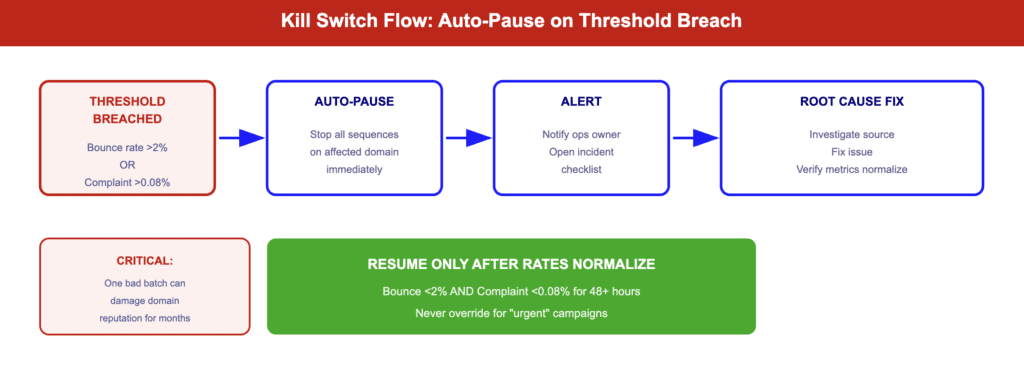
Ship this workflow first. It protects everything else you build.
12 Sales Workflow Automation Blueprints
Each uses the structure: Trigger → Logic → Actions → CRM writeback → Failure handling → KPI. Pick 2–3, confirm stability, then expand.
# | Workflow | Trigger | Key Risk | KPI |
1 | Inbound lead routing | Demo request | Unassigned leads | Speed-to-lead |
2 | Signal-based outbound | Hiring/funding signal | Spam, irrelevance | Reply rate |
3 | Waterfall enrichment | New lead created | Bounces | Bounce rate |
4 | Duplicate prevention | Sequence enrollment | Double-touch | Collision rate |
5 | Meeting → CRM | Meeting ends | Data gaps | CRM completeness |
6 | Objection capture | Call completed | Missed insights | Objection coverage |
7 | Coaching automation | Week end / key calls | Low adoption | Playbook adherence |
8 | Pipeline hygiene | Stage change | Bad forecasts | Field completion % |
9 | Nearbound signals | Page visit / usage spike | Over-automation | Signal-to-meeting rate |
10 | MQL → SQL handshake | MQL threshold | Double-touch | Handoff speed |
11 | Renewals/expansion | Usage/support signal | Churn | Save rate |
12 | Integration resilience | API sync | Data loss | Sync error rate |
Blueprint 1: Sales Lead Automation—Inbound Routing
Trigger: Demo request or high-intent form fill. Logic: Enrich → score against ICP → match territory. ICP + territory = assign AE; ICP only = SDR queue; no match = “unassigned” with 5-min escalation alert. Failure handling: No owner after 10 min → auto-assign backup. Enrichment fails → manual review queue (don’t block the lead). KPI: Speed-to-lead under 5 minutes.
Blueprint 2: Outbound Sales Automation—Signal-Based
Trigger: VP Sales hired, Series B+ funding, competitor signal at target account. Logic: Already customer → suppress. Open opp → route context to owner. Active sequence → skip. Unsubscribed → hard stop. All clear → enrich → verify → enroll in 2–3 step sequence referencing the specific signal. Failure handling: Verification fails → skip + log. Bounce on first send → remove + suppress. KPI: 8–15% reply rate (vs. 1–3% generic cold).
Blueprint 5: Meeting → CRM (Zero-Admin Follow-Through)
Trigger: Meeting ends. Logic: Match attendees to CRM records → extract summary, objections, next steps → map to CRM fields → generate follow-up draft for rep review. Failure handling: Poor transcript → flag manual review. CRM sync fails → retry + alert. KPI: 95%+ field completion; time from meeting end to follow-up sent.
tl;dv handles this end-to-end: records and transcribes, generates structured AI summaries, and pushes to CRM + 5,000 apps. Its conversational intelligence also powers Blueprints 6 (objection capture) and 7 (coaching).
Blueprint 10: Sales and Marketing Automation Handshake (MQL → SQL)
Trigger: Lead hits MQL threshold. Logic: Already assigned → notify rep + suppress marketing nurture. Unassigned → route via Blueprint 1. Single ownership rule: Once sales accepts, marketing pauses. No duplicate outreach. Failure handling: Lifecycle sync fails → alert ops. Sales rejects → return to nurture with reason logged. KPI: MQL-to-SQL rate; double-touch rate near zero.
Blueprint 12: Integration Resilience (API-Safe Sync)
Buffer sync requests in a queue processed within API rate limits. On error: retry with exponential backoff. After X failures: dead-letter queue + alert ops. Every update must be idempotent—running twice produces the same result. KPI: 99.5%+ sync success rate.
Choosing Sales Automation Software (Without the Listicle)
All-in-One vs. Composable Stack
All-in-one (HubSpot, Salesforce native, Zoho): faster setup, simpler maintenance—often the best sales automation software for small business. Composable (best-of-breed per layer): higher data accuracy and flexibility for GTM teams with dedicated ops. SaaS portfolios briefly shrank in 2023 but expanded again in 2024 (Zylo). Budget for integration maintenance either way.
Decision rule: Fewer than 3 people in ops → start all-in-one. Dedicated ops hitting data-quality limits → go composable.
What’s the Best AI Tool for Sales Automation?
Wrong question. Right question: what job are you hiring AI to do?
AI that helps: research/summarization, meeting intelligence (extracting action items, objections), routing suggestions, draft generation with human review, coaching and call scoring. AI that hurts: high-volume copy without review, generic “personalization,” full autopilot removing humans from the loop.
Evaluation checklist: data access controls, admin guardrails, SOC2/GDPR, explainability, human override, integration depth. Red flags: no suppression logic, no audit logs, black-box outputs.
For meeting intelligence, tl;dv auto-records, generates summaries, populates CRM fields—SOC2/GDPR compliant, fits composable and all-in-one stacks.
The Maintenance Tax: Keeping Your Sales Automation System Alive
Common failures: API changes, token expiry, field mapping drift, silent workflow failures, duplicate writes, rate-limit partial syncs. Each happens regularly—the question is when, not if.
Ownership model: Every automation needs a primary owner, backup owner, change log, staging/test step before production, and rollback plan.
Monthly audit:
- Review sync error logs
- Verify API tokens and OAuth connections
- Check CRM field mappings against current structure
- Confirm suppression lists capture bounces and unsubscribes
- Test critical workflows end-to-end
- Review deliverability metrics
- Confirm automation owners are current
30/60/90-Day Rollout Plan
Days 0–30: Safety + Foundation
Complete deliverability go/no-go checklist. Build suppression lists. Define CRM field ownership. Set up baseline dashboards. Ship Blueprint #1 (lead routing), #5 (meeting → CRM), and the kill switch. Assign automation owners.
Days 31–60: Signals + Enrichment
Implement waterfall enrichment (#3). Add verification to all outbound lists. Launch signal-based outbound (#2). Activate duplicate prevention (#4) and MQL → SQL handshake (#10). Review and adjust first 30 days of metrics.
Days 61–90: Governance + Scale
Establish monthly audit cadence. Activate kill switches on all sequences. Launch coaching (#7) and pipeline hygiene (#8). Evaluate GTM Engineer role split. Shift KPIs from activities to conversations and outcomes.
Sales Automation News (2024–2026)
- Deliverability enforcement is real. Google/Yahoo enforce SPF/DKIM/DMARC, one-click unsubscribe, complaint thresholds. Treat deliverability as a pre-launch gate. (Google, Yahoo)
- AI traffic distorts attribution. AI-referred sessions +527% YoY; Forrester projects ~20% of B2B organic by late 2025. Layer diverse signal sources.
- GTM Engineer is a distinct role. 205% YoY posting growth. One GTME can outperform five SDRs in pipeline throughput.
- Stack complexity persists. SaaS portfolios briefly shrank, then expanded again (Zylo 2025). Budget for integration maintenance.