Skip to content



Sales training software has been around for years, which makes it slightly impressive how often sales training still manages to not work at all.
Picture it now. The boss has spoken. There’s a NEW thing that’ll change EVERYTHING. Teams roll out a shiny new program, block out a day or two in the diary, everyone nods along, ticks the boxes, then quietly goes back to selling exactly how they did before.
Fast-forward three months later, and leadership wonders why nothing changed.
A big part of the problem is timing. Training tends to happen in bursts, kickoffs, quarterly sessions, the occasional motivational push when numbers wobble. Selling, meanwhile, happens every single day, in messy conversations that do not politely wait for the next enablement session. Skills slip in the gap between training and real use, especially for newer reps who are still trying to work out what good even looks like.
Managers are not the villains here either. Most are stretched thin, juggling targets, deals, meetings and people management. Coaching slips down the list, feedback arrives late, and by the time it does, the moment has passed. New reps end up learning by osmosis, watching whoever is loudest, busiest or most confident, and copying habits that may not actually be working.
Then there is the theory problem.
Slides about discovery frameworks and objection handling sound sensible in a room, but they fall apart when a customer throws something unexpected into a live call. Without access to real examples, training stays abstract, and reps are left improvising under pressure.
Sales training software has stepped in as a response to these gaps, not as a silver bullet, but as a way to keep learning tied to real work.
Table of Contents
What sales training software actually is now
Sales training software used to mean one very specific thing: an online course, a quiz at the end, maybe a certificate nobody ever looked at again. That definition does not survive contact with how sales teams actually work. The category has stretched, blurred and quietly reinvented itself because the old model was not doing the job.
Today, sales training software shows up in a few different shapes.
Some tools sit close to coaching and feedback, helping managers review calls, leave comments and guide reps without needing another meeting in an already chaotic calendar.
Others focus on enablement and readiness, structuring onboarding, tracking skill development and making sure people know what they are supposed to know before they speak to customers.
There is also a growing group of tools built around role play and practice. These are designed to let reps make mistakes in a safe environment, build confidence and get comfortable before the stakes are real.
Alongside that sit documentation and onboarding systems, which are less about skills and more about removing friction by giving reps clear processes, messaging and answers without having to ask around Slack.
Modern sales training software is less interested in delivering content and far more interested in changing behaviour over time. That means repetition, feedback and learning that stays close to the work reps are already doing.
For buyers, if you are looking for a single tool to replace everything, you will likely be struggling to find that elusive tool. If you are looking for software that supports how people actually learn, improve and sell, the newer generation of tools starts to make a lot more sense.
How sales training software improves rep performance in practice
When sales training software is doing its job, you can usually spot it without looking at a dashboard. The changes show up in how teams work day to day.
1. Faster feedback loops
Reps get feedback while calls are still fresh, not weeks later in a review meeting. Coaching lands when it can actually influence the next conversation, not just explain why the last one went wrong. New reps ramp without guesswork
2. Onboarding is not limited to shadowing whoever happens to be free.
New hires learn from real wins and real losses, which helps them recognize patterns and build judgement much faster.
3. Coaching stays consistent across managers
Examples, clips and guidance live in one place. That reduces mixed messages and stops each manager coaching from personal habits or gut feel alone.
4. Teams learn from what ACTUALLY happens
Wins and losses are both used as training material. Objections, pricing pushback and awkward moments are no longer abstract ideas, they are concrete examples everyone can learn from.
5. Live meetings stop being the bottleneck
Managers review calls asynchronously. Reps absorb feedback in their own time. Coaching no longer depends on two diaries lining up at exactly the right moment.
6. Training becomes continuous by default
Learning fades into the background of daily work instead of showing up as a big event. Improvement feels normal, expected and ongoing rather than forced or performative.
If most of these points are left unchecked, the issue is rarely effort but that the sales training software being used is too far removed from the reality of how the team actually sells.
The best sales training software for improving rep performance
There is no single definition of the best sales training software, because teams use these tools in very different ways. Some prioritize coaching from real conversations, others need structured onboarding, certification or practice before reps ever speak to customers.
The tools below reflect those differences. Each one earns its place for a specific reason, and each fits better in some environments than others. The key is understanding where they help, and where they do not.
1. tl;dv
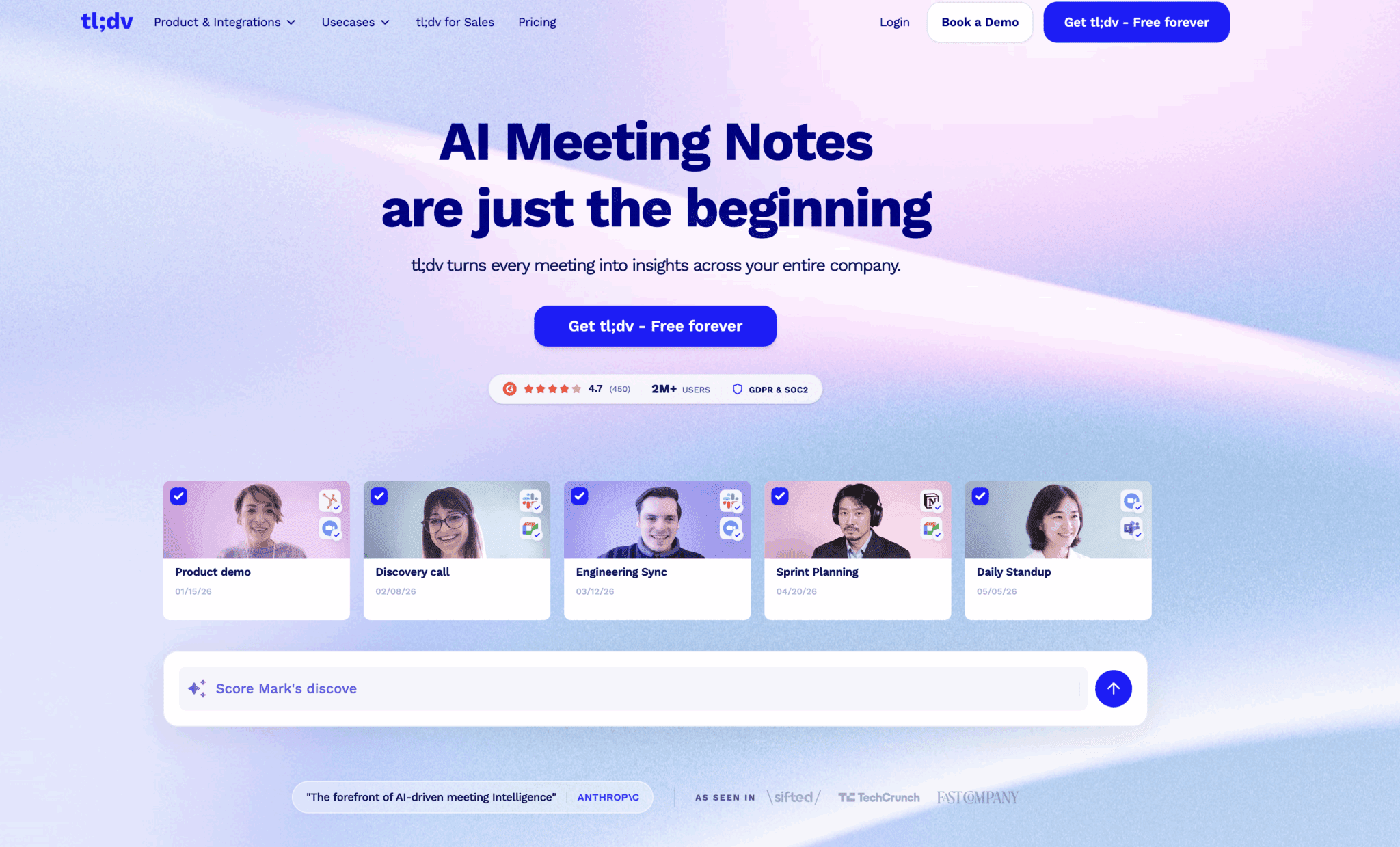
tl;dv is an AI-powered meeting recording, transcription and coaching platform that turns live calls across Zoom, Google Meet and Microsoft Teams into searchable, shareable insights and coaching material.
Sales reps can use it to revisit calls, search transcripts by keyword, bookmark key moments, use the AI coaching hub for feedback, and pull highlights into personal learning playlists.
Sales managers use it to automate coaching tasks, monitor playbook adherence, track objections and performance trends, and leave time-stamped feedback without having to sit through every call.
Meetings become resources for onboarding, coaching and team alignment rather than forgotten diary entries.
Pros
-
Automatic meeting capture and transcription across major video platforms, including speaker recognition and slide capture, so nothing is missed.
-
Template playbooks and AI coaching hub enable structured evaluation of calls against frameworks like MEDDIC, with scorecards that highlight skills gaps.
-
Clips and reels let users extract highlights instead of sharing full meetings, making coaching and onboarding more focused.
-
Searchable meeting library that surfaces past discussions by keyword or topic so teams can learn from patterns and common objections.
-
Recurring AI reports and agents automate insights across sets of calls, tracking objections, talk ratios, and themes over time.
-
Wide integrations sync summaries and outputs into CRMs, Notion and collaboration tools via Zapier or native connectors.
-
Strong privacy and compliance with GDPR-friendly design, EU data centers and visible consent on recordings.
Cons
-
Not a full LMS or course platform so structured training programs and certifications are outside its core remit. But this also means that it can be used by the entire team, sales or not, creating a centralized repository of customer calls, internal calls and everything that needs to be noted.
-
Dependent on recordings to unlock value; if teams do not consistently record meetings, insights will be limited. Thankfully, this can be made automatic ensuring that no meeting gets missed.
-
Less specialized on deep revenue analytics compared with full revenue intelligence suites that merge pipelines, email and call data. However, this does mean that it’s incredibly affordable compared to other more revenue-driven SaaS.
tl;dv thrives when teams treat meetings as learning opportunities rather than events to forget. Its strength is turning conversations into ongoing coaching fuel, not just transcripts to archive.
2. Gong

Gong is one of the most well known revenue intelligence platforms for sales training software. At its core, it records and transcribes sales calls, analyses patterns across huge volumes of interactions, and ties those patterns back to pipeline movement and outcomes. Sales reps can search past calls, look at flagged moments and hear how top performers handle objections. Managers lean on the platform for forecasting, messaging standardisation, and performance benchmarking across teams.
In practice, teams that invest in Gong will often run regular reviews where the revenue ops team pulls dashboards on talk ratios, objection categories and deal risk. Reps might be nudged to review calls that score below benchmarks, and coaches build playlists of “ideal behavior” for wider sharing.
Pros
-
Captures and indexes conversation data at large scale, making it possible to spot trends across teams.
-
Tight CRM integrations and unified data can support forecasting and executive reporting.
-
Useful for organisations with long, complex sales cycles that need historical visibility across deals.
-
Helps standardise language and messaging across large groups of reps.
Cons
-
It is INCREDIBLY expensive for most teams that are not enterprise scale; many organisations pay for analytics they never use.
-
Complexity means you often need a dedicated admin or revenue ops specialist to make sense of dashboards.
-
Too heavy for the day-to-day coaching most managers desperately need; the insight often arrives too late to shape the next call.
-
Reps sometimes feel measured rather than supported, especially when the focus is on activity metrics.
Gong works fairly well as a data-rich platform for large organizations that have dedicated resources to manage it. But for teams that want lighter coaching tied directly to real conversations, the sheer cost and complexity can feel like trying to pilot a battleship when what you really need is a responsive speedboat. Places where a tool like tl;dv gives quick, practical feedback in real time, Gong layers in analytics that are often nice to have, but can feel incredibly overkill for what the sales teams are trying to achieve.
3. Call AI from Mindtickle

Mindtickle’s conversation intelligence, branded as Call AI, sits inside its wider revenue enablement platform. It records and transcribes sales calls, scores them against predefined behaviours, and feeds those insights into dashboards designed for enablement leaders, managers and sales ops.
Sales reps experience this through call recordings, AI-generated summaries, scores tied to talk time, pace and questions asked, and Copilot prompts that help with follow-ups. Managers use it to prioritize which reps and deals need attention, surface coaching opportunities, and reinforce predefined “winning behaviors” across the team.
In practice, Call AI is used less as a day-to-day coaching companion and more as a signal generator. Calls are analysed at scale, patterns are surfaced, and insights are fed back into training programs, readiness frameworks and enablement initiatives. It is designed to inform coaching strategy rather than replace hands-on coaching itself.
Pros
-
Deeply integrated conversation intelligence within a broader revenue enablement platform
-
AI-driven call scoring across talk time, pace, questions and other defined behaviours
-
Copilot assists with summaries, action items and follow up drafting
-
Strong visibility for enablement and leadership into rep activity and buyer signals
-
Useful for surfacing competitive mentions, objections and market insights at scale
-
Tight CRM integrations support reporting and executive oversight
Cons
-
Conversation intelligence is framed around scoring and benchmarking rather than reflective learning
-
Coaching is mediated through dashboards and programmes, not always through direct call review
-
Behavior is inferred from metrics, which can flatten nuance in real conversations
-
Can feel evaluative to reps, especially when scores are emphasised over discussion
-
Heavy platform footprint for teams that mainly want lightweight call based coaching
-
Better suited to enablement and ops teams than frontline managers with limited time
- Price can quickly get out of hand. It’s opaque (what sales tool isn’t, am I right?) with no public plans and reported average annual contracts around $90k+, despite older list estimates suggesting figures as low as $15 per user per month, which makes it hard to assess value without going through a full sales cycle.
Mindtickle’s approach to conversation intelligence makes sense inside a large, structured revenue organisation where insight feeds training, readiness and leadership reporting. Where it falls down for many teams is immediacy. Coaching tends to happen after analysis, not in the moment of learning.
Compared to tools like tl;dv, which treat calls themselves as the primary coaching surface, Mindtickle treats conversations as data points feeding a broader system. That difference matters. One optimises for control and scale. The other optimises for real humans getting better at selling, one call at a time.
4. Allego

Not to be confused with Allego.eu which is an EV charging copany, Allego is a sales training software that combines sales training, coaching, content management, conversation intelligence and digital selling into a single system designed to support sellers and managers across the entire revenue process. Allego is pitched as being able to deliver bite-sized learning, practice key skills, access and share content, and analyse sales conversations alongside structured enablement programmes. The platform is built to deliver learning in the flow of work so reps can access what they need when they need it, not weeks after the fact.
Sales reps typically interact with Allego by participating in AI-driven training modules, reviewing conversation insights, using reinforcement learning in daily workflows and accessing curated content that helps them tailor messaging and approach with buyers. Managers use it to surface coaching opportunities, track progress against competencies, and align content with learning objectives at both the individual and team level. The system also supports onboarding and readiness tracking so new reps ramp faster and established reps continue refining skills.
Pros
-
Combines onboarding, training, coaching and content management in one platform, which can simplify tech stacks and reduce tool sprawl.
-
Built-in conversation intelligence and scoring helps teams spot winning behaviors and coaching opportunities tied to actual calls.
-
AI-driven learning and reinforcement can personalize the rep experience and deliver learning in the flow of work.
-
Supports microlearning and interactive practice that can boost retention and engagement.
-
Content management and collaboration features help align sales and marketing efforts around relevant assets.
Cons
-
Because it covers so many bases (training, enablement, content, selling and insights) it can be harder to navigate for teams that want a focused call-centric coaching tool.
-
Conversation intelligence is integrated into a broader enablement stack, which means coaching often happens through dashboards and frameworks rather than direct, lightweight peer-to-peer feedback.
-
Some teams find the user interface and navigation overwhelming when trying to pull just the simple insights they want.
-
Price and complexity can outstrip the needs of smaller teams that just want call-based coaching and quick feedback loops.
-
Like most enterprise-grade platforms, many of the deeper analytics and workflows require implementation support and ongoing admin investment.
Allego aims to be an all-in-one platform for sales development, not just a coaching tool. For organizations ready to consolidate training, content and conversation intelligence under a single roof, that can be a strong proposition. For teams that want lightweight, rapid coaching based on real calls without the overhead of a full revenue enablement stack, tools more narrowly focused on conversation workflows often feel more direct and easier to adopt.
5. Litmos

Litmos is a global learning management system used by international organizations to deliver onboarding, compliance training and role-based education at scale. It is designed for consistency across regions rather than sales nuance, which is exactly why so many global sales teams rely on it.
Sales reps encounter Litmos mainly during onboarding and mandatory training cycles. They complete structured courses, knowledge checks and certifications that ensure they understand products, processes and regulatory requirements before and during their role. Managers and enablement teams use Litmos to assign training by region or role, track completion and report upwards with confidence that nothing has been missed.
In practice, Litmos becomes the backbone for global sales education. It works quietly in the background, making sure everyone has been trained, in the right language, at the right time.
Pros
-
Strong multi-language support, well-suited to global rollouts
-
Reliable compliance and certification tracking across regions
-
Scales cleanly across large, distributed sales teams
-
Integrates well with enterprise systems and HR platforms
-
Predictable, structured learning experience for reps
Cons
-
Purely course-driven, with no connection to real sales conversations
-
Learning happens outside daily selling workflows
-
Completion-focused, not behavior-focused
-
Feels administrative rather than developmental for experienced reps
Litmos is at its best when the goal is standardization. It makes sure every rep, everywhere, knows the same fundamentals. It does not help reps get better on calls, and it does not try to. For international teams, that clarity is often a strength rather than a weakness.
6. Brainshark

Sounding cooler than it is, Brainshark positions itself as a sales readiness and sales enablement platform focused on onboarding, practice, and content-driven learning. It is designed to help reps get up to speed quickly, stay aligned on messaging, and reduce the amount of time they spend searching for materials instead of selling.
Sales reps typically use Brainshark to complete onboarding assignments, run through microlearning modules, practice pitches in a safe environment, and access approved content to send to prospects. The platform leans heavily on AI-powered role play and simulations, giving reps instant feedback without needing a manager present.
Sales managers and enablement teams use Brainshark to assign training, track readiness, and monitor whether reps are engaging with the right content. Over time, it becomes a system for keeping skills fresh and messaging consistent, especially in large or distributed teams.
Pros
-
Strong onboarding and readiness focus, particularly for new reps
-
Safe, on-demand practice through AI role play and simulations
-
Microlearning format suits distributed and remote teams
-
Content surfacing helps reps find approved materials faster
-
Integrates well with CRM and broader sales tech stacks
-
Useful for industries with complex products or regulated messaging
Cons
-
Improvement is measured through practice and content engagement, not live selling behavior
-
AI role play cannot fully replicate the unpredictability of real customer conversations
-
Coaching is simulated rather than grounded in actual deals
-
Can feel like training happening next to selling, not inside it
-
Less useful for experienced reps who need nuanced call-level feedback
Brainshark works well when the goal is speed, consistency, and confidence before reps go live. It helps teams practice, rehearse, and stay aligned, which is valuable, especially in complex sales environments.
Where it falls short is once reps are in the field. Practicing a pitch and navigating a real buyer conversation are not the same thing. Compared to conversation-led tools like tl;dv, which learn directly from live calls, Brainshark optimizes for preparedness rather than adaptation. For many teams, that makes it a solid readiness layer, but not the engine of ongoing performance improvement.
Why sales training software works better when it is not a standalone expense
One of the reasons sales training software so often disappoints is simple. It is bought as a line item that has to justify itself in isolation. Training budget in, training outcomes out. When results are hard to tie directly to revenue, the tool quietly gets questioned, usage drops, and renewal becomes a debate rather than a decision.
The tools that stick tend to earn their keep in more than one way. They support training, but they also solve everyday problems teams already care about, saving time, reducing friction, and improving visibility into work that is already happening. That makes their value obvious long before anyone tries to measure performance uplift.
This is where conversation-led tools behave very differently to classic training platforms. A tool like tl;dv supports coaching and rep development, but it is also used for meeting notes, follow-ups, knowledge sharing, onboarding, customer research, and internal alignment. Even if no formal training program is running, the tool still gets used daily because it helps people do their jobs.
That difference shows up clearly in return on investment. tl;dv’s Business plan is priced at $30 per seat per month, billed annually, with no usage-based AI fees, which works out at roughly €28 EUR. That flat pricing includes premium multi-language transcription, unlimited AI insights across meetings, scheduled reports, playbook monitoring, objection handling, and team-wide integrations and automations. Teams are not paying separately for call notes, follow-ups, onboarding examples, async coaching, and training insights. All of that sits inside one tool that delivers value whether training is the stated goal or not.
Instead of asking whether sales training alone justifies the cost, teams see value through time saved, fewer repeated meetings, better internal communication, and faster ramp for new hires. Training becomes a byproduct of real work rather than a separate initiative fighting for attention.
By contrast, tools that exist only as training systems often struggle once budgets tighten. If reps have to step out of their workflow to use them, adoption drops. If managers have to prove impact through reports rather than lived experience, skepticism creeps in.
The strongest sales training setups are rarely “training tools” in the traditional sense. They are tools that happen to make teams better because they sit inside the work that already matters. That difference is subtle, but it is usually the difference between software that gets renewed automatically and software that has to keep defending its existence.
FAQs About Sales Training Software
What is sales training software, and how is it different from an LMS?
Sales training software covers a broader category than a traditional learning management system.
An LMS such as Litmos is built to deliver structured courses, track completion and manage certifications at scale. It works well for onboarding, compliance and standardized knowledge.
Modern sales training software can include call recording platforms like tl;dv, revenue intelligence systems like Gong, enablement suites such as Mindtickle, or practice tools like Brainshark. These tools tie learning directly to live selling, coaching, feedback and real conversations rather than standalone courses.
If you are trying to improve behaviour on actual calls, an LMS alone will not get you there.
Does sales training software actually improve rep performance?
It can, but only if it connects closely to day to day selling.
Software that sits outside real conversations tends to become background noise. Reps complete modules, pass quizzes and move on. Behaviour rarely changes.
Tools that capture real calls, surface patterns and enable timely feedback are far more likely to influence performance. When reps can review real objections, hear how top performers handle pricing pushback and receive feedback while deals are still live, improvement becomes practical rather than theoretical.
The impact usually shows up in faster ramp time for new hires, more consistent messaging across the team and better handling of common objections.
Is sales training software only for large enterprise teams?
No, but the type of tool matters.
Enterprise platforms such as Gong or Allego are often built for large, structured revenue organisations with dedicated enablement and operations teams.
Smaller or mid sized teams often benefit more from lightweight, conversation led tools that are easy to adopt and do not require a full implementation project. If managers are short on time and reps are juggling active pipelines, simplicity usually wins.
The question is less about company size and more about internal capacity. If you do not have someone to manage dashboards and workflows, a heavy platform can quickly become shelfware.
How do you measure ROI from sales training software?
Measuring return purely through revenue uplift is difficult because sales outcomes depend on many variables.
Most teams look at a mix of indicators:
-
Time to ramp for new hires
-
Consistency of messaging across reps
-
Reduction in repeated internal meetings
-
Coaching frequency and speed of feedback
-
Improved objection handling in live calls
With conversation based tools like tl;dv, ROI is often visible through time saved on note taking, faster follow ups and improved internal knowledge sharing, not just training metrics. That broader utility makes the investment easier to justify.
What should you look for when choosing sales training software?
Start with how your team actually works.
If coaching rarely happens because managers are overloaded, look for tools that support asynchronous feedback. If onboarding is chaotic, prioritize structured readiness and clear learning paths. If reps struggle under pressure in live conversations, focus on platforms that learn from real calls rather than simulated ones.
Above all, choose software that fits inside existing workflows. If reps have to stop selling to use it, adoption will fade. If the tool quietly supports the work they are already doing, improvement becomes part of the job rather than an extra task.
Is tl;dv a sales training software?
Yes, but that label only tells part of the story.
tl;dv supports sales training because it captures real conversations, turns them into searchable transcripts, and allows managers to give time stamped feedback directly on live calls. Reps can revisit objections, review discovery questions, build personal highlight libraries and see how top performers handle tricky moments. That absolutely fits within modern sales training.
At the same time, it is not a standalone course platform or certification system. It does not sit outside selling. It sits inside it.
Teams use tl;dv for:
-
Call notes and summaries
-
CRM updates and follow ups
-
Onboarding libraries built from real wins and losses
-
Async coaching without adding more meetings
-
Internal knowledge sharing across sales, marketing and product
-
Customer research and messaging analysis
Training becomes one outcome of using the tool, not the only reason it exists.