


TL;DR
The best customer service interview questions probe four things:
- Empathy
- De-escalation
- Communication
- Problem-solving
But the questions are the easy part; every list has them. What separates a good hire from an expensive mistake is scoring the answers the same way, every time. This guide gives you the questions, what strong answers look like, the red flags to watch for, and a free scorecard to rate and compare candidates.
If you’re running customer service interviews, the questions worth asking are the ones that expose how a candidate behaves when a customer is angry, confused, or just plain wrong. It’s not useful to find out how they react when everything’s calm. In practice, that means behavioral and situational questions, ideally scored against a rubric instead of a gut feeling.
Customer service churns through people. SQM Group puts call-center agent turnover around 38%, and 47% of managers say it’s their single biggest operational headache. Every mis-hire feeds that cycle. So this guide is written for the hiring manager who wants to avoid that headache. It’s built around scoring empathy, de-escalation, communication and problem-solving.
The Best Customer Service Interview Questions
The best customer service interview questions are behavioral (“Tell me about a time…”) and situational (“What would you do if…”), because both force candidates to show judgment instead of reciting values. Start with these ten and you’ll cover the traits that actually predict good service:
- What does good customer service mean to you?
- Tell me about a time you turned an angry customer around.
- What would you do if a customer asked for something against policy?
- Tell me about a time you didn’t know the answer to a customer’s question.
- How do you handle several customers needing you at the same time?
- Describe a time you made a mistake with a customer.
- What would you do if a customer started shouting at you?
- Tell me about a time you went above and beyond.
- How would you explain something technical to a non-technical customer?
- Why do you want to work in customer service?
That’s the easy part. The hard part, and the thing that actually decides your hire, is how you score the answers. (Grab the free scorecard further down to rate candidates as they talk.)
Behavioral Customer Service Interview Questions
Behavioral questions are your highest-signal tool, because past behavior predicts future behavior better than any hypothetical. A candidate with real support experience will have real stories, and the specifics are where the truth lives. Ask each one, then listen for a concrete situation, a specific action, and an actual outcome (that’s the STAR method: situation, task, action, result). Here’s what to reward and what to flag:
| Question | What It Tests | A Strong Answer Shows | Red Flag |
|---|---|---|---|
| "Tell me about a time you dealt with an angry customer." | Empathy, de-escalation, resilience | Acknowledges the emotion first, then a concrete calming action and a real resolution | Blames the customer or leads with policy |
| "Tell me about a time you went above and beyond." | Initiative, ownership | A specific, proportionate action they chose to take — and why | A vague "I always go above and beyond" with no example |
| "Tell me about a time you made a mistake with a customer." | Accountability, honesty | Owns it plainly, explains the fix and what changed afterward | Can't recall one, or pins it on someone else |
| "Tell me about a time you couldn't give a customer what they wanted." | Judgment, communication | Says no while offering an alternative and keeping the relationship intact | Caves against policy, or shuts the customer down coldly |
| "Tell me about a time you handled several customers at once." | Prioritization, composure | A clear system for triaging urgency without dropping quality | "I just work fast" with no actual method |
If a candidate can’t produce a single real example across three or four of these, that’s your answer. They either haven’t done the work or don’t reflect on it.
Situational Customer Service Interview Questions for De-escalation and Judgment
Situational questions (“What would you do if…”) are how you test de-escalation and judgment before a candidate ever touches a real customer, making them especially useful for entry-level hires who don’t have a back catalog of stories yet. The goal isn’t a “correct” answer; it’s watching how they think under a little pressure. Make sure you score the reasoning behind the answer rather than the answer on its own:
| Scenario | What You're Scoring | Green Flag |
|---|---|---|
| A customer demands a refund that breaks policy. | Balancing empathy with the rules | Holds the line kindly, explains why, offers what they actually can |
| A customer starts shouting. | De-escalation under fire | Stays calm, lowers the temperature, doesn't match their energy |
| You don't know the answer. | Honesty, resourcefulness | Admits it, then explains how they'd find out fast |
| Three urgent tickets land at once. | Triage | Judges impact and urgency out loud, and communicates the wait |
| A customer blames you for something that isn't your fault. | Composure, ownership of outcome | Doesn't get defensive; owns the resolution regardless of fault |
Watch for the candidate who reaches for empathy before the fix. In customer service, acknowledging the feeling first is usually what de-escalates a situation. The solution lands far better once the person feels heard.
Customer Service Interview Questions by Core Competency
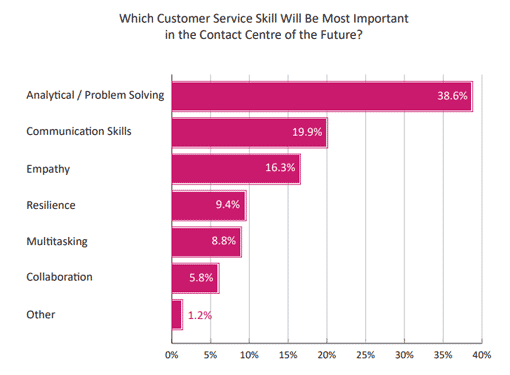
Zoom out from individual questions and you’re really testing four competencies. Call Centre Helper’s customer service skills survey found problem-solving now sits at the top of what advisors need, with communication, empathy, and resilience close behind. weight your interview accordingly.
Empathy and Emotional Intelligence
To test empathy, ask a candidate how they’d respond to a customer who’s upset. Listen for whether they name the emotion before jumping to the fix. Genuine empathy sounds like “I’d let them know I understand why that’s frustrating for them, then…”; scripted empathy sounds like a memorized “I understand your frustration” with no follow-through.
Good prompts: “Tell me about a time a customer was emotional — how did you handle it?” and “How do you show a customer you’re actually listening?“
Communication and Active Listening
Communication is more than talking; it’s confirming the customer feels understood. Ask a candidate to explain something complicated in simple words. It could be a return policy, how a product works, or anything slightly complicated. Watch for jargon, whether they check for understanding, and their tone.
For written channels, a short mock support email tells you more than any spoken question: is it clear, warm, and free of copy-paste stiffness?
Problem-Solving Under Pressure
Problem-solving is the skill that stops a ticket bouncing around forever. Ask “Walk me through how you’d handle an issue you’ve never seen before,” and score whether they diagnose the root cause, know when to escalate, and keep the customer informed while they work. “I’d escalate it” as a first move is a flag; “here’s how I’d try to solve it first” is the hire.
Customer Service Interview Questions by Role, Level, and Channel
One question set doesn’t fit every hire. Adjust for experience level and the channel they’ll actually work in.
Entry-Level, Experienced, and Team Lead
For entry-level candidates with no support experience, lean on situational questions and transferable examples: a retail shift, a group project, anything showing composure and care. Ask “Tell me about a time you helped someone solve a problem?”
For experienced reps, get specific: channels, tools, the metrics they owned, their hardest case.
For a team lead, shift to coaching: “How would you handle a rep who’s great with customers but misses every deadline?” This will show how they’ll manage difficult employees as well as difficult customers.
Phone, Chat, Email, and Remote Support
Channel changes the skill. Phone rewards composure and pacing; live chat rewards accuracy while juggling several conversations at once; email rewards clear, warm writing.
Ask channel-specific questions rather than assuming one skill transfers. For a customer service agent for chat, you could ask: “How do you keep three chats straight without going robotic?”
Hiring remote? Add self-management and async communication to the list; tl;dv’s guide to interview questions for remote workers has a full set. A candidate who’s thrived remotely will talk about how they structure their day, not just that they “like the flexibility.”
How to Score Customer Service Interview Answers
So how do you turn answers into a decision? The research is blunt: the U.S. Office of Personnel Management calls the structured interview “among the most valid assessment tools available”, precisely because the same questions and the same scoring rubric get used for every candidate. On paper, it obliterates bias. Unstructured “I just had a good feeling about her” interviews are barely better than a coin flip.
So score every candidate on the same rubric. Use the STAR method to keep behavioral answers honest (Situation, Task, Action, Result), rate each competency 1–5, and weight the ones that matter most for service. Empathy and de-escalation carry the most here:
| Competency | What to Score (1–5) | Weight |
|---|---|---|
| Empathy & EQ | Names the emotion before the fix; genuine, not scripted | 25 |
| De-escalation | Slows the heat, sets expectations, stays calm | 25 |
| Communication & Listening | Clear, adapts to the channel, confirms understanding | 20 |
| Problem-Solving | Finds the root cause and a concrete resolution | 20 |
| Resilience | Handles volume and knock-backs without carryover | 10 |
| Total weighted score out of 100 · Weighting reflects a hiring-manager emphasis on empathy and de-escalation · | ||
One tip on fairness: decide your questions and rubric before you meet anyone, and keep notes on what was actually said, not your impression of it. OPM’s free structured interview guide even includes sample rating forms if you want a paper version. That documentation doubles as your best defense if a hiring decision is ever challenged.
Score Candidates as They Answer
Reading a list of questions is easy. Remembering who actually answered them well, three interviews deep on a Friday afternoon, is not. Use the scorecard below to rate each candidate 1–5 while they talk, then line them up side by side.
How to use it: open this page on a second screen (or your phone) during the interview, rate each candidate as they answer, then hit Add candidate for the next person and compare the columns once you’re done. Bookmark this page (Ctrl/Cmd + D) so it’s ready before your next round. There’s no login, no spreadsheet to build, and nothing saved on our end.
Customer Service Interview Scorecard
Keep this open during the interview and rate each candidate 1–5 as they answer — the weighted total updates live. Add candidates to compare side by side.
Scoring by hand works — until you're typing instead of listening. tl;dv records and transcribes every interview and writes structured AI notes against a template you choose, so each candidate's answers are captured the same way — and you're free to actually listen. Bring the notes back here to score.
Stop typing, start listening — try tl;dv freeScoring live is harder than it sounds when you’re also supposed to be listening. This is where recording the interview earns its keep: tl;dv captures and transcribes each conversation and writes structured notes against a template you set, so every candidate’s answers are logged the same way and you can score from what was actually said, not a half-remembered impression. It’s the same principle as the rubric: consistency over memory.
If you’re building out the wider process, tl;dv’s interview tool for hiring and its guide to AI in recruitment go deeper.
Customer Service Interview Red Flags
A few answers should drop a candidate’s score hard, or end the conversation outright:
- Blaming the customer. “Some people are just impossible” tells you exactly how they’ll talk about your customers internally.
- No ownership. Every story is someone else’s fault: the system, the last agent, the policy.
- Can’t name a single mistake. Either dishonest or not self-aware; neither ends well on a support team.
- Pure script-reliance. Fine for compliance, a real problem the moment a situation goes off-script.
- Badmouthing a past employer or customer. Today’s interviewer is tomorrow’s target.
- Over-promising. “I’d just give them whatever they want” is a fast-track to exploitation-ville.
None of these is an automatic disqualifier on its own. But two or three together and you’re looking at a hire who’ll cost you more than it’s worth.
Happy Hiring!
The questions in this guide will get you 90% of the way to a good customer service interview. The last 10%, the part that actually separates a keeper from a costly mistake, is scoring the answers the same way, every time, against what the role really demands: empathy, de-escalation, clear communication, and problem-solving.
Ask good questions, score them honestly, and let the rubric, not the after-lunch energy dip, make the call. Oh, and record your interviews so you can scan notes, ask AI to find the key answers, and share highlights with stakeholders later.
Customer Service Interview Questions: FAQs
What are the most common customer service interview questions?
The most common are behavioral and situational:
- “Tell me about a time you dealt with an angry customer,”
- “What would you do if a customer asked for something against policy?”
- “What does good customer service mean to you?”
They’re common because they reveal empathy, judgment, and de-escalation rather than rehearsed talking points.
What interview questions test empathy in customer service?
Ask a candidate how they’d respond to an upset customer, and listen for whether they name the emotion before offering a fix. Genuine empathy acknowledges the feeling first; scripted empathy recites “I understand your frustration” with no follow-through.
How do you score customer service interview answers?
Use a fixed rubric: rate each candidate 1–5 on empathy, de-escalation, communication, and problem-solving, then weight the competencies that matter most for the role. Scoring every candidate the same way is what makes a structured interview more predictive than a gut feeling.
Use our scoring widget to do it from your browser during the interview.
What are the biggest red flags in a customer service interview?
The clearest red flags are blaming customers, taking no ownership for past problems, and being unable to name a single mistake. Any candidate who badmouths a previous employer or customer is showing you how they’ll talk about yours.
What questions should you ask entry-level candidates with no experience?
Lean on situational questions and transferable examples, like: “Tell me about a time you helped someone solve a problem.” Don’t focus on metrics they’ve never had the chance to earn. You’re testing potential and temperament, not track record.
Should you use role-play in a customer service interview?
Yes. A short angry-customer role-play or a mock support email shows you how a candidate actually handles a situation, not just how they describe it. Score the same things you would in the interview: empathy, clarity, and a real resolution.