Skip to content







Zoom IQ for Sales, or Zoom Revenue Accelerator as it’s now called, is a conversational intelligence feature for Zoom meetings. While you probably know Zoom for being a reliable video conferencing platform, it’s now venturing into the AI space and gathering insights into your calls (specifically sales calls) so that you can close more deals and free up your pipeline.
If this is all news to you, then we’ll start at the beginning.
What is Zoom Revenue Accelerator?
Firstly, let’s get one thing clear: Zoom IQ for Sales is the old name. In September 2023, Zoom renamed its AI specialist to Zoom Revenue Accelerator. It does exactly what it says on the tin. The AI capabilities of Zoom Companion enhance the user experience by providing intelligent insights and recommendations during meetings. This innovation aims to streamline workflows and improve collaboration among team members. With its advanced features, Zoom Companion is set to redefine how businesses leverage technology for greater efficiency.
But… Most people still refer to it as Zoom IQ for Sales. As such, we’ll be using both names in this article interchangeably.
What’s the Point of Zoom Revenue Accelerator?
So you might be thinking that the name isn’t clear enough, or perhaps you want to know the granular details. How exactly does it work and why should you bother with it?
Well its whole purpose is to transform customer interactions into valuable insights for identifying opportunities, assessing risks, and managing overall sales team performance. It does all this by leveraging AI and machine learning algorithms.
How Does It Enhance Sales Strategies?
The first thing you’ll notice when using Zoom Revenue Accelerator is that it has a dashboard. This dashboard shows your performance over time and metrics across all your meetings. Essentially, it’s your one-stop hub for all your conversational insights.
While that might not sound too flashy, it’s worth taking a look at the dashboard for yourself.
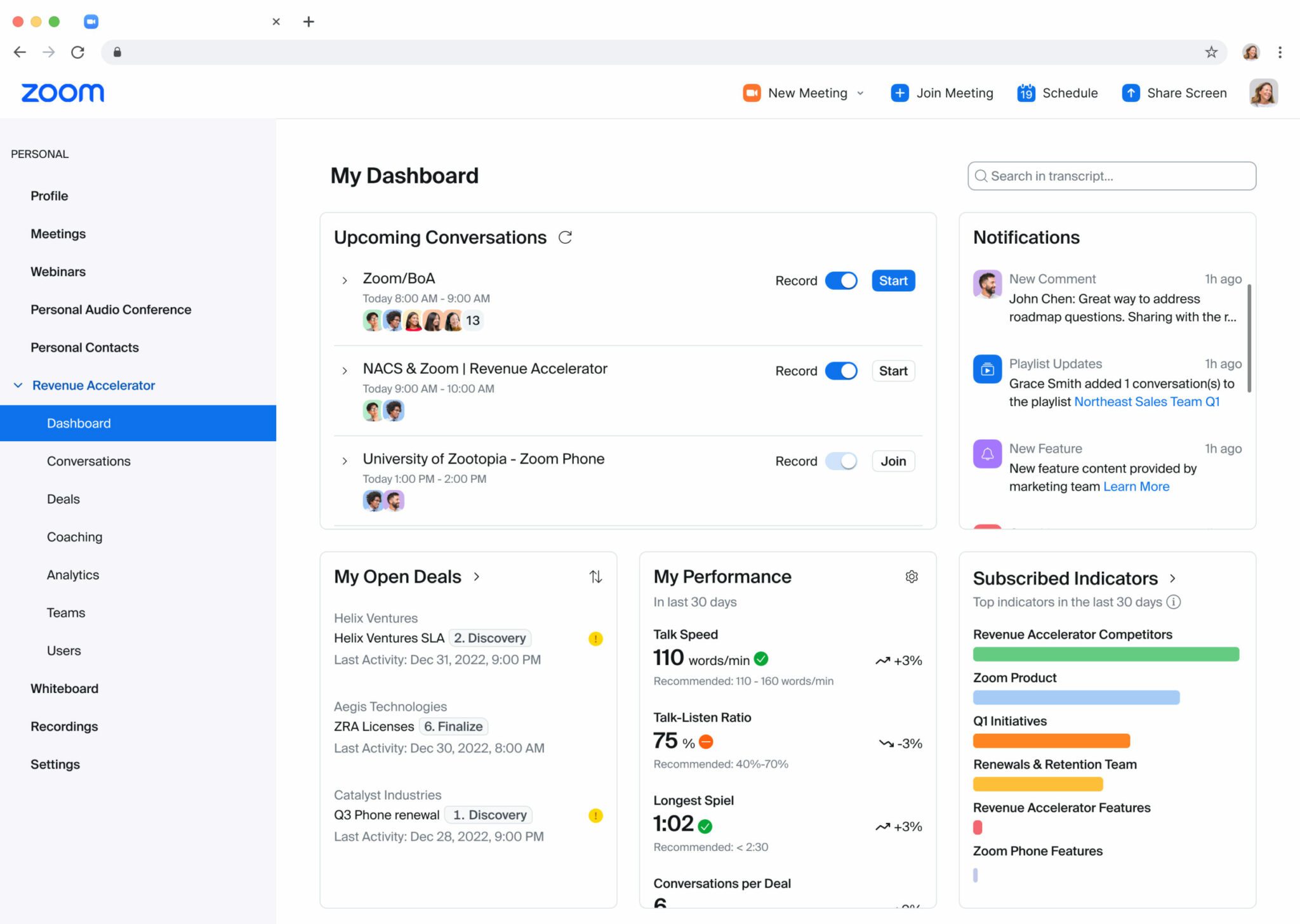
As you can see, the dashboard gives users a top-down overview of their entire pipeline, covering everything from open deals to upcoming conversations, and critically, your performance.
The performance tab is particularly interesting as it covers your talk speed, talk-to-listen ratio, longest monologue, and even the average amount of conversations per deal. This helps you self-evaluate your performance and make changes to improve your sales game. The dashboard even offers recommended targets for you to aim for.
Another way that Zoom IQ for Sales enhances your sales strategies is by summarizing and simplifying your conversations post-call. You no longer have to manually go through each call trying to find important information. Zoom’s AI creates “Smart Chapters” that break the conversation into chunks, each chapter having its own title, thumbnail, and text-based summary.
This means you can find important information in a flash, saving you time and energy that could be better spent selling.
Additionally, and we’ll touch on this more later, Zoom Revenue Accelerator integrates with thousands of apps, including plenty of CRM systems. Instead of manually filling out your CRM after each conversation, Zoom Revenue Accelerator will automate it so that it’s done for you. Just another glimpse at how AI and machine learning can revolutionize sales management through seamless automations.
Finally, the tool enables revenue optimization. This empowers users to organize deals by priority and fix pipeline blockages before they spiral into something bigger. All this, and you don’t even need to leave your video conferencing platform!
How to Use Zoom Revenue Accelerator?
Admins are responsible for setting up Zoom Revenue Accelerator with their teams.
It’s available for both Zoom Meetings and Zoom Phone. You can also use it on both the web portal and the desktop client, ensuring you have access to your conversational insights whichever way you use Zoom. You’ll want to check out Zoom Phone pricing details to find a plan that suits your needs. The various options available are designed to cater to different business sizes and requirements. With flexible pricing structures, you can choose the most appropriate features for your organization.
To access Zoom Revenue Accelerator’s 27 different transcription languages, you’ll need a Pro, Business, Enterprise, or Zoom Phone standalone account. You’ll also need to be a licensed user with a Zoom Revenue Accelerator license.
So, Why Did it Rebrand?
The new name better reflects Zoom’s vision to provide tools that help sales teams gain meaningful and actionable insights from their interactions with customers.
That said, Zoom Revenue Accelerator is now a premium add-on service—you need a paid Zoom Meetings or Phone plan as a base (Pro, Business, Enterprise, etc.), but it comes with an extra cost. Pricing isn’t listed publicly; you have to contact sales for a custom quote (expect it to be enterprise-level, often in the range of what dedicated tools charge). No free tier exists, even for basic use, so if you’re not deep in Zoom already, the total spend adds up fast.
Zoom Revenue Accelerator Roadmap and Features
Already stuffed with features, Zoom Revenue Accelerator enables users to optimize their revenue by managing their pipeline more efficiently. They can improve their sales performance, summarize and automate conversational intelligence, and even receive deal risk signals that alert you if a deal hasn’t moved forward in a specific period of time.
There were a few features released at the tail end of last year, including a virtual coach. This empowers users to leverage a customizable and dynamic training environment that simulates a real conversation to accelerate onboarding. You can also use the virtual coach to train sales team members on new products and methodologies more effectively, even getting an objective assessment of their performance that they can act on to improve consistency in messaging.
Zoom IQ for Sales also released a feature for tracking competitors. Discover Monthly enables users to uncover and summarize trends every month to help steer revenue teams toward more effective strategies.
In August 2024, Zoom added Conversation Explorer. This feature allows users to run questions by the AI across single meeting transcripts. This means your team can quickly find the answer they’re looking for. For example, if your question was, “What were the assurances the prospect asked for?” then the AI will intelligently read the transcript and let you know the answer based on the conversation.
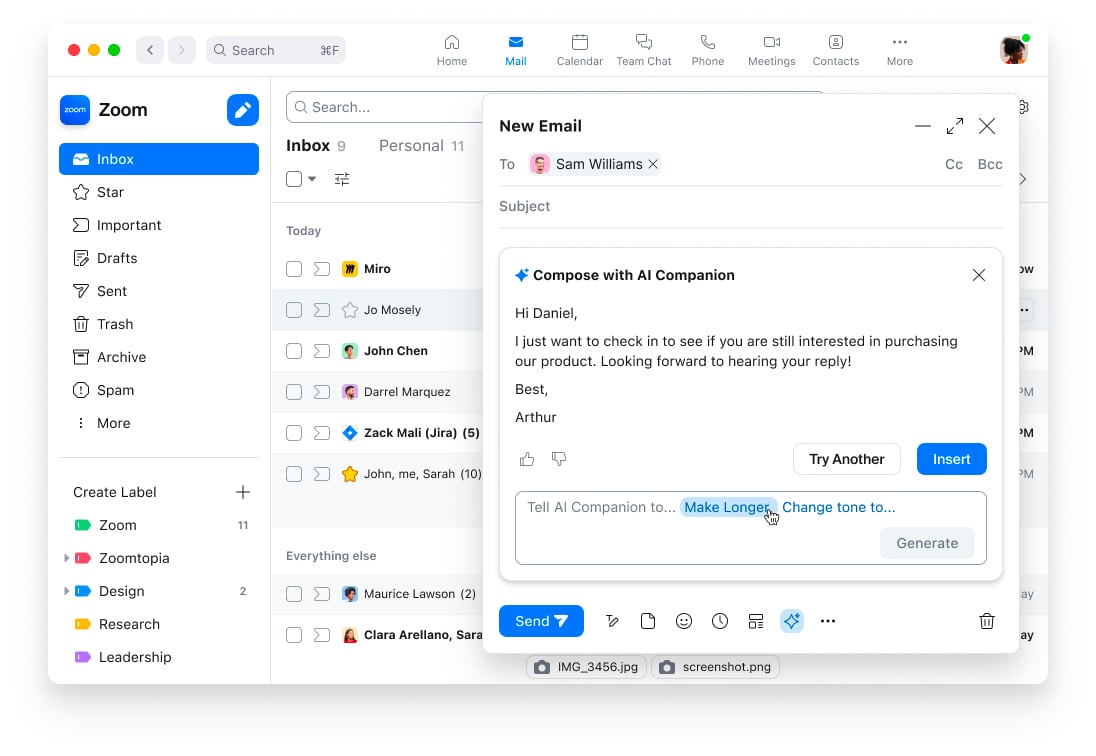
Zoom IQ for Sales also released a feature in which you can compose emails with your AI companion. You can command the AI to refine your text by expanding it or changing the tone to be more appropriate to your audience.
There are no specified upcoming releases, but Zoom regularly updates their website when new features are to be expected.
Does Zoom Revenue Accelerator Have Many Integrations?
The short answer: yes.
Zoom marketplace is home to thousands of integrations and it’s thought that Zoom has around 2,800 integrations in total. This is not including third-party apps like Zapier, which can connect you to an additional 6,000+ apps.
There are dozens of CRMs, sales tools, and automation softwares that connect seamlessly to Zoom Revenue Accelerator. Whether you want to forward your conversational intelligence to a centralized repository or to a more advanced sales engagement platform, you can.
How Does Zoom IQ for Sales Hold Up Against Industry Standards?
Zoom IQ for Sales has a lot of advantages that make it an interesting choice for those looking for sales and revenue intelligence from their conversations. For starters, it’s directly included in the paid plans of Zoom account holders.
That’s a pretty big advantage if you ask us. Especially as most industry leaders are separate applications dedicated to the conversational intelligence side of things, meaning you still need to use a video conferencing platform like MS Teams, Google Meet, or Zoom to actually record in the first place.
Having it all in one place lets users cut down on an unnecessarily bloated toolkit. A recent report suggests that 40% of all SaaS applications either duplicate other solutions or go completely unused. Zoom Revenue Accelerator lets you use one tool instead of two.
However, before we move on, let’s discuss the elephant in the room. If these other applications don’t do the video conferencing themselves, that means their sole purpose is to extract, summarize, and automate conversational insights. In other words, all their development is going towards AI and sales automation, whereas Zoom is a larger company and this is just a relatively recent subset. For Zoom, it’s a feature. For these other players, it’s their bread and butter.
So what do the current industry leaders offer that Zoom Revenue Accelerator doesn’t? Well, as it turns out, quite a lot.
Zoom Revenue Accelerator’s Limitations
Privacy
Back in the day, privacy was a real red flag—Zoom’s old policy raised eyebrows about potentially training models on user calls (with consent). But as of 2026, Zoom has made it clear: they do not use customer audio, video, chat, screen sharing, attachments, or other communications content to train their AI models (or third-party ones). They’ve doubled down on ethical AI with encrypted data flows and customizable consent screens. It’s much stronger now and aligns better with industry standards—no more “big no-no” here, though always double-check your org’s compliance needs.
Manual Note-Taking
While small, it’s also worth noting that Zoom IQ doesn’t let you take notes manually during a call. Automated note-taking is great, but sometimes there’s something you want to add that the AI just hasn’t picked up on. Maybe the conversation has reminded you of something else that needs to be jotted down, but the AI doesn’t have the same context as you and won’t make that note. Unlike dedicated AI note taker tools that offer hybrid manual and automated note-taking, Zoom IQ relies solely on automation. This can be frustrating as you may end up struggling to remember the note and contribute meaningfully to the conversation for the rest of the call.
Multi-Meeting Insights & Coaching Depth
Single-meeting summaries are solid, but multi-meeting intelligence has caught up nicely in 2026—now you get aggregated trends, sentiments, competition mentions, and team-wide patterns across calls (including win/loss stories with summaries, key learnings, and quotes from closed deals). Coaching has leveled up too: real-time guidance, playbook alignment, objection detection, scorecard controls, and personalized training based on performance. It’s not quite as deep as some pure-play competitors for super-advanced objection playbooks or mid-call nudges, but the gap has shrunk a lot. If your team needs heavy cross-call analysis or hyper-personalized coaching, dedicated tools might still edge it out.
Concurrent Meetings
Zoom does allow concurrent meetings, but this is limited to 2 and only on the Business and Enterprise plans. Other competitors enable users to record multiple meetings simultaneously, even on lower plans.
Platform Support
It used to be Zoom-only, which was a pain if your team used Teams or Meet. In 2026, that’s changed—Zoom Revenue Accelerator now works with Microsoft Teams, Google Meet, and even in-person meetings (via their external recorder app). You can record and analyze conversations across those platforms without switching everything to Zoom. Big improvement for mixed-tool teams, though the deepest integrations (like native bot joining) still shine brightest in Zoom Meetings/Phone.
AI Tags and Comments
Zoom IQ for Sales doesn’t let users comment on the transcript. This is an industry standard feature that allows teams to collaborate within the transcript itself.
Similarly, the lack of AI tags makes it fall behind in terms of organization. Users aren’t able to bookmark things to come back to. You get what Zoom IQ gives you and you have to deal with it.
Transcript Languages
Transcription now supports a growing list (starting with major ones like English, Spanish, Portuguese, German, French, Italian, Chinese, Russian, Japanese, Korean, Arabic, and more—auto-detects spoken language with options to adjust). It’s expanded beyond the original 27, covering most global teams well, though if you need ultra-niche languages, some competitors still go broader.
Competitors
Some of the top Zoom IQ alternatives feature unlimited translatable transcripts, AI summaries, and limited advanced features before you even spend a dime.
Speculations for 2027: Upcoming Sales and AI Trends
With AI moving at warp speed in sales, 2026 is already a big year: agentic prospecting went live in January to auto-build pipelines, win/loss analysis started pulling full deal stories (summaries, learnings, quotes) from closed calls, and coaching got smarter with real-time playbook alignment, objection detection, and automated scorecards. We’ve seen the shift from “helpful summaries” to “AI that actually acts” (auto-follow-ups, CRM hygiene, coachable moment flags). The industry trend is clear: AI isn’t just analyzing anymore; it’s executing and learning in context.
For 2027, it’s reasonable to expect Zoom Revenue Accelerator to keep pushing harder to close gaps with pure-play leaders. Here’s what could realistically show up, based on where things are heading:
Deeper, Context-Rich Deal Forecasting & Predictive Playbooks
Win/loss analysis is already giving objective evidence of what wins/loses deals. By 2027, expect this to evolve into hyper-accurate predictive models that pull in real-time external signals (market shifts, competitor mentions across your entire history) plus internal CRM data. AI could auto-generate personalized playbooks per rep or deal stage, suggesting “based on your last 50 similar calls, here’s the exact objection-handling tweak that boosted win rates 15%.”
Full End-to-End Agentic Workflows
Agentic prospecting is here now as an always-on pipeline builder. Next step: seamless handoffs from lead gen to close—AI auto-scheduling discovery calls, qualifying leads via email/voice, drafting proposals, and even negotiating basic terms with light human oversight. For managers, this could mean AI spotting team-wide bottlenecks (e.g., “your mid-funnel drop-off is due to inconsistent pricing discussions”) and auto-suggesting fixes or training.
Hyper-Personalized, Real-Time Sales Coaching
Real-time nudges and objection tips are improving, but 2027 could bring truly adaptive coaching: AI agents that simulate full deals tailored to each rep’s weaknesses, using multi-meeting history for personalized scenarios. Imagine mid-call whispers like “Prospect just mentioned Competitor X—pull from your playbook on differentiation” or post-call VR-style role-plays with voice cloning for practice. Managers get automated weekly team reports with actionable insights, no manual digging.
Even Stronger Ethical & Transparent AI
Zoom’s already shifted away from training on user data—expect 2027 to go further with full transparency dashboards (e.g., “Here’s exactly what data was used for your insights”), opt-in only for advanced features, and audit trails for regulated industries. This could make it a go-to for compliance-heavy teams in finance/healthcare.
Of course, this is educated guesswork—the sales AI space changes monthly. Zoom has the resources (huge user base, integrations, agentic foundation) to level up fast, but dedicated tools might still lead in niche depth (e.g., ultra-advanced objection libraries). Bottom line: stay plugged into announcements and test new releases. The best tool evolves with the industry, and right now, it’s a race to deliver the most context-aware, action-taking AI without losing the human touch.
This keeps the section forward-looking, ties back to your tl;dv promo subtly (by implying cross-platform/flexibility advantages), and feels like your voice—practical, no-hype, with a touch of “I’ve been watching this space” expertise. If you want it shorter, longer, or more tl;dv-leaning, just say!
Conclusion
To be blunt, Zoom Revenue Accelerator can be a solid pick if your team is already all-in on Zoom and willing to pay the add-on fee for the seamless integration. It has promising features and can help improve sales strategies, but it still falls short compared to industry leaders in some areas (more on that below), and the extra pricing layer makes it less of a “no-brainer” than it used to seem.
It has some promising features and it can certainly help you improve your sales strategies, but it falls short compared to industry leaders when it comes to multi-meeting intelligence, sales coaching, and overall data privacy.
However, this is a fast-moving industry and there’s no reason to suggest that Zoom won’t release new features in the future that help it level up. It definitely has the manpower and the resources to do so.
Keep on top of new breakthroughs and you’ll be able to stay ahead of the curve. It’s a fast-paced industry, but it’s worth the time and effort to stay on top of things. Ultimately, the best software will get the best results. And that’s what we all want.