Skip to content






TL;DR: How to Share Your Screen on Google Meet
To share your screen on Google Meet, join a meeting, click Present now (the screen-with-an-arrow icon) at the bottom of the call, choose either:
- Your entire screen,
- A window,
- or A tab,
and hit Share. To stop, click Stop presenting.
On mobile, tap the three-dot More menu, then Share screen.
Sharing your screen on Google Meet takes about three clicks: join the call, hit Present now, and pick what you want everyone to see. The trickier part is everything else. Can you share your audio without killing your mic? Or present slides without flashing your inbox? The other thing is figuring out why the Present button isn’t where it’s supposed to be in the first place…
Screen sharing isn’t a niche skill anymore. Roughly one in five American workers now teleworks at least part of the week, and 46% told Pew they’d be unlikely to stay if their employer pulled remote work. A shared screen is also a small mercy — it gives everyone something to look at besides each other’s faces, which Stanford’s research on “Zoom fatigue” pins as one of the main reasons video calls drain us.
Here’s how to share yours on every device, and how to fix it when it fights back.
How to Share Your Screen on Google Meet (Desktop)
To share your screen on a computer, join your Google Meet, click Present now at the bottom of the call, and choose what to share. Preview it, click Share, and you’re live.
Present now is the screen-with-an-arrow icon.

Whatever you pick shows up for everyone instantly, so make sure there’s nothing sensitive on your screen when you click Share. To stop, click Stop presenting at the bottom, or click You are presenting in the corner and choose Stop presenting.
Screen, Window, or Tab: Which Should You Share?
Share a tab for anything in your browser, a window for a single app, and your entire screen only when you genuinely need to jump between programs:
- A tab shares one browser tab and carries its audio. This is best for videos, web demos, or a single Google Doc.
- A window shares one app and keeps everything else private. This is best for a slide deck or a spreadsheet.
- Your entire screen shares everything you see. Use this for multi-app demos, but be aware that everyone can see your cluttered desktop and notifications.
Sharing your entire screen while looking at the Meet window causes an infinite-mirror effect. Share a tab or window instead, or move Meet to a second monitor if possible.
How to Share a Tab With Audio (Videos and Music)
To share sound, share a tab and check Share tab audio before you click Share. Tab sharing is the only option that sends audio cleanly. If you’re presenting a window or your entire screen and need audio too, switch on presentation audio in the dialog, but know it disables noise cancellation. That’s why nobody can hear your training video when you share your whole screen — the sound isn’t traveling with it. Switch to a tab and it’s fixed.
How to Share Your Screen on Google Meet by Device
The steps barely change across devices. You still find Present now (or Share screen on mobile) and pick your source, but each platform has a quirk or two worth knowing.
Windows and Chromebook
On Windows and ChromeOS, share straight from Chrome or Edge with Present now. You don’t need any extra permissions or setup.
Google Meet runs best in Chrome or Edge; Firefox and Safari work but drop the occasional feature, so if a sharing option is missing, switch browsers before you panic.
Mac
On a Mac, you’ll likely hit one extra step: macOS blocks screen recording until you allow it. Go to System Settings > Privacy & Security > Screen & System Audio Recording, switch on your browser, and restart it. Skip this and you’ll get a black screen or no Present option at all. This is the single most common Mac screen-sharing complaint, and it has nothing to do with Meet.
Android
On Android, tap the three-dot More menu inside the meeting, tap Share screen, then Start sharing. To include audio, check the box in the pop-up (some Android versions don’t support it). Tap Stop sharing when you’re done.
iPhone and iPad
On iPhone or iPad, tap More, then Share screen, then Start Broadcast, and wait for the countdown. iOS shares your whole screen, so switch on Do Not Disturb first unless you want your group chat on display. Tap the red status bar and Stop to end.
How to Present Slides and Docs Without Sharing Everything
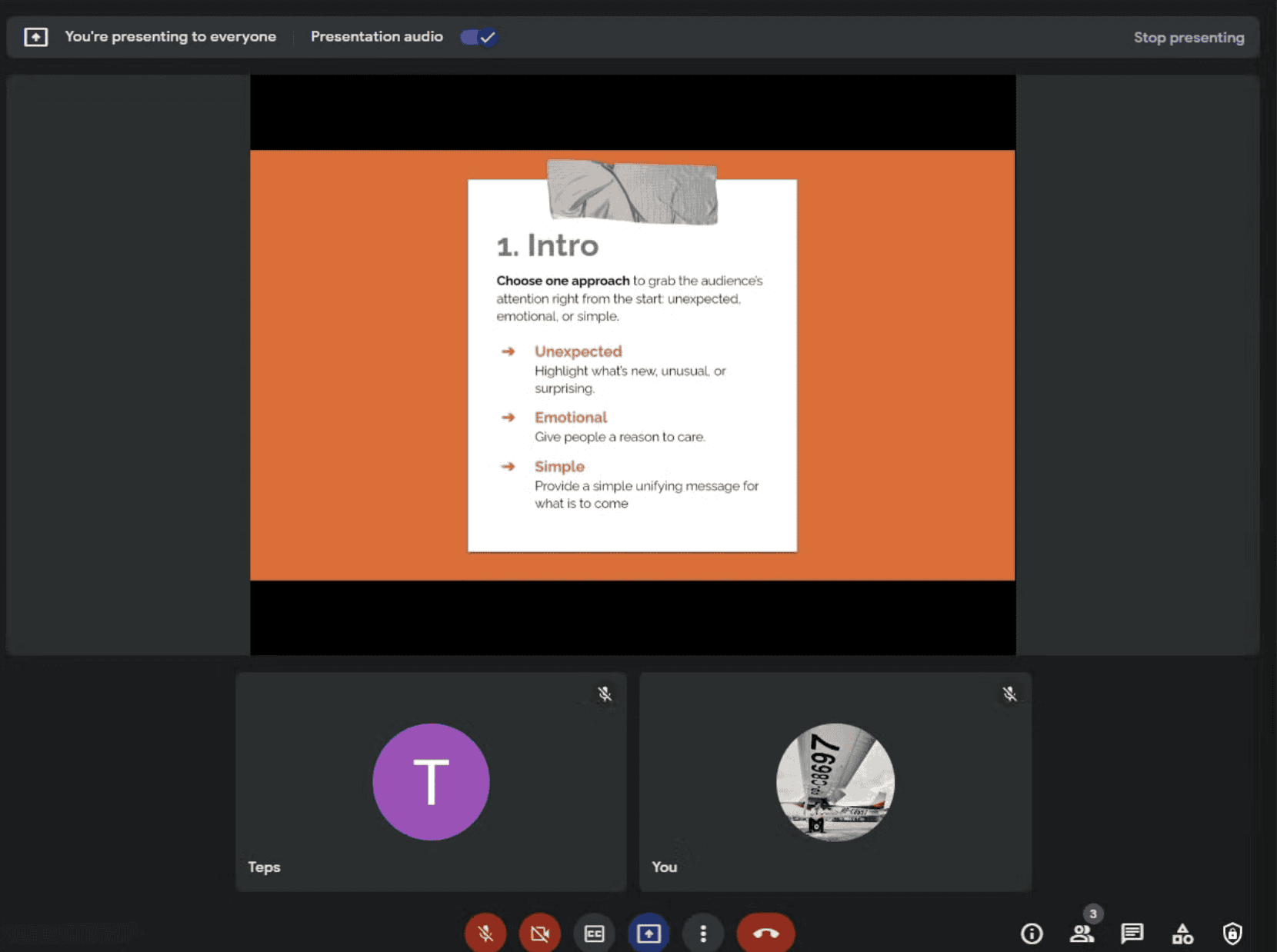
You can present Google Slides, Docs, or Sheets directly without handing over your whole screen. Open the file, click the Meet icon in the top corner, join, and share that tab. Your speaker notes and stray tabs stay hidden.
A few ways to present without oversharing:
- Present a tab for slides or video so playback stays smooth.
- Unpin your share to keep chat and faces visible while you talk. This saves you from presenting into the void.
- Use Companion Mode to drive your screen from a second device while your laptop handles camera and mic. That spares everyone the audio feedback.
Google Meet lets up to 10 people present at once, and you don’t need to wait your turn. Click Present Now and your screen takes over while the previous one pauses.
One habit prevents accidental over-sharing: close anything private and turn on Do Not Disturb before you present. This way, your Slack notifications don’t land in front of the room.
Who Can Share Their Screen? Host and Admin Controls
By default, anyone in a Google Meet can share their screen. The host can switch that off or a Google Workspace admin can lock it down entirely. If you’re hosting and want to stop surprise presentations, open Host Controls, find Share their screen, and toggle it off so only you can present.
If the Present button is grayed out for you, one of two things is happening: the host has restricted sharing, or your organization’s admin has disabled it Workspace-wide. The first is a quick ask; the second needs IT. This walkthrough of Google Meet’s host settings covers the controls in detail. Guests and external participants can share too, as long as the host hasn’t switched it off.
Troubleshooting Google Meet Screen Sharing
Most screen-sharing problems come down to permissions, browsers, or host settings. Here’s the fast diagnosis.
Present button missing or grayed out: the host or your Workspace admin has turned off sharing. Ask the host to enable it.
Black screen when you share: almost always the macOS permission above — allow your browser under Privacy & Security, then restart it.
Laggy, blurry, or frozen: close the tabs and apps you’re not using, and share a single tab instead of your entire screen. Full-screen sharing eats the most bandwidth.
No audio: you shared a window or full screen. Only tab sharing sends sound reliably, so switch to a tab and tick Share tab audio.
Participants can’t see it: refresh, or leave and rejoin the call. That clears most glitches faster than any setting.
You Can’t Present and Take Notes at Once…
There’s a problem with screen sharing: the second you start presenting, you stop being able to take notes. You’re demoing, fielding questions, watching the clock — and nobody’s writing down what was said or decided.
That’s the gap tl;dv fills. It records, transcribes, and summarizes the call while you present, so you leave with the discussion, the action items, and the decisions instead of a fuzzy memory of “it went well.” It works with a bot in the call or through a bot-free desktop app that captures any device audio — Meet, Zoom, a browser tab, whatever’s making sound — and it runs on the free plan, no card required. You can record the Meet and find the file afterward without bumping into Google’s own recording limits.
Share Your Screen with Ease
Sharing your screen on Google Meet is three clicks:
- Present now
- Pick your source
- Share.
There’s only friction when things don’t go as planned: tab audio for video, the macOS permission behind that black screen, a quick Do Not Disturb before you go live.
Get those right and you’ll present like a pro. Then let tl;dv remember what everyone said, because you’ll be busy talking.
FAQs About Sharing Your Screen on Google Meet
Can you share your screen before joining a Google Meet?
No. You have to be in the meeting first. Join the call, then click Present now on desktop or tap Share screen on mobile.
Does Google Meet tell people when you start sharing?
Yes. Your screen appears to everyone the instant you hit Share, and Meet labels you as presenting. Close anything private first.
Is there a limit on who can see a shared screen?
No. Everyone in the call sees your share, and only one shared screen shows at a time.
Can you share your screen on a free Google account?
Yes. Screen sharing works on free personal accounts and paid Workspace plans alike. Workspace admins can restrict it; personal accounts can’t.
Can you present without a Google account?
You can join some meetings as a guest without an account, but sharing can be limited, and the host has to let guests present.
How do you zoom in while presenting?
Use the zoom controls on the presentation tile. Google Meet supports preset levels from 25% up to 500%, so you can enlarge a slide without leaving the call.
Is a shared screen included in Google Meet recordings?
Yes. Recordings capture whatever’s being presented.
Can you share your screen in breakout rooms?
Yes. Sharing works the same inside a breakout room as in the main call. Present now stays in the same place.